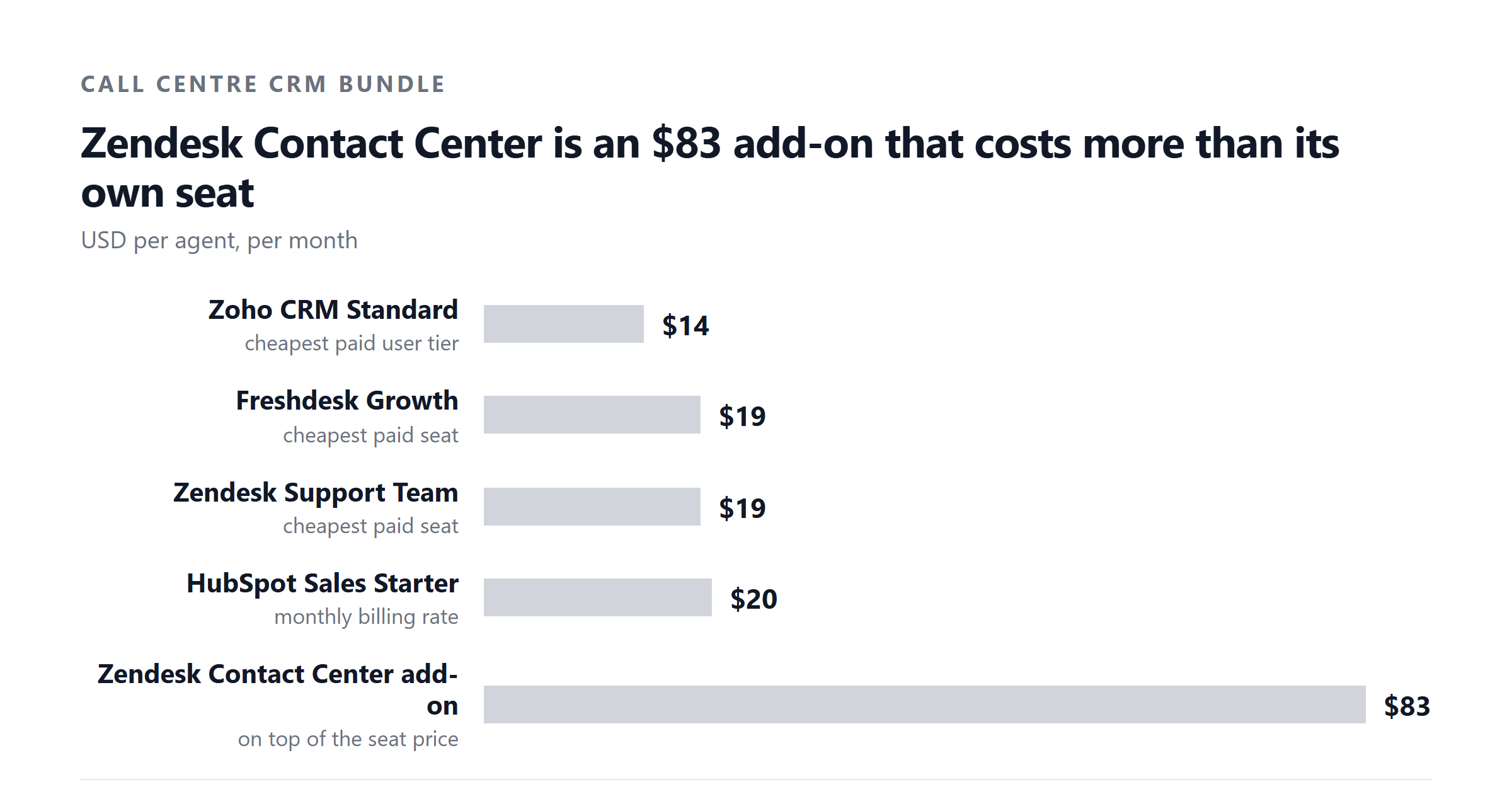
A call centre CRM purchase is really two purchases. You are buying the system that holds the customer record, and you are buying the telephony that rings them. Vendors bundle these in different ways, and the bundle is where the money hides. Zendesk is the clearest example: its Contact Center is an $83 per agent monthly add-on, which costs more than its own Suite Team plan at $55 per agent per month. If you only read the headline price, you miss that the call centre functionality is sold separately and on top.
The price you should compare across vendors is the all-in per-agent cost of running real calls: the seat price plus the telephony add-on, plus any AI you intend to turn on, plus the onboarding fee if it applies.
A call centre CRM is a CRM where the phone is a first-class channel, not an afterthought bolted onto a ticket queue. The buyer profile is usually a sales or support team whose primary contact channel is the phone call, with email and chat as supporting channels. The CRM needs to handle dialling, call recording, queues, routing, voicemail drops, IVR menus, post-call wrap-up time, and a tight link between the call and the customer record. That last point is the bit that distinguishes it from a stand-alone contact centre product like Aircall or RingCentral.
This market splits into three groups. There are the CRM-first vendors who added a contact centre product alongside their main suite. There are the contact-centre-first vendors like Aircall, RingCentral, Talkdesk, Five9 and Genesys, which are telephony platforms with CRM integrations. And there is a third group: AI-first products that deflect calls into chat or messaging before they ever reach an agent. The comparison you actually need depends on which group you are buying from.
The piece that catches buyers out is that the CRM and the telephony are sold separately in some bundles and together in others. Zendesk sells the CRM suite (Support Team at $19 per agent per month, Suite Team at $55 per agent per month when billed yearly) and then sells the telephony as Contact Center at $83 per agent per month. Salesforce and HubSpot lean the other way: the CRM is the product, and the telephony comes from partners or from a built-in voice SKU at the high end. Freshdesk and Zoho are CRM-and-help-desk products where voice is a partner integration rather than a first-party SKU.
Where the bundle hides the money
Headline prices for call centre CRMs are misleading because almost no team actually runs at the headline price. The CRM seat gives you the customer record, the ticketing and the integrations. It does not give you the dialler, the call recording, the queue logic, or the wrap-up timer. Those come as separate products, and the vendors price them on top of the seat.
Zendesk is the clearest example because all the prices are public. The published prices on Zendesk's own pricing page are these, all per agent per month when billed yearly:
| Zendesk product | Per agent per month (yearly) | What it does |
|---|---|---|
| Support Team | $19 | Ticketing only |
| Suite Team | $55 | Ticketing + email + chat + help centre |
| Suite Professional | $115 | Above + workflow, SLAs, customisation |
| Copilot add-on | $50 | AI assist for agents |
| Workforce Engagement add-on | $50 | WFM, QM, coaching |
| Contact Center add-on | $83 | Telephony, IVR, dialler, queues |
| Asyntai | $39 to $449 (self-serve) | AI chat agent that answers questions on your site |
The Asyntai row is ours; treat it as a disclosure. The Zendesk prices are taken from its own pricing page, checked 2026-09-04. Contact Center sits above Suite Team, not on top of free. Suite Enterprise is quote-only.
The pattern is the one to remember: the telephony is sold as an add-on, and the add-on is priced per agent per month in the same units as the seat. If you want both, you add the two lines. If you want AI assist on top, you add a third line. None of these prices is the wrong one to print, but printing only one of them hides the bundle.
Freshdesk prices on its own pricing page as of 2026-09-04 work the same way. Growth is $19 per agent per month billed annually, Pro is $55, Enterprise is $89. AI Copilot for agents is $29 per agent per month. The Freddy AI Agent is the autonomous tier, with 500 sessions included and then $49 per 100 sessions, which works out at $0.49 per session after that. Freshdesk also sells day passes at $2, $7 and $12 per person per day for short-term agent cover, which is useful for the seasonal peak some teams carry. Telephony in Freshdesk is mostly delivered through partner integrations (Freshcaller and partner diallers), and the cost of that part is not in the headline price.
Zoho CRM sits on a different axis. Its published prices are per user per month billed annually: Standard $14, Professional $23, Enterprise $40, Ultimate $52. Billed monthly, those become $20, $35, $50 and $65. Free edition is available for three users. Zoho has Zoho Voice and Zoho PhoneBridge for telephony, but those are sold separately and are not folded into the CRM seat price. If you want a fully bundled product, Zoho is not it.
HubSpot publishes per-seat prices for Sales Hub. Free tools are $0 for up to two users. Starter is $7 per seat per month billed annually, or $20 billed monthly, with 500 credits included. Professional is $90 per seat per month annually, or $100 monthly, with 3,000 credits, plus a required one-time $1,500 onboarding fee. Enterprise is $150 per seat per month, with 5,000 credits and a required one-time $3,500 onboarding fee. Extra credits are $0.01 each on annual billing. HubSpot does not bundle telephony into Sales Hub at the published prices. Calling features are limited in the lower tiers and a separate HubSpot product (or a partner integration) is required for the call centre functionality.
Salesforce publishes per-user prices for Sales Cloud. Free Suite is $0. Starter Suite is $25 per user per month. Pro Suite is $100. Core is $195. Advanced is $395. Max is $550, all billed annually except Free and Starter. AI add-ons can be attached to Core and above. Telephony in Salesforce historically meant Service Cloud Voice, which combines Amazon Connect with the Salesforce platform, but the price is not on the self-serve pricing page and has to be quoted.
Reading the price tables side by side
Here is the published price per seat for the CRM side of each product, taken from each vendor's own pricing page and checked 2026-09-04:
| Vendor | Entry seat | Mid seat | Top self-serve | Telephony |
|---|---|---|---|---|
| Zendesk | $19 Support Team | $55 Suite Team | $115 Suite Pro | $83 Contact Center add-on |
| Freshdesk | $19 Growth | $55 Pro | $89 Enterprise | Partner integration, separate quote |
| Zoho CRM | $14 Standard | $23 Professional | $40 Enterprise | Zoho Voice, separate quote |
| HubSpot Sales Hub | $7 Starter (annual) | $90 Professional (annual) | $150 Enterprise | Limited built-in, partners for full |
| Salesforce Sales Cloud | $25 Starter Suite | $100 Pro Suite | $550 Max | Service Cloud Voice, quote-only |
| Asyntai | $39 Starter | $139 Standard | $449 Pro | Not applicable; chat agent on the website |
The Asyntai row is ours; read it as a disclosure. Prices are the published self-serve rates for the CRM or help-desk seat only. They do not include telephony for any vendor except Zendesk's Contact Center add-on, which is also a published price. Where telephony is partner-led or quote-only, the table marks it as such rather than guessing.
Three things to notice in that table. First, the entry seats are clustered between $7 and $25, which gives the illusion that the products are similarly priced. Second, the top self-serve tiers are wildly different, from $40 at Zoho to $550 at Salesforce, because each vendor defines what counts as "top self-serve" differently. Third, only Zendesk publishes a per-agent telephony price on its own page. The others either partner or quote, which means the buyer cannot directly compare them in a spreadsheet.
The real cost of running calls
The arithmetic that matters is what an agent actually costs the business once telephony, AI and onboarding are added. Take Zendesk as the worked example, because every input is published and nothing has to be invented.
The point of that sum is not the number itself but the structure. Suite Team on its own is $55. The CRM side is less than a third of the all-in figure once telephony and Copilot are added. Anyone pricing a Zendesk call centre from the headline price has under-budgeted by a factor of about three.
HubSpot's Professional seat at $90 per seat per month billed annually does not look like the same kind of product, because telephony is not in the price. Add a typical partner dialler (Aircall, JustCall, or RingCentral) at published rates outside HubSpot's page, and the all-in figure climbs to a similar level for a smaller team. The catch is that the partner has its own per-user bill, which does not show up on HubSpot's invoice.
Salesforce's Core at $195 per user per month is the only top-tier self-serve price where the CRM side is large enough that the telephony add-on looks like a percentage on top rather than a doubling. Service Cloud Voice pricing is quote-only, so it does not appear in this article; if you are comparing Salesforce against the others, the vendor quote has to be requested before the spreadsheet makes sense.
Why the seat is not the unit of value
The unit of value for a call centre is the call, not the agent. The seat price is a proxy. It works when every agent handles roughly the same number of calls. It works less well when:
- Some calls are deflected by IVR or self-service before they reach an agent at all.
- Some agents handle two channels (call and chat) and others handle one.
- Call volume is seasonal and you staff for the peak.
- You use BPO partners or overflow desks that only sit on the queue some of the time.
Each of those realities punishes per-seat pricing differently. Seasonal volume punishes it most directly: you pay peak headcount all year. That is the same argument that shows up in seasonal businesses from retail to schools, and the maths is identical.
The maths there uses Freshdesk's published day-pass prices and Zendesk's published all-in seat price as inputs, but the inputs are yours: substitute your own peak headcount, your own trough headcount, and your own definition of the peak. The point is the comparison, not the absolute figure. Day passes and seasonal pricing make per-seat billing look expensive when most of the year runs below peak. They make deflection look cheap when the calls never happen.
AI features, by vendor
Every vendor in this market has bolted an AI feature on. The pricing is different in each case, and that is worth knowing before you turn it on.
- Zendesk Copilot: $50 per agent per month as an add-on to a Suite tier. It is an AI assist for the human agent, with summaries, replies and tone help. Pricing is published.
- Freshdesk Freddy AI Copilot: $29 per agent per month as an add-on. Same shape as Zendesk Copilot, lower published price. Freshdesk also sells a separate Freddy AI Agent for autonomous resolution: 500 sessions included, then $49 per 100 sessions, or $0.49 per session over that.
- Salesforce Einstein: add-on to Core and above. Pricing is not on the public Sales Cloud page and is part of the quote. The published fact is that AI can be added to Core, Advanced and Max.
- HubSpot AI: features appear in the higher Sales Hub tiers (Professional and Enterprise) and as credit usage. Extra credits are $0.01 each on annual billing. The published prices for Professional and Enterprise are $90 and $150 per seat per month annually, plus the one-time onboarding fees of $1,500 and $3,500 respectively.
- Zoho Zia: included in the paid CRM tiers, with usage limits depending on the tier. The published fact is the seat price; AI usage is generally not billed as a separate line item.
The shape of AI pricing is the same across vendors: a per-agent fee for the assist tier, and a per-resolution or per-session fee for the autonomous tier. The published numbers vary widely, which is why the all-in calculation above uses a Zendesk example where everything is on the public page.
What AI deflection does to the bill
The other side of the AI coin is deflection. If a chat agent answers the question before the call happens, the call does not exist and the per-agent cost does not apply to that interaction. That is a separate unit of value: the deflection, not the call.
Asyntai is built for that side of the problem. It is an AI chat agent that sits on your site and answers customer questions from your own content. Its published self-serve plans are:
- Free Plan, $0, 100 messages per month.
- Starter Plan, $39, 2,500 messages per month.
- Standard Plan, $139, 15,000 messages per month.
- Pro Plan, $449, 50,000 messages per month.
- Enterprise Plan, custom contract with a negotiated message allowance.
The pricing is per message allowance, not per agent, so the unit of value is the conversation the bot handles, not the seat the human occupies. The capability list is short: OIDC single sign-on including Entra and Google, per-tab permissions, per-website scoping, append-only audit log, configurable PII redaction, a separate output classifier rather than a prompt rule, configurable chat retention with auto-delete, and an install path that is a script tag or Code Injection on Squarespace.
The maths there uses 10,000 as a worked input. Use your own chat volume. The structure of the comparison is the point: a per-message bill for an AI chat agent is measured against a per-seat bill for a human agent, and the two are not in the same units until you translate them into the conversation that did or did not happen.
What the call centre CRM has to actually do
Whatever bundle you pick, the system has to do five things or the call centre workflow falls apart.
- Pop the customer record on inbound. If the agent has to ask for the customer number and look them up by hand, the call is already over.
- Log the call against the record. Recording, transcript, duration, outcome. Without that, the next agent has no context.
- Route by skill, queue and priority. Not just round-robin. VIP customers, language, product line, time-to-answer targets.
- Handle wrap-up time. After-call work is the difference between 6 calls an hour and 4. The system has to measure it, not hide it.
- Bridge to the rest of the stack. Help desk tickets, billing, the order system, marketing consent. The CRM is the spine.
The CRM-first vendors (Salesforce, HubSpot, Zoho, Zendesk, Freshdesk) all do the first and the last of those natively. The contact-centre-first vendors do the second, third and fourth natively. Almost no single product does all five without an integration. The bundle is partly an attempt to paper over that fact.
Onboarding fees and contract terms
Two contract shapes show up across these vendors and they are not interchangeable.
HubSpot requires a one-time onboarding fee on Professional and Enterprise Sales Hub. The published figures are $1,500 on Professional and $3,500 on Enterprise. These are not optional and they are not per seat. They are a fixed entry cost.
Zoho charges local taxes on top of its published per-user prices. The annual prepaid rates of $168, $276, $480 and $624 per user per year map to the Standard, Professional, Enterprise and Ultimate tiers. Monthly billing carries a premium ($20, $35, $50, $65 against $14, $23, $40, $52). Annual prepayment is the cheaper way to commit, but it locks spend for a year.
Salesforce Free Suite is the only one of these that has a true free tier at the entry level. Starter Suite at $25 per user per month is the cheapest published paid seat. Everything above Starter is annual billing.
Freshdesk has no free plan. It has a 14-day trial. Growth, Pro and Enterprise are billed annually for the lowest published rates.
Zendesk Support Team at $19 per agent per month is the cheapest published Zendesk seat. Suite Enterprise is quote-only, which is the same shape as Asyntai's enterprise tier: a signed order form with negotiated terms, not a self-serve checkout.
How to choose between the bundles
Three patterns cover most buyers.
You have a small team and you do not really need a call centre. If your team takes fewer than a hundred calls a day and most of them are existing customers calling about an existing ticket, a CRM-plus-help-desk product at the lower self-serve tier is enough. Zendesk Support Team at $19 or Freshdesk Growth at $19 give you the ticketing and the customer record without the per-agent telephony bill. Add a separate, cheaper partner dialler if you need to record calls.
You have a real call centre operation. If you have queues, IVR menus, skills-based routing, and an SLA on time-to-answer, you need the telephony as a first-class product. The all-in figure in the worked example above ($188 per agent per month on Zendesk with Suite Team, Contact Center and Copilot) is the kind of number to budget against. Compare that against Salesforce Core at $195 per user per month plus a quoted Service Cloud Voice add-on. Compare against a contact-centre-first platform like Aircall or RingCentral, with per-user telephony published and CRM bolted on as an integration.
You have more chats and emails than calls, and your calls are usually about things that have answers. If most of your inbound is asking a question that is already on your website, an AI chat agent handles a meaningful share of it before a human is needed. In that case the deflection is the unit of value, not the seat. The CRM side of the bill still has to exist for the calls that do happen, but it does not have to cover conversations that a chat agent can close.
Frequently asked questions
- What is the cheapest call centre CRM with telephony included? The cheapest published Zendesk combination that includes telephony is Support Team at $19 plus Contact Center add-on at $83, which sums to $19 + $83 per agent per month for the seat-plus-telephony pair on Support Team. Suite Team at $55 plus $83 is $138 per agent per month on the mid tier.
- Do any of these vendors include telephony in the seat price? Of the vendors in the published prices above, Zendesk is the only one with a first-party telephony SKU on its own pricing page at a published per-agent rate. The others either partner or quote.
- Why does Zendesk's Contact Center cost more than its Suite Team plan? Because they are sold as separate products. Suite Team at $55 per agent per month is the help-desk suite. Contact Center at $83 per agent per month is the telephony. Buying both gives you the help-desk and the phone on the same login, but they are two lines on the invoice.
- Is there a free tier that includes calls? Salesforce Free Suite at $0 per user per month is the only published free CRM tier among the vendors above. It does not include telephony. Asyntai has a Free Plan at $0 with 100 messages a month, which is deflection rather than call-centre functionality.
- What about AI? All five vendors have an AI feature. Zendesk Copilot is $50 per agent per month. Freshdesk Freddy AI Copilot is $29 per agent per month, and the autonomous Freddy AI Agent is $0.49 per session after the first 500. Salesforce AI is a quote-on add-on to Core and above. HubSpot AI consumes credits at $0.01 each on annual billing. Zoho Zia is included in the paid tiers with usage limits.
- Which vendor is best for a 10-person team? The honest answer is that the published prices do not pick a winner, because the telephony component is the same size or larger than the seat for most vendors and that component is rarely published. A 10-person team should ask each shortlisted vendor for an all-in quote that includes telephony and AI, then compare against the worked example above.
- Can I use day passes or seasonal seats? Freshdesk publishes day passes at $2, $7 and $12 per person per day. Most other vendors bill per seat per month with no published seasonal option, which is why seasonal teams overpay.
- What is enterprise pricing? Zendesk Suite Enterprise is quote-only. Salesforce Service Cloud Voice is quote-only. Asyntai Enterprise is a signed order form with a negotiated message allowance. None of those prices appear in this article by design.
What to do next
Pull the published prices from each vendor's own pricing page, dated within the last 90 days. Put them in a single table with the seat, the telephony add-on, the AI add-on, and any one-time fee. Add the inputs that are yours, not the market's: your agent headcount, your peak season, your call volume, your chat volume. Compute the all-in figure for each vendor using only those inputs and only the published prices. The vendor with the lowest all-in figure on your numbers is the one to take to a deeper demo. Everything else is noise.
If the all-in figure is still high once the telephony is added, ask whether half of those calls would have been deflected by a chatbot for your call center. If the answer is yes, the per-message price of an AI chat agent is the alternative you should price at the same time. The two are not substitutes, but the second one reduces the first.Asyntai answers customer questions on your site from your own content, with a published per-message plan starting at $39 for 2,500 messages. If a share of your calls are really repeat questions with answers on the website, that is the bill to compare against the call-centre seat. Try the Free Plan first at 100 messages a month, or request a quote for an enterprise message allowance.
Prices in this article were taken from each vendor's own pricing page, checked 2026-09-04. Zendesk: Support Team $19, Suite Team $55, Suite Professional $115, Copilot +$50, Workforce Engagement +$50, Contact Center +$83 per agent per month, billed yearly; Suite Enterprise quote only. Freshdesk: Growth $19, Pro $55, Enterprise $89 per agent per month billed annually; Freddy AI Copilot $29; Freddy AI Agent 500 sessions included then $49 per 100 sessions ($0.49 each); day passes $2, $7, $12; no free plan, 14-day trial. Zoho CRM: Standard $14, Professional $23, Enterprise $40, Ultimate $52 per user per month billed annually; monthly billing $20, $35, $50, $65; free edition for three users; annual prepaid per user per year $168, $276, $480, $624; local taxes charged on top. HubSpot Sales Hub: Free tools $0 up to two users; Starter $7 annually, $20 monthly; Professional $90 annually with $1,500 one-time onboarding fee; Enterprise $150 with $3,500 one-time onboarding fee; extra credits $0.01 each on annual billing. Salesforce Sales Cloud: Free Suite $0; Starter Suite $25; Pro Suite $100; Core $195; Advanced $395; Max $550, all annual except Free and Starter; AI add-on to Core and above. Asyntai: Free Plan $0, 100 messages; Starter $39, 2,500 messages; Standard $139, 15,000 messages; Pro $449, 50,000 messages; Enterprise is a signed order form with a negotiated message allowance.