AI Chatbot for Sites You Manage in Plesk
Add an AI assistant to any website you run through Plesk. Works with WordPress, static HTML, PHP, and Node.js sites — paste the embed once in File Manager and it is live. Set it up in minutes and try it now by opening the chat in the corner.
Try it on your own website for free
Enter your URL and see how an AI assistant would work on your site
See It In Action
Whether you host a single small-business site, a handful of client sites in one Plesk panel, or a portfolio of domains across a reseller account — see how an AI assistant fits onto the sites you manage
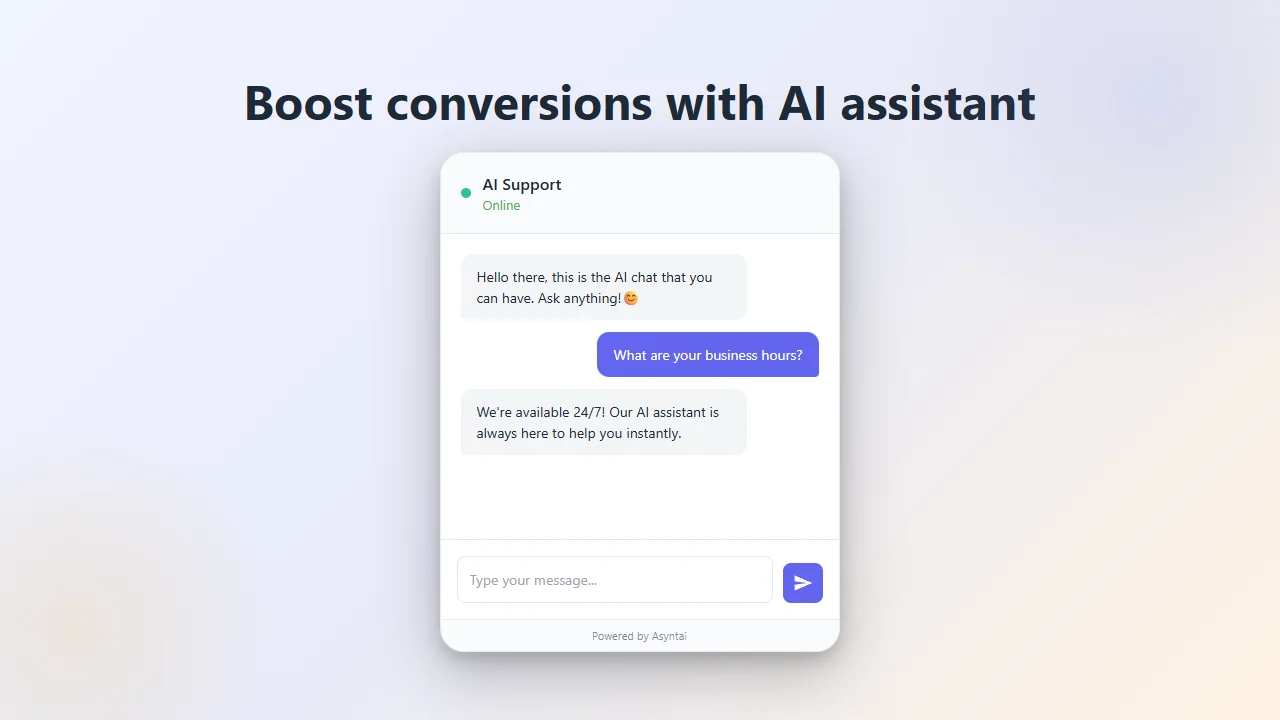
Answer Visitor Questions on Every Site You Host
A customer on a small-business site wants to check opening hours. A reader on a community site wonders how to volunteer. A client on a tradesperson's page asks if the business covers their postcode. Instead of waiting on an email reply, they ask the chatbot and get an instant answer pulled from the site content. That answer keeps them on the page and moving toward a booking, a donation, or a contact form submission.
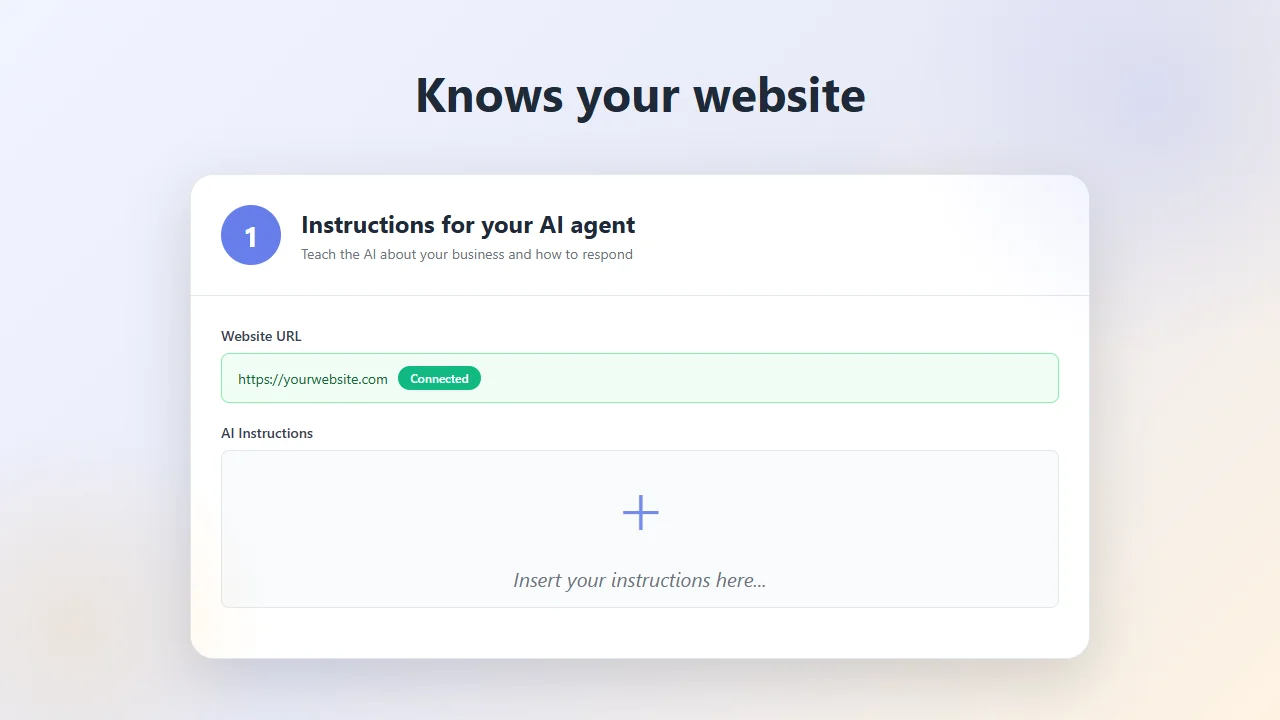
Reads Every Page Your Plesk-Hosted Site Publishes
The AI reads the pages served from the domain you host in Plesk — whether that is a WordPress site, a static HTML brochure, a PHP application, or a Node.js app. Upload PDFs like service menus, policy docs, or product sheets for knowledge that never quite makes it onto the live site. Every new page you or your client publishes adds to what the chatbot can answer.
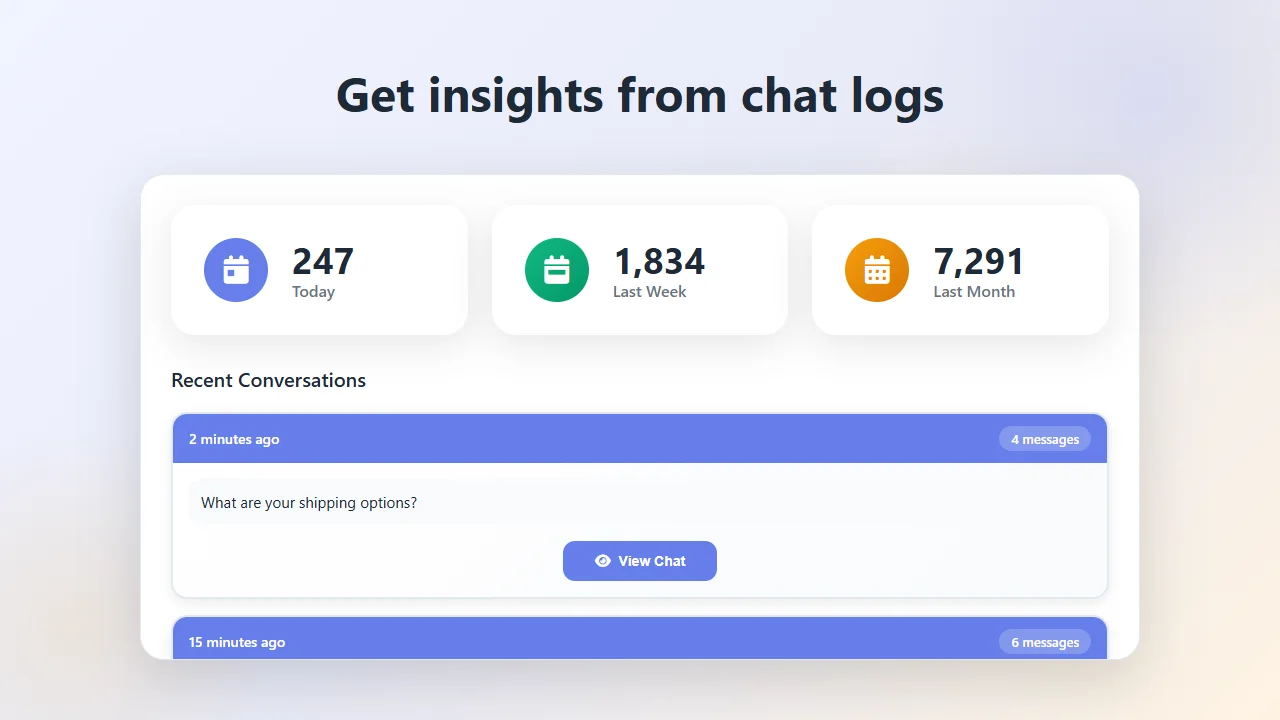
See What Your Visitors Actually Want to Know
Chat logs show you exactly what visitors are asking about but cannot find on the site. Maybe prospects keep asking about a service you never wrote a page for, or a FAQ answer is buried three clicks deep. Use those insights to brief your client, update the homepage, or add a missing page — tightening the site around what people actually look for.
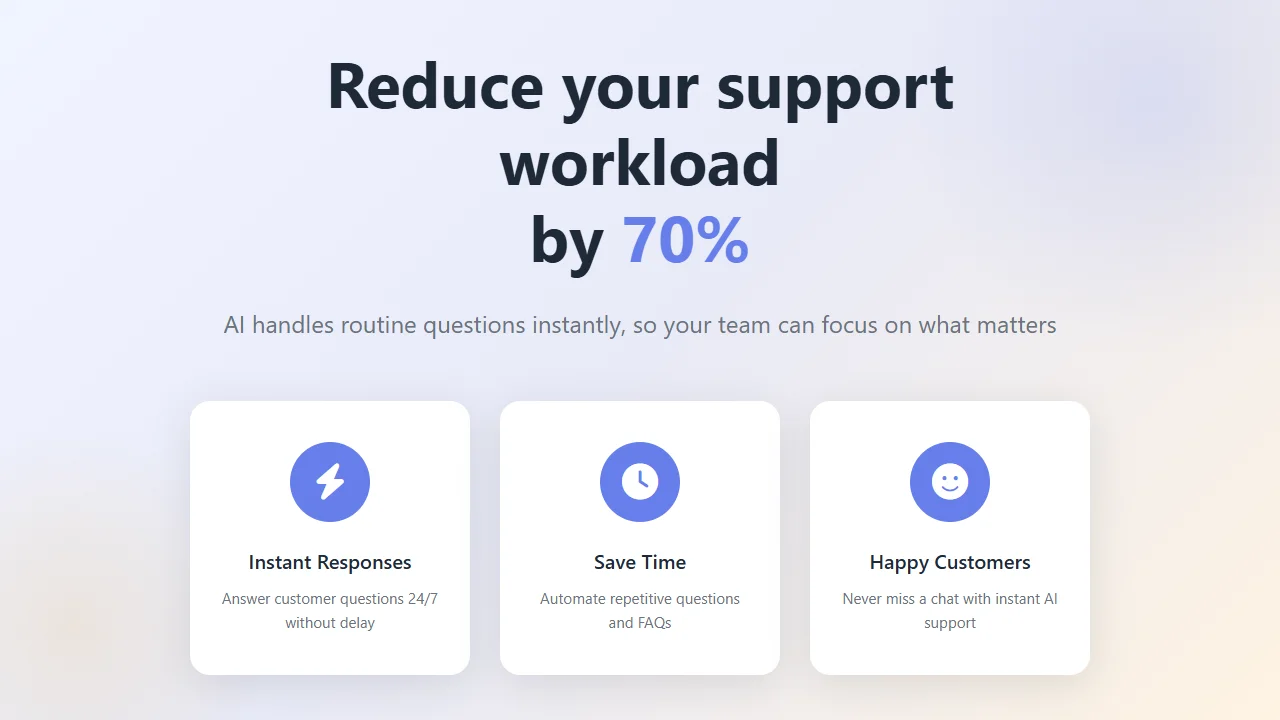
Stop Routing Every Visitor Question Back to You
If you manage sites for clients through Plesk, you know how often their inbound questions come straight to you — pricing, opening hours, whether they deliver, how to book. The chatbot handles those repetitive enquiries automatically, so your clients get back their mornings and you stop triaging the same three questions on every property you host.
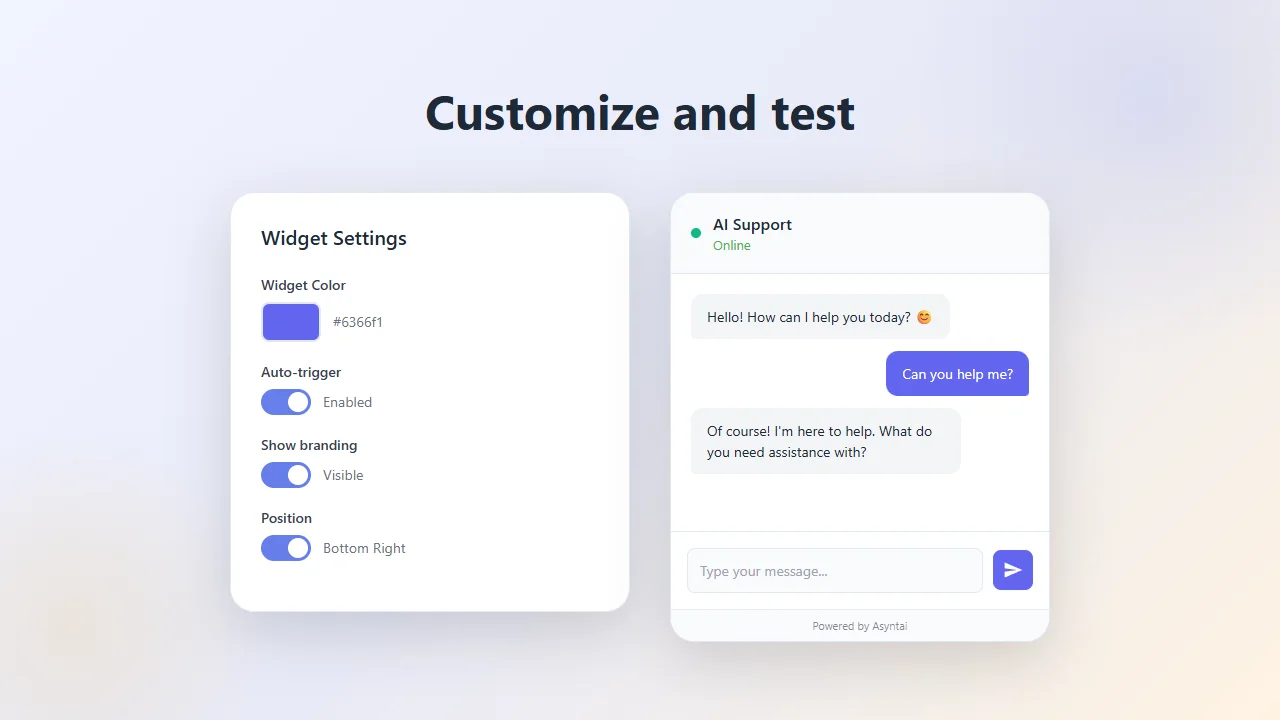
Works With Whatever Stack the Site Is Built On
Plesk hosts every kind of site — WordPress, Laravel, static HTML, a Node.js Express app, a plain PHP build. The widget drops in the same way on all of them. Customize colors, position, and welcome message from your Asyntai dashboard to match each client's brand. Test conversations before going live so you know the AI represents the business accurately.
Watch Introduction Video
See how an AI chatbot fits onto a Plesk-hosted site. This short tutorial walks you through signing up, pointing the AI at your content, and pasting the embed snippet into your site through Plesk File Manager so the widget appears on every page.
Have any questions? Try our AI chatbot right now
Ask it anything — it is live on this page
Built for Sites You Host on Plesk
Simple setup, works with any site you manage in Plesk — WordPress, static HTML, PHP, or Node.js. Your AI assistant is live in minutes.
Set Up in Minutes
Copy one script snippet, open Plesk File Manager, paste it before the closing body tag of your site, save. The whole install takes less than five minutes and does not require a Plesk extension or a new server package.
24/7 — Even When You're Not at the Desk
Sites hosted in Plesk get visitors at every hour of the day — people searching late at night, checking details on weekends, or browsing from other timezones. The chatbot answers whenever they arrive, so inbound interest does not wait for you or your client to check email in the morning.
Trains on the Site Content You Publish
Point it at the domain you host in Plesk and the AI reads every page — service pages, about pages, FAQs, blog posts. As you or your client publishes new content through WordPress, your PHP app, or by editing HTML in File Manager, the chatbot keeps up with what is live on the site.
Replies in Your Visitor's Language
Plesk commonly hosts local-business and community sites that end up with a wider audience than expected — travellers, relocators, out-of-region customers. The chatbot detects what language a visitor is typing in and replies in kind, across 32 languages. Multilingual replies are available from the Starter plan.
Works With Any Stack You Host
WordPress through Plesk WordPress Toolkit, static HTML sites, custom PHP applications, Laravel, Node.js apps behind the Plesk Node.js extension — the widget drops in the same way. One embed snippet, one place to paste it, no stack-specific glue required.
Easy to Roll Out Across Client Domains
If you manage multiple sites in one Plesk panel, you can configure a separate widget per domain so each one matches its own brand — or use a single configuration where appropriate. Rolling it out across the portfolio is the same embed-paste routine, just repeated for each site you want covered.
How It Works
Get your AI chatbot live on a Plesk-hosted site in three simple steps
Sign Up & Configure
Create your Asyntai account, add the site's URL, and customize the widget appearance to match the site — colors, position, welcome message, and the personality of the AI.
Paste the Snippet in Plesk
Open the domain in Plesk, go to File Manager, edit index.html (or the footer file for WordPress / PHP sites), and paste the embed snippet just before the closing body tag. Save the file.
Refresh the Site
Open the domain in your browser and the chatbot is live. It starts answering visitor questions immediately, and every conversation appears in your Asyntai dashboard.
Simple Plesk Integration
Get your AI chatbot live on a Plesk-hosted site in a few steps. The install happens in the site itself, not in the Plesk panel — so it works with any stack and across every domain in your panel.
-
1
Sign up and get your embed code
Create your Asyntai account, add the website URL, and copy the embed snippet from your Asyntai dashboard.
-
2
Open the site in Plesk File Manager
In Plesk, open the domain, launch File Manager, and navigate to the file that renders the site footer — typically index.html for static sites, footer.php for WordPress themes, or the main layout file for PHP and Node.js apps.
-
3
Paste the snippet before the closing body tag
Open the file in the Plesk code editor, paste the Asyntai snippet immediately before the closing body tag, and save. For WordPress sites you can also use the WP admin and a theme editor or a header/footer plugin instead.
-
4
Refresh and go live
Open the domain in your browser. The chatbot appears on every page served by that site — no Plesk extension required, no DNS changes, no restart.
Sign up free and get your personalized integration code instantly
Why Plesk Site Owners Choose Asyntai
Start with 100 free messages, upgrade as your traffic grows
Roll Out One Embed Across Multiple Client Sites
If you manage several domains in one Plesk panel — agency clients, reseller tenants, your own portfolio — you can cover multiple sites from a single Asyntai account depending on your plan. Each domain gets its own widget configuration, so every site keeps its own brand and voice.
Capture Leads From Visitors to the Sites You Host
Smart Lead Capture recognises when a conversation is heading toward a sales, booking, or contact question and invites the visitor to leave their name, email, and a short message — then saves the lead to your dashboard. Available from the Starter plan.
Works on Any Domain You Add to Plesk
Whether you add a brand-new domain to your panel tomorrow or you have been hosting the same site for years, the install is the same: paste the snippet into the footer, save, refresh. No stack-specific setup, no Plesk version constraints, no server tuning required.
Frequently Asked Questions
Everything you need to know about adding an AI chatbot to sites you manage in Plesk
Understanding Plesk for Your Business
What is Plesk?
Plesk is a web hosting control panel — the management layer that sits between you and the server running your websites. Instead of SSH-ing into a Linux box and configuring Apache, Nginx, PHP, databases, and DNS by hand, Plesk gives you a graphical interface to do all of that from a browser. It is widely used by small hosting providers, agencies managing client sites, web developers running their own servers, and individual site owners who want a friendlier interface than raw server administration.
A single Plesk panel typically hosts anything from one website to hundreds. Each domain is a separate entity inside Plesk, with its own files, database, email accounts, and SSL certificate. Tools like WordPress Toolkit help you spin up and patch WordPress installs, while the Node.js extension handles modern JavaScript applications. Plesk itself is not the website — it is the control room where you manage the sites you host.
How Plesk Works
When you add a domain in Plesk, it provisions a folder on the server, sets up the web server to serve files from that folder, and optionally creates a database and email accounts for you. You then upload or install a website into that folder — it might be a WordPress install, a static HTML brochure, a custom PHP application, a Laravel project, or a Node.js app running through the Plesk Node.js extension.
Everything a visitor sees on the site is produced by whatever runs in that folder. Plesk does not render your pages — it just makes sure the right stack is available to run them and gives you tools to manage files, databases, SSL, backups, email, and security. From a visitor's point of view, they are visiting yourbusiness.com, and the control panel in the background is invisible.
That separation is why adding a chatbot, analytics, or any other third-party script is always a matter of editing the site itself — not the Plesk panel. You paste the script tag into the file that renders your page footer, save, and every visitor's browser executes it. Plesk just happens to be the tool you use to open File Manager and reach that file quickly.
Who Uses Plesk?
Plesk is a common choice for small hosting providers who resell packaged hosting plans, web development shops managing client sites on a dedicated server or VPS, system administrators who prefer a GUI over the command line, freelancers and agencies with a portfolio of projects, and individuals or small businesses who have moved up from shared hosting to a managed server.
Teams pick Plesk when they want straightforward multi-site hosting with a friendly UI, solid defaults for WordPress and PHP stacks, and extension support for things like Node.js, Git deploys, and automatic SSL. It pairs well with a single VPS serving five to fifty sites, or with a reseller plan where the provider gives each customer their own lightly-branded Plesk login.
Why AI Chat Fits Sites Hosted on Plesk
Sites hosted in Plesk are often run by small teams, individual owners, or agencies looking after many clients. None of these setups have a big customer-service department sitting behind the contact form. Visitors still expect answers — opening hours, pricing, availability, how to book, how to return, how to volunteer — and when those answers do not come, visitors click away. The smaller the team behind a site, the bigger the gap between expected response time and actual response time.
An AI chatbot that reads the site's content closes that gap. The visitor asks a question in natural language, the AI pulls from the pages you have already published and any PDFs you have uploaded, and replies in seconds. It does not replace a human — it handles the repetitive, factual questions that do not need a human. For a small business owner hosting their own site in Plesk, that means fewer enquiries in the inbox for questions already answered on the about page. For an agency hosting client sites, it means fewer support emails cascading through every project.
And because Plesk hosts such a wide range of stacks — WordPress, static HTML, PHP frameworks, Node.js apps — the right chat tool has to be stack-agnostic. A plugin built only for WordPress does not help on a static site; a Node.js module does not help in a pure PHP project. A single embed snippet that pastes into the footer works across every one of them, which is why a lightweight widget is the right shape for this environment.
Adding the Chatbot to a Site in Plesk
The install is exactly where you would expect: the file that renders the footer of the site itself. For a static HTML site that is usually index.html in the document root. For a WordPress site it is the theme footer file, or you can do it through WP admin with a header/footer plugin. For a PHP or Laravel application it is the shared layout template. For a Node.js app behind the Plesk Node.js extension, it is the HTML template your framework serves. Paste the snippet before the closing body tag, save, and that is the install.
No Plesk extension is needed because Plesk is not what serves your HTML to visitors — your site is. You open File Manager, edit the file, and hit save. Everything else happens in the browsers of the people who visit the site. Your domain keeps serving the same pages with one extra script tag added, and the chatbot appears in the corner.
How AI Chat Helps Plesk-Hosted Sites
The Small-Team Support Gap
Most Plesk-hosted sites are not backed by a call centre. They are backed by the owner of a small business, a freelancer juggling client work, a volunteer who takes care of a community site on evenings, or an agency producing the site for a client who will then manage it themselves. That is the reality of independent hosting. The people behind the site are doing other things most of the day, and the inbox is the slowest channel of all.
Traditional chat tools ask the same people to also be live-chat operators. A contact form at least does not pretend to be fast — but it still leaves the visitor waiting. Rule-based bots break the moment someone phrases a question outside the script. Neither fits the everyday reality of a tradesperson site, a local-community site, a one-person consultancy, or a nonprofit with a single part-time webmaster.
AI chat is a better fit because it does not need a human babysitter. It reads the content on the site, understands natural-language questions, and answers them on its own. The owner stays focused on the work. The client stays in their day job. The visitor gets a useful answer right now, instead of an acknowledgement email at 9 AM the next day.
Speed Matters When You're Competing for Attention
Most visitors who land on a small-business or agency-built site are in the middle of comparing options. They opened three tabs, glanced at the homepage, and will likely pick whichever one answers their question first. A prospect wondering whether your client services their area does not want to fill out a contact form — they want to see the answer in the next five seconds, or they are gone.
An AI chatbot closes that window. A visitor asks a question, the AI reads the site content and replies immediately, and the visitor now has what they came for — often enough to make the booking, call the number, or send the contact form with real intent instead of a vague enquiry. For a plumber, an accountant, a local café, or a community nonprofit, that compressed response time is the difference between a new customer and a bounce.
The same thing applies at agency scale. If you host twenty client sites in one Plesk panel, twenty sites each sending the owner one unnecessary email a day is twenty hours a week of triage work for someone. Handing the predictable questions off to a chatbot is not just a nice feature — at that volume, it is an operational win.
AI Chat vs. Contact Forms and Rule-Based Bots
The default communication tool on most Plesk-hosted sites is still a contact form. It works, but it optimises for the operator, not the visitor — the visitor fills out fields, waits, and in the meantime moves on. Rule-based chat bots were a partial upgrade, but anyone who has used one on a real site knows how quickly the tree of canned options becomes frustrating.
AI-powered chat takes a different approach. Instead of pre-built decision trees, the system understands the intent behind a visitor's question. You provide the site's URL and any supporting documents — service menus, rate cards, policy PDFs, internal FAQs — and the AI constructs a natural, relevant answer. Whether a visitor asks if you service their area, which suburbs you cover, or whether you can come to their postcode, the AI recognises these all map to your coverage area information.
This is particularly useful for the kind of sites Plesk commonly hosts — small businesses with a handful of service pages, community groups with an events calendar and an about page, agency-built brochure sites for clients. The AI can connect those pages in its answers, pointing a visitor to the booking form after it has answered their eligibility question, or to the donation page after it has explained how the nonprofit uses funds.
What Plesk Site Owners Gain
The first benefit is simply being open at all hours. Small businesses often get evening and weekend enquiries from people who are searching in their spare time. Community sites get questions from volunteers and members outside of meeting hours. Agency-built sites get leads for clients who are never going to reply at midnight. An AI chatbot is the only cost-effective way to meet that demand without hiring.
The second benefit is fit with the hosting reality. The widget is a lightweight script loaded asynchronously, so it does not slow the site down, increase the server load on your Plesk VPS, or burn through your traffic allowance. It works on caching plugins, CDNs, and SSL without any tuning. It does not conflict with WordPress plugins or PHP framework internals — it is outside the stack, talking to Asyntai directly from the visitor's browser.
The third benefit is the time you and your clients get back. Instead of the site owner answering the same three or four questions every week, the chatbot handles them automatically. You still see every conversation in the Asyntai dashboard, so you keep visibility and can notice patterns — recurring questions that deserve a new page, FAQ sections that are not actually answering the real questions, or a pricing line that keeps causing confusion.
Getting Your Site Content Into the Chatbot
Plesk-hosted sites vary enormously in how much content they carry — from a single-page static site to a WordPress blog with hundreds of posts. The AI scales to both. The fastest way to train it is to give it your site URL. The system crawls the pages your site publishes and indexes what it finds, building an understanding of what the business offers. The Free plan crawls up to 100 pages, Starter crawls up to 500, and Standard crawls up to 1,000.
For content that is not on the site — internal price lists, booking terms, coverage maps, service availability, product spec sheets — you can upload files directly to the Asyntai dashboard. That extends the AI's knowledge beyond what a visitor can see on the public pages. You can also write custom instructions to shape how the chatbot responds, such as always pointing visitors to the booking page after a service question, or redirecting sensitive queries to a human contact.
If you manage multiple sites in one Plesk panel, each one is trained separately. A plumber's coverage area does not leak into a cafe's menu, and an agency client's internal documents stay in that client's widget configuration. Each domain is its own conversation.
Results Plesk Site Owners See
The impact usually shows up in two places: inbound response quality and inbox volume. Sites with the chatbot live tend to see visitors stay longer when they engage with it — they ask a question, read the answer, click through to the relevant page, and often come back with a second question. That engagement is visible in pages-per-session and time-on-page analytics.
On small-business and tradesperson sites, the chatbot turns tire-kicker traffic into qualified enquiries. Visitors who are not a fit drop off after the AI answers their question — which is actually good, because they were not going to convert anyway. Visitors who are a fit come to the contact form with clearer intent, which makes every booking conversation shorter and more productive.
On community, nonprofit, and hobby sites, the chatbot reduces the volunteer time spent answering the same recurring question about events, membership, or how to get involved. Every conversation appears in the Asyntai dashboard, so you retain full visibility — but you are no longer the first line of manual replies.
Choosing a Chat Tool for Plesk-Hosted Sites
Site owners hosting on Plesk have specific practical needs. First, the tool must not require a Plesk extension, root access, or server-side changes — the install should be something you can do as an ordinary hosting customer with File Manager. Second, it must work across every stack Plesk commonly hosts, because your portfolio probably includes WordPress, static HTML, PHP, and Node.js sites side by side. Third, it must not add server load, because you or your provider are already paying for the resources on a shared VPS.
Fourth, it should fit the visual identity of each site without looking bolted on. Customizable colors, position, and welcome message help the widget blend into whatever theme or brand each domain uses. Fifth, the pricing should make sense for the sort of traffic volume Plesk-hosted sites actually see — not enterprise-scale seat licenses, but sensible monthly tiers that scale with messages and number of sites.
Finally, consider multi-site management if you host more than one domain. An agency or reseller running ten client sites in one Plesk panel benefits from a tool that lets them configure each site independently in a single dashboard, rather than logging into ten separate accounts. Asyntai supports per-site widgets with per-site training and analytics, which fits the way Plesk itself organises your hosting.
Ready to Add AI Chat to Your Plesk-Hosted Site?
Start with 100 free messages and see how AI-powered answers can keep visitors engaged on the sites you manage in Plesk.