AI Chatbot for MedusaCMS Storefronts
Add an AI assistant to your Medusa-powered storefront. It reads your published product pages, answers pre-sales questions in every region you ship to, and works with the official Next.js starter, Gatsby, or any custom React, Vue, Svelte, or Astro frontend you build on top of the Medusa backend. Set it up in minutes and try it now by opening the chat in the corner.
Try it on your own storefront for free
Enter your storefront URL and see how an AI assistant would work on your site
See It In Action
Whether you run an indie DTC apparel brand, a multi-region home goods storefront, or a B2B wholesale catalog on Medusa - see how AI chat fits onto your headless commerce frontend
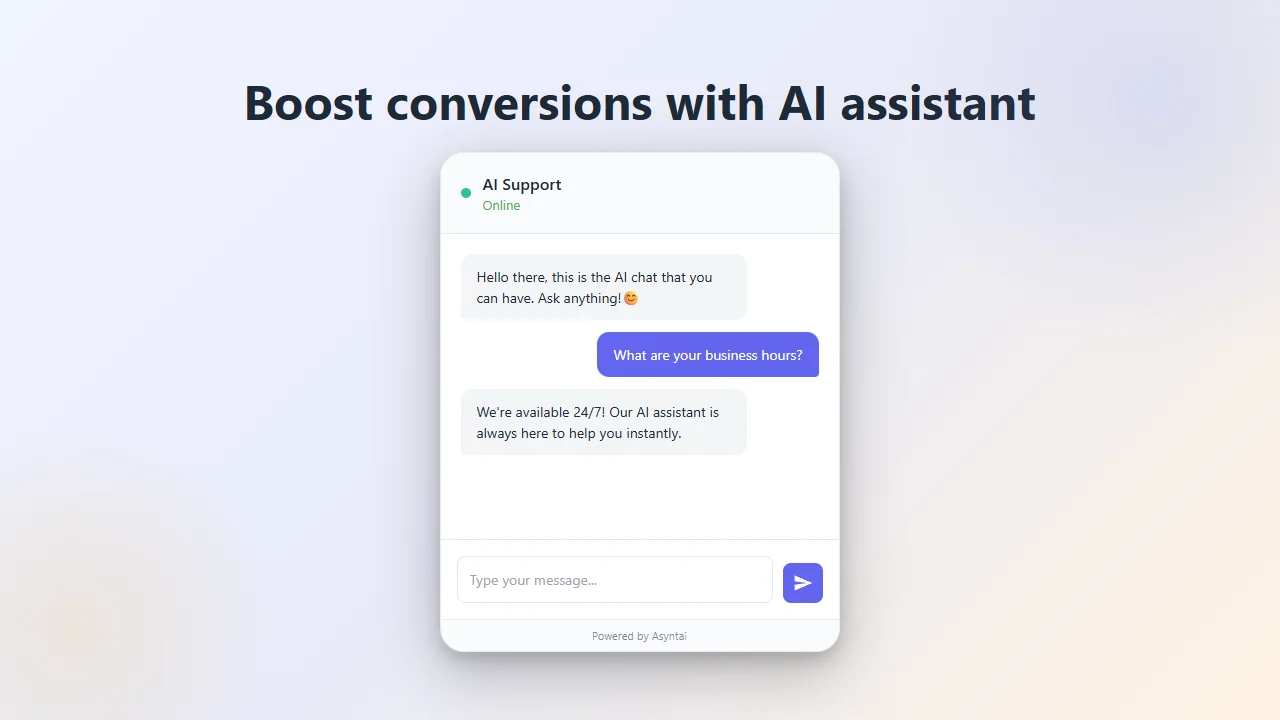
Recover Sales That Would Have Bounced From a Product Page
A shopper on your Medusa-powered storefront wants to know if a sweatshirt runs true to size, or whether you ship to Germany before duties. A wholesale buyer is wondering about your minimum order quantity. Instead of leaving the page to email you - and probably never coming back - they ask the chatbot and get an instant, accurate answer drawn from your product pages and policies. That answer keeps them in the cart funnel.
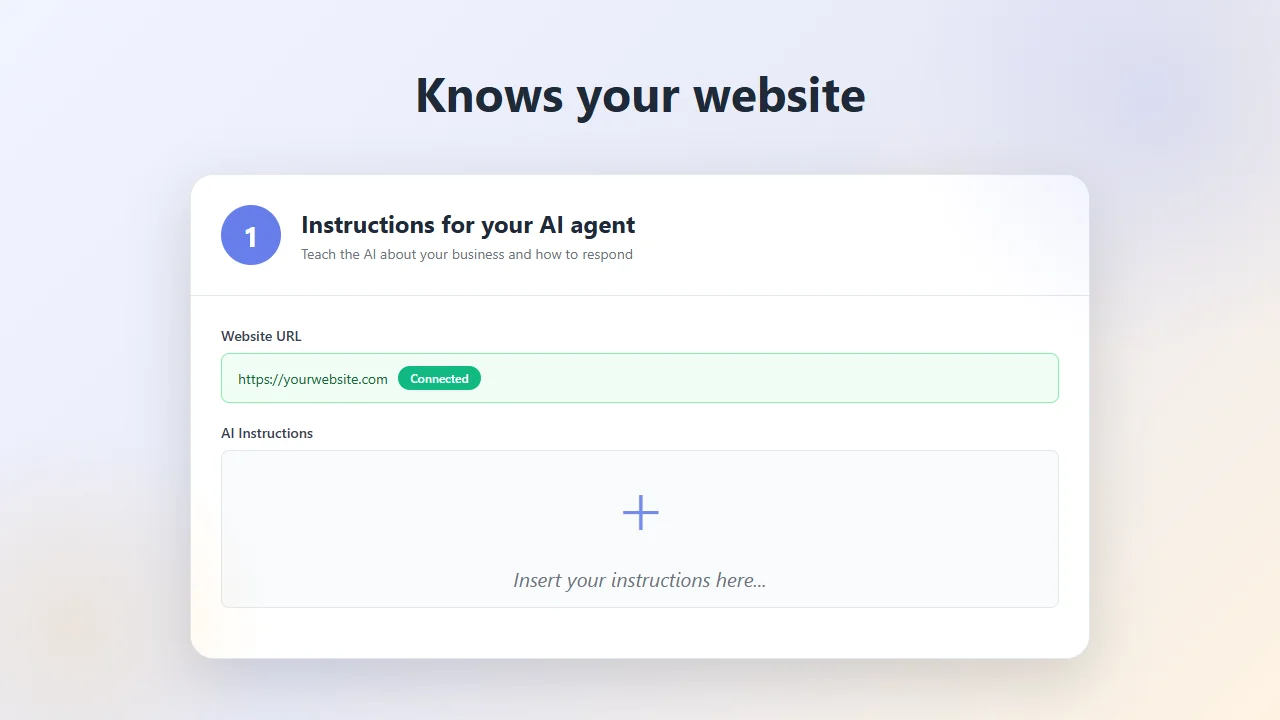
Knows Every Page Your Storefront Renders From the Medusa Catalog
The AI reads the product, collection, and policy pages your Next.js starter, Gatsby site, or custom React frontend renders from the Medusa backend. Upload PDFs like size charts, fabric care guides, B2B price lists, or shipping matrices for knowledge that does not live on the live storefront. Every new product or collection your team publishes adds to what the chatbot can answer.
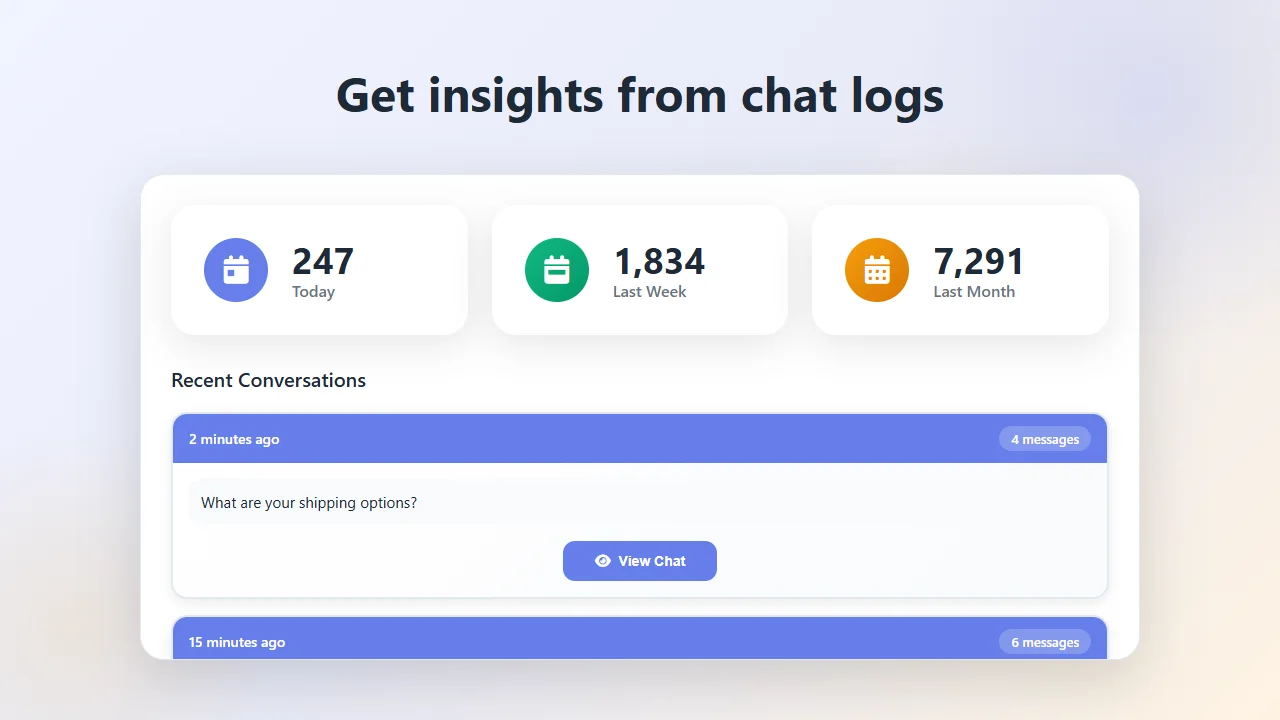
Spot Catalog Gaps and Missing Info on Your Storefront
Chat logs show exactly what shoppers are asking but cannot find on your storefront. Maybe buyers keep asking about a colourway you forgot to mark out-of-stock, or wholesale visitors want a tier-pricing breakdown you never published. Use those insights to update your Medusa catalog, refresh a collection landing page, or write the FAQ entry your customers are clearly searching for.
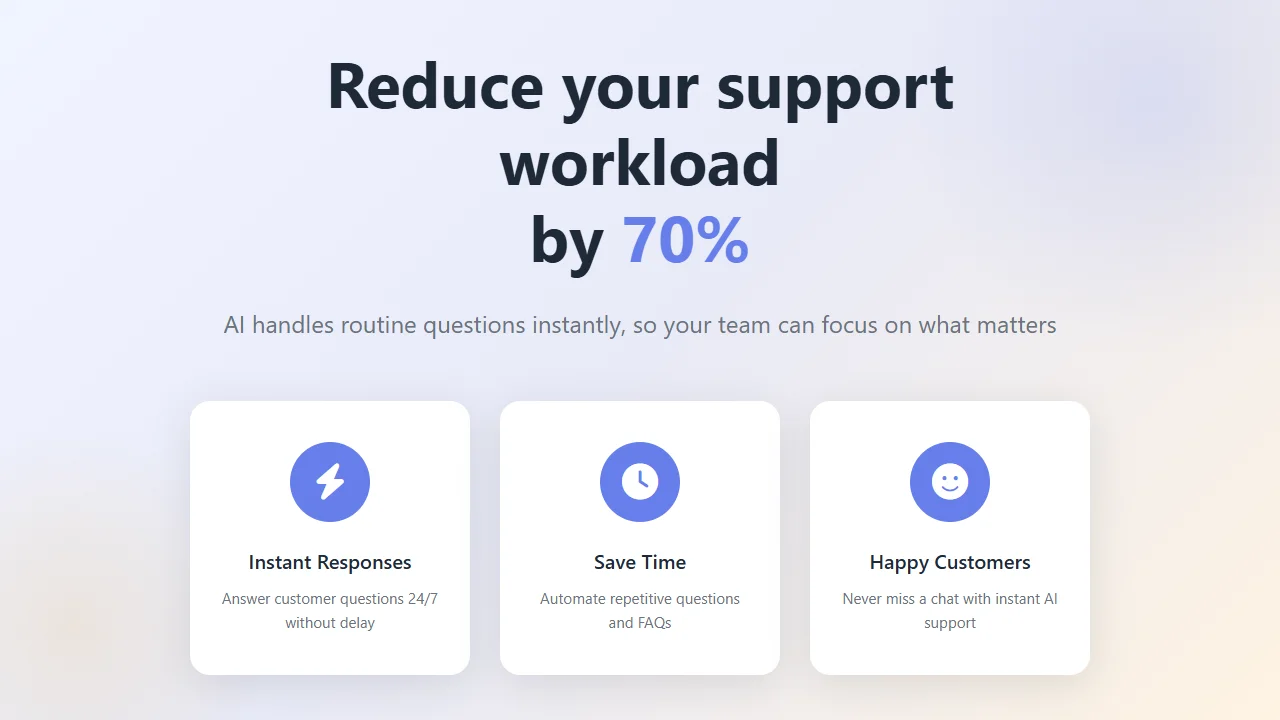
Stop Answering the Same Sizing and Shipping Questions Every Day
DTC merchants on Medusa drown in the same questions over and over - sizing, fit, fabric, lead times, shipping windows, return policy, region availability. The chatbot handles those repetitive inquiries automatically using the information already on your storefront, so your founder, ops lead, or one-person CX team can stay focused on the work only humans can do.
Works With Any Storefront Framework on Top of Medusa
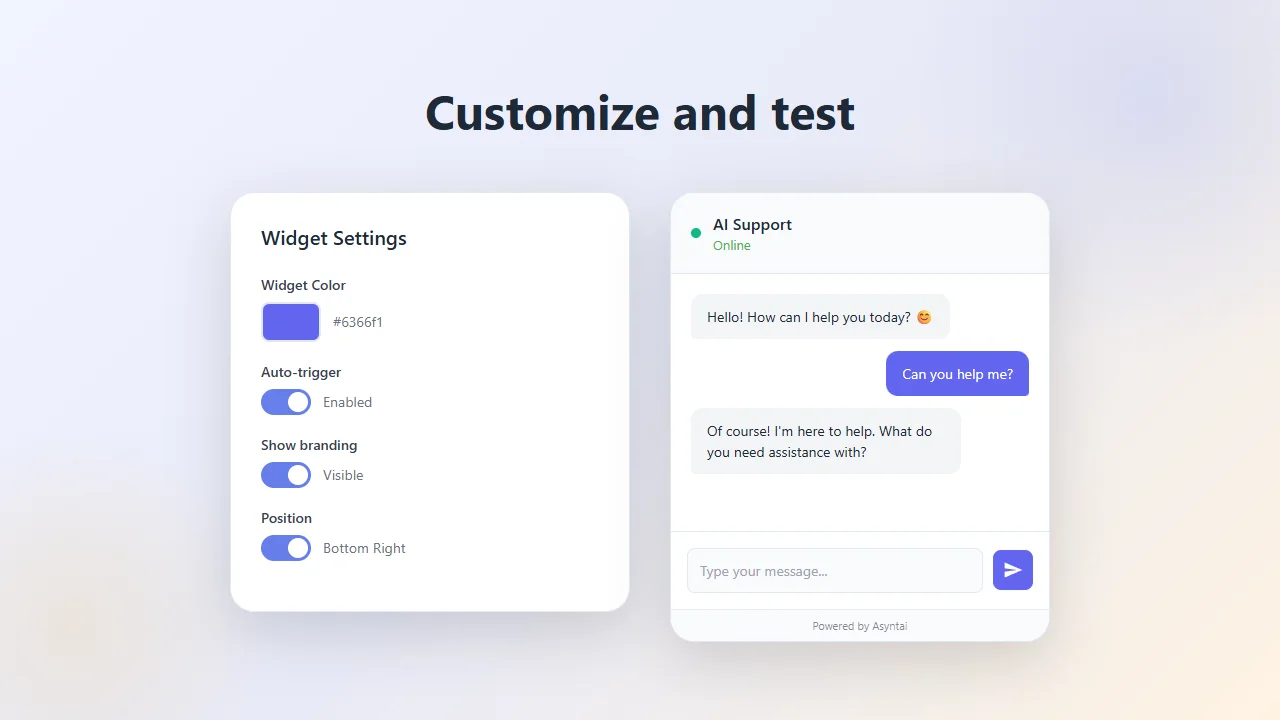
Whether your Medusa storefront is built with the official Next.js starter, Gatsby, a custom React app, Vue, Svelte, or Astro - the chat widget drops in the same way. Customize colors, position, and welcome message from your dashboard so the widget feels like part of your brand. Test conversations before going live so you know the AI represents your store voice accurately.
Watch Introduction Video
See how an AI chatbot fits into a Medusa-powered storefront. This short tutorial walks you through signing up, pointing the AI at your product catalog, and dropping the script into your storefront framework root layout so the widget appears on every product, collection, and cart page.
Have any questions? Try our AI chatbot right now
Ask it anything - it is live on this page
Built for Medusa-Powered Storefronts
Simple setup, works with any storefront framework that talks to your Medusa backend. Your AI assistant is live in minutes.
Set Up in Minutes
Copy one script snippet, paste it into your storefront root layout, and you are live. Works with the official Medusa Next.js starter, Gatsby, custom React, Vue, Svelte, and Astro storefronts. The whole setup takes less than five minutes and does not require a Medusa plugin.
24/7 Pre-Sales Coverage
Medusa storefronts often serve shoppers in many timezones - the buyer in Berlin browsing at midnight, the wholesale prospect in Sydney during their morning. The chatbot handles questions about products, sizing, shipping, and returns at 2 AM on a Sunday just as well as during your working hours.
Reads Your Catalog From the Storefront
Point it at your live storefront and the AI reads every rendered product page, collection page, FAQ, and policy. As you publish new products or update copy in your Medusa admin and redeploy the storefront, the chatbot keeps learning from what you ship.
Replies in Your Visitor's Region and Language
Medusa is built for multi-region commerce, and the chatbot should match. It detects what language a visitor is typing in and replies in kind, across 32 languages. Multilingual replies are available from the Starter plan.
Works With Any Storefront Framework
Medusa Next.js starter (App Router or Pages Router), Gatsby, custom React, Vue, Svelte, or Astro - the widget drops in the same way. Add it once to your storefront root layout and it ships on every product, collection, and cart route.
No Backend Changes Needed
The script lives in your storefront frontend, so there is nothing to install on the Medusa server, no module to register, no admin extension to build. Your Medusa backend, admin dashboard, and database stay untouched.
How It Works
Get your AI chatbot live on your Medusa-powered storefront in three simple steps
Sign Up & Configure
Create your Asyntai account, add your storefront URL, and customize the widget appearance to match the brand system your storefront ships.
Add the Script to Your Storefront
Copy the snippet into your storefront root layout - Next.js app/layout.tsx, Gatsby gatsby-ssr.js, or the equivalent for your stack. Commit and push.
Deploy and Go Live
Deploy your storefront to Vercel, Netlify, Railway, or wherever you host it. The chatbot appears on every product, collection, and cart page and starts answering shopper questions immediately.
Simple MedusaCMS Integration
Get your AI chatbot live on your Medusa storefront in a few steps. The install happens on your storefront app, not inside the Medusa backend or admin - so it works with any storefront framework, any hosting provider, and across every region you sell into.
-
1
Sign up and get your embed code
Create your Asyntai account, add your storefront URL, and copy the embed snippet from your Asyntai dashboard.
-
2
Open your storefront app
Open the repo for your storefront - typically the official Medusa Next.js starter, a Gatsby app, or a custom React, Vue, Svelte, or Astro frontend. This is the app that talks to the Medusa backend API, not the Medusa server itself.
-
3
Add the Asyntai script
For Next.js App Router, use the Script component in app/layout.tsx with strategy=afterInteractive. For Pages Router, use pages/_document.tsx. For Gatsby, add to gatsby-ssr.js. For custom React, Vue, Svelte, or Astro storefronts, add to public/index.html or your root layout.
-
4
Deploy your storefront
Push to Vercel, Netlify, Railway, or your own hosting. The chatbot appears on every product, collection, and cart page of your Medusa-powered storefront - no Medusa plugin required.
Sign up free and get your personalized integration code instantly
Why Medusa Storefront Owners Choose Asyntai
Start with 100 free messages, upgrade as your traffic grows
Built for Multi-Region Storefronts
Multi-region commerce is one of Medusa's signature strengths - your storefront might ship to five regions or fifteen, each with its own currency, tax rules, and shipping options. The chatbot detects each visitor's language and replies across 32 languages, so a French-speaking buyer asking about regional availability gets answered in French. Multilingual replies are available from the Starter plan.
Capture Leads From Wholesale and B2B Inquiries
When a visitor asks about wholesale pricing, custom orders, or trade accounts, the chatbot recognises the intent and invites them to leave their name, email, and a short message - then saves the lead to your dashboard. Available from the Starter plan.
Frees You From Repeating the Same Pre-Sales Questions
DTC and B2B merchants on Medusa drown in the same shipping, sizing, lead-time, and availability questions every single day. The chatbot handles those repeat inquiries from your storefront content, so the founder or one-person CX team can stop typing the same answer for the hundredth time and focus on the orders that actually need a human.
Frequently Asked Questions
Everything you need to know about adding an AI chatbot to your Medusa-powered storefront
Understanding MedusaCMS for Your Business
What is MedusaCMS?
MedusaCMS - more commonly written as Medusa - is an open-source headless commerce engine. It is the backend that powers your store: products, variants, inventory, carts, orders, fulfilment, payments, regions, and pricing all live inside the Medusa server. What it deliberately does not do is render the pages your customers see. That job belongs to a separate storefront app, which queries Medusa over an API and decides exactly how to display the catalog.
Medusa is popular with merchants who want the structure and reliability of a real commerce backend without locking themselves into a hosted platform's frontend, theme system, or pricing. It is widely used by indie DTC brands, headless migrations away from Shopify or WooCommerce, B2B and wholesale operators, multi-region brands selling across borders, marketplaces, and teams building custom commerce experiences that an off-the-shelf platform cannot accommodate.
How MedusaCMS Works
Your team configures products, collections, regions, price lists, and shipping options inside the Medusa admin dashboard. The Medusa server stores all of this in a database and exposes it through two APIs: a storefront API for shopper-facing reads (product listings, cart, checkout) and an admin API for back-office operations. The platform handles cart logic, region-aware pricing, tax calculations, inventory reservations, and order workflows.
When a shopper loads your store, it is not Medusa serving the HTML directly. A storefront app - usually the official Medusa Next.js starter, but it can be Gatsby, a custom React app, Vue, Svelte, or Astro - queries the Medusa storefront API and renders product pages, collection pages, cart, and checkout. That storefront is what the browser actually downloads and runs.
This separation of backend and frontend is why any script you want on every shopper-facing page - analytics, chat, personalization, tag management - belongs in the storefront app, not in the Medusa backend. Medusa is the source of truth for catalog and orders; the storefront is the delivery layer. The chatbot, like every other shopper-facing script, lives in that delivery layer.
Who Uses MedusaCMS?
Medusa is a common choice for indie DTC brands that want flexibility a hosted platform will not give them, founders migrating from a hosted store and tired of theme customization limits, B2B and wholesale operators who need price lists and gated catalogs, multi-region brands selling across borders with different currencies and tax rules, marketplaces and multi-vendor experiences, and product teams building custom commerce experiences such as subscription boxes or made-to-order flows.
Teams choose Medusa when they want a real commerce engine - inventory, regions, taxes, payments - paired with the freedom to design any storefront experience they like, host wherever they prefer, and avoid the per-transaction cuts hosted platforms charge. The tradeoff is that there is real engineering work involved: someone has to build and host the storefront, deploy and operate the Medusa backend, and maintain both over time.
Why AI Chat Fits a Medusa Storefront
Storefronts built on Medusa are usually catalog-heavy and policy-heavy at the same time. There are product pages, collection pages, size guides, fabric or material details, lead times, regional shipping windows, return windows, and wholesale terms. That is exactly the kind of store where shoppers ask questions whose answers exist somewhere on your site - just not on the page they are currently looking at. The bigger your catalog grows, the harder it becomes for a shopper to navigate from the outside.
An AI chatbot that reads your storefront can surface those answers instantly. The shopper asks a question in plain English, the AI pulls from the same content your storefront is rendering from Medusa, and replies in seconds. For a DTC apparel brand, this turns a confused sizing question into a confident add-to-cart. For a B2B catalog, it turns a wholesale visitor into a captured lead. For a multi-region store, it tells a buyer in Berlin whether you ship to Germany - without making them dig through a shipping policy page.
And because Medusa is built for multi-region commerce, the chatbot needs to match. Asyntai detects each visitor's language and replies in kind, so a single deployment can serve shoppers across every region your storefront sells into. Multilingual replies are available from the Starter plan.
Adding the Chatbot to Your Storefront (Not Your Medusa Backend)
The install is exactly where you would expect: the root layout of your storefront app, the same file where you already load analytics scripts, fonts, and global styles. For the official Medusa Next.js starter that is app/layout.tsx with the Script component (App Router) or pages/_document.tsx (Pages Router). For Gatsby that is gatsby-ssr.js or gatsby-browser.js. For custom React single-page apps it is public/index.html. For Vue, Svelte, or Astro it is the equivalent base layout.
No Medusa plugin or admin extension is required because Medusa is not what is shipping the HTML to your shoppers. Your operations team continues working in the Medusa admin exactly as before. Your developers add one script tag to the storefront, commit, push, and the chatbot is live on the next storefront deploy. Nothing in your Medusa server, modules, or admin configuration changes.
How AI Chat Helps Medusa-Powered Storefronts
The Pre-Sales Question Drain on DTC Founders
Medusa-powered stores are usually run by small teams - a founder, a co-founder handling ops, maybe a CX person who also packs orders. The store is polished, the storefront is fast, the catalog is clean. But every day, a stream of pre-sales questions arrives over email, Instagram DMs, and contact forms: does this run small, do you ship to Norway, what is the lead time on the natural oak version, do you offer trade pricing, when is the linen restocking. Every one needs a reply. None of them need the founder personally.
Most chat tools available today are one of two things: rule-based bots that follow rigid click-through flows, or live-chat platforms that require a human sitting at a keyboard. Neither is a great fit for a small DTC team on Medusa. Rule-based bots break the moment a shopper phrases a question outside the script. Live chat ties up the founder during their working hours and leaves the storefront silent the rest of the day - including the evenings and weekends when most consumer shopping actually happens.
AI chat changes that equation. It reads the content you have already published on your storefront, understands natural-language questions, and answers them on its own. Your ops team stays in Medusa admin. Your developers stay in the storefront repo. The chatbot handles the pre-sales questions that would otherwise have pulled the founder away from the work that actually moves the business.
Speed Matters on Modern Storefronts
Teams that pick Medusa usually care about performance. You chose a headless architecture partly so you could ship a fast storefront - static generation where possible, edge caching, careful image optimization, predictable Core Web Vitals. Milliseconds matter. Page speed is a conversion lever, especially in commerce, where every second of delay measurably costs orders.
The same logic applies to shopper communication. A buyer who fills out a contact form and waits two days for a reply has already moved on - probably to a competitor whose storefront answered the question on the page. An AI chatbot closes that gap. A shopper asks a question, the AI pulls the answer from your published product pages and policies, and replies in seconds - while the shopper is still in the cart funnel and still interested.
For a DTC apparel brand, that instant answer often decides whether the buyer adds to cart or bounces. For a B2B wholesale storefront, it is the difference between a captured lead and a closed tab. For a multi-region brand, it keeps a shopper engaged long enough to find the region, the size, or the variant they actually came for.
AI Chat vs. Traditional Chat Tools on Headless Stores
Traditional chat widgets either connect to a live agent or follow pre-built decision trees. Both approaches strain at small-team commerce scale. Live-agent chat requires staffing - someone has to be online, trained on the catalog, and available across every timezone your Medusa store ships to. Decision-tree bots only answer questions you have explicitly programmed, and shoppers quickly end up in dead ends when their phrasing does not match your script.
AI-powered chat takes a fundamentally different approach. Instead of following rigid scripts, the system understands the intent behind a shopper's question. You provide it with your storefront content and any additional documents - size guides, fabric care PDFs, internal FAQs, wholesale price sheets - and the AI constructs a natural, relevant answer. Whether a shopper asks 'do you ship to Germany' or 'can I order this in Berlin' or 'how long does delivery take to the EU,' the AI recognises these all map to your shipping policy.
This is particularly valuable for Medusa stores because your catalog is often deep. Product pages link to related variants. Collection pages reference size charts. Policy pages explain region-specific shipping. The AI can follow those relationships in its answers, pointing a shopper to the next relevant page instead of ending the conversation at a dead end.
What Medusa Storefront Owners Gain
The first benefit is round-the-clock pre-sales coverage. Medusa storefronts often serve international shoppers across many timezones - a DTC brand selling into the EU and US, a B2B catalog with buyers in Asia placing orders outside their own business hours, a multi-region brand answering questions before the founder is awake. An AI chatbot answers at 3 AM on a Sunday just as accurately as at 10 AM on a Tuesday. You capture orders that would otherwise be lost to after-hours hesitation.
The second benefit is fit with a modern stack. The widget loads asynchronously via a lightweight script, so it has no impact on your Core Web Vitals or Lighthouse scores - metrics that matter to performance-conscious Medusa teams. It does not interfere with ISR, SSG, SSR, or edge rendering on the storefront. It does not touch your storefront build output or your deployment pipeline. And it does not touch your Medusa backend at all.
The third benefit is the time your team gets back. The founder spends less of the day fielding the same 'does this run small' or 'do you ship to my country' questions. Ops spends less time on customer email triage. The chatbot handles the repeat work while you still see every conversation in the Asyntai dashboard, so you keep visibility without doing the manual labour - and you can spot patterns in what shoppers ask, which is gold for product copy and FAQ updates.
Getting Your Medusa Content Into the Chatbot
Medusa storefronts are rich in structured, published content - product pages, collection pages, size guides, FAQ, shipping and returns policies, lookbooks, brand story pages. All of that is valuable knowledge base material for the AI. The fastest way to get your chatbot up to speed is to provide your live storefront URL. The system crawls the pages your storefront renders and indexes the content, building an understanding of what your store sells and how it operates. The Free plan crawls up to 100 pages, Starter crawls up to 500, and Standard crawls up to 1,000.
For multi-region Medusa stores, the AI reads each regional version your storefront publishes. A shopper asking a question in French about your French-language pricing or shipping page gets an answer drawn from that specific region, not from the English source. This keeps regional information accurate - currencies, units, availability, customs language - without you having to manually translate your chatbot training.
For content that is not on your storefront - wholesale price sheets, B2B contract terms, detailed product specification PDFs, internal FAQ documents - you can upload files directly to the Asyntai dashboard. This extends the AI's knowledge beyond what is publicly visible. You can also write custom instructions that shape how the bot responds, like always offering to capture a wholesale lead when buyers ask about trade pricing, or directing custom-order requests to a specific email address.
Results Medusa Storefront Owners See
The impact tends to show up in two areas: cart-funnel metrics and operational workload. Stores with the chatbot typically see shoppers spend more time on product and collection pages when they interact with the AI - they ask about sizing, get pointed to the right size guide or variant, read it, and often add to cart. That engagement is visible in session duration, pages-per-session, and add-to-cart rate.
On B2B and wholesale Medusa storefronts, the chatbot serves a second job - lead capture. Instead of a wholesale visitor bouncing because they cannot find trade pricing on the public storefront, they ask the chatbot, get told the right path, and leave their contact details for follow-up. This turns previously invisible browsers into named leads in your dashboard.
On the operational side, the reduction in repetitive inbound is immediate. The questions that used to fill the founder's inbox and Instagram DMs now get handled automatically. You still see every conversation in the dashboard, so you maintain full visibility - and can spot patterns like recurring sizing complaints (time to update a product page), repeated wholesale interest (time to publish a trade landing page), or persistent shipping confusion (time to rewrite that policy page).
Choosing a Chat Tool for a Headless Commerce Stack
Medusa teams have specific needs when picking a chat tool. First, it must not require a Medusa plugin or backend integration - it should drop in via a script tag that works with any storefront framework. Second, it must play well with modern rendering strategies on the storefront: static generation, incremental revalidation, server rendering, and edge deployment should all work the same way. Third, it must handle multi-region content natively, because a single-language chatbot on a multi-region Medusa store creates a jarring shopper experience.
Fourth, it should help - not hurt - the performance work your team has already done on the storefront. A chat script that blocks the main thread, inflates your JavaScript bundle, or degrades your Lighthouse score is at cross-purposes with the reason you picked a headless architecture in the first place. Asynchronous loading after page interactivity is the right default, and every Medusa storefront we have seen treats Core Web Vitals as a non-negotiable conversion lever.
Finally, consider customization and lead capture. The chat widget should feel like part of your brand storefront, not a foreign element bolted on. Customizable colors, position, and welcome message help the widget blend in rather than stand out. And if you sell B2B as well as DTC, the ability to capture wholesale leads directly from chat - without forcing a contact form - turns the widget from a support tool into a top-of-funnel lead source.
Ready to Add AI Chat to Your Medusa Storefront?
Start with 100 free messages and see how AI-powered answers can keep shoppers in the cart funnel on your headless storefront.