Every help desk on the market now ships with an AI layer, and the meter splits the field in two. Some charge per agent, which grows when you hire. Others charge per resolution, which grows when your customers do. Only the second one is under your control, because the first scales with your payroll and the second scales with your traffic.
The break-even between those two meters, for any given team, is a ratio you can work out in five lines. We will work it out for the five named vendors below, then show what it means at a realistic ticket volume.
There is a third meter in the room too. Some products count something else, like tickets (Gorgias) or conversations (Front's Autopilot, Intercom's Fin on some line items). They are all variations on the same idea: the bill moves with usage rather than headcount. We will come back to the distinction, because it decides which tool wins for your specific mix of staffing and volume.
What the meter actually controls
If you pay per agent, every new hire is a new licence. The cost rises on a date you choose (the hire date) and never falls back down, even if the new person only answers a handful of tickets in their first month. A team that doubles in size doubles its software bill. A team that halves in size still pays the old bill until renewals.
If you pay per resolution, the bill moves with what your customers do. A quiet month costs less. A busy month costs more. You never buy capacity you are not using, and you never leave capacity on the table because nobody is hired yet.
For a business with steady ticket volume, the difference is mostly philosophical. For a business with volatile ticket volume, it is the difference between a budget that breathes and a budget that does not. Seasonal businesses, product launches, marketing spikes, B2B contracts that all renew on the same day: every one of those makes per-resolution cheaper than per-agent, because you are not paying for the peak headcount in the quiet months.
15,000 messages
from $0.05
$49 per 100 sessions
$0.75 per resolution
resolution also bills a ticket
$0.99 per resolved outcome
The seven meters, side by side
| Product | Meter | AI layer price | Base licence | Charged when |
|---|---|---|---|---|
| Zendesk | Per agent | Copilot +$50 per agent | $19 to $115 per agent | You hire a person |
| Freshdesk | Per agent | Freddy AI Copilot $29/agent. Freddy AI Agent $0.49 per session after 500 included. | $19 to $89 per agent | You hire a person; AI when it runs |
| Help Scout | Per user | AI Answers $0.75 per resolution | $0 to $75 per user | You add a user; AI when it runs |
| Intercom | Per seat | Fin $0.99 per resolved outcome | $29 to $132 per seat | You add a seat; AI when it resolves |
| Front | Per seat | Autopilot from $0.05 per conversation; Copilot $20 per seat | $25 to $105 per seat | You add a seat; AI per conversation |
| Gorgias | Per ticket | AI Agent $0.90 to $1.00 per resolution, and each resolution is also a billable ticket. | $10 to $750 by ticket band | A ticket exists, automated or not |
| Asyntai | Per message | Chat agent on every self-serve tier | $0 to $449 per month | A conversation happens |
We make Asyntai, so read that row as a disclosure. The Gorgias price is from a third-party listing of Gorgias charges, not from Gorgias' own checkout, and Gorgias double-counts an AI resolution as a ticket on top of the per-resolution fee.
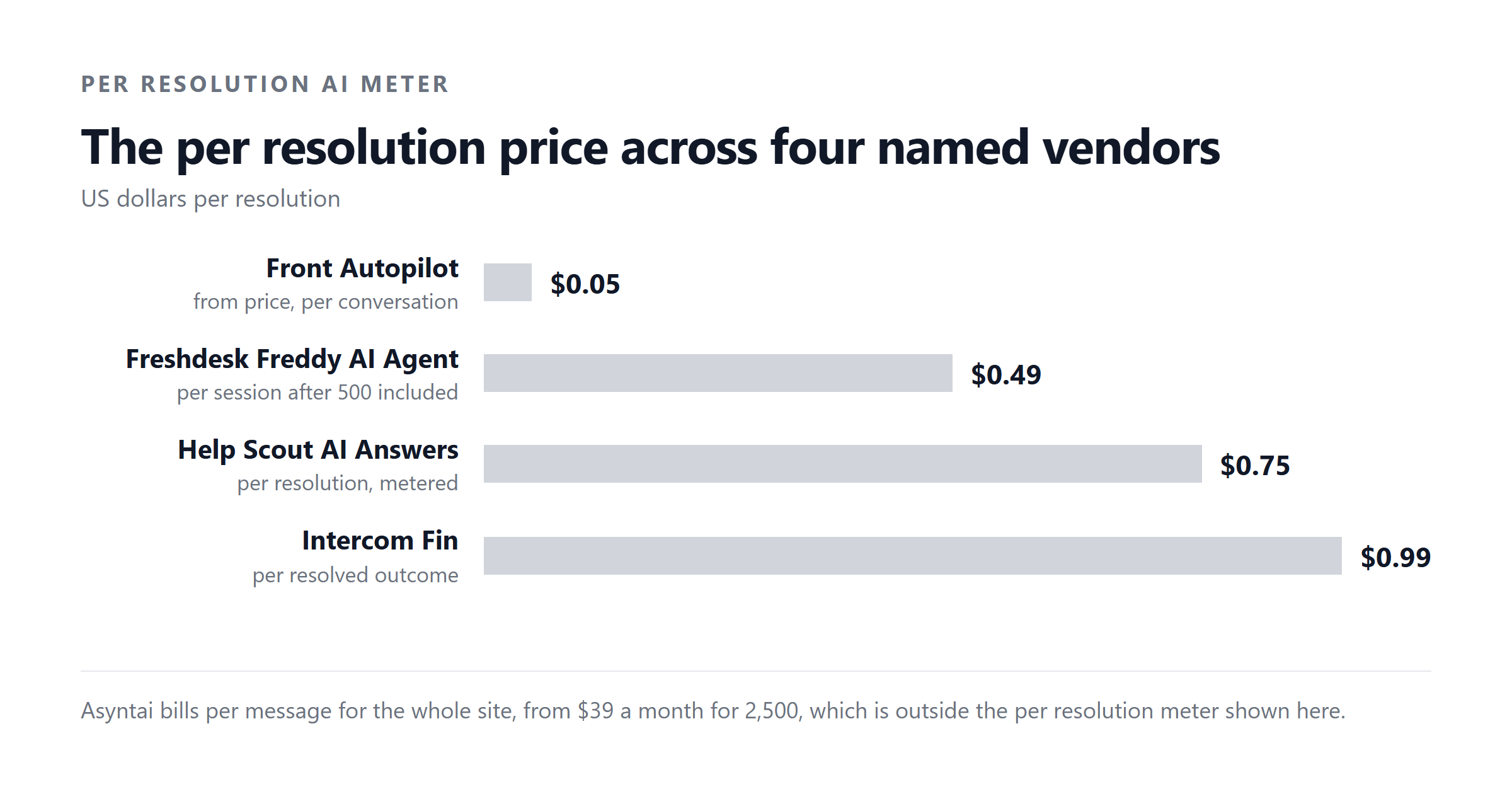
What each vendor's AI layer costs in plain numbers
Two of the five named tools charge for AI purely as a per-agent add-on. Three of them charge per resolution (with Front's Autopilot charged per conversation). Here is the published price for each, taken from the vendors' own pricing pages on 4 September 2026.
| Vendor | AI layer | Published price |
|---|---|---|
| Zendesk | Copilot add-on | $50 per agent per month on top of the Suite seat |
| Freshdesk | Freddy AI Copilot | $29 per agent per month |
| Freshdesk | Freddy AI Agent | 500 sessions included, then $49 per 100 sessions ($0.49 each) |
| Help Scout | AI Answers | $0.75 per resolution |
| Intercom | Fin AI | $0.99 per resolved outcome, charged once per conversation |
| Front | Autopilot | From $0.05 per conversation |
| Front | Copilot | $20 per seat per month |
| Gorgias | AI Agent | $0.90 to $1.00 per resolved conversation; each resolution also counts as a ticket |
| Asyntai | Chat agent | Free to $449 per month by message tier |
We make Asyntai, so read that row as a disclosure.
Notice the Freshdesk AI Agent row, because it shows the metering trap that catches most buyers. You get 500 sessions included with the plan. Anything beyond that is billed in blocks of 100, and a block of 100 sessions costs $49. At 1,200 resolutions in a month, the billable amount is 700 sessions beyond the included 500, which is 7 blocks at $49 each.
That $343 is for AI alone. The agent seats sit on top of it, and so do the day passes, connector tasks and any other line items that arrive once the system is in use. The pricing page is honest about it: every Freshdesk customer on Freddy AI Agent pays for the plan, pays for the seats, and then pays for the agent on top.
The break-even you actually need
The question is not which tool is cheapest on paper. The question is which tool is cheapest at your resolution count, given your headcount. The ratio that decides it is resolutions per agent per month, which we will call R.
Take a team of 10 agents, each paying $50 a month for an AI add-on (Zendesk Copilot at the published price). The team's AI bill is 10 × $50 = $500 a month, regardless of how many tickets they resolve. If instead you paid $0.50 per resolution, the bill at R resolutions per agent is 10 × R × $0.50, which equals 5R. The two bills are equal when:
Below 100 resolutions per agent per month, per-resolution is cheaper. Above 100, per-agent is cheaper. A team of 10 agents that resolves 50 tickets each a month pays $500 for per-agent AI and $250 for per-resolution. The same team resolving 200 each pays $500 for per-agent and $1,000 for per-resolution.
The break-even depends on three things: how many agents you have, how much the per-agent add-on costs, and how much the per-resolution fee is. Change any one of them and the break-even moves.
The same ratio for the named vendors
Use the published prices to derive a break-even for each per-agent product against its closest per-resolution alternative. The maths is identical: per-agent bill divided by per-resolution price gives the resolutions per agent per month at which they match.
Read those as the line on the floor, not as advice. If your average agent resolves fewer than the break-even number, per-resolution wins. If they resolve more, per-agent wins. Most small support teams run below the break-even for at least one of the named comparisons above, which is why per-resolution products have been eating the lower end of the market for three years.
A worked example at a realistic ticket volume
Pick a volume you can plan against: assume 2,000 customer conversations a month, of which 80% are resolved by AI without a human, and the remaining 20% require an agent. That is 1,600 AI resolutions and 400 human-handled tickets in a typical month.
Under Zendesk with Copilot on five agents, the bill is the five seats plus the Copilot add-on:
Under Help Scout Plus with AI Answers on the same five users, the seat cost is fixed and AI is per resolution:
At 1,600 AI resolutions a month, the per-agent tool is cheaper by a factor of nearly three. The reason is straightforward: Help Scout's $0.75 per resolution is expensive at high volumes, and 1,600 is high.
Reverse the assumption. Assume the AI handles only 200 of the 2,000 conversations, and the other 1,800 need a human. Then:
Same five agents, same 2,000 conversations, totally different answer. The number that flips the result is the share of conversations the AI resolves. When the AI handles a small slice, per-resolution wins. When the AI handles most of them, the fixed per-agent cost dominates and per-agent wins.
What Gorgias does that nobody else does
Gorgias is the only product on this list that charges per ticket for the base product. It is also the only one that double-counts an AI resolution as both a resolution and a ticket. The published numbers are $0.90 to $1.00 per resolved conversation, and each automated resolution also counts as a billable ticket on the plan.
That makes Gorgias a different shape of tool. A team that automates a high share of its tickets pays for them twice: once as a resolution, once as a ticket. A team that automates almost nothing pays only the ticket fee on the plan. The published pricing rewards the second team and penalises the first, which is the opposite of what most buyers expect from an AI product.
The Gorgias base price for the Advanced plan is $750 a month for 5,000 tickets. If the AI resolves 1,000 of those, the additional bill is 1,000 × $0.95 (mid-range) = $950, and those 1,000 also count against the 5,000 ticket allowance. The plan either needs to be larger or the overage applies.
The Freshdesk AI Agent in more detail
The Freshdesk AI Agent is the most counter-intuitive meter in the market. You get 500 sessions a month included, then you pay $49 for every block of 100 beyond that. Sessions are not resolutions: a single conversation can run several sessions, depending on how the product counts turns.
Two consequences follow. First, a team that handles 500 conversations a month with the AI pays $0 for AI on top of the plan. A team that handles 1,200 pays $343. A team that handles 2,500 pays 2,000 billable sessions, which is 20 blocks, which is 20 × $49 = $980.
Second, the per-session fee is cheap at low volumes and unforgiving at high ones. At $0.49 a session it is below Help Scout's $0.75 per resolution and Intercom's $0.99 per resolved outcome. At 2,500 conversations it costs more than Help Scout would charge for the same 2,000 resolutions, because the per-session fee accumulates across every session in the conversation, while the per-resolution fee charges once.
The Intercom Fin detail
Intercom charges $0.99 per resolved outcome, and the published pricing page says it charges once per conversation. That makes it the most expensive per-resolution tool on this list at the unit level, but the line that catches buyers is the seat cost above it: $29, $85 or $132 per seat, depending on the tier.
Intercom's pricing is the cleanest version of the hybrid model. You pay per seat for the humans, and you pay per resolution for the AI. There is no free AI tier, no included sessions, no blocks. A team of five on Advanced pays 5 × $85 = $425 a month for seats, plus 1,600 × $0.99 = $1,584 for AI resolutions, plus 400 × $0.99 = $396 if you count the human-handled conversations as resolved outcomes too. The published price says once per conversation, so the human-handled 400 do not count. The total for the team is $425 + $1,584 = $2,009 a month.
The Front Autopilot detail
Front's published price for Autopilot starts at $0.05 per conversation. That is the cheapest unit price in the table, by a factor of ten against Help Scout and Intercom. It is also the least informative, because "from" is not a published price for a specific tier. A buyer who wants a firm number has to talk to Front, which is a different kind of cost.
Front also sells Copilot at $20 per seat, which is a per-agent add-on like Zendesk's and Freshdesk's. The two are sold separately, and a team that wants both pays for both. For a team of five on the Growth plan, the bill is 5 × $65 = $325 in seats, plus 5 × $20 = $100 in Copilot, plus Autopilot usage on top.
The Asyntai shape
Asyntai charges per message, with four self-serve tiers and a custom contract above them. The published tiers are Free (100 messages), Starter at $39 for 2,500 messages, Standard at $139 for 15,000 messages, and Pro at $449 for 50,000 messages. The enterprise tier is a signed order form with a negotiated allowance, and it does not appear on the public pricing table.
Per-message pricing is a finer meter than per-resolution, because a single conversation is usually several messages. At the same 2,000-conversation volume above, a typical conversation runs five to ten exchanges, which is 10,000 to 20,000 messages a month. That volume sits inside the Standard tier, which costs $139 a month. The same volume on the Pro tier (50,000 messages) costs $449 a month, which is the upper bound for a team that handles up to roughly 8,000 conversations a month.
Two practical points follow. First, the Asyntai bill is the same whether the humans are involved or not, because the meter is on the conversation, not on the resolution or the seat. Second, the bill moves with traffic, not headcount, which is the property most teams want when they do not yet know how busy they will be.
The capabilities on the Asyntai side that matter for a buyer comparing this list: OIDC single sign-on (including Entra and Google), per-tab permissions, per-website scoping, an append-only audit log, configurable PII redaction, a separate output classifier, configurable chat retention with auto-delete, and a script-tag or Code Injection install on Squarespace. None of those are part of the meter; they sit alongside it.
The single decision you actually have to make
Set aside the feature lists, the integrations, the mobile apps, the inbox design. Set aside the brand. The single decision is whether you want a bill that grows with your team or a bill that grows with your customers. Once you have answered that, the comparison gets short.
If your team is stable and your volume is volatile, pick a per-resolution product. Help Scout AI Answers at $0.75, Intercom Fin at $0.99, Front Autopilot from $0.05, Freshdesk AI Agent at $0.49 per session after the first 500, Gorgias at $0.90 to $1.00 with the double-counting caveat, or Asyntai at the per-message rate of your chosen tier.
If your team is volatile and your volume is stable, pick a per-agent product and add the AI layer as a per-agent add-on. Zendesk Copilot at $50, Freshdesk AI Copilot at $29, Front Copilot at $20, or the per-agent path inside any of the per-resolution products above.
If both move together (you hire as you grow, you fire as you shrink, and your traffic tracks), the answer is genuinely a coin flip on price. Pick on the secondary factors: SSO, audit log, PII redaction, the install method, the output controls, the retention settings.
Three traps the published prices hide
Three things the pricing pages do not make obvious, and that change the answer once you know them.
Trap one: included sessions are not unlimited. Freshdesk includes 500 sessions a month, then bills in blocks of 100. The included number is generous for a pilot and stingy for production. Buyers who only see the $0.49 unit price miss that the first 500 are the cheapest sessions they will ever run.
Trap two: resolutions are counted, conversations are counted, sessions are counted. Three different products, three different units. A "resolution" usually means the AI closed the ticket. A "conversation" means a customer opened a chat, regardless of outcome. A "session" is closer to a turn within a conversation. Comparing the unit prices without checking what the unit actually counts is the most common error in this market.
Trap three: Gorgias double-counts. Gorgias charges the AI per resolution and counts each resolution as a ticket on the plan. A team that automates a high share of its work pays twice for the same event, which is the opposite of the per-resolution discount most buyers expect.
How to read the table you build for your own team
Take your own resolution count for the last three months. Take your own headcount for the same period. Compute resolutions per agent per month. Multiply by the per-agent add-on price to get your current per-agent AI bill. Multiply your resolution count by the per-resolution price to get your current per-resolution bill. The cheaper one is the one to extend.
If you do not have three months of data, take your best guess and run both calculations at 50% of the guess and at 200% of the guess. The cheaper product at low volume is the cheaper product in a quiet quarter. The cheaper product at high volume is the cheaper product in a launch quarter. If those are different products, you have a real decision and not a paper exercise.
What to do next
You now have the meter, the break-even, the worked example at two volumes, and the per-vendor footnotes. The rest of the comparison is a feature checklist, and feature checklists are what the rest of the market already covers. The arithmetic is the part nobody else writes down.
Two specific actions are worth taking this week. First, ask each vendor on your shortlist for the exact unit their meter counts (resolution, session, conversation, ticket, message). If two vendors on your list use the same word for different units, the comparison is broken before it starts. Second, ask each vendor for the unit price in dollars at three different volumes (500, 2,000 and 10,000 events a month). If a vendor will not give you a number at one of those volumes, that volume is the one they expect you to discover on your own invoice.
Asyntai is the per-message option in the table. The free tier covers 100 messages, the Starter tier is $39 for 2,500, the Standard tier is $139 for 15,000, and the Pro tier is $449 for 50,000. The enterprise tier is a signed order form with a negotiated allowance and is not sold self-serve. If your volume is volatile and your team is small, the per-message meter is the one that matches the budget you actually have.
Frequently asked questions
- Is per-resolution always cheaper than per-agent? No. Below the break-even, per-resolution is cheaper. Above it, per-agent is cheaper. The break-even depends on the per-agent add-on price, the per-resolution unit price, and your resolutions-per-agent-per-month ratio.
- What is a session in Freshdesk's AI Agent? Freshdesk's pricing page describes a session as a unit of AI conversation, and charges $0.49 for each one beyond the included 500. The exact definition is on Freshdesk's own pricing page, dated 4 September 2026.
- Why does Gorgias charge twice for an AI resolution? Because Gorgias counts the resolution against the per-resolution fee and the same event against the per-ticket plan allowance. A team that automates most of its work therefore pays for it twice.
- Does the per-agent add-on price include any AI resolutions? Zendesk Copilot, Freshdesk AI Copilot and Front Copilot are sold as add-ons to the seat. The published prices do not include a separate per-resolution fee for those add-ons, which means the AI runs as part of the seat.
- What happens at 10,000 conversations a month? At 10,000 conversations a month, a per-agent product on five seats costs roughly $500 a month in seat and add-on fees (5 × $50 + 5 × $55). A per-resolution product at $0.75 costs $7,500 a month at the same volume, which is fifteen times more.
- Can you mix per-agent and per-resolution in the same tool? Yes. Most products sell the seat as per-agent and the AI layer as per-resolution or per-session. The bill is the sum of the two, not a choice between them.
- Which meter is best for a B2B SaaS support team? Teams with a small headcount and a high ticket count usually save with per-resolution. Teams with a high headcount and a steady ticket count usually save with per-agent. The break-even calculation above gives the line for your specific numbers.
- What is the cheapest published AI layer on this list? Front Autopilot, from $0.05 per conversation. "From" is not a published price for a specific tier, so a buyer who wants a firm number has to ask Front directly.
Zendesk published pricing, checked 4 September 2026. Freshdesk published pricing, checked 4 September 2026. Help Scout published pricing, checked 4 September 2026. Intercom published pricing, checked 4 September 2026. Front published pricing, checked 4 September 2026. Gorgias pricing summary from a third-party listing, checked 4 September 2026. Asyntai published pricing, asyntai.com, checked 4 September 2026.