A complete white label chatbot platform — not just a widget, the whole operation
Manage 20 client chatbots from one account. Each gets its own knowledge base, branded widget, analytics dashboard, and lead capture — all under your agency name.
Test the platform with any website
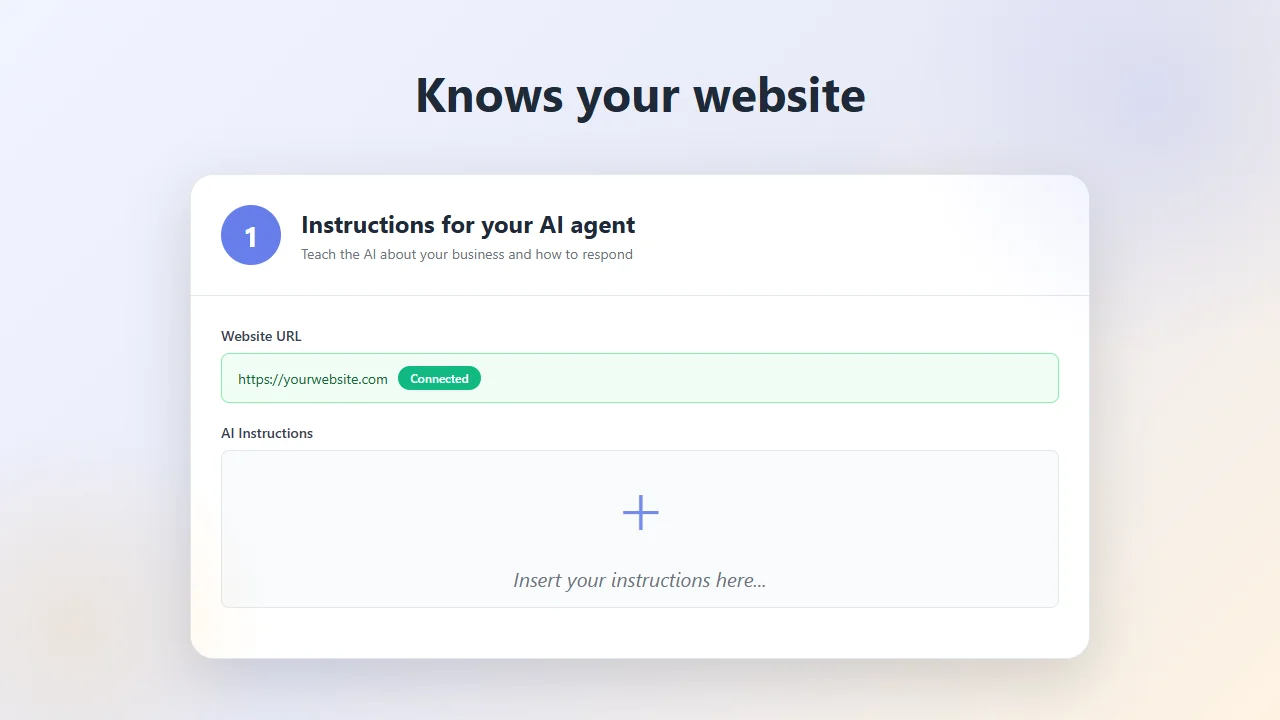
Paste a URL below and watch the AI build a knowledge base from the site content — this is how every client onboarding starts on the platform
A multi-tenant platform with dashboard, analytics, and client management built in
Most white-label chatbot products give you a widget and stop there. This is an entire platform: multi-site management for up to 20 clients, an embeddable dashboard your clients can log into, analytics they can review, and leads they can export — every surface carrying your brand. On the Pro plan, all Asyntai branding is removed. Standard plan users who want white-label activation can email [email protected] for manual setup.
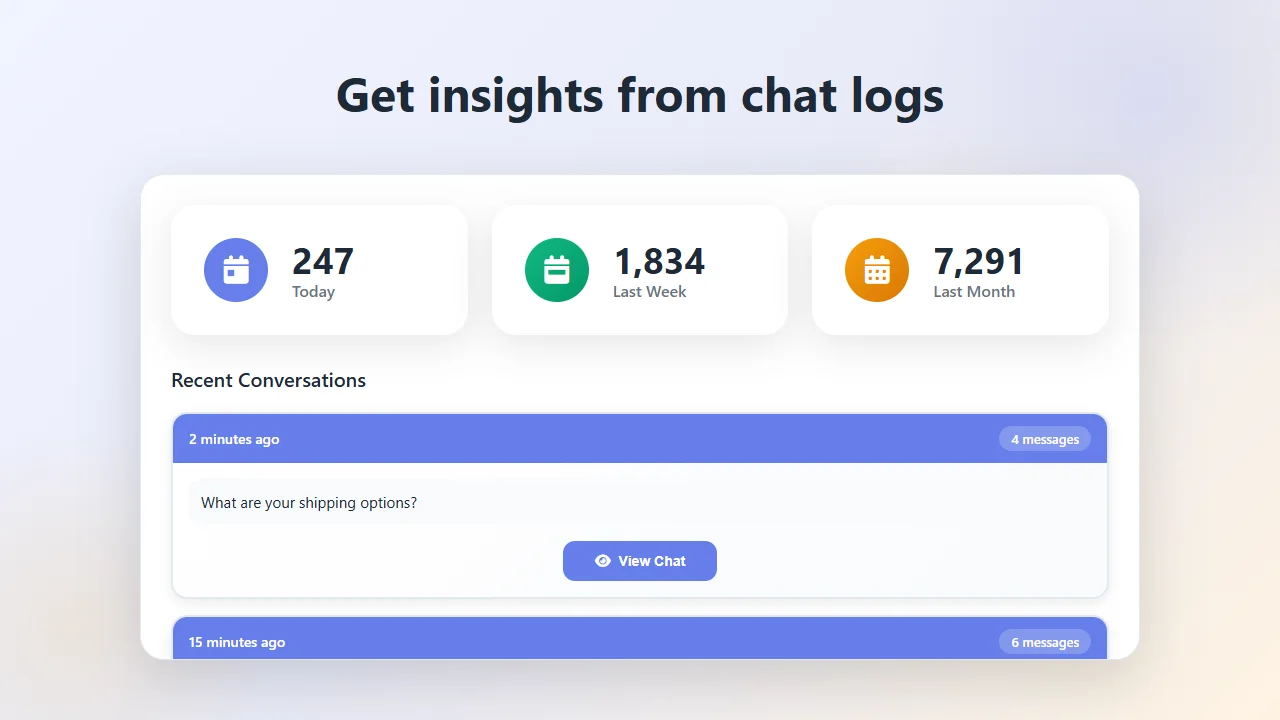
- Embeddable client dashboard with three tabsEach client accesses a white-labeled portal with Conversations (full chat transcripts), Analytics (message volume, response quality, trends), and Leads (captured contact info with CSV export). Embed it on your own website via a JS snippet — your logo, your colors, your domain.
- Isolated environments for every clientEach of your 20 sites runs in complete isolation. Separate knowledge bases, separate widget configurations, separate AI instructions, separate conversation histories. A veterinary clinic and an accounting firm share nothing — not data, not settings, not even color schemes.
- 36 languages with automatic detectionThe AI detects the visitor's language and responds in kind across 36 supported languages. A French client's visitors get French responses. A Japanese client's visitors get Japanese. No separate instances needed — one chatbot per client handles every language automatically.
One subscription powers your entire client roster — the margin compounds from day one
The Pro plan at $449/month covers 20 sites and 50,000 messages. Your per-client cost: roughly $22. Charge $150 to $300 per client and the margin speaks for itself. Agencies scaling past 20 clients can move to a Custom Pro plan with higher site and message limits.
- $22 per client at full capacityTwenty clients on a $449/month Pro subscription means approximately $22 per client in platform cost. Even at five clients, your cost per client is under $90 — well below what the market pays for managed AI chat services.
- No revenue share, no commission to usYou set prices, invoice clients, and keep every dollar above your subscription. There is no percentage going back to the platform. Your margin is your margin.
- 50,000 messages shared across the portfolioThe message pool is shared, so quiet clients subsidize busy ones. A dental office using 400 messages per month leaves room for an ecommerce store using 3,000. The math works across mixed portfolios.
- Custom Tools for action-driven botsOn Standard and Pro plans, Custom Tools let each client's chatbot call their own API endpoints — checking order status, booking appointments, looking up account details. Each client's tools are configured independently.
- Scale beyond 20 with Custom ProWhen your agency outgrows 20 sites or 50,000 messages, the Custom Pro plan extends both limits. No migration needed — your existing client configurations carry over.
Go from signup to a live client chatbot in twenty minutes
The platform handles the heavy lifting — AI crawling, knowledge base building, widget rendering. You handle branding and deployment.
- Subscribe to the Pro plan at asyntai.com/pricing — 20 sites, 50,000 messages, full white-label branding removal.
- Add your first client's website in the platform dashboard. Set your agency name, logo, colors, and welcome message on the widget.
- The AI crawls the client's site and builds a knowledge base automatically. Upload supplementary documents — product catalogs, policy PDFs, internal FAQs — to fill gaps.
- Copy the one-line embed script and paste it into the client's site. The branded chatbot is live, answering visitor questions from the client's own content.
<!-- Widget carries your agency branding, not ours -->
<script src="https://asyntai.com/widget.js"
data-id="client-site-id" async>
</script>
# One script tag. Full platform behind it.
# Dashboard, analytics, leads — all white-labeled.
How reselling works
From signing up to billing your first client — four simple steps.
Choose a plan
Subscribe to a plan that fits how many client websites you need. Pro is the most popular for resellers — white-label plus up to 20 websites.
View plans →Add a client website
Each website you add under your account is one client's chatbot. Add up to the number your plan allows.
Go to your dashboard →Set up the chatbot
Add the client's content, customize the widget to their brand, and install it on their site. You can also give the client read-only access to their chat logs, analytics and leads on your own website.
Setup guide →Resell at your price
Charge your client whatever you like. You own the relationship and bill them directly — the margin is yours, every month.
Reseller Resources
Everything you need to get started, answer client questions, and see the dashboard in action
Reseller Guide
Step-by-step walkthrough: white-label branding, the embeddable client dashboard, and how to get your first client live.
Read the guideReseller FAQ
Pricing, margins, billing, white-label details, platform compatibility, and everything else partners ask before starting.
View FAQClient Dashboard Demo
See the embeddable white-label dashboard with sample data — conversations, analytics, and leads under your brand.
See the demoWhite label chatbot platform — FAQs
Technical and business questions about the platform architecture, multi-site management, and client-facing features.
What makes this a platform rather than just a chatbot widget?
A widget is a single component — a chat bubble on a website. This platform includes the widget plus everything behind it: a multi-site management dashboard where you control up to 20 client chatbots from one account, an embeddable client portal with three tabs (Conversations, Analytics, Leads), automatic knowledge base building via AI-powered site crawling, per-client branding and configuration, lead capture with CSV export, and 36-language auto-detection. You are not embedding a widget. You are running a managed AI chat operation.
How does the multi-tenant architecture work?
Each of your 20 sites operates in complete isolation. Client A has its own knowledge base, widget configuration, AI instructions, conversation history, analytics, and lead data — entirely separate from Client B. There is no shared state between clients. You manage all of them from a single dashboard, but from a data perspective, each client's environment is a sealed compartment. A visitor on Client A's site will never receive information from Client B's knowledge base.
Can my clients access their own data without seeing my backend?
Yes. The platform includes an embeddable client dashboard with three tabs: Conversations (full chat transcripts with visitor details), Analytics (message volume, response metrics, usage trends), and Leads (captured contact information with CSV export). You embed this dashboard on your own website using a JS snippet. It displays your logo, your brand name, and your primary color. You can set password protection and restrict access by domain per client. Your clients log in, review their data, and see your brand — never the underlying platform.
What plan do I need to run this as a white-label platform?
The Pro plan at $449/month is the primary choice. It includes complete branding removal (the "Powered by Asyntai" badge disappears entirely), up to 20 sites, and 50,000 messages per month. Standard plan users ($139/month, 3 sites, 15,000 messages) who want white-label activation can email [email protected] for manual setup. Pro is recommended for resellers because of the higher site count and better per-client economics.
How does the platform handle knowledge base creation for each client?
When you add a client's website, the AI crawls the site automatically — reading pages, blog posts, product listings, FAQ sections, and other content. It builds a knowledge base from that content without manual data entry. If the client has additional material not published on their website — PDFs, product catalogs, policy documents, internal FAQs — you upload those files and the AI incorporates them alongside the crawled content. Each client's knowledge base is independent and updates as their website content changes.
Does the platform work across different website builders and CMS platforms?
Yes. The embed script is a single line of JavaScript that works on any website supporting custom HTML. WordPress clients can use the official plugin distributed from your dashboard. Shopify clients install via the Shopify App Store. Wix, Squarespace, Webflow, Magento, Joomla, Drupal, and virtually every other platform support the embed via a custom code block or header injection. The platform has plugins for 30+ platforms, so your client base is not limited by their technology stack.
What analytics does the platform provide per client?
Each client's Analytics tab shows message volume over time, response quality metrics, conversation counts, and usage trends. You see the data across all clients in your management dashboard, while each client sees only their own data in the embeddable portal. Lead capture data — visitor names, emails, phone numbers collected during chat — appears in the Leads tab with CSV export for CRM import. All analytics update in real time as conversations happen.
What happens when I outgrow 20 sites or 50,000 messages?
The Custom Pro plan extends both site and message limits beyond what the standard Pro plan offers. Your existing client configurations, knowledge bases, and conversation histories carry over — no migration or rebuilding required. Contact us at [email protected] to discuss volume-based pricing tailored to your agency's scale.
Is there an affiliate option if I do not want to manage clients directly?
Yes. The affiliate program pays a 20% recurring commission on any subscription referred through your tracking link — for for up to 12 months active. A Pro plan referral earns $89.80/month with no client management on your part. Some agencies use both models: white-label for their managed clients and affiliate links for referrals they do not want to handle directly.
What separates a white label chatbot platform from a rebranded widget — and why the distinction matters for your agency
The phrase "white label chatbot" gets thrown around loosely, and most of the time it refers to nothing more than removing a logo from a chat bubble. Strip the badge, change the colors, call it yours. That is cosmetic reskinning, not a platform. A genuine white label chatbot platform gives you operational infrastructure: a place to manage multiple client chatbots from a single account, a client-facing portal where your customers review their own data, analytics that track performance across your roster, lead capture that feeds directly into your clients' sales pipelines, and a knowledge base engine that builds itself from each client's website content. The difference between a widget and a platform is the difference between handing someone a hammer and handing them a workshop. One is a tool. The other is a business.
The architecture underneath matters because it determines what you can actually deliver to clients. Each of the 20 sites you manage on a Pro plan runs in complete isolation. Client A is a physiotherapy clinic in Melbourne. Client B is a boutique hotel chain in Portugal. Client C is a SaaS company selling inventory management software. Each has its own knowledge base — built automatically when the AI crawls their website — its own widget configuration with distinct colors, logos, and welcome messages, its own AI behavior instructions tuned to their industry, and its own conversation history that belongs exclusively to them. There is no crossover. A visitor asking the physiotherapy clinic about appointment availability will never accidentally receive hotel booking information. The isolation is structural, not just cosmetic, and it is what allows you to serve wildly different verticals from a single platform account.
The embeddable client dashboard is the feature that turns a reseller operation into something that looks and feels like a SaaS product you built yourself. Each client receives access to a white-labeled portal with three tabs. The Conversations tab shows full chat transcripts — every question a visitor asked, every answer the AI gave, timestamps, and visitor details. The Analytics tab displays message volume over time, response quality metrics, and usage patterns. The Leads tab captures contact information that visitors share during chat and makes it exportable as a CSV for CRM import. You embed this dashboard on your own website using a JS snippet, set your logo and brand colors on the portal, and optionally add password protection and domain restrictions per access token. When your client logs in to check their chatbot's performance, they are logging into your website, seeing your brand, reviewing their data. They have no reason to look behind the curtain.
Knowledge base creation is where the platform eliminates the labor that would otherwise make multi-client deployment impractical. Adding a new client does not require manually writing out answers to their frequently asked questions or building decision trees by hand. You enter their website URL, and the AI crawls every page — service descriptions, blog posts, product listings, team bios, pricing pages, FAQ sections. Within hours, the chatbot can answer visitor questions using that content accurately. If the client has information not published on their site — internal pricing sheets, detailed product specifications in a PDF, policy manuals, training documents — you upload those files and the AI incorporates them into the knowledge base alongside the crawled material. The entire process takes minutes of your time per client, and the knowledge base keeps itself current as the client updates their website.
The financial structure of the platform is designed for reseller margin, not usage-based anxiety. The Pro plan costs $449/month and includes 20 sites with 50,000 messages across all of them. The math at full capacity: $449 divided by 20 equals roughly $22 per client per month in platform cost. If you charge a client $200/month for managed AI chat — a rate that is conservative for a service delivering 24/7 automated support, lead capture, and analytics — your margin is $178 per client. Ten clients at that rate puts you at $2,000 in monthly revenue against $449 in cost, leaving $1,551 in profit. Twenty clients at $200 each: $4,000 in revenue, $3,551 in margin. The subscription is fixed regardless of how many of the 20 slots you fill, which means every new client after your break-even point is almost pure margin. Agencies that grow beyond 20 clients can move to a Custom Pro plan for higher limits without migrating or reconfiguring anything.
Platform compatibility is not an afterthought — it is foundational to serving a diverse client base. The chatbot deploys via a single line of JavaScript that works on any website capable of including a script tag, which covers virtually every CMS, website builder, and custom-coded site in existence. WordPress clients get an official plugin you can distribute from your dashboard. Shopify clients install through the Shopify App Store listing. Clients on Wix, Webflow, Squarespace, Magento, Joomla, Drupal, OpenCart, PrestaShop, BigCommerce, and dozens of other platforms paste the embed snippet into a custom code block or site header. The platform supports plugins for over 30 platforms, so when a new client tells you their site runs on an unfamiliar CMS, the answer is almost certainly "yes, it works." You never have to turn away a client because of their technology stack.
Language support across the platform removes a constraint that limits most chatbot resellers to a single market. The AI handles 36 languages with automatic detection — it identifies the language a visitor is writing in and responds in that language, without any configuration per language. A German visitor on your Munich client's site gets German responses. A Thai visitor on your Bangkok client's hotel site gets Thai responses. The knowledge base content can be in any language, and the AI bridges the gap between content language and visitor language naturally. For agencies operating across borders — or serving clients who attract international traffic — this eliminates the need for separate chatbot instances per language, separate knowledge bases per language, or manual translation work. One chatbot per client handles the full linguistic range.
Custom Tools extend the platform from information retrieval into action execution. Available on Standard and Pro plans, Custom Tools let you configure each client's chatbot to call external API endpoints during a conversation. The practical effect: a client's chatbot does not just answer questions — it performs tasks. An ecommerce client's bot checks order status by calling their fulfillment API, retrieves shipping tracking numbers, and initiates return requests. A medical practice's bot checks appointment availability against their scheduling system and books slots. A SaaS client's bot looks up a user's subscription tier and triggers a password reset. Each client's Custom Tools are configured independently, so the actions available to one client's chatbot are entirely separate from another's. The platform handles the API orchestration; you configure the endpoints and parameters per client.
The onboarding process for a new client on the platform takes roughly twenty minutes and requires no development work, no API integration, and no coding. Step one: add the client's website domain in your dashboard. Step two: configure the widget branding — your agency name in the header, your logo, your color palette, a welcome message. Step three: let the AI crawl the client's site. Step four: copy the embed script and paste it into the client's site. The chatbot is live, answering visitor questions from the client's own content, displaying your brand. If the client needs refinements — adjusting the AI's tone, adding specific instructions about how to handle certain questions, uploading additional documents — those are five-minute configuration changes, not development tasks. The platform is built for operators who manage many clients, not for engineers who build bespoke solutions for each one.
Vertical specialization is the strategy that separates agencies earning modest supplemental income from agencies building serious recurring revenue on the platform. Instead of positioning yourself as a generic "AI chatbot reseller," you pick an industry and become the specialist. A dental AI chatbot agency pre-configures AI instructions for common dental inquiries, appointment workflows, insurance questions, and emergency triage. A legal AI chatbot agency sets up intake qualification, practice area routing, and consultation booking. A hospitality AI chatbot agency configures room availability checks, amenity descriptions, and local recommendations. The platform underneath is identical — the same dashboard, the same knowledge base engine, the same widget — but your packaging, your pricing, and your expertise are industry-specific. Clients pay more for a specialist who understands their vertical than for a generalist offering a generic chatbot. The platform gives you the infrastructure; the vertical positioning gives you the pricing power.
Client retention on the platform benefits from a natural accumulation of value over time. When you first deploy a chatbot for a client, the knowledge base is built from their current website content. Over the following weeks and months, you refine the AI's instructions based on real conversation data, add documents the client provides, adjust the tone and response style, and configure Custom Tools for specific workflows. Each refinement makes the chatbot more accurate and more useful. Three months in, the chatbot handles edge cases that stumped it on day one. Six months in, it has become an integral part of the client's customer interaction stack. That accumulated configuration and knowledge refinement represents switching cost — a client would have to rebuild everything from scratch to move to a different provider. The platform's value compounds over time, which means your churn rate drops as your client relationships mature.
The alternative to using a white label chatbot platform — building your own from scratch — is worth examining for perspective. A comparable platform would require: a conversational AI engine with retrieval capabilities (the knowledge base layer), a web crawler and document parser for automated content ingestion, a multi-tenant architecture with strict data isolation, a customizable chat widget (desktop and mobile, accessible, brand-configurable), a client dashboard with conversation viewer, analytics, and lead export, an embedding and hosting infrastructure, multilingual support across 36 languages, and an API integration framework for Custom Tools. The engineering cost to build this is measured in years of senior development time and hundreds of thousands of dollars in infrastructure — before you deploy a single client's chatbot. The platform gives you all of it for $449/month with the Pro plan. The decision is not about technology preference. It is about how quickly you want to start generating revenue.
For agencies considering the affiliate model as a complement to platform reselling, the two programs work in parallel rather than competing. As a white-label platform reseller, you bill clients directly, set your own prices, and keep the full margin — that is your core business. As an affiliate, you refer businesses to Asyntai using a tracking link and earn a 20% recurring commission on their subscription. A Pro plan referral generates $89.80/month in passive income with no setup, no support, and no client management. The hybrid approach covers both scenarios: white-label for the clients you want to manage closely with high margins, affiliate for the contacts who want a chatbot but do not need your managed service. Both programs run from the same account.
The operational overhead of running 20 clients on the platform stays remarkably low because the system is designed for managed scale, not manual maintenance. Knowledge bases update automatically as client websites change — new blog posts, updated product pages, revised pricing, changed hours. You do not need to manually refresh each client's chatbot. The dashboard gives you a centralized view across all clients, and the client-facing portal handles the reporting layer. When a client wants to tweak their chatbot's behavior — making it more formal, adding guidance about a new product line, changing the welcome message — that is a configuration change measured in minutes. The platform handles crawling, indexing, AI responses, analytics collection, and lead capture without intervention. Your time goes toward client relationships and new business development, not chatbot maintenance.
Questions about the platform, custom limits, or getting started? Reach out at [email protected] — we respond within 24 hours.