Every customer service platform listed here now has AI features bolted on. The useful question is no longer which one uses AI. It is how each one charges for it and what it is allowed to touch. Two pricing models dominate: a per-agent fee that adds a fixed surcharge to every seat, and a per‑outcome meter that charges only when the AI actually resolves something. They produce very different bills at very different volumes. The table below shows the published rates and the volume at which the cheaper model flips.
The phrase "AI customer service" used to mean something narrow. It meant a chatbot that deflected a few questions. In 2026 it covers copilots that draft replies for human agents, autonomous agents that handle whole conversations, suggested macros, automatic categorisation, and intent detection. Every vendor on this page sells at least one of those, and most sell three.
So the buying decision has shifted sideways too. You are not comparing features any more. You are comparing meters.
Two meters, two cost shapes
Look at any customer service software with AI in 2026 and you will find one of two pricing patterns.
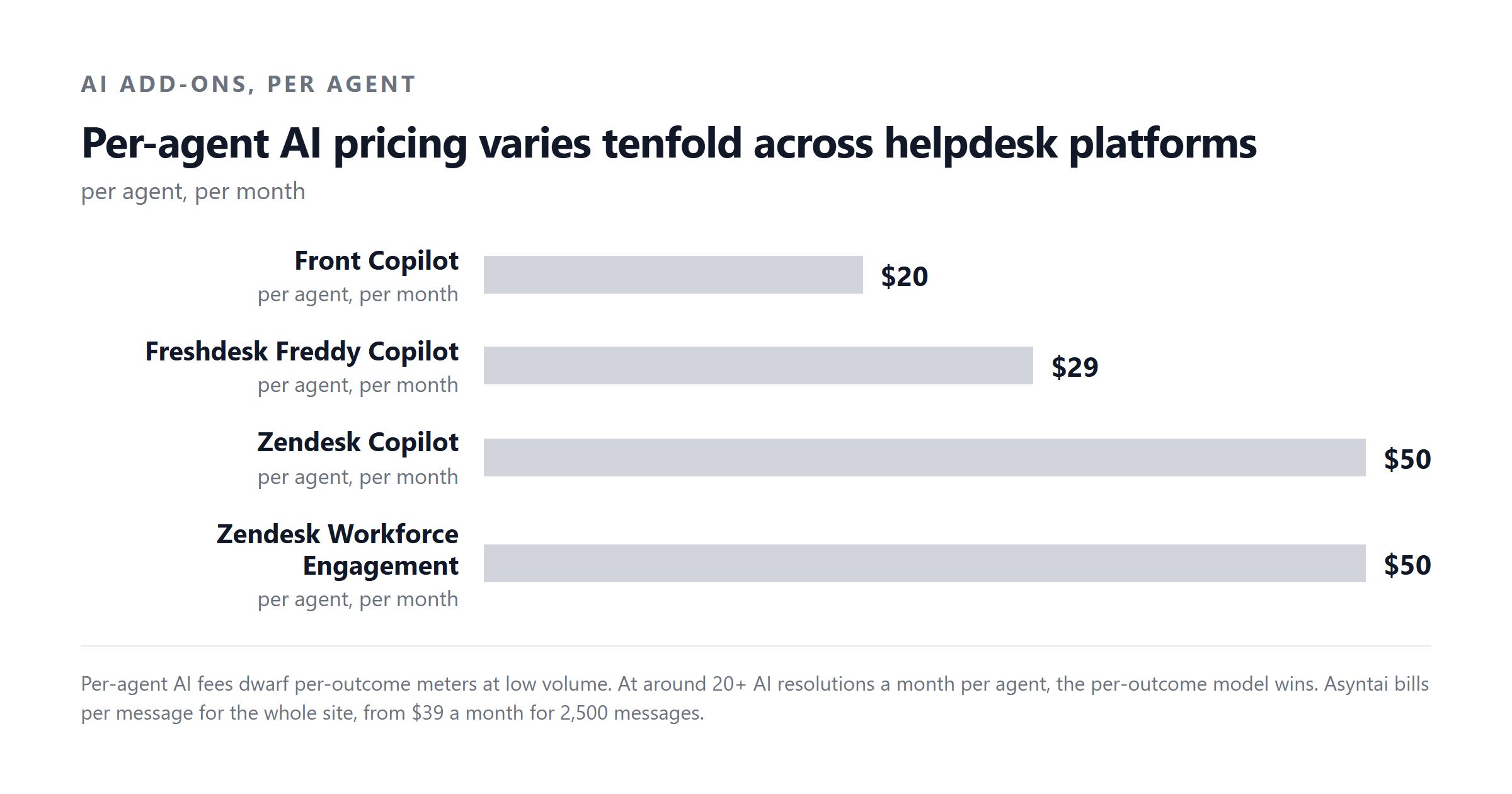
Per agent. The AI is a feature on a seat. You pay a fixed surcharge per agent per month and the AI does as much work as your volume allows. Zendesk Copilot is +$50 per agent. Freshdesk's Freddy AI Copilot is $29 per agent. Front's Copilot is $20 per seat. Predictable, but you fund the capacity even on quiet days.
Per outcome. The AI is a metered service. You pay per resolution, per resolved conversation, or per handled conversation, and you pay nothing on the tickets humans handle. Intercom's Fin charges $0.99 per resolved outcome. Freshdesk's Freddy AI Agent charges $0.49 per session after the first 500. Front's Autopilot starts at $0.05 per conversation. Gorgias charges $0.90 to $1.00 per resolved conversation, on top of a ticket that itself becomes billable once automated. Help Scout charges $0.75 per resolution through AI Answers.
Both can be the cheaper answer. The trick is matching the meter to your volume.
Who charges what, and at what rate
The numbers below are taken from each vendor's own pricing page, checked on 2026-09-04. Self-serve tiers only. Where a vendor requires a quote for the top tier, that is noted.
| Vendor | Meter | Base plan range | AI price | What AI is allowed to do |
|---|---|---|---|---|
| Zendesk | Per agent | $19 to $115 per agent per month (yearly) | Copilot +$50 per agent | Reply drafting, summarisation, intent detection, autonomous resolution in higher tiers |
| Freshdesk | Per agent | $19 to $89 per agent per month (yearly) | Copilot $29 per agent; AI Agent $0.49 per session after 500 included | Copilot drafts, AI Agent resolves autonomously |
| Help Scout | Per user | $0 to $75 per user (Pro has a 10-user minimum) | AI Answers $0.75 per resolution | Resolves from help center content, drafts replies |
| Intercom | Per seat | $29 to $132 per seat | Fin $0.99 per resolved outcome (once per conversation) | Autonomous resolution, copilot, summarisation |
| Front | Per seat | $25 to $105 per seat (yearly) | Copilot $20 per seat; Autopilot from $0.05 per conversation | Copilot drafts and triages; Autopilot runs conversations |
| Gorgias | Per ticket | $10 to $750 per tier, billed on ticket volume not seats | AI Agent $0.90 to $1.00 per resolved conversation; the resolution itself is also a billable ticket | Order lookups, refunds, replacements, status updates |
| Crisp | Per workspace | $0 to $295 per workspace (seat caps from 2 to 20+) | AI features included in paid tiers; usage caps apply | Chatbot, suggested replies, summarisation |
| Asyntai | Per message | Free 100 messages; Starter $39 for 2,500; Standard $139 for 15,000; Pro $449 for 50,000 | Included in plan, metered per message (see per‑resolution maths in the section below) | Customer‑facing chat answering from your site content, with configurable routing to a human |
We make Asyntai, so read that row as a disclosure.
Two cells in the table need unpacking. Gorgias bills on tickets, not seats, and each automated resolution also counts as a billable ticket. So an AI resolution costs you the ticket fee plus the AI fee. Crisp includes AI features inside its paid tiers but caps usage, which means heavy customers feel the cap before they feel a meter. Asyntai's row shows a per-message meter, which is a third pattern; we work through it below.
What the AI is allowed to touch
Pricing is half the story. The other half is scope: what the AI can read, write, and act on. This is where buying decisions quietly go wrong.
Read access. Vendors split on whether the AI sees your full ticket archive and knowledge base, or only what is explicitly linked. Intercom's Fin trains on connected sources and you point it at the URLs or help center articles you want it to use. Zendesk's Copilot pulls from the knowledge base you have published inside Zendesk. Help Scout's AI Answers answers from your help center content. Freshdesk's Freddy AI Agent draws from your help articles, FAQs and any connected data sources. Front's Autopilot and Copilot draw from your shared inbox history, internal macros and connected integrations. Gorgias's AI Agent is built for ecommerce, so it reads order data, Shopify or BigCommerce stores, and your macro library.
Write access. The split is sharper here. Some AI features only suggest. Others send. Reply drafting, summarisation, intent detection and macro suggestion are read-and-suggest: a human presses send. Autonomous resolution is read-and-act: the AI closes the ticket or hands off the conversation without a human in the loop.
Side effects. Gorgias is the clearest example of the trap. Each automated resolution counts as a billable ticket on top of the AI fee. So the AI saves labour and inflates the bill at the same time. Read the Gorgias row carefully before you assume Gorgias is cheaper than the per-agent vendors.
Asyntai's answer to scope is narrower. It reads your published site content and the pages you point it at. It writes customer replies. Anything you have not given it access to, it cannot reach, which means it has no way to act on order data, billing data or anything behind a login unless you put it there for your help desk.
The volume at which the answer flips
Per agent wins at low volume because you do not pay for AI capacity you do not use. Per outcome wins at high volume because you stop paying for humans to do work the AI can do. The crossover depends on your deflection rate, which is the share of incoming volume the AI actually resolves.
Take a three-agent team on Zendesk Suite Team at $55 per agent per month with Copilot at +$50 per agent. The monthly AI bill is three agents times $50 = $150 for AI capacity. Suppose you instead ran Intercom Fin at $0.99 per resolved outcome. Fin costs less than $150 per month until you exceed roughly 151 resolved outcomes, on the working below.
The same shape holds for the other pairs. Freshdesk's Freddy AI Agent at $0.49 per session after the included 500 is cheaper than $29 per agent for Copilot once your AI-handled sessions exceed the Copilot surcharge, which it usually does. Help Scout's AI Answers at $0.75 per resolution is cheaper than carrying a Copilot surcharge once you resolve enough volume through it. Front's Autopilot at $0.05 per conversation is the cheapest per-conversation meter on this page.
Gorgias looks like an outlier but the maths still works. The AI fee of $0.90 to $1.00 per resolved conversation is the headline. Each resolution also uses a billable ticket on top. Once you account for both, Gorgias's AI is the most expensive per resolution in this set, which is why ecommerce brands with very high deflection still sometimes pay for Gorgias: the order actions are worth more than the ticket.
Asyntai's meter, worked in public
Asyntai meters per message, which is a different shape again. A message is one exchange with one visitor. The published tiers are 100 messages on the Free plan, 2,500 on Starter at $39 per month, 15,000 on Standard at $139 per month, and 50,000 on Pro at $449 per month. Enterprise is a signed order form with a negotiated message allowance and is not sold self-serve.
The per-message implied rates work out as follows. We show the arithmetic so you can check it.
Compare those to Intercom Fin at $0.99 per resolved outcome. Fin charges once per resolved conversation regardless of how many messages that conversation took, so it is cheaper per message when one resolution covers many exchanges. Asyntai is cheaper per resolution when the conversation takes only a handful of messages and a paid plan is in play.
The crossover looks like this. Suppose a typical resolved conversation on Fin is 5 messages. Fin is $0.99 per resolution. Asyntai Standard is roughly $0.009 per message, so the same conversation would cost about 5 × $0.009 = $0.046 on Asyntai. That is Fin at more than twenty times the cost of Asyntai for the same exchange, on these rates.
The crossover point is when Asyntai Standard costs as much as Fin for the same volume. At $0.009 per message and Fin at $0.99 per resolved outcome, Asyntai costs more than Fin once the average conversation length exceeds roughly 110 messages. Real customer service conversations do not reach 110 messages. So at typical conversation shapes, Asyntai Standard is cheaper per resolved conversation than Fin.
That comparison is not apples to apples, because Fin and Asyntai do different jobs. Fin sits inside Intercom's inbox and resolves inside a live conversation flow. Asyntai sits on your website and answers from your published content. The crossover is informative when you are choosing between them for the same workload.
What "AI" actually means in each product
Labels travel badly across vendors. Here is the working vocabulary.
- Copilot. A drafting and summarisation assistant for the agent. It does not close tickets. Zendesk Copilot, Freshdesk Freddy AI Copilot and Front's Copilot are this type. Priced per agent or per seat.
- AI Agent / Autopilot. An AI that holds the customer-facing conversation without a human in the loop. Intercom Fin, Freshdesk Freddy AI Agent, Front Autopilot, Gorgias AI Agent, Crisp's chatbot, Asyntai. Priced per resolution or per conversation, with included allowances on some plans.
- AI Answers. Help Scout's term for an AI that reads the help center and resolves questions directly. Priced per resolution at $0.75.
- Suggested replies and macros. Lighter features that propose text for the agent to send. Usually bundled into copilots.
- Knowledge surfacing. The AI pulls the right help article into the reply. Often bundled.
If you want AI to handle whole conversations, you are looking at Fin, Freddy AI Agent, Autopilot, Gorgias AI Agent, Crisp's chatbot, or Asyntai. If you want AI to make humans faster, you are looking at Copilots. The cost shape changes with the role.
The features that decide a real purchase
Three practical questions determine whether the AI is usable in production.
Can it authenticate? Enterprise customers need single sign-on. Asyntai supports OIDC single sign-on including Entra and Google. Intercom, Zendesk, Freshdesk and Front support SSO on their higher tiers. Crisp supports SSO on Plus. Gorgias supports SSO on Advanced. If your security team requires SSO, the Free and cheapest tiers of any vendor are off the table.
Can you control access? Per-tab permissions and per-website scoping matter when the same account serves more than one site. Asyntai offers per-tab permissions and per-website scoping, so a single installation can answer different audiences on different domains.
Can you audit it? Compliance teams want an append-only audit log. Asyntai offers an append-only audit log where entries cannot be edited or deleted. Zendesk, Freshdesk, Intercom and Front offer audit logs on higher tiers. Help Scout offers audit history on Pro. Gorgias offers audit logs on Advanced.
Two more features decide whether the AI is safe to deploy. PII redaction removes personal data before the AI sees it. Asyntai offers configurable PII redaction, and the other vendors offer it as a setting or add-on. Output controls decide whether the AI is allowed to send a given message. Asyntai uses a separate output classifier rather than a prompt rule, which is a stricter design.
Retention is the last piece. Some vendors keep chat data indefinitely for training, others let you set retention. Asyntai offers configurable chat retention with auto-delete. Zendesk, Intercom, Freshdesk and Front expose retention controls on higher tiers. Help Scout exposes retention on Pro.
Where each vendor is the obvious pick
You do not need a single winner. You need a vendor whose meter matches your volume and whose scope matches your risk.
Pick Zendesk if you want one platform for support, contact centre and workforce engagement, you are happy paying per agent, and you are happy paying $50 per agent per month for Copilot on top of $55 per agent for Suite Team. Zendesk is the safest answer when the team is large and steady.
Pick Freshdesk if you want per-agent pricing with a per-session meter for the AI agent as a fallback, you occasionally need day passes for surge capacity ($2, $7 or $12 per person per day), and you like having Freddy available in two forms (Copilot for drafting, AI Agent for resolution).
Pick Help Scout if your team is small, you want a free tier up to 5 users with 1 inbox and 100 contacts a month, and you are happy paying $0.75 per resolution through AI Answers. Pro has a 10-user minimum, which is the catch for growing teams.
Pick Intercom if you want a mature product-first inbox and you are happy paying per resolved outcome for Fin. Fin at $0.99 per resolution is one of the most expensive per-outcome meters in this set, but the product around it is the deepest.
Pick Front if you want a shared inbox with both meters available. Copilot at $20 per seat for drafting, Autopilot from $0.05 per conversation for resolution. Front is the only vendor that gives you both on the same platform at modest rates.
Pick Gorgias if you are an ecommerce brand whose AI can act on orders, returns and replacements, and you are willing to pay per ticket with each AI resolution also counted as a billable ticket. Gorgias's combined AI + ticket cost is the most expensive per resolution in this list, but the order actions are often worth more than the ticket.
Pick Crisp if you want a workspace-priced product with a free 2-seat tier, you want to cap usage rather than meter it, and you do not need heavy automation. AI is included in paid tiers with usage caps, which is fine up to a point.
Pick Asyntai if your customer questions are answerable from your published content, you want a per-message meter rather than per seat, and you want to deflect inbound tickets rather than handle them with a human team. Asyntai is the answer when the customer is on your website reading your help center, not in an inbox waiting for a human reply. Anything that needs an order, a refund, a login reset or a human decision routes straight to your team, which is the behaviour you configure.
How to read the prices without being misled
Three traps catch buyers who only look at the headline rate.
Trap 1: the surcharge is not the AI. Copilot at $50 per agent is a fixed fee for AI capacity, regardless of whether the AI does useful work. Per-outcome meters charge for what the AI actually did. If your deflection rate is low, per-agent AI is wasted money. If your deflection rate is high, per-outcome AI is wasted money.
Trap 2: tickets and resolutions stack. Gorgias charges for tickets and charges again for AI resolutions. Read the Gorgias row carefully. If you assume Gorgias is the cheapest per-resolution vendor, the bill will surprise you.
Trap 3: minimums matter. Help Scout Pro has a 10-user minimum. That makes Pro meaningful only above 10 users. Front's Starter caps at 10 seats. Crisp's tiers cap seats at 2, 4, 10, and 20+. These caps decide which vendor is actually buyable at your team size.
Asyntai meters per message, starts at $39 per month for 2,500 messages, and lets you deflect the questions that have published answers on your site. Free plan with 100 messages, no card required. See the plan calculator.
The short version
Every customer service software on this page uses AI now. The differentiator is the meter. Per-agent pricing is cheaper at low volume and at low deflection rates. Per-outcome pricing is cheaper at high volume and at high deflection rates. The flip happens in the low hundreds of resolved conversations per month for most pairs. Pick the meter that matches your volume, then check the scope: what the AI is allowed to read, write and act on. That is the decision that matters in 2026.
Sources: Zendesk's own pricing page, checked 2026-09-04. Freshdesk's own pricing page, checked 2026-09-04. Help Scout's own pricing page, checked 2026-09-04. Intercom's own pricing page, checked 2026-09-04. Front's own pricing page, checked 2026-09-04. Gorgias's own pricing page, checked 2026-09-04. Crisp's own pricing page, checked 2026-09-04.