White label digital marketing software that converts your clients' traffic into conversations
Your agency drives traffic — SEO, paid search, social campaigns. Add a white-label AI chatbot to your clients' sites that turns those visitors into conversations and leads. Your brand, your pricing, around the clock in 36 languages.
See how the AI converts website visitors into leads
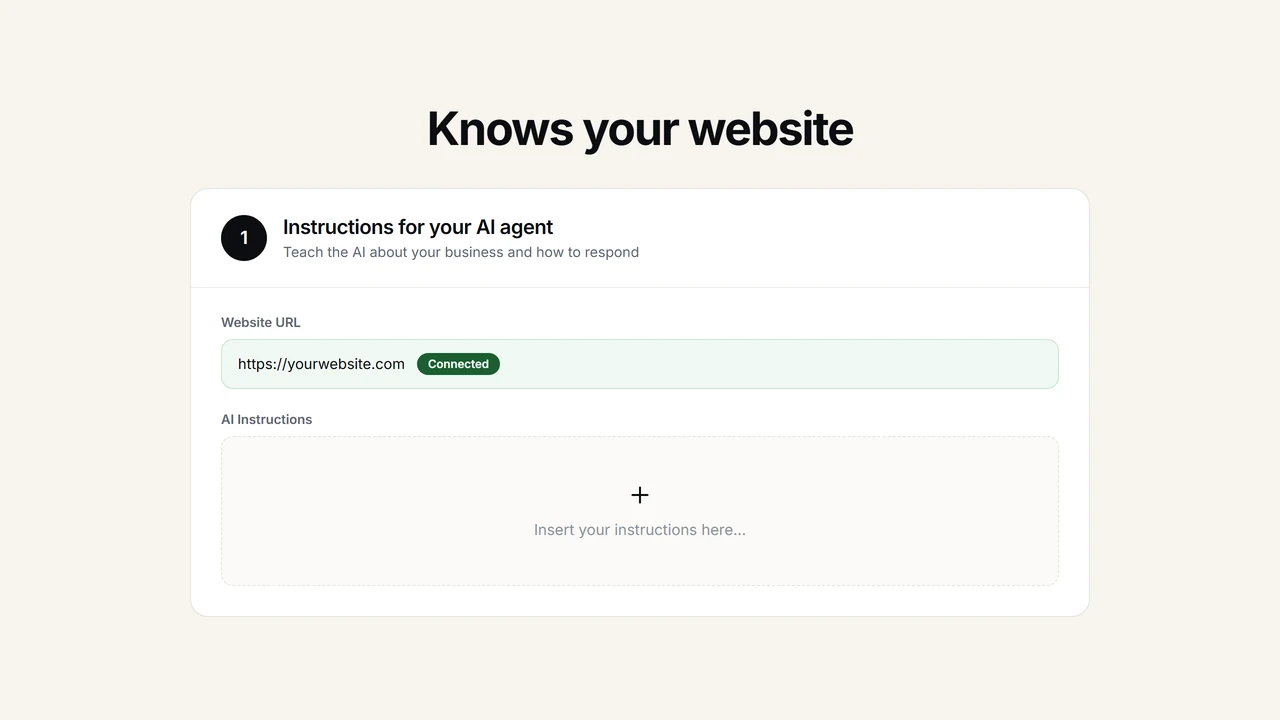
Enter a client's URL below and watch the AI build a knowledge base from their site — then picture this as your branded digital marketing tool on every client website
Every channel you manage drives traffic — this tool makes sure that traffic converts
SEO brings organic visitors. PPC campaigns bring paid visitors. Content marketing brings readers. Social media brings followers. But none of these channels answer the question the visitor actually has at the moment they land on the page. An AI chatbot that responds using the client's own website content bridges that final gap. It reads every page, blog post, product listing, and FAQ on the client's site, then answers visitor questions instantly and accurately. Leads are captured within the conversation — name, email, phone number, plus the full transcript showing exactly what the visitor was interested in. The chatbot runs under your brand on the Pro plan, with your agency name in the header, your logo in the widget, and your colors throughout. It is the conversion layer that sits on top of all the traffic your other channels generate.
- Turns passive browsing into active engagementVisitors arrive on a client's site and the AI engages them with relevant, context-aware responses. Instead of reading a page and leaving, they ask questions, get accurate answers from the client's own content, and share contact details naturally within the conversation. The chatbot turns every page into a conversion opportunity.
- Leads with full conversation contextEvery captured lead includes the complete chat transcript — what the visitor asked, which products or services interested them, and how the AI responded. This context makes follow-up calls dramatically more effective than cold outreach from a static form submission.
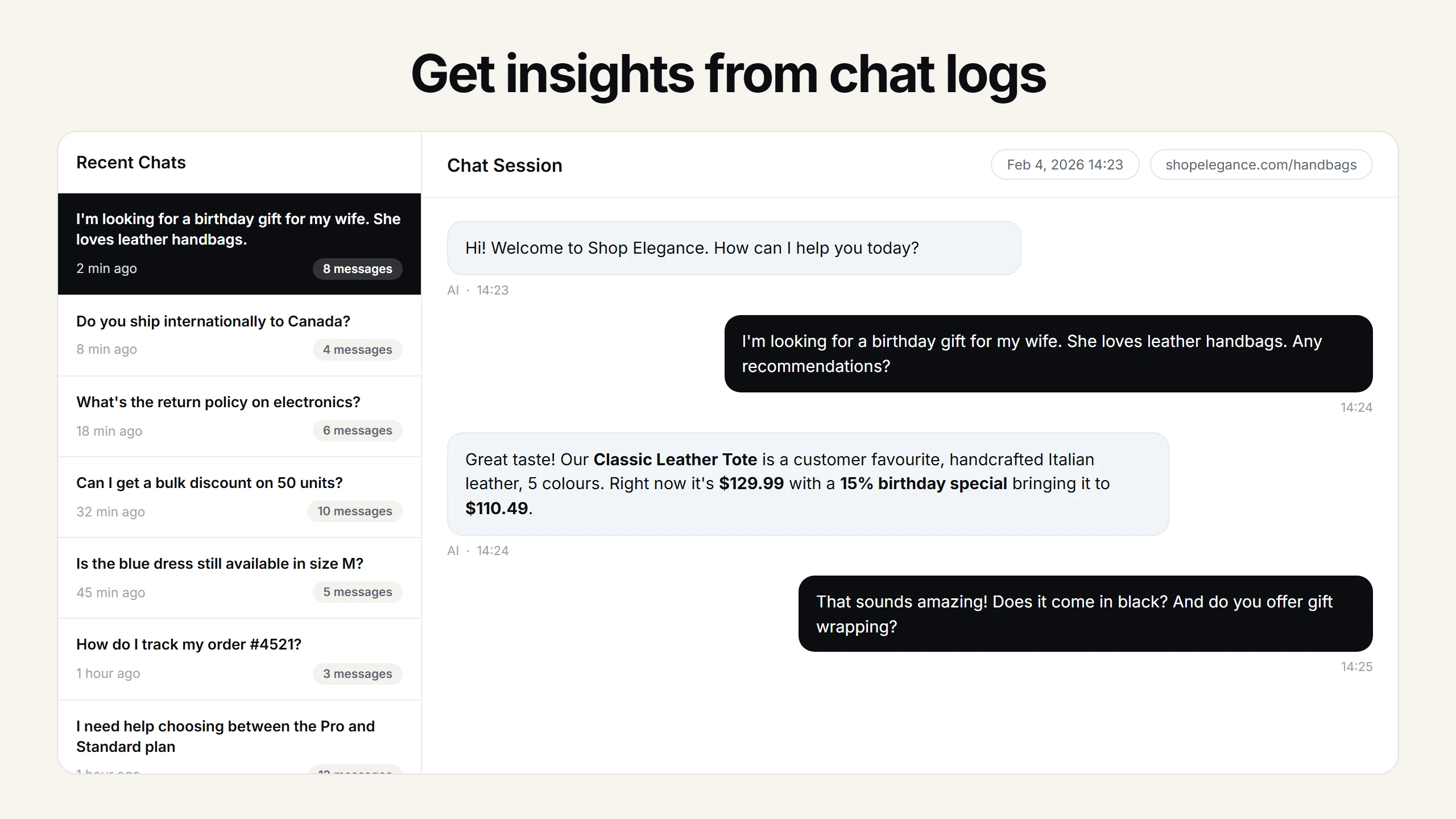
- Your brand on the widget and the client dashboardPro plan removes all Asyntai branding. The chat widget carries your agency name, logo, and colors. Clients access a branded dashboard on your website with three tabs: Conversations, Analytics, and Leads with CSV export. Password protection and domain restrictions per client.
Add a high-margin recurring service to every client engagement
Most digital marketing services — SEO, PPC management, content creation — involve significant ongoing labor per client. The AI chatbot is different. After a twenty-minute setup, it runs continuously without your involvement, answering visitor questions and capturing leads on the client's website around the clock. The Pro plan at $449/month supports 20 client sites with 50,000 messages. That is approximately $22 per client in cost. Layer this into your existing digital marketing packages at $150 to $350 per client per month. The revenue is recurring, the margin is substantial, and the labor cost after initial setup is close to zero. Agencies moving beyond 20 clients can scale through the Custom Pro plan.
- Near-zero marginal cost per clientOnce you set up a client's chatbot — about twenty minutes of configuration — there is no ongoing labor. The AI updates its knowledge automatically as the client's website content changes. Your cost is the fixed Pro subscription divided by however many clients you serve. At 20 clients, that is $22 each.
- Bundle with existing services or sell standaloneOffer the AI chatbot as an add-on to your SEO, PPC, or web design packages. Or sell it as a standalone "AI-powered lead capture" service. Either way, it creates monthly recurring revenue that compounds as you add clients, independent of project-based work.
- Complete isolation per client siteEach of your 20 client sites has its own knowledge base, widget configuration, AI behavior instructions, conversation history, and lead data. A restaurant client's chatbot never references a law firm client's content. You manage all 20 from one account, but the data stays compartmentalized.
- Custom Tools for transactional interactionsStandard and Pro plan clients can configure Custom Tools that let the AI call API endpoints during conversations — booking appointments, checking order status, looking up account information. The chatbot goes beyond answering questions and starts handling actions, which justifies higher per-client pricing.
Get a client's digital marketing chatbot live in twenty minutes
No coding, no API integrations, no complex setup. Four steps from sign-up to a white-labeled AI chatbot capturing leads on your client's website.
- Choose the Pro plan at asyntai.com/pricing for white-label branding removal, 20 client sites, and 50,000 monthly messages.
- Add the client's domain and brand the widget — your agency name, logo, and color palette. Each client site gets its own identity within your account.
- The AI automatically crawls the client's website to build a knowledge base from their pages, blog content, product listings, and FAQs. Add supplementary documents to fill in details not on the public site.
- Paste the one-line embed script into the client's website. The branded AI chatbot goes live immediately — engaging visitors, answering questions, and funneling leads into your dashboard.
<!-- Converts traffic into leads, branded under your name -->
<script src="https://asyntai.com/widget.js"
data-id="client-site-id" async>
</script>
# Your brand everywhere. Ours nowhere.
# The conversion layer your clients have been missing.
How reselling works
From signing up to billing your first client — four simple steps.
Choose a plan
Subscribe to a plan that fits how many client websites you need. Pro is the most popular for resellers — white-label plus up to 20 websites.
View plans →Add a client website
Each website you add under your account is one client's chatbot. Add up to the number your plan allows.
Go to your dashboard →Set up the chatbot
Add the client's content, customize the widget to their brand, and install it on their site. You can also give the client read-only access to their chat logs, analytics and leads on your own website.
Setup guide →Resell at your price
Charge your client whatever you like. You own the relationship and bill them directly — the margin is yours, every month.
Reseller Resources
Everything you need to get started, answer client questions, and see the dashboard in action
Reseller Guide
Step-by-step walkthrough: white-label branding, the embeddable client dashboard, and how to get your first client live.
Read the guideReseller FAQ
Pricing, margins, billing, white-label details, platform compatibility, and everything else partners ask before starting.
View FAQClient Dashboard Demo
See the embeddable white-label dashboard with sample data — conversations, analytics, and leads under your brand.
See the demoWhite label digital marketing software — FAQs
What digital marketing agencies ask before adding AI-powered lead capture to their service offering.
How does an AI chatbot fit into a digital marketing service stack?
Think of it as the conversion layer that sits on top of all your other channels. SEO, PPC, content marketing, and social media all drive traffic to your client's website. The AI chatbot engages that traffic once it arrives — answering questions using the client's own content, qualifying visitor intent through conversation, and capturing lead information. It completes the loop that other digital marketing tools start. Without it, the traffic arrives and most of it leaves silently. With it, visitors get immediate answers and the client gets leads with full conversation context.
Can I sell this as my own digital marketing software?
Yes. On the Pro plan, all Asyntai branding is removed — no "Powered by" badge, no third-party references. The chat widget displays your agency name, logo, and colors. The client dashboard (Conversations, Analytics, Leads) embeds on your website under your brand. You can name the product whatever you want and present it as proprietary technology. Your clients see your digital marketing platform. Their visitors see your brand.
How does this complement the SEO work I already do for clients?
SEO brings visitors to the page. The chatbot converts them once they are there. When a visitor arrives via an organic search result and has a follow-up question — about pricing, availability, specifications, booking — the AI answers instantly using the same website content that the visitor found through search. Instead of the visitor reading a page and leaving, they get their specific question answered and share their contact information in the process. The chatbot amplifies the ROI of every organic ranking you achieve for the client.
What about PPC landing pages — does the chatbot work there?
Especially well. PPC visitors arrive with high intent and specific questions. A landing page that includes the AI chatbot can engage those visitors at the moment of peak interest, answer their objections, and capture their information within the conversation. The AI answers using the client's website content, so it can address the same topics the landing page covers — plus deeper product details, FAQ-style questions, and anything else on the client's site. For agencies managing Google Ads or social ad campaigns, the chatbot turns a static landing page into an interactive conversion tool.
How many client sites can I manage and what does it cost?
The Pro plan at $449/month supports 20 client sites with 50,000 messages shared across all sites. Each site has its own knowledge base, branding, and data. At 20 clients, your cost is about $22 per client. The Standard plan at $139/month covers 3 sites with 15,000 messages — suitable for agencies starting small. White-label activation on Standard is available by contacting [email protected]. Agencies exceeding 20 clients use the Custom Pro plan.
Does the chatbot work across different website platforms?
Yes. The embed script is a single line of JavaScript that works on WordPress, Shopify, Wix, Squarespace, Webflow, Magento, Joomla, Drupal, and any platform that accepts custom HTML. Plugins for 30+ platforms provide one-click installation where available. The widget loads asynchronously, so it does not slow down the client's site or interfere with existing tracking, analytics, or marketing tools.
Can the chatbot handle clients with multilingual audiences?
Yes. 36 languages with automatic detection. A visitor typing in French gets a response in French. A visitor on the same site typing in English gets a response in English. No separate chatbot instances per language, no manual language switching. This is particularly valuable for digital marketing agencies serving clients in multilingual markets or clients with international traffic from paid campaigns targeting multiple regions.
What can the chatbot do beyond answering questions?
Custom Tools on Standard and Pro plans allow the AI to call your client's API endpoints during a conversation — checking order status, booking appointments, looking up account details, and processing requests. The chatbot becomes an interactive tool that handles transactions, not just information. For ecommerce clients, the Real-Time Data Feed connects product catalog data so the AI can search and surface specific products when visitors ask. Standard gets 200,000 characters; Pro gets 10,000,000 characters of catalog capacity.
How do I start reselling digital marketing chatbot software?
Sign up for the Pro plan, add a client's website, configure the branding, and embed the script. About twenty minutes total. For questions about reselling, pricing for larger deployments, or your specific use case, email [email protected] — response within 24 hours.
How white-label AI chat gives digital marketing agencies a compounding revenue stream
Digital marketing agencies live on a treadmill. Every month, the work resets. The SEO campaign needs new content. The Google Ads budget needs optimization. The social calendar needs fresh posts. The client expects a report showing what all that effort produced. Revenue is tied to labor — more clients means more hours, and margins shrink as the team stretches thin. White-label AI chatbot software breaks this pattern because it generates recurring revenue without recurring labor. After an initial twenty-minute setup per client, the chatbot runs independently — answering visitor questions using the client's own content, capturing leads, operating in 36 languages, working at 3 AM on a holiday — and the monthly fee arrives whether you touch the account that month or not.
The fit between a digital marketing agency and an AI chatbot reselling business is unusually tight because the agency already owns the client relationship and understands the client's traffic problem. Every agency knows that the hardest part of digital marketing is not generating traffic — it is converting that traffic once it arrives. A well-optimized Google Ads campaign might deliver 10,000 clicks a month to a client's website. A strong SEO strategy might bring 20,000 organic visitors. But if the website converts at 2%, that is 200 to 400 leads from 10,000 to 20,000 visitors. The other 9,600 to 19,600 people saw the page, maybe read something, and left. An AI chatbot sitting on that same page catches the visitors who have questions but would not have filled out a form. It engages them in conversation, answers their specific question, and captures their contact information with the full transcript attached. The same traffic, more conversions, and the agency gets to bill for it.
White labeling is what makes this a product rather than a referral. On the Pro plan at $449/month, every trace of the underlying platform disappears. The chat widget on the client's website displays the agency's name in the header, the agency's logo in the chat window, and the agency's color scheme throughout. There is no "Powered by" badge, no footer link, no attribution of any kind. The client sees the agency's digital marketing tool. The visitor sees a branded chat assistant. If the agency wants to call the product "SmartChat Pro" or "ConvertIQ" or anything else, they can — nothing in the interface contradicts whatever name they choose. Standard plan resellers who want white-label activation can email [email protected] for manual setup.
The client dashboard elevates the relationship from "vendor managing a tool" to "platform provider." Each client accesses a white-labeled dashboard with three tabs: Conversations, where they can read complete chat transcripts with visitor details; Analytics, where they see message volume, engagement trends, and performance data; and Leads, where captured contact information sits ready for CSV export into their CRM. This dashboard embeds on the agency's own website via a JS snippet. The agency's logo, brand name, and primary color appear throughout. Password protection and domain restrictions keep each client's data secure. When the client logs in, they interact with the agency's platform — not a third-party tool the agency happens to resell. This perception matters enormously for retention, because switching away from a third-party tool is easy, but switching away from your agency's proprietary platform feels like leaving the relationship entirely.
The economics scale in a way that project-based digital marketing work does not. The Pro plan costs $449/month and supports 20 sites with 50,000 messages. At full capacity, the cost per client is approximately $22. An agency charging $200/month per client generates $4,000 in monthly revenue from chatbot services alone, against $449 in cost — a margin of $3,551. At $250/client, that margin rises to $4,551. At $300, it hits $5,551. These margins exist because the chatbot requires no ongoing labor. The AI updates its knowledge base automatically as the client's website content changes. Configuration adjustments — if a client wants to change the welcome message or add a new document to the knowledge base — take minutes, not hours. The time investment is front-loaded into the initial setup, and then the revenue flows monthly with near-zero incremental effort.
For agencies that already run SEO campaigns, the chatbot creates a measurable lift in the metrics clients care about. When organic traffic lands on a page that has an AI chatbot, the visitor engagement changes. Instead of reading and bouncing, visitors interact — asking the chatbot questions about the business, the product, the service, the pricing. Each interaction is a signal, and each lead captured is a data point the agency can include in monthly reports. "Your organic traffic generated 847 chatbot conversations this month, resulting in 124 qualified leads" is a line item that justifies both the SEO retainer and the chatbot fee. The two services reinforce each other: better SEO drives more traffic, which drives more chatbot conversations, which drives more leads, which justifies continued investment in both.
PPC agencies find a particularly compelling synergy. Landing pages for Google Ads campaigns are designed to convert, but even well-optimized landing pages lose the majority of visitors. The AI chatbot adds an interactive element to those pages — when a visitor arrives from a search ad for "kitchen renovation contractor" and has a follow-up question about materials, timelines, or financing, the chatbot answers immediately using the contractor's website content. The visitor does not need to navigate away from the landing page to find the answer. They get it in real time, and the chatbot captures their information in the process. For agencies billing on a performance or lead basis, the chatbot directly increases the lead volume that justifies the ad spend.
Content marketing and blog-driven strategies benefit from a dimension that static content cannot provide: two-way interaction. A client's blog post about "how to choose the right mortgage" might attract readers searching for mortgage information. On a static page, those readers finish the article and leave. With a chatbot, they can ask follow-up questions — "What about FHA loans for first-time buyers?" or "Can I refinance if my credit score is under 700?" — and get accurate answers drawn from the mortgage broker's website content. The chatbot transforms a one-way content experience into a conversation that qualifies the visitor and captures their contact information. For agencies whose content marketing strategy aims to generate leads (not just traffic), this is the conversion mechanism the content has been missing.
The Real-Time Data Feed feature turns the chatbot into a product discovery tool for ecommerce clients. Connect a URL that returns the client's product catalog — prices, descriptions, images, stock levels — and the AI searches the live data when visitors ask about products. A visitor asking "Do you have women's running shoes under $120?" gets an answer based on the current inventory. Standard plan clients get 200,000 characters of data feed capacity. Pro plan clients get 10,000,000 characters — enough for catalogs with thousands of SKUs. For digital marketing agencies serving ecommerce brands, this feature transforms the chatbot from a support tool into a sales channel that drives product discovery and purchase intent.
Multi-language support makes the white-label digital marketing tool viable for agencies operating in international markets or serving clients with diverse traffic sources. The AI supports 36 languages and auto-detects the visitor's language. A tourism client in Barcelona gets chatbot responses in Spanish, English, French, German, or Japanese — depending on which language the visitor uses — from a single chatbot installation. No separate instances, no per-language configuration, no translation management. For agencies running multilingual PPC campaigns across different Google Ads regions, the chatbot handles the language layer automatically. One setup covers every market the client advertises in.
Custom Tools on Standard and Pro plans push the chatbot beyond information into action. The AI can call client API endpoints during a conversation — booking appointments, checking availability, looking up order status, processing form submissions, triggering email notifications. A fitness studio client's chatbot checks class schedules and books sessions. A real estate client's chatbot queries available listings by price range and location. A professional services client's chatbot schedules consultations. Each client's Custom Tools are configured independently, meaning the chatbot adapts to each business's specific workflow. For digital marketing agencies, this is the feature that elevates the chatbot from a "nice-to-have" widget into a "business-critical" tool — and justifies premium monthly pricing.
Deployment works across the entire landscape of platforms that digital marketing agencies encounter in client work. The embed code is a single JavaScript snippet that works on any website. WordPress, Shopify, Wix, Squarespace, Webflow, Magento, WooCommerce, Joomla, Drupal, custom builds — all supported. Official plugins exist for 30+ platforms for simplified installation. The script loads asynchronously, meaning it does not affect page speed scores, interfere with existing analytics tracking, or conflict with other marketing tools. For agencies that manage clients across half a dozen different CMS platforms, this universality eliminates the "will it work on their site?" question entirely.
The alternative to white labeling — building a proprietary chatbot platform — is instructive to consider because it reveals the scale of what an agency gets for $449/month. A comparable build requires a knowledge base ingestion pipeline (web crawling, document parsing, chunking, embedding, vector search), a conversational AI engine with natural language understanding, a chat widget frontend (desktop, mobile, accessibility), multi-tenant architecture (20 isolated client environments), a client-facing dashboard (conversations, analytics, leads, CSV export), 36-language support with auto-detection, and the infrastructure to run it reliably at scale. The development cost to replicate this is measured in years of engineering and six figures of investment — before the first client is served. The white-label model delivers all of it, maintained and updated, for a monthly subscription. The decision framework is not technical. It is financial: build for years, or deploy this afternoon.
Agencies that outgrow 20 sites on the Pro plan scale via the Custom Pro plan, which extends both site count and message allocation. For agencies that prefer referral income over client management, the affiliate program offers a 20% recurring commission on referred subscriptions. A referral who subscribes to the Pro plan generates $89.80/month in passive commission. Many agencies combine both models: white-label reselling for clients they manage directly, and affiliate links for businesses they advise but do not want to onboard as managed accounts. The two paths coexist without conflict.
Questions about adding AI chatbot services to your digital marketing agency? Email [email protected] — we respond within 24 hours.