White label conversational AI that talks like a person, not a phone tree
Rebrand and resell an AI that holds real conversations — understanding context, interpreting intent, and responding naturally in 36 languages.
Hear the difference between conversational AI and a scripted bot
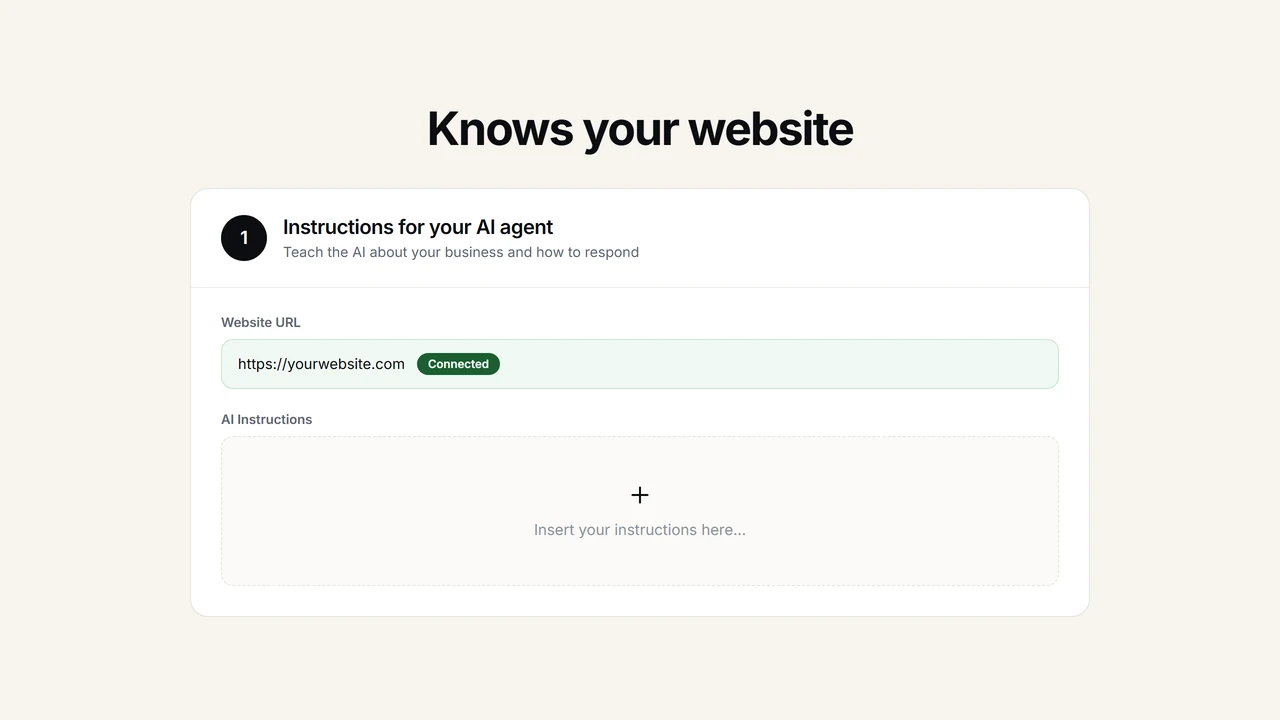
Enter a URL and watch the AI build understanding from the content — then ask it something unexpected
Visitors type freely and the AI actually understands what they mean
Old-school chatbots force visitors through decision trees — pick a category, choose a sub-topic, click an option. Conversational AI removes that friction entirely. Your client's visitors type natural questions in their own words, and the AI interprets what they mean, finds the relevant information from the website content, and responds in complete, human-sounding sentences. Typos, slang, vague phrasing, multi-part questions — the AI handles all of it. And because it draws answers from the client's own content, every response is grounded in facts specific to that business rather than generic filler.
- Free-form input, no menus or button treesVisitors type whatever they want. No predetermined paths, no rigid flows. The AI parses natural language and finds the best answer from the knowledge base — whether the visitor asks in one word or three sentences.
- Context carries across messagesThe AI remembers what was discussed earlier in the same conversation. A visitor who asks about pricing, then says "and what about the premium version?" does not need to repeat context. The AI knows what "the premium version" refers to.
- 36 languages with automatic detectionA visitor typing in Japanese gets a response in Japanese. A visitor switching mid-conversation from English to Spanish gets a seamless transition. No configuration per language — the AI detects and adapts on every message.
Strip our name and sell conversational AI as your own product
The Pro plan at $449/month gives you full white-label rights: the "Powered by Asyntai" badge disappears, your name and logo go on every widget, and you manage up to 20 client sites from one account. Each client gets their own knowledge base, their own configuration, and their own branded dashboard — embeddable on your website via a JS snippet — where they review conversations, track analytics, and export leads as CSV. Charge $150, $250, or $400 per client per month. No revenue share, no commission split. Agencies exceeding 20 sites can scale via the Custom Pro plan.
- Complete branding removal on ProEvery trace of Asyntai disappears. The chat widget shows your agency name, your logo, your colors. Visitors interact with what appears to be your proprietary conversational AI platform — because as far as they know, it is.
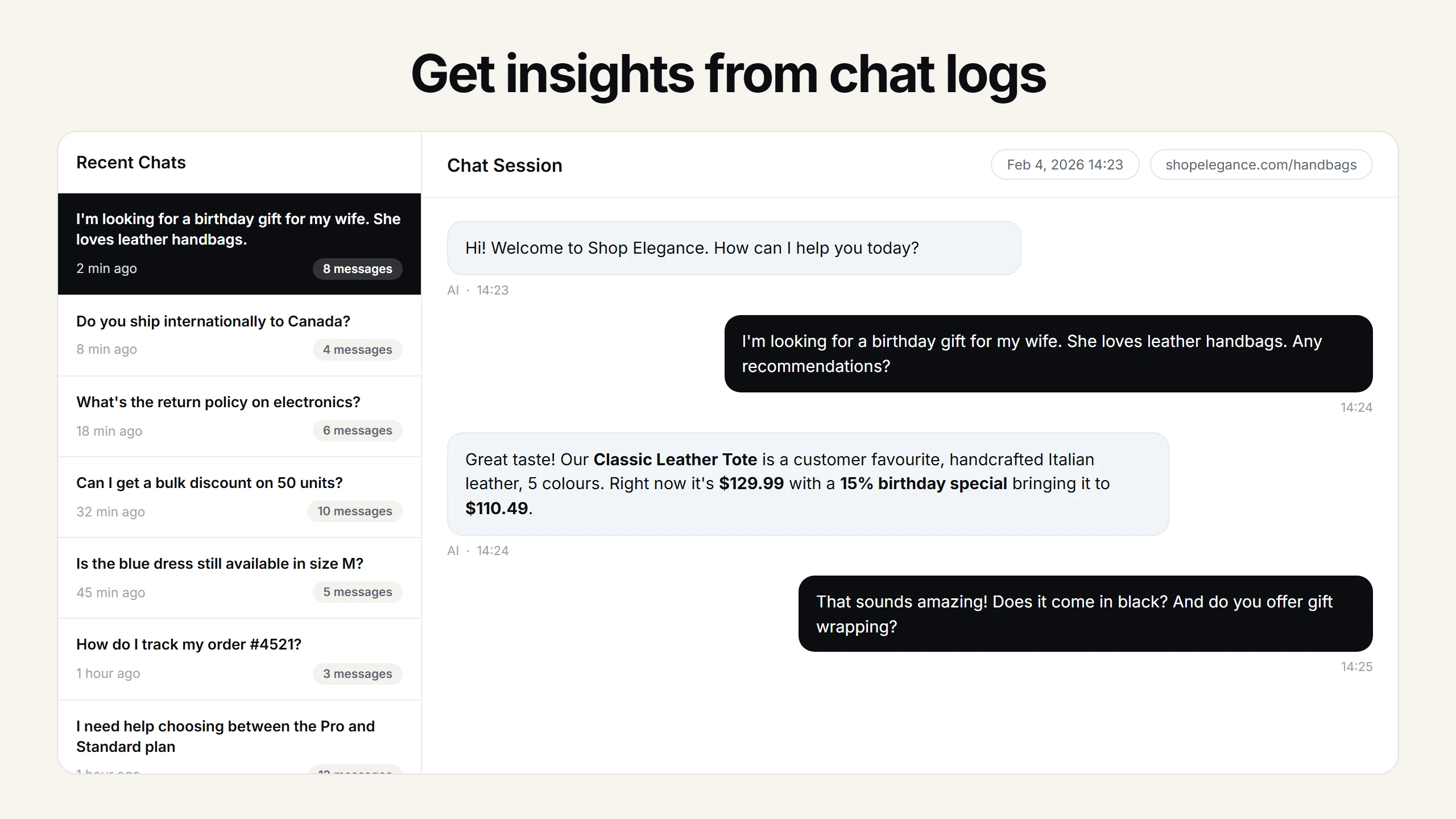
- Embeddable client dashboard with three tabsEach client accesses a white-labeled dashboard: Conversations for full transcripts, Analytics for usage trends and response metrics, and Leads for captured contacts with CSV export. Embed it on your site with a JS snippet. Your logo, your colors, your domain.
- 20 isolated environments on one subscriptionEvery client's knowledge base, widget design, AI instructions, and data are sealed off from every other client. The veterinary clinic's pet health answers never cross into the accounting firm's tax guidance.
- Custom Tools turn conversation into actionOn Standard+ plans, the AI can call your client's API endpoints mid-conversation — checking reservation availability, looking up order status, pulling account details. The conversation becomes a transaction.
Deploy conversational AI for a client in under thirty minutes
No coding, no API work, no model training. Add a site, let the AI read the content, paste one script tag, and the conversational AI is live.
- Subscribe to the Pro plan for white-label branding, 20 sites, and 50,000 messages per month.
- Add your client's domain. The AI crawls their website and builds a knowledge base from every page, post, and FAQ it finds.
- Set your branding — agency name, logo, widget colors, welcome message — so the conversational AI matches your identity.
- Copy the embed snippet and paste it into the client's site. The AI goes live immediately, answering visitor questions naturally.
<!-- Natural dialogue, not decision trees -->
<script src="https://asyntai.com/widget.js"
data-id="client-site-id" async>
</script>
# Your brand. Natural conversation.
# No menus, no button flows, no trace of us.
How reselling works
From signing up to billing your first client — four simple steps.
Choose a plan
Subscribe to a plan that fits how many client websites you need. Pro is the most popular for resellers — white-label plus up to 20 websites.
View plans →Add a client website
Each website you add under your account is one client's chatbot. Add up to the number your plan allows.
Go to your dashboard →Set up the chatbot
Add the client's content, customize the widget to their brand, and install it on their site. You can also give the client read-only access to their chat logs, analytics and leads on your own website.
Setup guide →Resell at your price
Charge your client whatever you like. You own the relationship and bill them directly — the margin is yours, every month.
Reseller Resources
Everything you need to get started, answer client questions, and see the dashboard in action
Reseller Guide
Step-by-step walkthrough: white-label branding, the embeddable client dashboard, and how to get your first client live.
Read the guideReseller FAQ
Pricing, margins, billing, white-label details, platform compatibility, and everything else partners ask before starting.
View FAQClient Dashboard Demo
See the embeddable white-label dashboard with sample data — conversations, analytics, and leads under your brand.
See the demoWhite label conversational AI — FAQs
What agencies and resellers ask before deploying conversational AI under their own brand.
How is conversational AI different from a regular chatbot?
A regular chatbot relies on predefined buttons, menus, and decision trees. The visitor clicks options and follows a fixed path. Conversational AI lets visitors type naturally in their own words. The AI interprets what they mean — even with typos, slang, or vague phrasing — and responds with relevant information drawn from the website content. There are no rigid flows to build, no decision trees to maintain, and no dead ends when a visitor asks something outside a scripted path. The difference is the experience for the end user: instead of clicking through menus, they have a conversation.
Does the AI actually understand context within a conversation?
Yes. The AI maintains context throughout the entire conversation thread. If a visitor asks about wedding packages, then says "how much does that cost for a Saturday in October?" — the AI knows "that" refers to the wedding package, not something else. Follow-up questions, pronouns, and references to earlier messages are all tracked. This is what makes it conversational rather than transactional: each message builds on what came before, just like a real dialogue with a knowledgeable person.
Where does the AI get its answers?
The AI builds a knowledge base by reading your client's website content — pages, blog posts, product listings, FAQs, documentation. You can also upload additional documents like PDFs, spreadsheets, or internal guides. When a visitor asks a question, the AI searches this knowledge base and constructs an answer using the relevant content. It does not make things up or pull information from the general internet. Every response is grounded in the specific content you have provided for that client.
Can the conversational AI handle questions it was not explicitly prepared for?
As long as the answer exists somewhere in the client's content, yes. The AI does not need a question-answer pair written in advance. If a visitor phrases a question in a way nobody anticipated — using different words, asking from an unusual angle, combining two topics — the AI still finds and delivers the relevant information. You do not need to predict every possible question. You only need to make sure the content is in the knowledge base. The AI figures out the connection between the question and the answer.
What does white labeling include?
On the Pro plan ($449/month), all Asyntai branding is removed. The "Powered by Asyntai" badge disappears from the chat widget. Your agency name, logo, and colors replace ours on every surface — the widget header, the chat interface, and the embeddable client dashboard. Your clients access a dashboard with Conversations, Analytics, and Leads tabs, all branded with your identity. You embed it on your own website using a JS snippet. There is no visible connection to Asyntai at any point in the end-user or client experience.
How does the AI handle multiple languages?
The AI supports 36 languages and detects the visitor's language automatically on every message. There is no language selector and no separate configuration per language. A visitor typing in Korean receives a response in Korean. A visitor switching from German to English mid-conversation gets a seamless response in English. The knowledge base content can be in any language — the AI handles the mapping between the question's language and the content's language. This makes a single white-labeled deployment work for international audiences without any extra setup.
Can the conversational AI do things beyond answering questions?
Yes. With Custom Tools (available on Standard and Pro plans), you can configure the AI to call external API endpoints during a conversation. A hotel client's AI can check room availability and start a booking. A logistics company's AI can pull real-time shipment tracking. A SaaS client's AI can look up subscription status or reset passwords. Each client's Custom Tools are configured independently. The conversation transitions smoothly from answering a question to performing an action — all within the same natural dialogue.
What are the plan options for resellers?
The Pro plan at $449/month is the primary reseller plan: full white-label branding, 20 sites, 50,000 messages per month. The Standard plan at $139/month supports 3 sites and 15,000 messages — suitable for resellers starting with a small client roster (email [email protected] for white-label activation on Standard). The Starter plan at $39/month supports 2 sites and 800 messages for testing. Agencies that outgrow 20 sites can move to a Custom Pro plan with higher limits.
How do I get started as a reseller?
Sign up for the Pro plan, add your first client's domain, set your branding, and paste the embed script on their site. The entire process takes about twenty minutes per client with no coding required. For questions about reselling, volume pricing, or your specific use case, email [email protected] and you will hear back within 24 hours.
Why the shift from scripted bots to conversational AI changes the reseller equation entirely
Scripted chatbots had their moment. For a few years, they were the default way businesses added automation to their websites — decision trees with branching paths, button-driven menus, and pre-written responses for every anticipated question. Agencies built them for clients, charged setup fees, and moved on. But the cracks showed early. Every new FAQ required manual scripting. Every edge case created a dead end. And every visitor who typed a question instead of clicking a button hit a wall: "I did not understand that. Please select from the options below." The experience was brittle, the maintenance was constant, and the value proposition eroded as visitors grew tired of clicking through trees when they just wanted an answer. Conversational AI replaces that entire paradigm. The visitor types naturally. The AI understands. The answer arrives. No menus, no dead ends, no frustrated visitors closing the tab.
The difference is not cosmetic. Decision-tree bots require someone to anticipate every question a visitor might ask and write a response for each one. Miss a question and the bot fails visibly. Conversational AI, by contrast, reads the client's website content and builds understanding from it. When a visitor asks something, the AI searches its knowledge base — the same content that already exists on the client's site — and constructs a natural response. Nobody needs to write scripts. Nobody needs to predict phrasing. If the answer is somewhere in the content, the AI finds it and delivers it in a way that reads like a person wrote it on the spot. This is not a subtle upgrade. It is a structural change in what a chatbot can do and how much work it takes to keep it running.
For agencies, this structural change transforms the business model. The old model for chatbot reselling involved heavy upfront work: mapping out conversation flows, writing scripts, building decision trees, testing paths, and then maintaining all of it when the client's business changed. Every new product, updated policy, or seasonal promotion meant going back into the bot builder and rewriting flows. The agency was essentially doing ongoing content work disguised as technology work. Conversational AI eliminates that maintenance burden. The AI crawls the client's website automatically and updates its knowledge when content changes. A new blog post, an updated FAQ page, a revised pricing table — the AI picks up the changes on its next crawl. The agency deploys the chatbot once and it stays current without manual intervention.
The white-label component turns this low-maintenance technology into a high-margin recurring service. On the Pro plan at $449 per month, you get full branding removal and room for 20 client sites. The "Powered by Asyntai" badge vanishes. Your agency name sits in the chat header. Your logo appears in the widget. Your colors define the interface. Visitors interact with what appears to be your proprietary conversational AI platform. For each client, you charge whatever the market supports — $150, $250, $400 per month. Your cost per client on a full 20-site roster is roughly $22. The margin math is not subtle: at $200 per client, you clear $3,551 per month after your subscription cost. And because the AI handles its own content updates, your operational time per client approaches zero after the initial setup.
The embeddable client dashboard rounds out the reseller picture. Each of your clients can access a branded dashboard with three tabs: Conversations, where they read full chat transcripts and see visitor details; Analytics, where they track message volume and response metrics over time; and Leads, where they view captured contact information and export it as CSV for their CRM or email tool. You embed this dashboard on your own website using a JS snippet. It carries your logo, your brand name, and your primary color. Your client sees it as a native part of your platform. They log in, review their chatbot's performance, export their leads, and never encounter a third-party brand name. It is your product, on your domain, with your identity.
Intent recognition is what separates conversational AI from keyword matching, and it matters in practice more than most people expect. A visitor to a real estate site who types "something with a view near downtown under 500k" is not matching keywords — they are expressing a composite intent involving location, price range, and a preference. The AI interprets the intent, searches the knowledge base for properties matching those criteria, and responds with relevant listings. A visitor to a veterinary clinic who asks "my dog ate chocolate, should I be worried?" is expressing urgency and seeking specific guidance. The AI recognizes the concern and delivers the clinic's relevant content about chocolate toxicity and emergency protocols. These are not scripted responses. They are constructed in real time from the client's content, tailored to what the visitor actually meant.
Multi-turn conversation is the other capability that decision trees cannot replicate convincingly. In a real dialogue, each message builds on the previous ones. A visitor asks about a service, then asks about pricing for that service, then asks if there is a discount for annual commitment — and the AI tracks the thread, understanding that "that service" and "annual commitment" refer to what was discussed earlier. Decision-tree bots lose this thread immediately because each button press starts a new branch. Conversational AI keeps the context alive for the entire session. Visitors can ask follow-up questions, clarify their needs, change direction, and circle back — all without repeating themselves. The experience mirrors a conversation with a knowledgeable person, not an interaction with a machine.
Custom Tools add a transactional layer that makes the conversational AI genuinely useful for businesses that need to do things, not just answer things. Available on Standard and Pro plans, Custom Tools let you configure the AI to call external API endpoints during the conversation. A restaurant client's AI checks table availability and makes reservations. A logistics client's AI pulls tracking numbers and delivery estimates. An insurance client's AI retrieves policy details and claim status. Each tool is configured independently per client, so the restaurant's booking API has nothing to do with the insurance company's claims API. The visitor experiences a seamless transition: they ask a question, the AI recognizes it requires a live data lookup, calls the endpoint, and returns the result — all within the natural flow of the conversation. No redirect to another page, no "please call us during business hours."
The 36-language support deserves attention because it solves a problem that would otherwise require separate deployments, separate configurations, and separate content management per language. The AI auto-detects the visitor's language on every message and responds in kind. A visitor in Japan asks in Japanese and gets a Japanese response. A visitor in Brazil asks in Portuguese and gets Portuguese. The knowledge base content can be in any language — the AI handles the mapping. For agencies with international client rosters, this means one white-labeled deployment serves all markets. A single chatbot on a single client site handles visitors in any of the 36 supported languages. There is no language selector, no manual routing, and no separate bot per locale.
The knowledge base architecture is what keeps the AI honest. Unlike general-purpose language models that might generate plausible-sounding but incorrect information, the conversational AI anchors its responses to the client's actual content. When a visitor asks about return policies, the AI finds the return policy page in the knowledge base and constructs its answer from that content. When a visitor asks about pricing, the AI references the pricing information that exists in the crawled pages or uploaded documents. If the answer does not exist in the knowledge base, the AI says so rather than making something up. This is critical for business use cases where accuracy matters — legal firms, medical practices, financial services, ecommerce stores with specific policies. The AI responds from facts, not assumptions.
Deploying conversational AI for a new client takes roughly twenty minutes and requires no development work. You add the client's domain in your dashboard, configure the widget branding (your agency name, logo, colors, welcome message), and let the AI crawl their website. The crawl runs automatically and builds a knowledge base from the site's content. If the client has additional material — internal documents, product catalogs, training guides — you upload those files and the AI incorporates them. You copy a single-line JavaScript snippet and paste it into the client's website. The conversational AI appears, branded with your identity, ready to engage visitors. The embed works on any website platform: WordPress, Shopify, Squarespace, Wix, Webflow, Magento, custom-built sites — anything that supports a script tag. Plugins for 30+ platforms make installation even simpler.
The competitive positioning for agencies selling white-label conversational AI is stronger than it was for scripted chatbot services. Businesses have tried button bots. Many were disappointed. They know the difference between clicking through menus and having a real conversation. When you demo conversational AI on a prospect's own website — showing it answering real questions from their real content — the gap between what they have experienced and what you are offering is immediately visible. The AI does not just match keywords. It understands what the visitor means and responds as a knowledgeable team member would. That is a dramatically easier sell than another menu bot, and it commands a higher price because the perceived value is higher.
Retention in the conversational AI reseller model benefits from a compounding effect. The AI's knowledge base is not static — it refines over time. As the client adds content to their website, updates products, publishes blog posts, and expands their FAQ, the AI's knowledge grows. You or the client can also add custom AI instructions that shape the bot's personality, tone, and handling of specific topics. After three months of refinement, the conversational AI is significantly more valuable than on day one. It knows more, responds better, and handles edge cases that stumped it early on. This accumulated intelligence is a switching cost. A client who moves to a competitor would start from zero — losing months of refinement, conversation history, and lead data. They stay because the product gets better the longer they use it.
The affiliate program provides a parallel revenue stream for agencies that encounter businesses they do not want to manage directly. Instead of white-labeling and billing the client yourself, you refer them to Asyntai using a tracking link and earn a 20% recurring commission on their subscription. A Pro plan referral generates $89.80 per month in passive income. Some agencies white-label for their managed clients and use affiliate links for leads that fall outside their service scope — businesses in different verticals, companies they consult for casually, or audiences that follow their content. The two models layer cleanly: active margin from white-label reselling, passive income from affiliate referrals.
Ready to resell conversational AI under your brand? Email [email protected] or start with the Pro plan today.