White label automation software that answers, captures, and qualifies — without a human in the loop
An AI chatbot you rebrand as your own. It handles support questions, captures leads, and deflects repetitive inquiries around the clock. No agents, no scripts, no downtime.
Watch automation handle visitor questions in real time
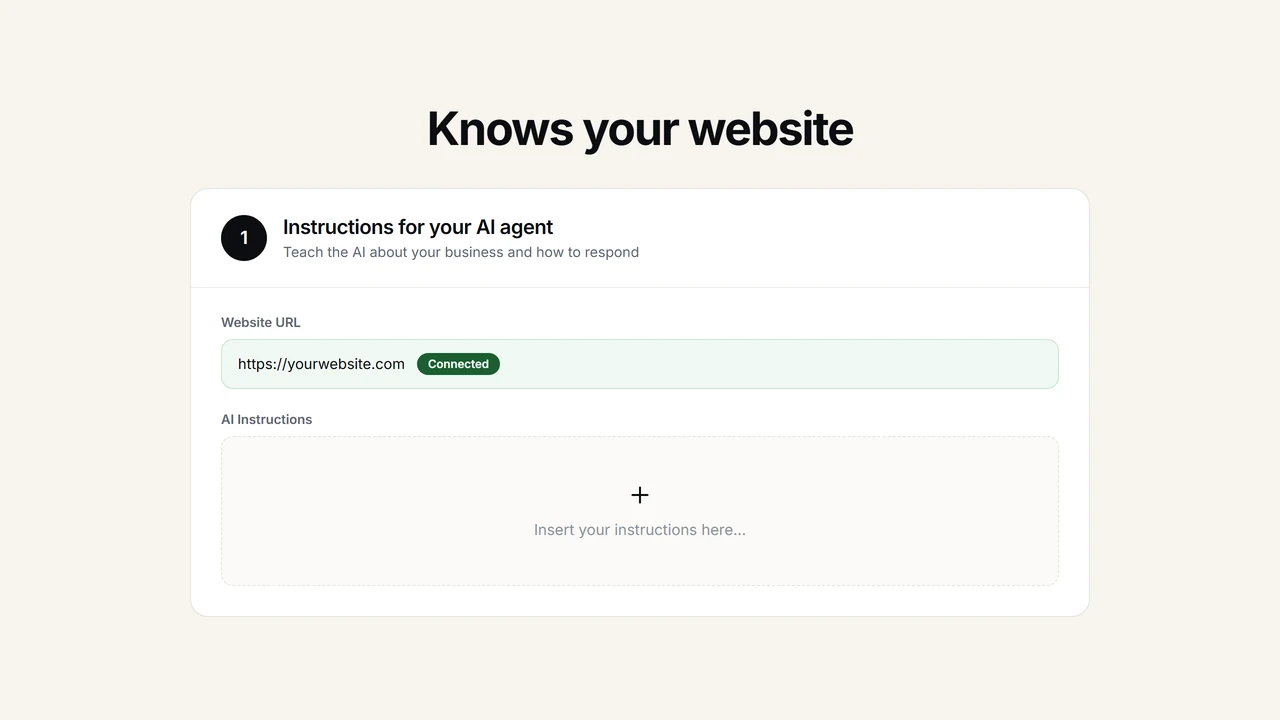
Paste any website URL and see the AI build a knowledge base from the content — then imagine this automating support for every one of your clients
Every automated response carries your name — never the vendor's
White label automation software only works if your clients never see the vendor behind it. On Asyntai's Pro plan, the "Powered by" badge is gone entirely. The chat widget shows your company name, your logo, and your brand colors. The automated responses come from what looks like your proprietary product. Your clients' visitors interact with your brand. Your clients log into a dashboard on your website. No pixel, no link, no line of text points to anyone but you. Standard plan users who want the same branding removal can email [email protected] for manual activation.
- Complete vendor removal on ProNo footer badge, no watermark, no hidden attribution. The chat widget is a blank canvas for your brand. End users see your name in the header, your colors on every surface, and your logo in the window. The experience looks like something your team engineered in-house.
- Per-client customization across 20 sitesEach client site gets independent branding and behavior. One client's automation can be formal and corporate. Another can be casual and conversational. Different names, different colors, different welcome messages — all managed from a single dashboard.
- Branded client reporting portalEmbed a white-labeled dashboard on your own website via a JS snippet. Three tabs — Conversations (transcripts), Analytics (volume and trends), and Leads (contact info with CSV export) — all under your logo and brand colors. Password-protected and domain-restricted per client.
Support deflection, lead capture, and FAQ handling — all running simultaneously
Most automation tools do one thing. This one does three at the same time, around the clock. The AI answers support questions using your client's own website content. It captures visitor contact information as leads when the conversation calls for it. And it handles repetitive FAQ inquiries that would otherwise consume staff time — all without human intervention. The Pro plan is $449/month for up to 20 client sites and 50,000 messages. No per-client fee, no revenue share. For agencies outgrowing 20 sites, the Custom Pro plan raises both limits.
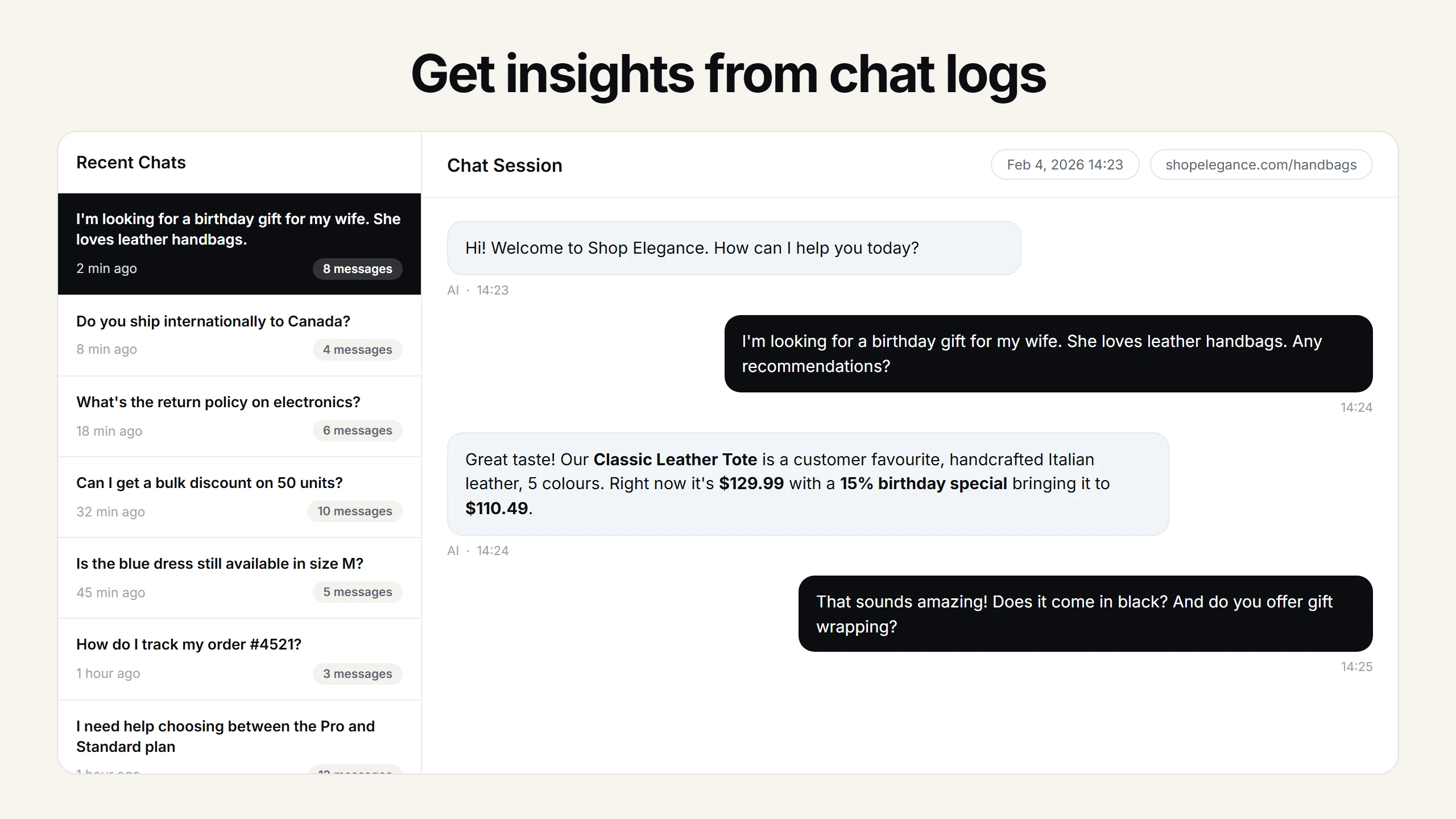
- Support automation that never clocks outThe AI reads your client's website — pages, blog posts, product listings, policies — and answers visitor questions using that information. At midnight, on weekends, on holidays. No staffing schedule, no coverage gaps. A question asked at 3 AM gets the same quality answer as one asked at 10 AM.
- Lead capture built into the conversationWhen a visitor expresses interest or asks about pricing, the AI captures their name, email, and context. Those leads appear in the client's dashboard tab with CSV export for CRM import. No separate form, no popup, no friction — the lead capture happens naturally within the conversation.
- FAQ deflection that scales infinitelyShipping policies, return windows, business hours, pricing tiers — the questions that make up 60-80% of support volume. The AI handles all of them simultaneously, accurately, and instantly. Ten visitors asking the same question at the same second all get immediate answers.
- Custom Tools connect the AI to client systemsOn Standard and Pro plans, the AI can call your client's own API endpoints mid-conversation — checking order status, verifying appointment slots, pulling account details. This moves the automation beyond Q&A into real transactional work.
- 36 languages with automatic detectionThe AI detects the visitor's language and responds accordingly. Spanish, German, Japanese, Arabic — no separate configurations, no multilingual staff, no per-language cost. One deployment handles all 36 supported languages.
Deploy your first automated client in twenty minutes
No code, no developers, no complex integrations. From signup to a fully branded, always-on automation chatbot on your client's site — four steps.
- Subscribe to the Pro plan at asyntai.com/pricing — you get complete branding removal, 20 client sites, and 50,000 messages per month.
- Add your client's domain and customize the widget — name, logo, colors, welcome message. Everything reflects your brand exclusively.
- The AI crawls the client's website automatically and builds a knowledge base from their content. Support answers, FAQ responses, and product info are ready within hours.
- Copy the one-line embed script into the client's site. The automated chatbot appears immediately and starts handling visitor questions 24/7.
<!-- AI-powered. Always running. -->
<script src="https://asyntai.com/widget.js"
data-id="client-site-id" async>
</script>
# Automating support, leads, and FAQs.
# Your brand. No human required.
How reselling works
From signing up to billing your first client — four simple steps.
Choose a plan
Subscribe to a plan that fits how many client websites you need. Pro is the most popular for resellers — white-label plus up to 20 websites.
View plans →Add a client website
Each website you add under your account is one client's chatbot. Add up to the number your plan allows.
Go to your dashboard →Set up the chatbot
Add the client's content, customize the widget to their brand, and install it on their site. You can also give the client read-only access to their chat logs, analytics and leads on your own website.
Setup guide →Resell at your price
Charge your client whatever you like. You own the relationship and bill them directly — the margin is yours, every month.
Reseller Resources
Everything you need to get started, answer client questions, and see the dashboard in action
Reseller Guide
Step-by-step walkthrough: white-label branding, the embeddable client dashboard, and how to get your first client live.
Read the guideReseller FAQ
Pricing, margins, billing, white-label details, platform compatibility, and everything else partners ask before starting.
View FAQClient Dashboard Demo
See the embeddable white-label dashboard with sample data — conversations, analytics, and leads under your brand.
See the demoWhite label automation software — FAQs
Common questions from agencies and consultants evaluating AI-powered automation software they can white-label and resell.
What kind of automation does this software actually perform?
Three things simultaneously. First, it automates support by answering visitor questions using the client's own website content — product details, policies, pricing, how-to guides, anything published on their site. Second, it captures leads by collecting visitor contact information during natural conversation flow, without requiring a separate form or popup. Third, it deflects repetitive FAQ inquiries — shipping times, return policies, business hours, pricing — that would otherwise consume human staff time. All three functions run around the clock without human intervention.
How is this different from a scripted chatbot or decision-tree bot?
Scripted bots follow predefined paths. They offer buttons, walk visitors through branching menus, and get stuck when questions fall outside the script. This is AI-powered natural language processing. Visitors type freeform questions — whatever they want, however they phrase it — and the AI understands the intent and responds using the client's actual content. No decision trees, no button menus, no scripted dead ends. The AI handles follow-up questions, multi-part inquiries, and edge cases that would derail any script-based system.
What does "white label" mean specifically for this automation software?
It means every visible element belongs to you. On the Pro plan, the "Powered by Asyntai" badge is removed entirely — not minimized, not grayed out, but deleted. The widget header shows your company name. Your logo appears in the chat window. Your brand colors run through every surface. Your clients and their visitors never see a name that is not yours. You also get a white-labeled client dashboard you embed on your own website, so reporting happens under your brand too.
How much does it cost to run automation for multiple clients?
The Pro plan is $449/month for up to 20 client sites and 50,000 messages. There is no per-client surcharge, no per-message fee beyond the included volume, and no revenue share on what you charge your clients. Your cost is fixed. Your revenue scales with each client you add. At 20 clients paying you $200 each, your margin is $3,551 per month. The Standard plan ($139/month, 3 sites, 15,000 messages) and Starter plan ($39/month, 2 sites, 800 messages) are available for agencies starting smaller.
Can the automation handle tasks beyond answering questions?
Yes. On Standard and Pro plans, Custom Tools let the AI call your client's own API endpoints during a conversation. The ecommerce client's bot checks order status. The medical practice's bot verifies appointment availability. The SaaS client's bot retrieves account details. Each client's Custom Tools are independent — the restaurant's reservation system has no connection to the retailer's inventory lookup. This moves the automation from passive Q&A to active transactional work.
What platforms does the automation widget work on?
Every platform that allows embedding a JavaScript snippet — which is virtually all of them. WordPress sites can use the official plugin for a no-code install. Shopify sites use the Shopify App Store listing. Wix, Squarespace, Webflow, Magento, Joomla, Drupal, OpenCart, and more than 30 other platforms are supported with official plugins or direct embed. For custom-built websites, the single-line script tag loads asynchronously and does not interfere with existing functionality.
How does the AI learn what to automate for each client?
When you add a client's website, the AI automatically crawls their pages — every product listing, service description, FAQ, blog post, and about page. It builds a knowledge base from that content and uses it to answer visitor questions accurately. You can also upload documents like PDFs, product manuals, or policy sheets to expand what the AI knows. The AI answers using the client's own content. It does not fabricate information. Each client's knowledge base is completely isolated from every other client's.
Does the automation work in languages other than English?
Yes. The AI supports 36 languages with automatic detection. When a visitor types in Portuguese, the response comes in Portuguese. When the next visitor types in Thai, the response comes in Thai. No separate widget instances, no language-specific setup, and no per-language pricing. A single automation deployment handles all 36 languages simultaneously. For agencies serving clients with international audiences, this eliminates the need for multilingual staff entirely.
What happens when the automation encounters a question it cannot answer?
The AI acknowledges that it does not have the specific information rather than guessing or fabricating a response. You can configure fallback behavior per client through AI instructions — directing the bot to suggest contacting the business via email or phone, offering related topics it can help with, or capturing the visitor's contact information as a lead. The fallback strategy is fully customizable for each client site, so a medical practice might direct visitors to call the office, while a retail store might offer to email a specialist.
Why automation software without white-labeling is a missed opportunity — and what changes when you own the brand
Automation in customer-facing communication is not a new idea, but the execution has always fallen short in one critical way: the businesses that need automation the most — small and mid-sized companies with limited staff — are the least equipped to build, configure, and maintain it themselves. They know they need something that answers visitor questions at midnight, captures leads on weekends, and deflects the same shipping-policy inquiry for the hundredth time without tying up a human. They just cannot figure out how to make it happen. That gap between knowing and doing is where you step in as a reseller, and white-label automation software is the tool that makes the business model work. Without white-labeling, you are a middleman pointing clients to someone else's product. With it, you are the product. Your name on the widget. Your brand on the dashboard. Your relationship with the client.
The automation itself runs on a straightforward principle: the AI reads the client's website content — every page, every product listing, every blog post, every FAQ section — and builds a knowledge base it uses to answer visitor questions. There is no manual programming of responses. There are no decision trees to design. There are no conversation flows to map out in a visual builder. The AI understands natural language, which means visitors type whatever they want, in whatever phrasing comes naturally, and the AI responds using information it pulled directly from the client's published content. When a visitor asks "how long does shipping take to California," the AI finds the shipping policy on the client's site and answers with the specific timeframe. When the next visitor asks "can I return a gift if I lost the receipt," the AI locates the return policy and responds with the relevant conditions. Neither of those interactions requires a human to participate, monitor, or approve.
Lead capture inside the conversation eliminates one of the most frustrating friction points in traditional lead generation: the popup form. Visitors ignore popups. They close them reflexively. They find them intrusive. But when a visitor is already engaged in a conversation — asking about pricing, requesting a demo, inquiring about custom orders — the AI can naturally ask for their name and email to follow up. The lead appears in the client's dashboard tab with full context: what the visitor asked, what the AI answered, and the contact information they provided. Export to CSV for CRM import takes one click. The lead capture is not a separate feature stapled onto the chat — it is woven into the conversation itself, which is why the conversion rate is dramatically higher than a static form sitting in the corner of the page.
FAQ deflection is where the volume math gets compelling. Every business has a set of questions that come in dozens or hundreds of times per week: What are your hours? How much does shipping cost? Do you accept returns? What is your warranty policy? How do I reset my password? Each of these questions takes a human support agent two to five minutes to read, respond to, and close. Multiply that by the daily volume and a significant portion of your client's support capacity is consumed by questions that have the same answer every time. The AI handles all of them simultaneously, instantly, and accurately — whether ten visitors ask the same question at the same second or one visitor asks at 4 AM when no one is awake. The human staff is freed to handle the complex, judgment-heavy cases that actually need a person. For your client, that means faster resolution times across the board. For you as a reseller, it means a clear, measurable value proposition: your automation service reduced their support workload by a quantifiable percentage.
The white-label layer transforms this from a useful tool into a business you control. On the Pro plan, every visible element of the chatbot widget belongs to you. Your agency name in the header. Your logo in the window. Your brand colors on every surface. The "Powered by" badge — gone. Not shrunk, not tucked into a corner, but removed from the DOM. When your client's visitors interact with the chatbot, they see a polished, branded automation product that looks like something your team designed. When your client logs into the reporting dashboard, they see your logo, your colors, and your domain. The entire experience reinforces your brand at every touchpoint. Your client never discovers the underlying vendor. Your visitors never navigate away from your ecosystem. Your brand occupies every pixel.
The economics make the case for automation software as a reseller business. The Pro plan costs $449 per month for up to 20 client sites and 50,000 messages across all of them. At full capacity, your per-client cost is roughly $22. Price your automation service at $150 per month — well below what any business pays for even a part-time support agent — and your revenue at 20 clients is $3,000. Your margin is $2,551. At $250 per client, margin climbs to $4,551. At $350, it reaches $6,551. The subscription cost does not change. Every additional client you add improves the math without increasing your expenses. There is no revenue share, no commission owed back, and no per-client fee. You invoice your clients directly and keep every dollar of the markup.
Custom Tools on Standard and Pro plans push the automation beyond answering questions into performing real transactional work. You configure the AI to call your client's own API endpoints during a conversation. The ecommerce client's chatbot checks a shopper's order status by querying their order management system. The dental practice's chatbot verifies whether a Tuesday afternoon slot is available by calling their scheduling API. The SaaS company's chatbot looks up a user's subscription tier and renewal date by hitting their account database. Each client's Custom Tools are completely independent — the dental appointment system has no connection to the ecommerce order tracker. For visitors, the experience is seamless: they ask a question, the AI acts on it in real time, and the answer arrives in seconds. For your clients, it means the chatbot is not just informational — it is operational.
The 36-language capability multiplies the value of each deployment without multiplying your work. The AI detects the visitor's language automatically and responds in kind. A French visitor gets French. A Korean visitor on the same site gets Korean. An Arabic visitor gets Arabic. No separate widget instances, no per-language configuration, no multilingual agents to hire. One deployment, one setup, all 36 languages. For agencies serving clients with international customer bases — ecommerce stores that ship globally, hospitality brands that attract travelers, SaaS companies with users worldwide — this eliminates an entire category of operational complexity. You install the automation once, and it handles visitors from every market your client serves.
Platform compatibility is not a limitation. The automation widget is a single line of JavaScript that loads asynchronously on any website. WordPress sites get a dedicated plugin for one-click installation. Shopify stores install from the Shopify App Store. Wix, Squarespace, Webflow, Magento, Joomla, Drupal, OpenCart, and more than 25 other platforms have either official plugins or direct embed support. For clients on custom-built sites, the script tag goes into the page header and the widget appears. No backend modifications, no server-side dependencies, no framework requirements. Your client's tech stack is irrelevant — if it renders a web page, the automation widget runs on it. For resellers managing clients across diverse platforms, this universality means you never turn away a prospect because of their CMS.
Site isolation ensures that multi-client management does not create cross-contamination risks. Each of the 20 sites on the Pro plan is a sealed environment. The restaurant's menu does not leak into the accounting firm's responses. The medical clinic's service descriptions do not appear in the online store's chat. Each site has its own knowledge base built from its own content, its own widget design, its own AI behavior instructions, its own conversation history, and its own lead capture data. You switch between clients in the dashboard with a click, but under the surface, each client's data exists in complete isolation. A configuration change to one site has zero effect on any other.
The affiliate program adds a secondary revenue channel for contacts that do not fit the full white-label reseller model. For businesses you encounter that want automation but do not need your managed service, you can share a referral link and earn a 20% recurring commission on their subscription. A referral who signs up for the Pro plan at $449/month generates $89.80 per month in passive income. Some agencies run both models: white-label automation for managed clients where they want full brand control and high margins, and affiliate links for casual contacts who prefer to run their own setup. The two models coexist under one account.
The vertical specialization opportunity is where reseller margins expand the most. Instead of selling generic automation, you package the solution for a specific industry: automated patient intake for dental practices, automated property inquiry handling for real estate agencies, automated product discovery for ecommerce stores, automated enrollment Q&A for educational institutions. The underlying platform is identical, but your expertise in configuring the AI instructions, curating the knowledge base, and connecting the right Custom Tools for each vertical lets you charge premium prices. You are not selling a chatbot. You are selling a virtual receptionist, a digital concierge, or an automated support specialist tailored to a specific type of business.
Agencies growing beyond 20 sites or 50,000 messages per month can scale seamlessly with the Custom Pro plan, which raises both limits to match your volume. Same dashboard, same white-label features, same workflow — just higher ceilings. There is no platform migration, no feature regression, and no need to split your client roster across multiple accounts.
Questions about white label automation software? Reach out at [email protected] — we respond within 24 hours.