The best white label AI software for agencies that want to resell smarter
Deploy AI chatbots under your own brand. No code, no development team, no trace of our platform — just your name on every surface.
See it work on any website
Paste a URL below — the AI reads the site content and starts answering questions in minutes
Built for resellers from day one — not bolted on as an afterthought
Most AI platforms add white labeling as a premium toggle that hides a logo and calls it done. Asyntai was designed around the reseller workflow: multi-site management, per-client isolation, an embeddable client dashboard, and branding removal that reaches every corner a visitor or client might see. The result is AI software that agencies can actually sell as their own without improvising around the gaps.
- Complete branding removal — not just a hidden logoOn the Pro plan, the "Powered by Asyntai" badge is gone. Your agency name sits in the chat header, your logo loads in the widget, and your color scheme runs through every element. Visitors see your product. Clients see your platform. Our name appears nowhere.
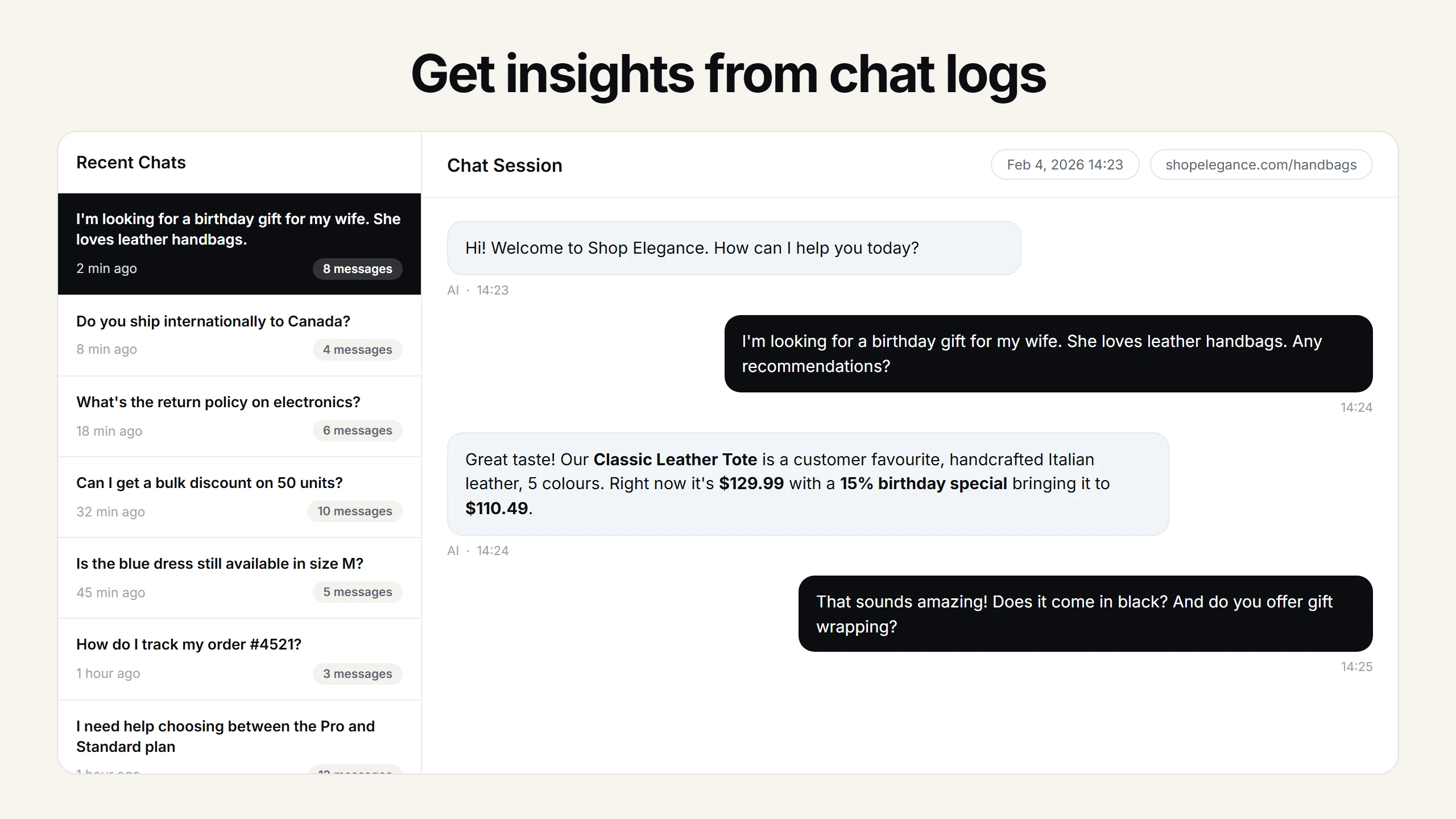
- Embeddable client dashboard under your brandEach client gets a white-labeled dashboard with three tabs — Conversations, Analytics, and Leads with CSV export. Embed it on your website via a JS snippet. Your logo, your brand name, your primary color. Password-protect each client's access and restrict by domain.
- 36 languages with automatic detectionThe AI detects the visitor's language and responds in kind — no configuration per language, no separate bot instances. One chatbot on one client site handles visitors in any of 36 supported languages. Agencies serving international markets do not need extra setup per country.
$449 a month covers 20 clients — the margin math is yours to set
The Pro plan gives you white-label branding, up to 20 sites, and 50,000 messages per month. At capacity, your per-client cost is roughly $22. Charge your clients $150, $250, $400 — whatever the engagement warrants. You bill them directly, keep 100% of the margin, and answer to no revenue-share agreement. The Custom Pro plan extends limits for agencies scaling beyond 20 sites.
- No revenue share, no commission splitYour pricing is your business. There is no percentage flowing back to us, no minimum monthly sales quota, and no contract tying you in. The Pro subscription is your only cost — everything above it is margin.
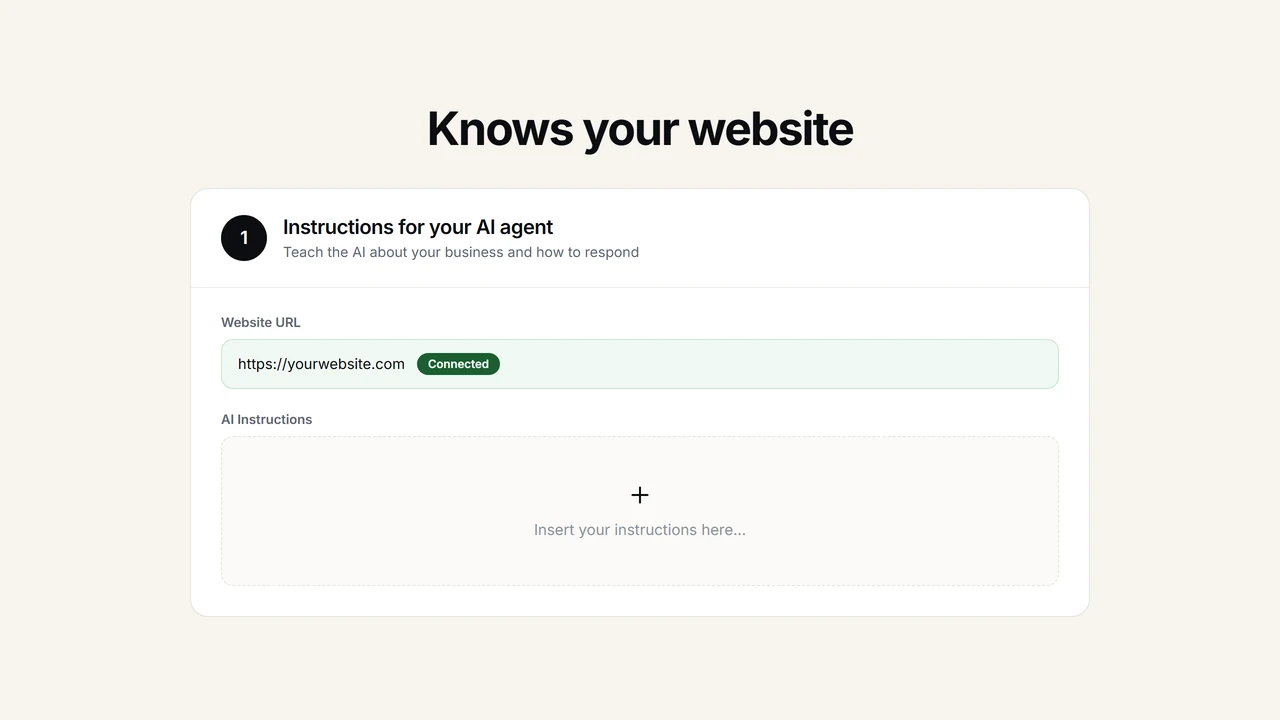
- Per-client isolation by defaultEach of your 20 sites has its own knowledge base, widget design, AI instructions, conversation logs, and analytics. Client A's data is completely sealed off from Client B's. No cross-contamination, no shared context, no accidental data leaks between accounts.
- Custom Tools turn the bot into an action-takerOn Standard and Pro plans, Custom Tools let the AI call your client's own API endpoints — checking order status, booking appointments, verifying account details. Each client's tools are configured independently, so a hotel bot checks availability while an ecommerce bot tracks shipments.
- Scale past 20 with Custom ProAgencies that fill all 20 slots and need more can move to a Custom Pro plan with higher site and message limits built for your volume.
Your first white-labeled client — live in twenty minutes
No APIs to integrate. No developers to hire. Four steps from sign-up to a branded AI chatbot answering questions on your client's website.
- Sign up for the Pro plan to get white-label branding removal, 20 sites, and 50,000 messages per month.
- Add your client's domain, then set the widget branding — your agency name, your logo, your colors. The widget will look like your own product.
- Let the AI crawl the client's site to build a knowledge base. Upload any extra documents (PDFs, product sheets, internal FAQs) for topics the site does not cover.
- Copy the one-line embed script and paste it into the client's site. The white-labeled chatbot goes live immediately.
<!-- White-labeled: no third-party branding visible -->
<script src="https://asyntai.com/widget.js"
data-id="client-site-id" async>
</script>
# One line of code. Your brand everywhere.
# No watermarks, no footers, no third-party links.
How reselling works
From signing up to billing your first client — four simple steps.
Choose a plan
Subscribe to a plan that fits how many client websites you need. Pro is the most popular for resellers — white-label plus up to 20 websites.
View plans →Add a client website
Each website you add under your account is one client's chatbot. Add up to the number your plan allows.
Go to your dashboard →Set up the chatbot
Add the client's content, customize the widget to their brand, and install it on their site. You can also give the client read-only access to their chat logs, analytics and leads on your own website.
Setup guide →Resell at your price
Charge your client whatever you like. You own the relationship and bill them directly — the margin is yours, every month.
Reseller Resources
Everything you need to get started, answer client questions, and see the dashboard in action
Reseller Guide
Step-by-step walkthrough: white-label branding, the embeddable client dashboard, and how to get your first client live.
Read the guideReseller FAQ
Pricing, margins, billing, white-label details, platform compatibility, and everything else partners ask before starting.
View FAQClient Dashboard Demo
See the embeddable white-label dashboard with sample data — conversations, analytics, and leads under your brand.
See the demoBest white label AI software — FAQs
Questions agencies ask when evaluating white-label AI software for reselling.
What makes this the best white label AI software compared to other options?
Three things that most competitors lack: a fully embeddable client dashboard (not just a shared login — an actual dashboard you embed on your own site with your branding), genuine multi-site isolation (each client's knowledge base, config, and data are completely separate), and 36-language support with automatic detection. Most white-label AI tools stop at hiding a logo. Asyntai removes every trace of the original platform and gives you a client-facing infrastructure that looks like something your agency engineered.
Do I need developers or technical staff to set up the white label AI software?
No. The entire setup is no-code. You add a client's domain, configure the branding (name, logo, colors) through a visual interface, let the AI crawl the website to build its knowledge base, and copy a one-line embed script. Most agencies get their first client chatbot live within twenty minutes. There are no APIs to integrate, no webhooks to configure, and no code to write unless you choose to use the optional REST API for custom integrations.
How does the embeddable client dashboard work?
Each client gets access to a dashboard with three tabs: Conversations (full transcripts with visitor details), Analytics (message volumes, response metrics, trends), and Leads (captured contact information with CSV export). You embed this dashboard on your own website using a JS snippet. The dashboard shows your logo, brand name, and primary color — your client sees it as part of your platform. Each client gets a separate access token with optional password protection and domain restriction.
What does "36 languages with auto-detection" mean in practice?
The AI identifies the language a visitor writes in and responds in that same language automatically. A visitor on your Spanish client's site can ask in Spanish, and a visitor on your Japanese client's site can ask in Japanese — both handled by the same platform, no separate configurations. The knowledge base content can be in any language; the AI bridges the gap. For agencies with clients across countries, one setup covers every market.
Which plan do I need for white-label reselling?
The Pro plan at $449/month is the dedicated white-label plan. It includes complete branding removal (the "Powered by Asyntai" badge disappears entirely), up to 20 sites, and 50,000 messages per month. Standard plan users ($139/month, 3 sites, 15,000 messages) can request white-label activation by emailing [email protected]. Pro is recommended for resellers because it supports more clients and higher volume.
Can the AI do more than answer questions from website content?
Yes. Custom Tools, available on Standard and Pro plans, let the AI call your client's own API endpoints during a conversation. A property management bot can check unit availability. A SaaS bot can look up a customer's subscription status. An auto parts bot can search inventory by vehicle make and model. Each client's tools are independent — you configure actions specific to each business without affecting other clients.
What happens when I need more than 20 client sites?
The Custom Pro plan extends both site and message limits beyond the standard Pro plan. Agencies that fill their 20 slots and need room to grow transition to Custom Pro with limits tailored to their volume — more sites, more messages, same white-label features.
Is there an affiliate option instead of reselling?
Yes. The affiliate program pays a 20% recurring commission on any subscription referred through your tracking link. A referral who signs up for Pro at $449/month earns you $89.80 every month they remain a customer — no setup, no support, no client management. Some agencies run both models: white-label for managed clients, affiliate links for referrals they do not want to handle directly.
How do I get started or ask questions before committing?
The fastest path is to sign up for the Pro plan — you get immediate access to white-label features and can deploy your first client in twenty minutes. If you want to discuss your use case, ask about custom limits, or have questions about the reseller model, email [email protected] and expect a response within 24 hours.
What separates the best white label AI software from everything else on the market
Agencies evaluating white-label AI software tend to discover a frustrating pattern: platforms that promise complete rebranding but deliver surface-level cosmetic tweaks. A hidden logo here, a color picker there, maybe a custom domain option if you pay extra. The underlying experience still leaks the original vendor's identity — in email notifications, in dashboard URLs, in help text that references the platform by name, in a "Powered by" badge that reappears in certain contexts. The best white label AI software does not play that game. It gives you genuine ownership of the client experience, from the first widget interaction through the analytics dashboard, with no residual traces of the underlying platform. That is the standard Asyntai sets, and it is the standard against which agencies should measure every alternative.
The first differentiator is depth of branding control. On the Pro plan, the "Powered by Asyntai" badge does not get dimmed, minimized, or pushed to a less visible location — it is removed entirely. The chat widget header displays your agency name. Your logo appears where ours would. Your primary and accent colors render throughout the widget interface. When a visitor opens the chatbot on your client's website, they see a clean, branded experience that matches your agency's visual identity. There is nothing to decode, no small-print clue pointing back to the original platform. This matters because agencies build credibility through consistency, and a stray third-party reference undermines the perception that the AI chatbot is your product.
The second differentiator is the embeddable client dashboard — a feature most white-label AI tools either skip entirely or implement as a shared-login afterthought. With Asyntai, each of your clients gets access to a dedicated dashboard with three tabs: Conversations, where they can read complete chat transcripts and see visitor details; Analytics, where they track message volume, response quality, and usage trends over time; and Leads, where they view captured contact information and export it as a CSV for import into their CRM. This dashboard is not a separate platform your client logs into. It is a widget you embed on your own website using a JS snippet. You set your logo, your brand name, and your primary color on the dashboard. Your client visits your site, enters their credentials, and sees their data — all under your brand. They never see a third-party interface.
Language capability is the third area where the gap between the best white label AI software and average alternatives becomes stark. The AI supports 36 languages and detects the visitor's language automatically. This is not a translation layer bolted on top — it is native to the conversational engine. A visitor writing in Dutch gets a response in Dutch. A visitor writing in Korean gets a response in Korean. The same chatbot, on the same client site, handles both without any per-language configuration from the reseller. For agencies with international clients — or clients whose visitors come from multiple countries — this eliminates the need for separate chatbot instances, separate knowledge bases, or language-specific routing rules. One deployment covers every visitor, regardless of the language they speak.
Multi-site architecture is where the operational advantage compounds. The Pro plan supports up to 20 independent client sites from a single account. Each site has its own knowledge base, constructed automatically when the AI crawls the client's website. Each site has its own widget configuration — separate name, logo, colors, welcome message, AI behavior instructions. Each site has its own conversation history, analytics data, and lead capture pipeline. None of this crosses between clients. A dental practice's patient inquiries never bleed into a law firm's case qualification responses. An ecommerce store's product information stays sealed off from an accounting firm's service descriptions. You manage the entire portfolio from one dashboard, but each client's environment is a self-contained compartment.
The no-code setup story deserves specific attention because it determines who can actually use the software. The best white label AI software should not require your agency to employ developers. With Asyntai, the setup process for each client involves four steps, none of which involve writing code: add the client's domain, configure the widget branding through a visual interface, let the AI crawl the site to build a knowledge base, and paste a one-line embed script into the client's website. The entire sequence takes about twenty minutes. There are no APIs to integrate, no webhooks to set up, no configuration files to edit. An account manager, a project coordinator, or the agency founder can do it — the workflow was designed for operators, not engineers.
The economics of white-label reselling on the Pro plan create a margin structure that is difficult to replicate with other service models. A single Pro subscription at $449 per month covers up to 20 sites and 50,000 messages. At full capacity, each client costs approximately $22 per month. Charge $200 per client — a reasonable rate for a white-labeled AI chatbot service — and your revenue is $4,000 against $449 in cost, yielding $3,551 in monthly margin. The math works from your very first client: even with five clients at $200 each, you collect $1,000 and spend $449, clearing $551 in profit. There is no revenue share. There is no commission split flowing back to the platform. There is no minimum sales volume. You decide what to charge, you invoice your clients, and you keep every dollar above your subscription.
Custom Tools introduce a capability that elevates the white-labeled chatbot from an information retrieval widget to a functional business assistant. Available on Standard and Pro plans, Custom Tools let you configure the AI to call your client's own API endpoints mid-conversation. A hotel client's chatbot can check room availability for specific dates. A SaaS client's bot can verify whether a user's subscription includes a particular feature. An auto dealership's bot can search the parts inventory by vehicle year, make, and model. Each client's Custom Tools are configured independently, and the AI knows when to invoke them based on what the visitor is asking. The visitor experiences a chatbot that does not just describe things — it takes action and retrieves live information.
Platform compatibility eliminates deployment friction for agencies whose clients use different website builders. The embed script is a single line of JavaScript that works on any platform supporting custom HTML — which covers WordPress, Shopify, Wix, Squarespace, Webflow, Magento, Joomla, Drupal, and dozens more. WordPress sites get an official plugin distributed from the dashboard. Shopify sites can install via the App Store. Everyone else pastes the script into their header or a custom code block. The widget loads asynchronously, so it does not slow down the client's page load or conflict with their existing theme. One embed method serves your entire client roster, regardless of the CMS mix.
The knowledge base construction process is fully automatic and ongoing. When you add a client's domain, the AI crawls their website — reading pages, blog posts, product listings, FAQ sections, help articles, and any other content it can access. The result is a knowledge base built from the client's own material, not generic templates or placeholder text. The AI then answers visitor questions using that content, citing relevant details and adapting its tone to match the business context. If the client publishes new pages, updates a product listing, or changes their operating hours, the next crawl picks up the changes. You can also upload supplementary documents — PDFs, product catalogs, policy manuals — to fill gaps the website content does not cover.
Vertical specialization represents the most profitable strategy for agencies using white-label AI software. Rather than marketing a generic "AI chatbot" service, the smartest agencies package the platform for a specific industry and refine the setup process, AI instructions, and sales pitch for that vertical. A dental AI assistant service comes with pre-built AI behavior instructions for appointment scheduling, insurance verification questions, and emergency triage. A real estate AI service is tuned for property inquiries, open house scheduling, and neighborhood questions. The platform underneath is identical, but the agency's expertise and vertical positioning justify premium pricing — because the client is not buying a chatbot, they are buying a dental receptionist or a real estate concierge that happens to be powered by AI.
Client retention in this model is structurally high because the value compounds over time. A freshly deployed chatbot answers questions accurately from day one, using the client's website content. Over the following weeks, the agency or the client refines the AI instructions — adjusting tone, adding custom responses for edge cases, uploading new documents, configuring Custom Tools. Each refinement makes the chatbot more accurate, more aligned with the client's brand voice, and more capable. Three months in, the chatbot is a finely tuned asset that the client relies on daily. Switching to a different provider would mean starting over: rebuilding the knowledge base, rewriting the instructions, losing the conversation history, re-training staff. The switching cost grows every month the chatbot runs, which means the client stays — and your recurring revenue stays with them.
The affiliate program runs parallel to the white-label reseller model and provides a second revenue stream for agencies that encounter prospects they do not want to manage directly. Instead of white-labeling a chatbot for a referral, you share your affiliate tracking link. When the referral signs up, you earn 20% recurring commission on their subscription for up to 12 months per referral. A Pro plan referral generates $89.80 per month in passive income. Some agencies use the affiliate channel for leads that fall outside their target vertical — businesses they encounter but do not want to onboard as managed clients. The white-label model handles their core roster; the affiliate link handles the rest.
The competitive landscape for white-label AI software includes platforms that offer varying degrees of rebranding, but the practical difference comes down to a checklist of operational requirements. Can you embed a client-facing dashboard on your own website? Does the AI support enough languages to serve international clients without extra configuration? Is client data genuinely isolated or just visually separated? Can the bot take actions (not just answer questions) via API calls? Can you manage 20 clients from a single subscription with clean per-client economics? Does the setup process require developers or can your account team handle it? Asyntai answers yes to all of these. Most alternatives answer yes to some and expect you to work around the gaps. The best white label AI software does not ask you to compromise — and the margin, the deployment speed, and the client experience should never require compromise.
Ready to evaluate? Sign up for the Pro plan and deploy your first white-labeled client in twenty minutes, or email [email protected] with questions.