AI search for WooCommerce that turns browsers into buyers
WooCommerce's built-in search matches keywords against product titles. Your shoppers search by need — "organic moisturizer for sensitive skin" or "lightweight laptop bag with padded sleeve." Asyntai's AI search understands what they actually want, searches your live product catalog through a Real-Time Data Feed, and shows matching products as Dynamic Product Cards with images, prices, and buy buttons — inside a chat widget on every page. No search results page. No keyword guessing. A shopping conversation that finds the right products, every time.
See the AI search your WooCommerce products live
Enter your WooCommerce store URL and watch the AI find and display your products as visual cards
Shoppers describe what they want — the AI searches your entire WooCommerce catalog
WooCommerce search scans product titles and descriptions for exact keyword matches. When a shopper types "gentle face wash for acne-prone skin," it searches for those exact words — and returns nothing useful, because your products are labeled with terms like "purifying cleanser" and "salicylic acid." Asyntai's AI search understands that the shopper wants a mild facial cleanser suitable for breakout-prone skin, searches your Real-Time Data Feed for products that match that intent, and displays them as Dynamic Product Cards — visual cards with product image, price, a short description, and a direct buy button. Multiple results fan out as a swipeable carousel. The shopper goes from describing a need to browsing real products in seconds, without ever leaving the conversation.
- Understands intent, not just keywordsShoppers describe what they need in plain language — "a birthday gift for a coffee lover under $40," "cruelty-free sunscreen that doesn't leave white residue," "something similar to the lavender set but unscented." The AI grasps the intent behind the words and searches your catalog for products that genuinely match, even when the shopper's vocabulary doesn't overlap with your product titles.
- Dynamic Product Cards inside the chatMatching products appear as rich visual cards — product image, name, price, description, and a buy/view button — directly in the conversation. Multiple results display as a carousel shoppers can swipe through. Products are merchandised within the chat, not dumped onto a search results page that shoppers have to sort through themselves.
- Searches your live WooCommerce catalogThe AI searches your Real-Time Data Feed — a URL (JSON, CSV, or REST API endpoint) that returns your current product data. Prices update when you change them. Out-of-stock items vanish from results. New products appear within 24 hours. The AI always shows what your store actually sells right now, not yesterday's index.
Real-time prices, instant stock updates, and a WordPress plugin that just works
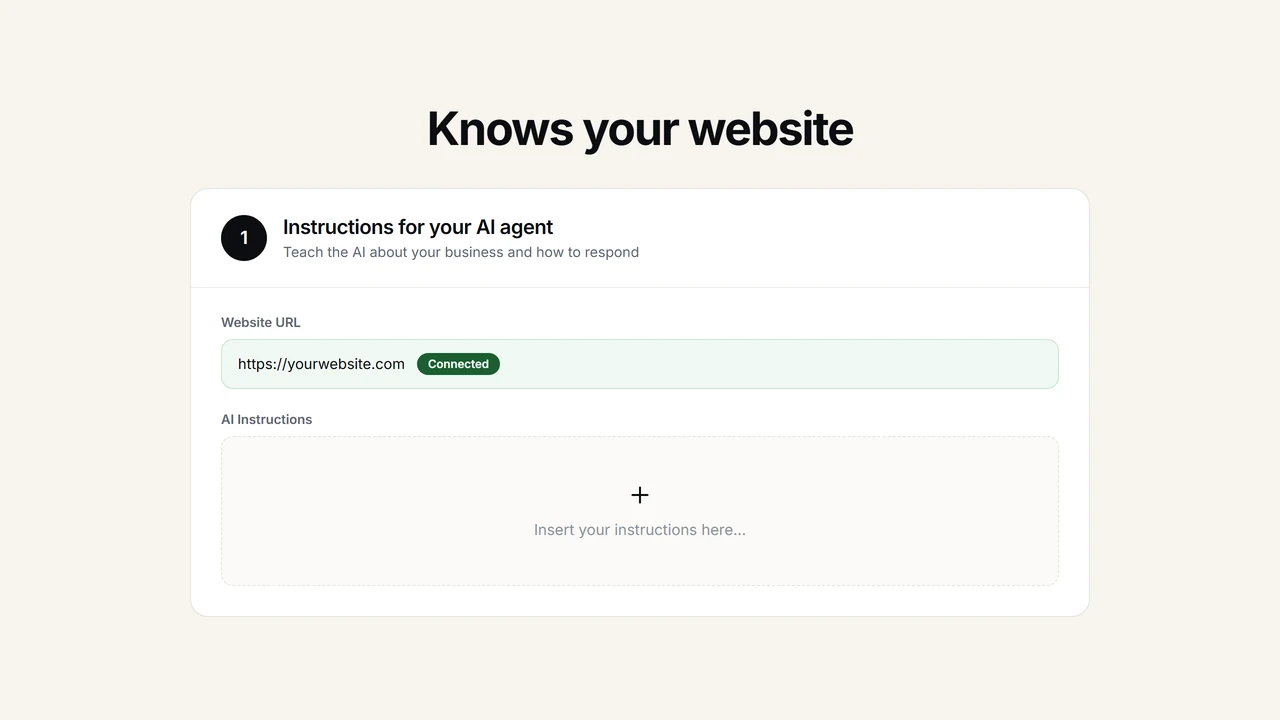
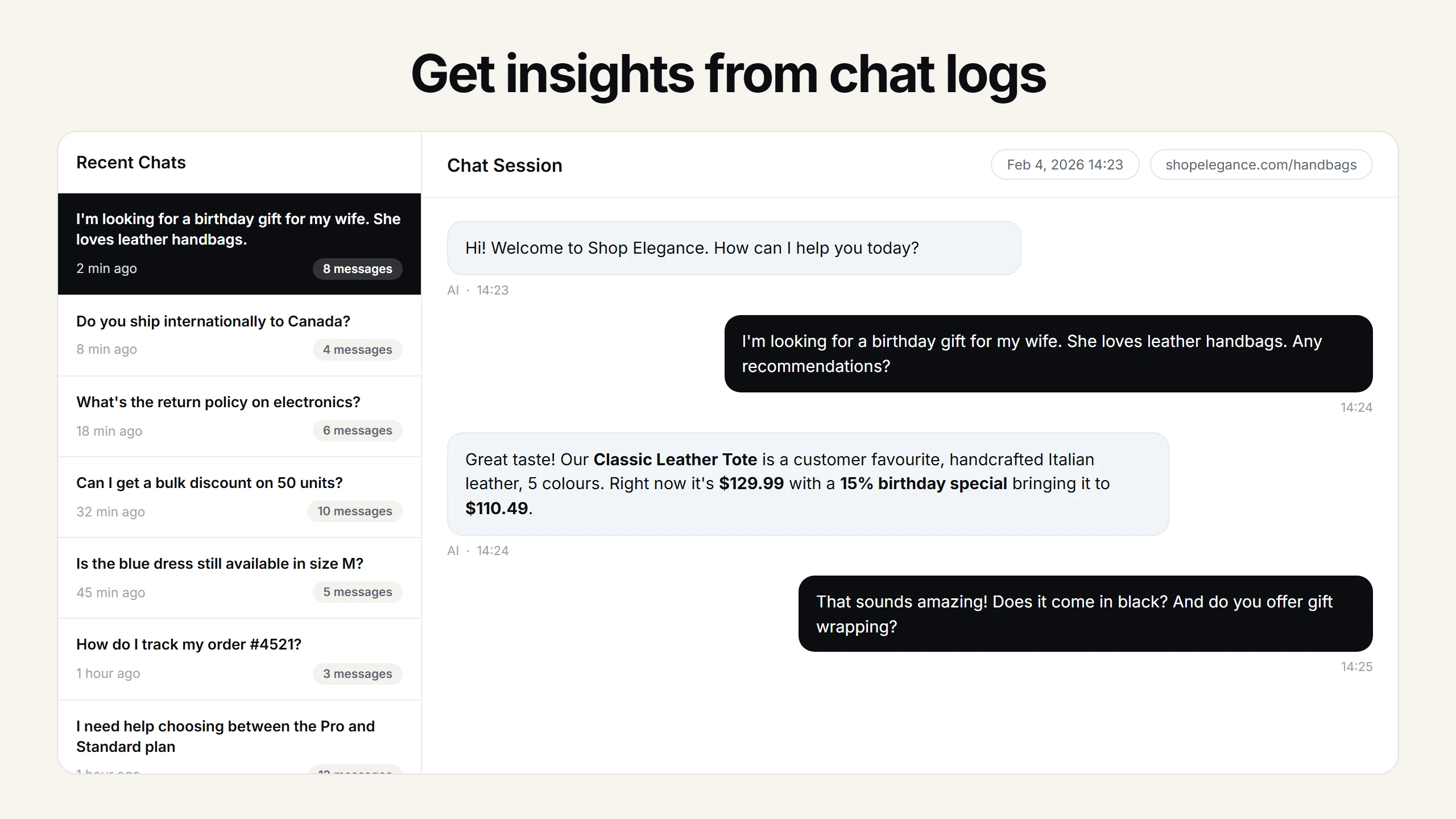
AI search is only useful if the data behind it is current. Asyntai's Real-Time Data Feed keeps your product information accurate — when you mark a product out of stock or run a flash sale, the AI reflects the change immediately. And because the AI also crawls your WooCommerce product pages, category pages, and store policies, it can answer questions beyond products too. Setup is a WordPress plugin downloaded from your Asyntai dashboard — one click, works with every WooCommerce theme, no code changes needed.
- Real-Time Data Feed for live catalog dataPoint Asyntai at a URL that exports your WooCommerce products (JSON, CSV, or the WooCommerce REST API). The AI indexes it automatically. Price changes and stock updates reflect immediately. New products are indexed within 24 hours. Standard plan supports up to 200,000 characters of product data; Real-Time Data Feed Max handles up to 10,000,000 characters — roughly 25,000 products with full descriptions.
- WooCommerce REST API powers Custom ToolsCustom Tools let the AI perform actions through your WooCommerce REST API — check inventory for a specific size and color, look up an order by number, estimate shipping costs, verify coupon eligibility. The AI doesn't just help shoppers find products; it handles post-purchase questions too. Each tool you connect extends what the AI can do inside the conversation.
- WordPress plugin, every WooCommerce themeDownload the official Asyntai plugin from your dashboard — not from WordPress.org — and activate it on your WordPress site. The chat widget appears on every page automatically. Works with Storefront, Flatsome, Flavor, Flavor, Astra, OceanWP, and every other WooCommerce theme. No code, no shortcodes, no theme file edits.
Add AI search to your WooCommerce store in minutes
No developer needed. The WordPress plugin installs from your Asyntai dashboard, the data feed connects with a URL, and Dynamic Product Cards turn on with a toggle. Your shoppers get intelligent product search right away.
- Sign up at Asyntai, download the WordPress plugin from your dashboard, and activate it on your WooCommerce site.
- The AI automatically crawls your WooCommerce product pages, categories, and store content.
- Connect a Real-Time Data Feed by pasting a URL that exports your product catalog (JSON, CSV, or WooCommerce REST API). The AI indexes it within hours.
- Enable Dynamic Product Cards in widget settings — the AI will render matching products as visual cards with images, prices, and buy buttons inside the chat.
<!-- Installed automatically by the WordPress plugin -->
<script src="https://asyntai.com/widget.js"
data-id="your-site-id" async>
</script>
# Plugin handles the embed. You handle the products.
AI search for WooCommerce — FAQs
Common questions from WooCommerce store owners, product managers, and agencies evaluating AI-powered product search.
How is this different from the WooCommerce product search?
WooCommerce's built-in search looks for keyword matches in product titles and descriptions. If a shopper types "hydrating serum for dry winter skin," WooCommerce looks for those exact words — and usually returns nothing, because your product is listed as "Intensive Moisture Complex." Asyntai's AI search understands the intent behind the query. It recognizes that the shopper wants a hydrating facial product for cold-weather dryness, searches your catalog for products that match that need, and presents them as visual product cards with images, prices, and buy buttons. It works through conversation, so the shopper can refine naturally — "something lighter" or "do you have one without fragrance?" — without restarting the search.
How does the AI get my WooCommerce product data?
Two main sources. First, the AI crawls your WooCommerce product pages — reading titles, descriptions, attributes, categories, tags, and images. This happens automatically when you install the plugin. Second, you connect a Real-Time Data Feed: a URL that returns your product catalog as JSON, CSV, or through the WooCommerce REST API. The data feed gives the AI structured product data with current prices and stock levels. Most WooCommerce stores already have a product export or REST API endpoint that works. You can also upload files like product catalogs or spec sheets to the knowledge base for additional coverage.
Does it understand WooCommerce variable products?
Yes. When your data feed includes variable products with their variations — different sizes, colors, materials — the AI understands them as a single product with multiple options. A shopper asking "do you have the Silk Pillowcase in queen size, in navy?" triggers the AI to check whether that specific variation exists and is in stock. Product cards show the base product with a note about available variations. If you connect inventory checking via Custom Tools, the AI can verify stock for individual variations in real time during the conversation.
How quickly do price and stock changes show up?
Changes in your Real-Time Data Feed reflect immediately — the AI reads the feed on each relevant query, so it always has current data. If you drop the price on a product for a flash sale, the next shopper who asks about it sees the new price on the product card. If an item sells out, it stops appearing in results. New products added to the feed are indexed within 24 hours. For crawled product pages, updates follow your crawl schedule (typically daily). The data feed is the recommended path for any store with frequent price or inventory changes.
What do Dynamic Product Cards look like?
Dynamic Product Cards are visual cards that appear directly in the chat conversation. Each card displays the product image, name, price, a short description, and a "View Product" button linking to the product page in your store. When the AI finds multiple matches, cards display as a horizontal carousel the shopper can swipe through. They work on desktop and mobile, and they turn the chat from a text-only experience into a visual product browsing interface. The shopper sees the products right where the conversation is happening — no need to navigate to a separate search results page.
How many products can the AI search through?
The Standard plan supports Real-Time Data Feeds up to 200,000 characters — enough for catalogs of a few hundred products with full descriptions, prices, and image URLs. For larger WooCommerce stores, Real-Time Data Feed Max supports up to 10,000,000 characters, which handles roughly 25,000 products with complete data. The AI also crawls your WooCommerce product pages with no hard product limit. Between the data feed and crawled pages, stores with thousands of SKUs are well within range.
Can the AI check order status or process returns?
Yes, through Custom Tools. You can connect the AI to your WooCommerce REST API to perform actions like order lookups, return initiation, shipping status checks, and coupon validation. When a returning customer asks "where's my order #4582?", the AI calls your WooCommerce API, retrieves the order details, and responds with tracking information — all within the chat. Custom Tools are available on the Standard plan and above. Each tool you connect adds a new action the AI can perform without the shopper leaving the conversation.
What plan do I need for AI search with product cards?
The AI chat widget works on all plans — including Free — with answers from your crawled WooCommerce content. Real-Time Data Feed and Dynamic Product Cards require the Standard plan ($139/month) or Pro plan ($449/month). Standard includes up to 15,000 messages/month and 200,000 characters of data feed. Pro includes 50,000 messages/month and Real-Time Data Feed Max (10,000,000 characters). Custom Tools for order lookups and WooCommerce API actions are also Standard+.
Why WooCommerce search loses sales — and how conversational AI recovers them
WooCommerce is the most widely used ecommerce platform in the world, powering over 5 million online stores. Its flexibility is legendary — you can sell physical products, digital downloads, subscriptions, bookings, and memberships, all from a single WordPress installation. Yet for all that capability, the product search experience on most WooCommerce stores is stuck in 2012. The default search bar scans product titles and descriptions for keyword matches. Type "organic moisturizer for sensitive skin" and you get either a random assortment of products that happen to contain the word "organic" or, more often, zero results. The shopper wanted a specific kind of product. The search returned noise. The shopper leaves. This happens hundreds of times a day on stores with large catalogs, and most store owners never know because abandoned searches don't show up in WooCommerce analytics.
The fundamental problem is the mismatch between how shoppers think about products and how WooCommerce search works. Shoppers think in terms of needs, occasions, attributes, and preferences: "a lightweight day cream with SPF for oily skin," "a birthday gift for someone who loves baking," "something like the charcoal cleanser but gentler." WooCommerce search thinks in terms of keywords — it splits the query into individual words and looks for products whose titles or descriptions contain them. The word "gentle" might appear in dozens of unrelated product descriptions. The concept of "for oily skin" isn't a keyword — it's a skin type attribute that might be stored in a custom field, a product tag, or buried in the long description. Keyword search can't bridge that gap. It matches characters, not meaning.
Search plugins like SearchWP, Relevanssi, and Ajax Search for WooCommerce improve on the default by searching across custom fields, weighting product attributes, and offering autocomplete suggestions. They're better keyword matchers. But they're still keyword matchers. They still require the shopper to guess which words appear in your product data. They still return results as a list of links on a page. And they still fail when the shopper describes what they want in their own words rather than in your catalog's vocabulary. The gap between what the shopper means and what the search finds remains open — the algorithm is just narrower.
Asyntai's AI search for WooCommerce replaces keyword matching with conversational product discovery. Instead of a search bar that returns a list of links, shoppers interact with an AI chatbot for WooCommerce that understands natural language, searches your live product catalog, and displays matching products as Dynamic Product Cards — rich visual cards with product images, prices, descriptions, and buy buttons, right inside the chat. The search happens through conversation, which means the shopper can refine, compare, and explore products the way they would with a knowledgeable store assistant. "Something like that but fragrance-free." "Do you have a smaller size?" "What pairs well with the serum I just looked at?" Each question narrows the results without starting the search over.
The technology that powers this is the Real-Time Data Feed. You provide Asyntai with a URL that returns your WooCommerce product catalog — a JSON export, a CSV file, or the WooCommerce REST API endpoint. The AI indexes this feed and uses it as its primary source of product knowledge. When a shopper asks "do you have a vitamin C serum that works under makeup?", the AI doesn't just look for products containing the words "vitamin C serum." It understands the shopper wants a skincare product with vitamin C as an active ingredient, in a lightweight formulation that absorbs quickly and layers well under cosmetics. It searches your data feed for products whose descriptions, ingredients, categories, and attributes match that holistic understanding. It might surface a product labeled "Brightening Antioxidant Serum" that never mentions "vitamin C" in the title but lists ascorbic acid in the ingredients and is tagged as "lightweight" — exactly what the shopper wanted, invisible to keyword search.
WooCommerce stores face a unique challenge with variable products — a single product with multiple variations for size, color, material, or other attributes. A store selling t-shirts might have one "Essential Tee" product with 24 variations across 4 colors and 6 sizes. The default search returns the parent product page regardless of which variation the shopper wants. The AI search handles this differently. When the data feed includes variation data, the AI understands that the "Essential Tee in Ocean Blue, size Large" is a specific purchasable variant. A shopper asking "do you have the Essential Tee in blue, large?" gets a direct answer — yes, it's in stock, here's the product card — instead of landing on a product page and having to navigate the variation dropdowns themselves. This matters enormously for stores with complex variable products like apparel, footwear, and configurable goods.
Dynamic Product Cards are what make AI search feel like shopping rather than searching. When the AI finds products that match the shopper's request, it doesn't return a text list of product names. It renders visual cards — each one showing the product image, name, price, a short description, and a "View Product" button that links directly to the product page. When there are multiple matches, the cards display as a horizontal carousel the shopper can swipe through. The visual format does something a text list never can: it lets the shopper browse with their eyes. A shopper asking for "a moisturizer for dry skin" can see three options side by side — different brands, different price points, different packaging — and make an immediate visual comparison. Products are merchandised inside the conversation, not relegated to a search results page that most shoppers never scroll past the first few items.
The Real-Time Data Feed is what keeps the visual experience honest. Because the AI reads the feed on each relevant query, the prices on product cards are always current. When you run a WooCommerce coupon that adjusts the price, the next shopper sees the updated price on the card. When inventory hits zero, the product stops appearing in results — no "add to cart" dead ends. New products added to the feed are indexed within 24 hours. This immediacy matters most during the exact moments when accurate data is critical: Black Friday sales, flash promotions, end-of-season clearance. Traditional search plugins rely on periodic re-indexing and often serve stale prices during the hours when your store is busiest and price accuracy matters most.
Capacity scales to match WooCommerce catalog sizes. The Standard plan supports data feeds up to 200,000 characters, which covers most small-to-medium catalogs — a few hundred products with full descriptions, prices, categories, and image URLs. For larger stores, Real-Time Data Feed Max extends to 10,000,000 characters, accommodating roughly 25,000 products with complete data. The AI also crawls your WooCommerce product pages, category pages, tag archives, and custom pages with no character limit on crawled content. This dual approach — structured data from the feed, unstructured content from crawling — means the AI can answer both "show me blue running shoes under $100" (product search) and "what's your return policy for shoes?" (content question) from the same widget.
The conversational format solves a product discovery problem that no search results page can address: the shopper who doesn't know what to search for. Consider someone buying a skincare routine for the first time. They don't know the difference between a toner and an essence. They can't search for "hyaluronic acid serum" because they don't know hyaluronic acid exists. What they can do is describe their situation: "my skin gets really dry in winter and my foundation looks flaky by noon." In a conversation, the AI can understand that context — dry skin, makeup application issues, seasonal factors — and recommend products that address those concerns. It can explain why a hydrating serum under moisturizer helps with foundation adhesion. It can show a three-product routine as a carousel of product cards. The shopper learns while they shop, and each exchange brings them closer to a purchase. A search bar can't teach. A conversation can.
Custom Tools extend the AI search beyond product discovery into full-service customer support. WooCommerce's REST API is well-documented and comprehensive, which makes it an ideal backend for Custom Tools. You can connect the AI to check real-time inventory for specific product variations — "is the Rose Gold pendant available in 18-inch chain?" The AI calls your WooCommerce API, checks the variation stock, and responds in seconds. You can connect order lookups so returning customers can ask "where's my order?" and get tracking details without navigating your My Account page. You can connect return initiation so a customer can start a return within the chat. Each tool turns the AI from a product search assistant into a full-service store concierge, handling pre-sale discovery and post-sale support from the same widget.
The WordPress plugin makes deployment trivial. You download the plugin from your Asyntai dashboard — not from WordPress.org — upload it through the WordPress Plugins page, and activate it. The chat widget appears on every page of your WooCommerce store immediately. It works with Storefront, Flatsome, Flavor, Flavor, Astra, OceanWP, Flavor, and every other WooCommerce-compatible theme. Page builders like Elementor and Divi don't conflict because the widget loads asynchronously via an independent script. No theme files are modified. No shortcodes need placement. If your WooCommerce store loads in a browser, the plugin works.
Multilingual search unlocks revenue from international shoppers without a multilingual catalog. Asyntai supports 36 languages. A French-speaking shopper can ask "je cherche une crème hydratante pour peau sensible" and the AI searches your English-language product data feed, finds matching moisturizers for sensitive skin, and presents the product cards with a response in French. The product names, prices, and images on the cards come from the feed in your catalog's language. The conversational text — the AI's recommendation, comparison notes, follow-up questions — is in the shopper's language. You don't need WPML or Polylang. You don't need translated product descriptions. The AI handles the language gap; your products stay in one language.
The economic impact of AI search on WooCommerce stores tracks a specific metric: the conversion rate of shoppers who search. On most ecommerce sites, shoppers who use search convert at 2-3x the rate of those who browse — because search signals intent. But that conversion premium evaporates when search returns poor results. A shopper who searches for "gentle cleanser for rosacea," gets irrelevant results, and leaves is the most expensive kind of lost sale: a motivated buyer your store failed to serve. AI search recovers these shoppers by understanding what they want even when their words don't match your product titles. Every product card shown to a shopper who would have bounced from keyword search represents incremental revenue your store would never have captured.
WooCommerce stores that benefit most from AI search share a pattern: they sell products where the shopper describes a need rather than a product name. Skincare ("something for hormonal acne that won't dry me out"), supplements ("joint support for a runner in their 40s"), home goods ("a non-toxic candle that actually throws scent in a large room"), specialty food ("keto-friendly snacks that taste like actual food"), pet products ("a puzzle toy for a large breed dog who destroys everything"). In each case, the shopper has a detailed mental picture of what they need but no idea what it's called in your store. They can't keyword-search their way to it because the search bar doesn't understand context, attributes, or intent. The AI does. It translates the shopper's need into the products you sell. That translation — from "what I want" to "what you have" — is where WooCommerce search has always failed and where conversational AI search delivers.
The default WooCommerce search isn't broken in the traditional sense — it does exactly what it was designed to do: match keywords. The problem is that keyword matching was designed for an era when shoppers searched for product names and SKUs. Today's shoppers describe needs, compare options conversationally, and expect the store to understand them. The search bar can't evolve to meet that expectation because the expectation isn't about better keyword matching — it's about understanding language. Asyntai's AI search brings that understanding to WooCommerce. The shopper describes what they want. The AI finds it in your catalog. Products appear as visual cards with images and buy buttons. That's what product search should feel like in a WooCommerce store: a conversation, not a keyword lottery.