The WordPress AI chat plugin that learns your site on its own
Asyntai publishes an official WordPress AI chat plugin — download it from your dashboard, upload through WordPress admin, connect in one click, and the AI reads your pages, posts, and products automatically. Real AI chat, not a rules engine. Works with every major theme and page builder.
Preview AI chat running against your WordPress content
Type your WordPress URL and watch the AI compose replies from your actual published pages before you install anything
An official WordPress plugin that delivers actual AI — not keyword triggers
Most chat plugins for WordPress still rely on branching dialogues, canned responses, or keyword-match libraries that fall apart whenever a visitor words something slightly differently than anticipated. The Asyntai WordPress AI chat plugin replaces all of that with a language model that reads your content, reasons about intent, and writes a fresh reply for each message. There are no dialogue flows to author and no intent lists to maintain.
- Language-model reasoning on every turnThe AI composes answers by retrieving relevant passages from your indexed WordPress content and generating natural-language responses — no templates, no fixed scripts, no keyword matching.
- Follow-up memory within each sessionA visitor who asks about a service and then follows up with "how much is that?" gets an answer referencing the service they just asked about, not a generic pricing dump.
- Plugin distributed at /plugins/wordpress/asyntai-chatbot/The official plugin ZIP lives at your Asyntai dashboard and installs through the standard WordPress Plugins → Add New → Upload Plugin workflow. Tested across WordPress 5.0 through 6.9.
Point the plugin at your site — the AI handles the rest of the curriculum
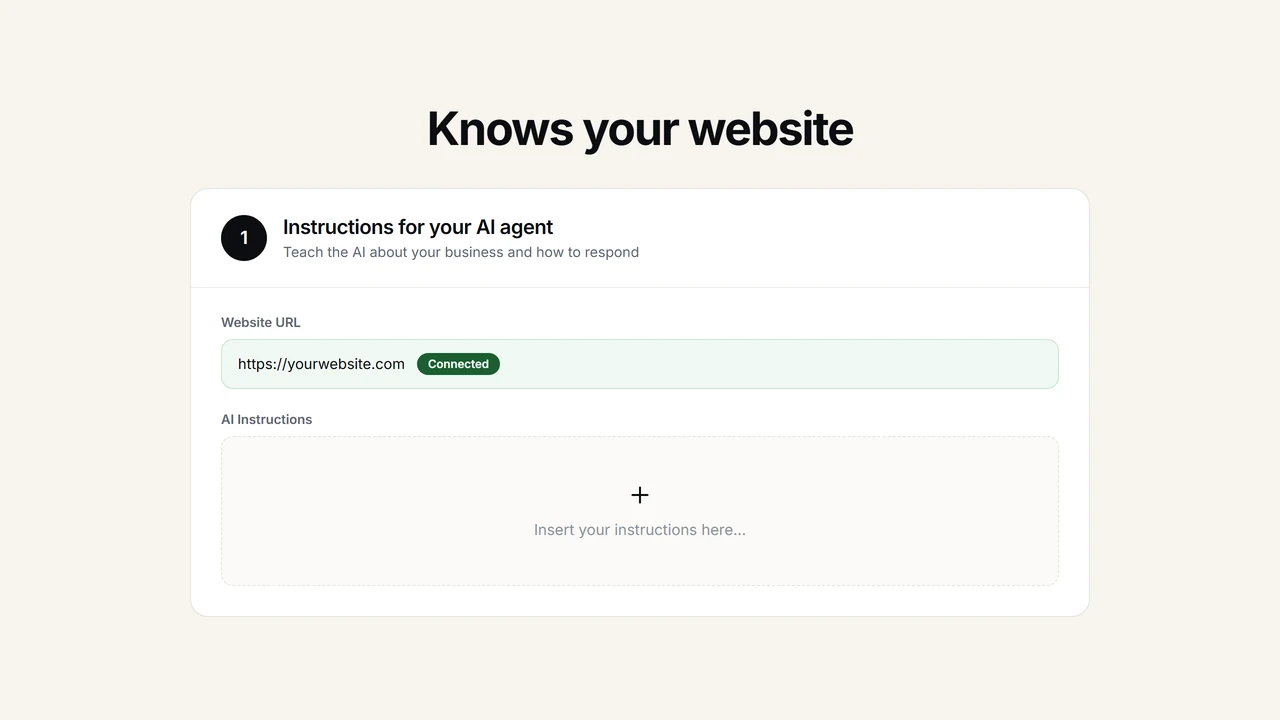
Once the plugin connects to your Asyntai account through a one-click OAuth handshake, the AI crawls every published URL on your WordPress site and builds its own retrieval index. Pages, posts, categories, WooCommerce products, policy documents — everything visitors can read, the AI can reference. No manual FAQ sheets required.
- Full-site index built from the live URLPublished pages, blog posts, landing pages, documentation articles, and any publicly linked content are discovered and indexed within minutes of connecting.
- WooCommerce catalog awarenessWith WooCommerce active, products, pricing, variants, and images reach the AI chatbot for WooCommerce so shoppers receive product-specific answers grounded in real catalog data.
- Private documents for depth beyond the published siteUpload internal PDFs — onboarding workflows, detailed pricing matrices, white papers, client case studies not yet published — and the AI draws on them without exposing them to visitors.
Install the official plugin from your Asyntai dashboard
The WordPress AI chat plugin is distributed as a downloadable ZIP hosted at /plugins/wordpress/asyntai-chatbot/ within your Asyntai dashboard. Install it using the familiar WordPress admin upload path, activate it, and click one button to complete the OAuth connection. No API keys to copy. No theme files to touch. No FTP sessions.
- Sign up for a free Asyntai account, then download
asyntai-chatbot.zipfrom the plugin installation page. - Open your WordPress admin, head to Plugins → Add New → Upload Plugin, pick the downloaded ZIP, and hit Install Now.
- Activate the plugin. An Asyntai menu item appears in the WordPress admin sidebar.
- Click Connect to Asyntai — an authentication popup at asyntai.com/wp-auth binds your site to your Asyntai workspace and saves the connection details automatically. Content indexing starts within seconds.
→ Plugins → Add New → Upload Plugin
→ Select asyntai-chatbot.zip → Install Now
→ Activate → Connect to Asyntai
# OAuth popup handles the rest.
# AI chat is live on every page within minutes.
WordPress AI chat plugin — what people ask before installing
The practical questions WordPress site owners settle before adding AI chat.
Where do I find the plugin download?
After creating your Asyntai account, the plugin ZIP is available at /plugins/wordpress/asyntai-chatbot/ inside your dashboard. It is not distributed through the WordPress.org plugin directory, so the standard "Search Plugins" bar inside WordPress admin will not return it. Download the ZIP once and upload it manually through the Upload Plugin flow.
What makes this different from a chatbot plugin that uses decision trees?
Decision-tree plugins require you to map every possible visitor question to a pre-written reply. The Asyntai AI chat plugin uses a language model that reads your site content and composes answers dynamically. Visitors can ask questions in any phrasing, any order, and any language — the AI handles all of it without needing you to predict the conversation in advance.
Does the plugin work with caching and security plugins?
Yes. The AI chat renders as a client-side overlay injected after the cached page loads, so WP Super Cache, W3 Total Cache, LiteSpeed Cache, WP Rocket, and similar caching layers do not interfere. Security plugins like Wordfence and Sucuri coexist without conflict because the plugin does not modify .htaccess or create custom post types that would trigger rules.
Is the AI grounded in my site content or does it hallucinate freely?
Grounded. The AI retrieves relevant passages from your indexed content before generating each reply, and it is instructed to decline questions it cannot answer from that material rather than inventing information. You can reinforce this with dashboard rules like "never quote a price not on the pricing page" or "always link to the source post when citing blog content."
Does the AI chat handle WooCommerce product questions?
When WooCommerce is active on your WordPress site, the plugin syncs product titles, descriptions, pricing, images, and variant data into the AI knowledge base. Shoppers can ask about specific products mid-conversation and receive accurate, catalog-grounded answers — including product card displays where relevant.
Can the AI recognize a logged-in WordPress user?
On Standard and Pro plans, your theme can fill window.Asyntai.userContext ahead of widget initialization with relevant logged-in visitor attributes — display name, membership tier, last order, account status. The AI weaves that context into personalized replies without needing direct database reads or a custom backend integration.
What WordPress and PHP versions are supported?
WordPress 5.0 through 6.9, running on PHP 7.2 or newer. The plugin has been tested alongside common stacks — Apache and Nginx, shared hosting and managed WordPress hosts, single-site and multisite installations. It does not require Composer or any external PHP dependency.
How does multi-site pricing work?
Free: 1 WordPress site with 50 messages monthly. Starter: 2 sites, 800 messages, $39/month. Standard: 3 sites with User Context support. Pro: up to 10 independently trained AI chat instances. Each connected site maintains its own knowledge base, so an agency managing diverse client WordPress builds keeps everything separate under one billing account.
What a WordPress AI chat plugin actually does — and why it replaces the old model
WordPress has hosted chat plugins for over a decade, and for most of that time the fundamental architecture stayed the same: you build a tree of if-then branches, wire each branch to a canned response, publish the tree, and hope visitors stick to the paths you predicted. When they did not — and they almost never did — the bot apologized and offered a contact form. The entire exercise felt like building a phone menu for a website: technically functional, universally disliked, and abandoned the moment the operator realized how much maintenance the branches required. A WordPress AI chat plugin breaks that cycle by replacing the decision tree with a language model that reads the site, reasons about each question, and generates a reply without any pre-authored structure at all.
The difference surfaces immediately in how visitors interact with the chat. On a branching plugin, the visitor has to work within the system's vocabulary. "Pricing" triggers the pricing response. "How much does it cost" might trigger it too, if someone remembered to add that variant. "What's the damage for the professional tier" does not trigger anything. On the Asyntai WordPress AI chat plugin, all three phrasings resolve to the same underlying question because the model reads intent, not keywords. Compound questions work too — "is the pro plan worth it if I only need five users and I already have a help desk" is a single message that a language model can parse and answer in one pass, while a branching bot would need five separate intent classifiers and still get confused by the conjunction.
Installation deliberately follows the pattern WordPress site owners already know. You download the ZIP from the Asyntai dashboard — the official distribution point is /plugins/wordpress/asyntai-chatbot/ — and upload it through the Plugins screen in WordPress admin. Add New, Upload Plugin, select the file, install, activate. At that point an Asyntai menu item appears in your sidebar with one clear button: Connect to Asyntai. Pressing it launches a secure OAuth popup that verifies your Asyntai account, binds the WordPress site to that account, and stores the connection credentials inside the plugin automatically. No API key to copy, no webhook URL to configure, no developer to coordinate. The popup closes, the connection is live, and the AI begins crawling your published content within seconds.
What the crawler discovers shapes everything the AI chat can do. On a content-driven WordPress site — a consultancy with a blog, a services agency with a portfolio, a professional with a personal brand — the crawler finds pages, posts, category archives, and whatever policies or legal documents are linked from the footer. On a WooCommerce store, product pages, variant data, pricing, and images join the index through the WooCommerce REST API, so the AI can answer product-specific questions with real numbers rather than approximate descriptions. On a membership site running MemberPress, Restrict Content Pro, or a similar plugin, the public-facing content enters the knowledge base while gated content stays out unless you explicitly upload it as a private document. The index is comprehensive by default and private by design.
Private documents extend the AI beyond the published site. Every WordPress business holds knowledge that matters for visitor conversations but does not belong on a public page. A law practice has an intake questionnaire that shapes how prospects should prepare. A SaaS company has a technical comparison sheet for enterprise evaluations. An agency has a scoping template that informs how projects are estimated. A therapist has a detailed consent and process document. Upload any of these as a PDF or paste the text, and the AI draws on them during conversations while keeping every word of those documents hidden from the public-facing page. This dual-source model — public content plus private documents — is what allows the AI to field questions a visitor would normally only get answered by emailing the business owner directly.
Behavioral rules are the steering mechanism. Instead of wiring a decision graph, you write sentences. "When the conversation reaches pricing, confirm the visitor's use case before quoting a tier." "Route enterprise inquiries to the demo-booking page and capture an email." "Never compare our product to a named competitor — acknowledge the question and redirect to our strengths page." "Always mention the free trial before the paid plans." These instructions propagate across every conversation the AI conducts, in every language, without per-rule configuration. Adding a new rule is typing a sentence into a text box in the dashboard and clicking save. Removing one is deleting the sentence. That management overhead is negligible compared to maintaining a branching tree where adding one rule might require touching a dozen nodes.
The plugin itself lives in the WordPress Plugins list alongside everything else the site runs. This matters more than it sounds for WordPress ecosystems where multiple people manage the site. A developer doing an audit sees "Asyntai" in the plugin roster and knows exactly what is responsible for the chat layer. An agency inheriting the site during a handoff can find the plugin, click through to the Asyntai dashboard, and understand the configuration without digging through theme files for a buried script tag. Deactivation and deletion follow the standard WordPress plugin lifecycle — deactivate to stop rendering, delete to remove the files. Nothing lingers in obscure database tables or injected theme hooks.
Page-builder compatibility is a non-issue by architecture rather than by testing every builder individually. The AI chat renders as a DOM overlay that attaches after the page has finished building, regardless of which tool built it. Whether your pages are assembled in Elementor, styled in Divi, structured with WPBakery, or composed natively in Gutenberg blocks, the output is standard HTML that the chat widget layers itself on top of. Switching page builders later does not affect the chat. Changing themes does not affect the chat. The widget exists in its own rendering layer, which is why there is no compatibility matrix to worry about.
Multilingual operation is handled at the model level rather than through a WordPress translation plugin. The widget surface is available in 36 language editions, and the underlying model identifies which language the visitor is using from the opening line of the conversation. A Portuguese-speaking visitor sees Portuguese replies derived from your English-language WordPress content. A Japanese-speaking visitor gets Japanese. An Arabic-speaking visitor gets Arabic with right-to-left interface orientation. If you already run WPML or Polylang for on-site translation, the chat operates independently — it does not conflict with translation plugins, does not duplicate their work, and does not require any language-aware configuration on the WordPress side.
Lead capture within the AI chat follows conversational logic rather than a fixed form. The AI judges when a visitor is engaged enough that asking for contact information feels natural rather than intrusive — after a pricing question has been thoroughly answered, after a service fit has been confirmed, after a product hesitation has been resolved. The captured lead lands in the Asyntai dashboard with every message from the conversation attached. Enable email alerts and the same package reaches an inbox in real time. The difference from a WordPress contact form is specificity: the form submission says "I'm interested," while the chat lead says "I asked about the professional tier for a five-person team, the AI confirmed it fits, and here is my email for the proposal." That level of context compresses the sales cycle from days of back-and-forth into a single warm reply.
Personalization for logged-in WordPress users relies on the User Context mechanism available on Standard and Pro plans. A few lines of PHP or JavaScript in your theme's header set window.Asyntai.userContext before the chat widget loads, passing whichever user attributes make sense for your business — display name, subscription level, last purchase date, account age, enrollment status. The AI weaves those attributes into its replies without making a separate database query. A returning WooCommerce customer asking about order status gets a reply that acknowledges their account. A membership-site member asking about the next content release gets an answer scoped to their tier. You control precisely what the AI sees by controlling what your code passes.
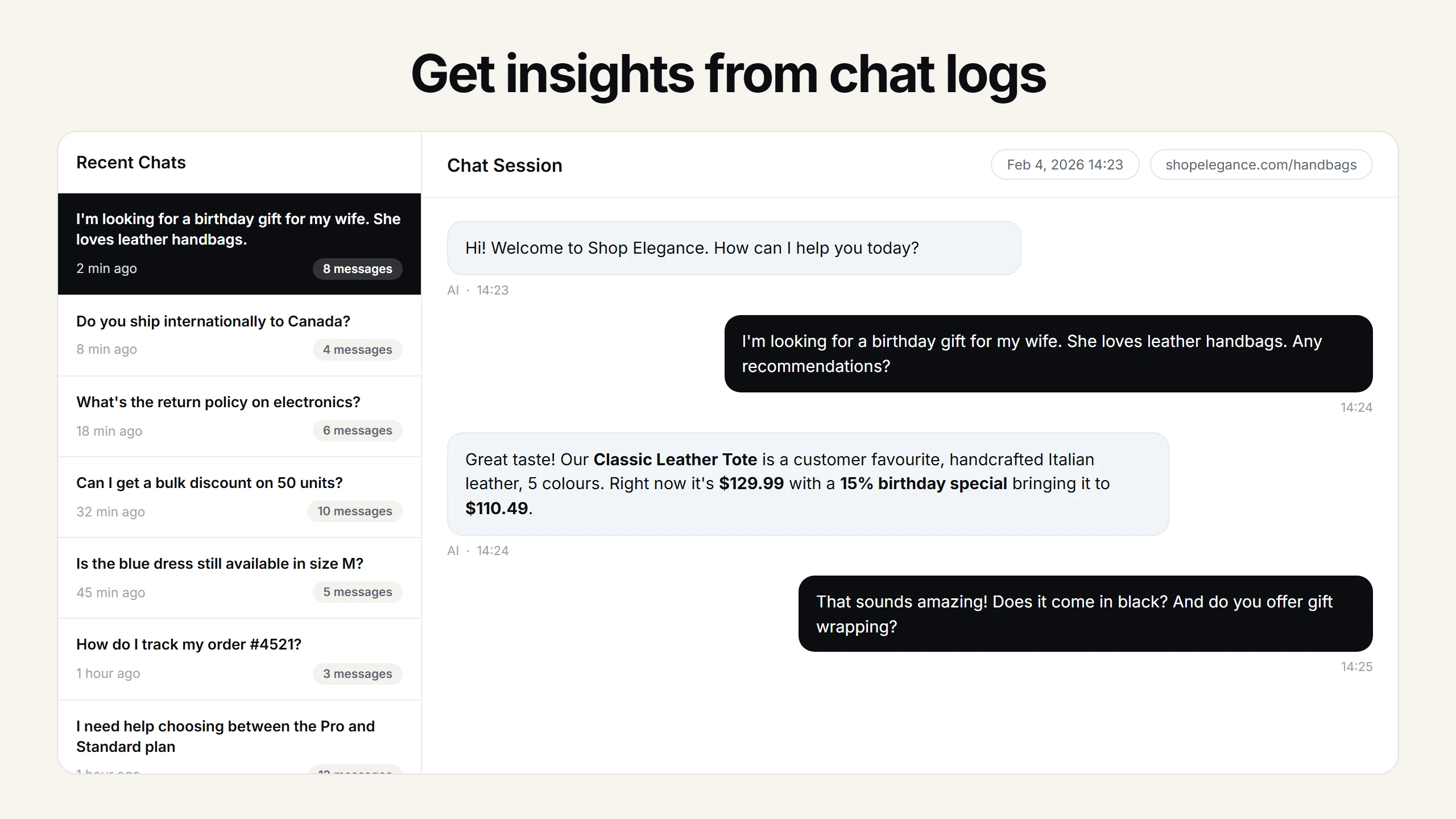
The analytics console inside your Asyntai account turns AI chat transcripts into a diagnostic lens on the WordPress site itself. Every conversation is logged with the originating URL, the visitor's language, and the topic cluster the AI assigned. Over weeks, patterns emerge that no traffic dashboard would reveal. Repeated questions about a missing pricing detail flag a content gap. Product questions that cluster on a single WooCommerce category suggest that category page needs better descriptions. Blog posts that generate disproportionate chat engagement are doing conversion work worth amplifying with internal links and calls to action. The AI chat is both a service layer and a research tool — it handles the visitor in the moment and simultaneously tells you what to fix for the next one.
Pricing is scaled to the WordPress ecosystem. Free covers 50 messages monthly on a single site. The $39/month Starter tier unlocks 800 messages across two sites. Standard and Pro step up to three and ten sites, with User Context available from Standard onward. Warning emails arrive before the monthly cap so a viral blog post or newsletter mention does not silently switch off the chat mid-surge. Agencies consolidate billing under one account without merging knowledge bases across client sites.
The practical arc of adding AI chat to a WordPress site through this plugin is measured in minutes rather than hours. Download the ZIP from your Asyntai dashboard, upload through WordPress admin, activate, click Connect, approve the OAuth popup. The AI indexes your site. Upload any private documents. Write a few behavioral rules in plain English. Match the widget colors and greeting to your brand. Fire off several test questions to verify the tone matches your brand. Publish. From that point, the WordPress AI chat plugin handles the visitor conversations that your contact form was losing — the after-hours questions, the nuanced service inquiries, the product hesitations, the multilingual visitors who previously had no way to engage — and delivers each one as a contextual, transcript-rich lead ready for the kind of follow-up that actually closes.