A widget chat box that sits in the corner of your website and answers visitor questions using your own content
A small floating button in the bottom corner of every page. Visitors click it, a clean chat interface opens, and an AI answers their questions — drawing from what is already on your website. No staff, no schedules, 36 languages.
See how the chat box works on your website
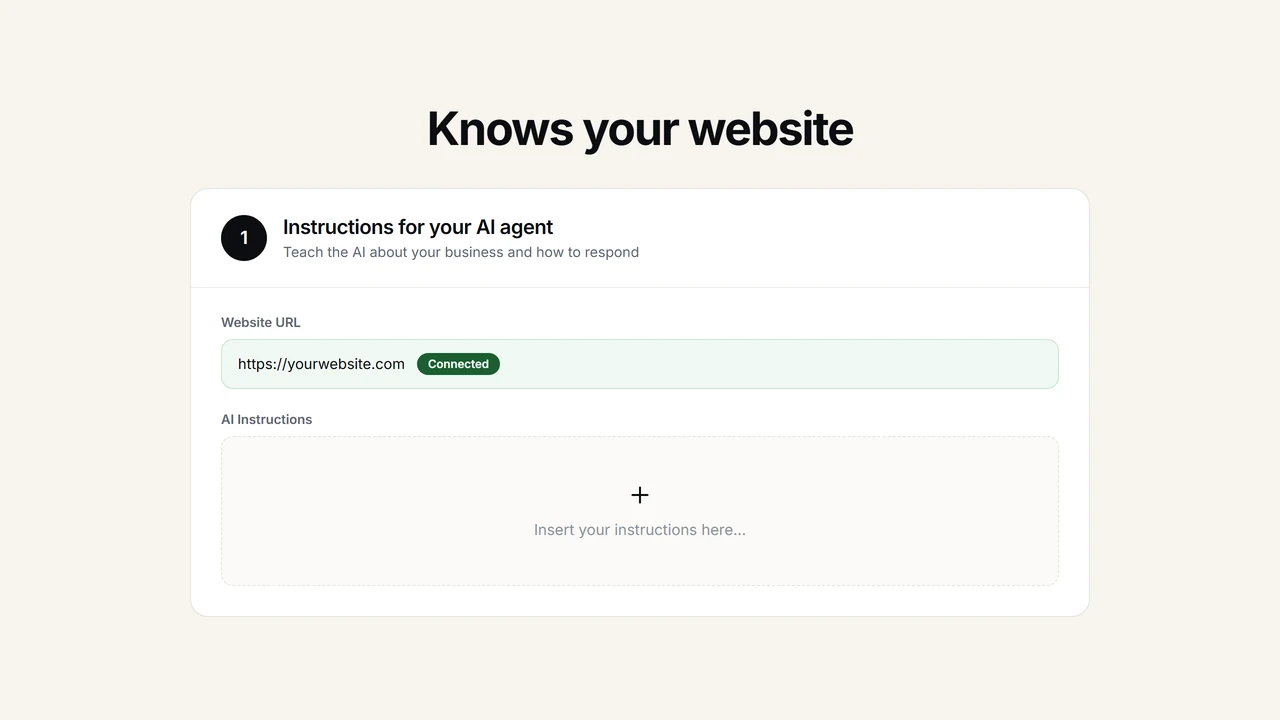
Enter your website URL below. The AI reads your pages and starts answering visitor questions using your content — the same way the widget chat box would work on your live site.
Your website has the answers — visitors just cannot find them fast enough
Every website has this problem, regardless of how well it is designed. A visitor lands on your page with a specific question. The answer exists somewhere on your site — buried in a product description, tucked inside a FAQ accordion, mentioned on a page they have not clicked yet. They scan the navigation, skim a few paragraphs, maybe try the search bar and get ten loosely related results. After thirty seconds of friction, they leave. Or they call your phone number and wait on hold for information that was sitting right there on your About page. A widget chat box eliminates this gap by giving visitors a single place to ask a question in plain language and get an immediate answer drawn from your own website content. The AI reads your pages — up to 50 of them — and uses that knowledge to respond conversationally. The visitor does not need to know which page has the answer. They just ask, and the chat box tells them. It is the difference between sending someone into a library and handing them the exact paragraph they need.
- A floating button that stays out of the way until neededThe chat box appears as a small, branded button in the bottom corner of your website. It does not cover content, does not interrupt scrolling, and does not pop up with aggressive prompts. When a visitor decides they have a question, they click the button. A clean chat interface slides open. When they are done, it closes. The widget respects the visitor's attention instead of demanding it.
- Answers come from your website, not a generic databaseThe AI reads the actual pages on your website — service descriptions, pricing information, product details, team bios, location hours, policies — and uses that content to answer questions. A visitor asking "do you offer same-day delivery?" gets an answer based on what your shipping page says, not a canned template. If you update your website, the AI picks up the changes automatically on the next crawl.
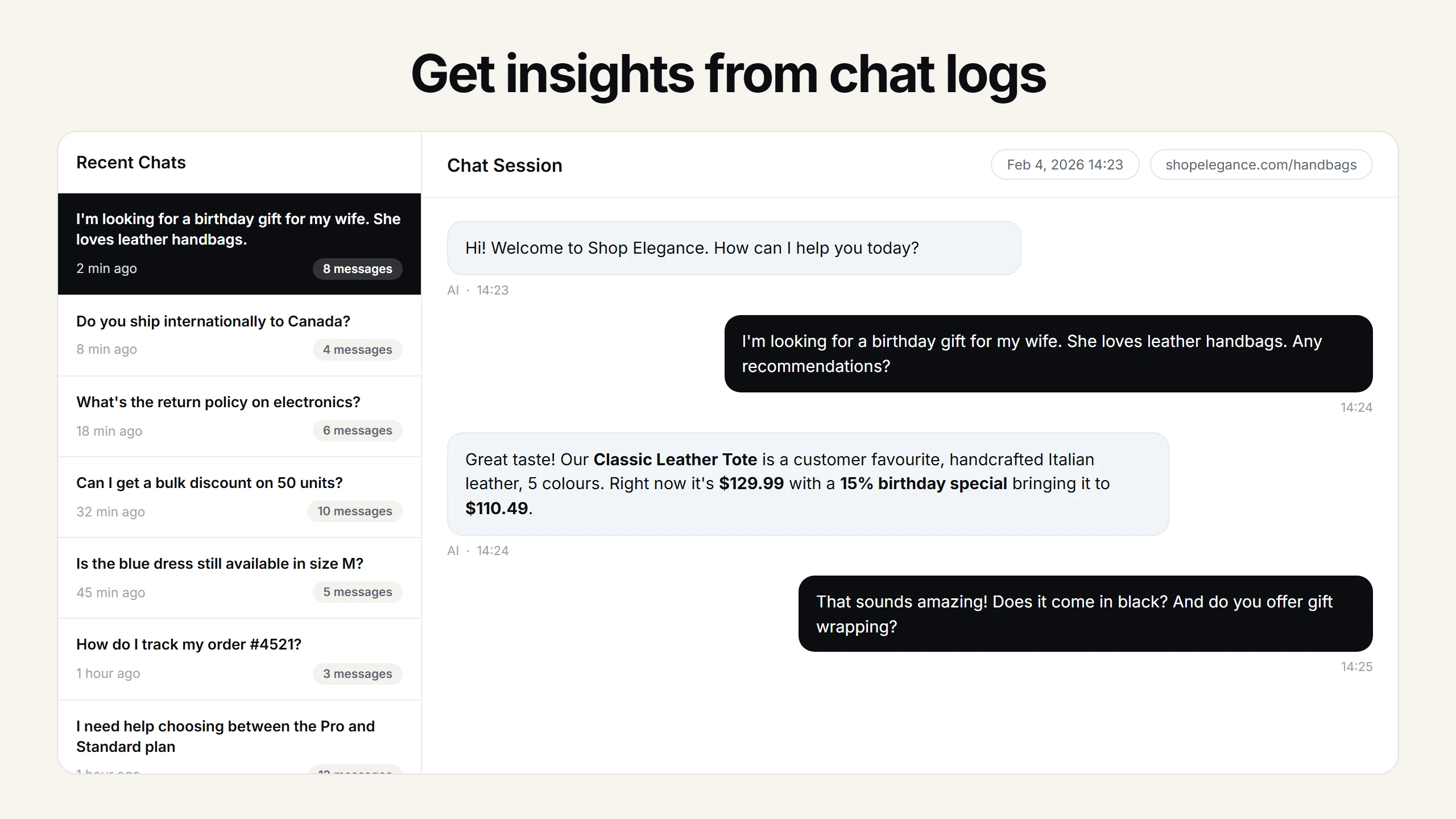
- Every conversation is a chance to capture a leadWhen someone engages with the chat box, you learn what they care about. The AI can collect contact information naturally during the conversation — a name and email when they ask about a quote, a phone number when they want a callback. Every interaction is logged in your dashboard with the full transcript, so you see not just who reached out but exactly what they were interested in.
Connect the chat box to your own systems for live data
Answering from website content covers most visitor questions. But some questions need live data — real-time inventory, order tracking, appointment availability, account balances. Custom Tools, available on Standard ($139/month) and Pro ($449/month) plans, let the chat box call your own APIs mid-conversation. The visitor asks a question, the AI queries your system, and the answer comes back in seconds — all inside the same chat interface.
- Order and shipment trackingConnect a Custom Tool to your order management system. When a visitor asks "where is my order?" the AI collects their order number, queries your system, and responds with the current shipping status, carrier, and expected delivery date — no staff involvement, no switching to another portal.
- Appointment and availability checksService businesses can connect their booking system as a Custom Tool. The chat box answers "do you have any openings this Thursday?" with real availability pulled from your calendar, then guides the visitor through scheduling — all within the conversation.
- Product inventory lookupsRetail and e-commerce sites can let the chat box check stock levels in real time. A visitor asking "do you have this in size 10?" gets an accurate yes or no from your inventory system, not a guess based on a product page that might be out of date.
- Account and membership statusIf your site serves logged-in members or subscribers, a Custom Tool can let the chat box answer account-specific questions: billing dates, subscription tier, remaining credits, or membership renewal status. The visitor gets self-service answers without navigating account settings or calling support.
- Automatic language detection across all integrationsCustom Tools work in every language the chat box supports — 36 in total. A Spanish-speaking visitor asks about their order status, the AI queries your English-language system, and delivers the answer in Spanish. The data is the same; the conversation happens in the visitor's language.
Add the widget chat box to your website
One script tag, any website platform, under five minutes. The chat box starts answering visitor questions immediately using your existing website content.
- Choose a plan at asyntai.com/pricing — the Free tier includes 1 site and 50 messages per month so you can test with real visitor traffic before committing.
- Enter your website URL in the dashboard. The AI crawls up to 50 pages — homepage, service pages, product listings, FAQ sections, pricing tables, about pages — and builds its knowledge base from your content automatically.
- Customize the chat box appearance. Set your brand name, primary color, logo, welcome message, and button position. The widget matches your website design so it feels native, not bolted on.
- Copy the embed script and paste it before the closing </body> tag on your website. Works on WordPress, Squarespace, Wix, Shopify, Webflow, custom-built sites, and 30+ other platforms. The chat box appears immediately and starts handling visitor questions.
<script src="https://asyntai.com/widget.js"
data-id="your-site-id" async>
</script>
# One line. Any website. Instant chat box.
# Answers visitor questions using your own content.
Widget chat box — FAQs
Common questions about adding a chat box widget to your website.
What does the widget chat box look like on my website?
The chat box appears as a small circular or rounded button in the bottom-right corner of your website (you can reposition it). It displays your brand logo or a chat icon. When a visitor clicks the button, a clean chat panel slides open — typically around 380 pixels wide and 520 pixels tall on desktop. On mobile, it expands to fill the screen for easy thumb-typing. The widget uses your brand colors and displays your company name, so it looks like a native part of your site rather than a third-party add-on. When closed, the button is small enough that it does not interfere with your content or navigation.
How does the chat box know the answers to visitor questions?
When you set up the widget, you provide your website URL. The AI crawls up to 50 pages of your site — reading product descriptions, service pages, FAQ sections, about pages, pricing tables, policy documents, and any other published content. It uses this content to answer visitor questions in natural conversation. If a visitor asks something covered on your website, the chat box responds with an accurate answer drawn from your own pages. You can also upload additional files — PDFs, documents, spreadsheets — to supplement the website content with information that is not published online.
Can I customize the colors, logo, and greeting message?
Yes. The dashboard gives you full control over the chat box appearance: primary color, button shape, your company logo, the name displayed at the top of the chat window, and the initial greeting message visitors see when they open the widget. You can also write custom instructions in plain English that control the AI's tone, what topics it covers, what it redirects, and how it collects lead information. Every element is configurable without writing code.
Does the chat box work on mobile devices?
Yes. The widget is fully responsive. On desktop, it appears as a compact chat panel anchored to the corner of the screen. On mobile phones and tablets, it expands to a full-screen view when opened, providing a comfortable typing and reading experience. The floating button is sized and positioned to be easy to tap without accidentally triggering it while scrolling. The mobile experience is built in — there is no separate mobile configuration.
Will the chat box slow down my website?
No. The widget loads asynchronously, which means your website content renders first and the chat box initializes in the background without blocking anything. The script is lightweight and does not affect your page load speed, Core Web Vitals scores, or SEO ranking. Visitors see your website immediately; the chat button appears a moment later once the script has loaded.
What happens when the AI cannot answer a question?
You control the fallback behavior through custom instructions. Common configurations include: collecting the visitor's name and email so someone on your team can follow up, displaying a phone number or email address for direct contact, or redirecting the visitor to a specific page on your site. The AI captures the question and any contact information in your dashboard regardless, so no inquiry is lost even when the chat box cannot fully answer it.
Does it support multiple languages?
The chat box supports 36 languages and detects each visitor's language automatically. If a visitor types a question in French, the AI responds in French — using the content from your English-language website to generate the answer. No translation setup is required. This is included on every plan at no extra cost, and it works across all features including Custom Tools integrations.
What does it cost?
The Free plan gives you 1 website and 50 messages per month — enough to test the chat box with real visitor traffic. Starter is $39/month with 800 messages and 2 sites. Standard is $139/month with 15,000 messages, 3 sites, and Custom Tools for connecting your own systems. Pro is $449/month with 50,000 messages, 20 sites, white-label branding, and full Custom Tools access. All plans are month-to-month with no contracts.
Can I use this on more than one website?
Yes. The Free and Starter plans cover 1 and 2 sites respectively. Standard supports 3 sites, and Pro supports up to 20. Each site gets its own chat box with its own knowledge base, branding, and custom instructions. If you run multiple websites — a main site and a blog, or separate sites for different products — each one can have a tailored chat box under a single account.
The widget chat box: a better way for visitors to get answers from your website
There is a moment on every website visit when the balance tips. A person arrived with a question — maybe they clicked an ad, followed a search result, or typed the URL directly. They start reading. They scan the headline, skim a paragraph, glance at the navigation. And at some point, one of two things happens: they find what they need, or they decide the effort of finding it is not worth the payoff. The second outcome is far more common. Not because the answer is missing, but because the answer is scattered across pages the visitor has not seen yet, buried in paragraphs they do not have time to read, or phrased in language that does not match what they searched for. A widget chat box changes this dynamic by giving every visitor a single, obvious place to ask what they actually want to know.
The visual design matters more than most website owners realize. A chat box that intrudes — auto-opening, covering content, demanding attention — damages the experience it is supposed to improve. The Asyntai widget takes the opposite approach. It appears as a compact button in the bottom corner of your site. It sits there quietly. No auto-pop, no animated bounce, no fake "agent is typing" notification designed to manufacture urgency. When a visitor has a question, they click the button. A clean chat panel opens with your brand name, your colors, and a simple greeting. They type their question, get an answer, and close the panel. The widget respects the visitor's intent: it is available without being aggressive.
What distinguishes this from a traditional live chat is who — or rather what — is on the other side. A conventional live chat box requires a human sitting at a dashboard, waiting for conversations. During business hours, that person might be available. Outside business hours, the visitor sees "leave a message" and knows the conversation is over before it started. An AI-powered chat box eliminates the staffing dependency entirely. The AI reads your website content and uses it to answer questions around the clock, in 36 languages, with no queues, no hold times, and no shift schedules. A visitor at 2 AM on a Sunday gets the same quality of response as one at 10 AM on a Tuesday.
The knowledge source is your own website. When you set up the chat box, you provide your URL. The AI crawls up to 50 pages — your homepage, product or service pages, FAQ sections, about page, pricing table, policy documents, team bios, location details — and builds its understanding from that content. When a visitor asks "what are your business hours?" the AI answers using whatever your contact page says. When they ask "do you offer free consultations?" the AI checks your services page. The answers are grounded in your published content, not generated from a generic model. If you update your website, the AI picks up the changes on the next crawl without any manual intervention.
For the visitor, the experience is immediate and natural. They type a question the way they would type it into a search engine or ask a friend. "How much does the basic plan cost?" "Do you ship to Canada?" "Can I book an appointment online?" "What is your return policy?" The chat box responds in seconds with an answer that directly addresses what they asked, using information from your site. There is no menu to navigate, no category to select, no ticket number to remember. Just a question and an answer, in a conversation that feels human even though it is not.
Contact forms were supposed to solve the communication problem on websites, but they created a different one. A visitor fills out a form, hits submit, and then waits — hours, sometimes days — for a response. By the time someone on your team replies, the visitor has moved on to a competitor who answered faster, or they have forgotten why they reached out in the first place. The chat box replaces this dead time with an instant exchange. The visitor gets their answer now, while they are still on your site, still interested, still ready to act. And because the AI captures every conversation in your dashboard, your team still has the contact information and inquiry details that a form would have collected — plus the full context of what the visitor asked and what they were told.
Phone calls follow a similar pattern of friction. A visitor finds your phone number, dials it, navigates a menu or waits on hold, and eventually reaches someone who may or may not know the answer to their specific question. For simple inquiries — "what time do you close?" or "do I need an appointment?" — calling a business feels like an overreaction. Many visitors will not do it. They will just leave. The chat box handles these low-effort, high-frequency questions without requiring the visitor to pick up a phone or your team to answer one. The calls that do come through are the ones that genuinely require a human conversation — complex situations, emotional concerns, negotiations — not "what is your address?"
The chat box works on any website platform because it is a single script tag pasted into your HTML. WordPress, Squarespace, Wix, Shopify, Webflow, Joomla, Drupal, custom-built sites, static HTML pages — the integration is identical everywhere. You paste the script before the closing body tag, and the chat box appears. There are no plugins to install, no dependencies to manage, no compatibility issues to debug. If your website can load a JavaScript file (and every modern website can), the chat box will work on it.
Customization determines whether the chat box feels like part of your brand or an obvious third-party overlay. The Asyntai widget lets you set your company name, primary color, logo, welcome message, and the position of the floating button. On the Pro plan, white-label branding removes any mention of Asyntai entirely, so visitors see only your brand. The chat box matches your design system — your colors, your tone, your identity. First-time visitors assume it is something you built, which is the right impression.
Custom instructions give you precise control over the AI's behavior without writing any code. You write rules in plain English: "If someone asks about pricing, always mention the free consultation." "Never discuss competitor products." "When the visitor seems ready to buy, ask for their email and phone number." "If someone asks about returns, link them to the returns page." The AI follows these instructions in every conversation, consistently, without the variability that comes from different staff members interpreting guidelines differently. You can update the instructions at any time from the dashboard, and the changes take effect immediately.
The data captured by each conversation has value beyond the immediate interaction. Your dashboard shows every chat — who asked what, when, how the AI responded, and whether the visitor provided contact information. Over time, this becomes a record of what your website visitors actually want to know, in their own words. You might discover that thirty percent of chat questions are about a shipping policy that is buried on a page nobody visits, or that visitors keep asking about a service you do not mention prominently enough. The chat box does not just answer questions; it reveals the questions your audience is asking.
Businesses that operate across time zones or serve an international audience see the most immediate impact. A consulting firm in New York with clients in London, Dubai, and Singapore cannot staff a live chat across all those business hours. The AI chat box covers every time zone simultaneously, in whatever language the visitor writes in. A German-speaking visitor types a question in German, the AI reads your English-language website content, and responds in German. No translation layer, no multilingual staff, no language-specific configuration. Thirty-six languages, automatic detection, included on every plan.
For e-commerce and SaaS businesses, the chat box acts as a pre-sales advisor that never takes a break. A visitor comparing plans wants to understand the difference between two tiers. A shopper wondering whether a product comes in a specific size wants a quick yes or no before adding it to the cart. A potential subscriber wants to know if there is a free trial before entering their credit card. These are conversion-critical moments — the visitor is right at the edge of a decision, and a fast, accurate answer pushes them forward. A contact form pushes them away. The chat box catches them at the moment of highest intent.
On Standard ($139/month) and Pro ($449/month) plans, Custom Tools extend the chat box beyond answering from static content. You can connect your own APIs — order management, booking systems, inventory databases, CRM — and the AI queries them mid-conversation to deliver real-time answers. "Where is my order?" gets a live tracking update. "Do you have availability next Tuesday?" gets a real answer from your calendar. The chat box becomes a self-service portal inside a conversation, handling tasks that would otherwise require a login, a phone call, or a support ticket.
Ready to give your website visitors a better way to get answers? Start with the Free plan — 1 site, 50 messages, no credit card — and see how the chat box works with your content. When you are ready for more, upgrade any time with no contracts.