One chat plugin that works on every website
WordPress, Shopify, Wix, Squarespace, a custom React app, a static HTML page you built yourself — if it can load a script tag, Asyntai's website chat plugin works on it. One JavaScript snippet, pasted once, and your visitors get an AI assistant that answers using your actual content. No platform lock-in. No compatibility charts. No "check if your CMS is supported." Paste the snippet. The chat plugin goes live.
See the chat plugin answer from your website's content
Enter any website URL and watch the AI compose replies using your real published pages — before you install anything
A single JS snippet turns any webpage into a conversation
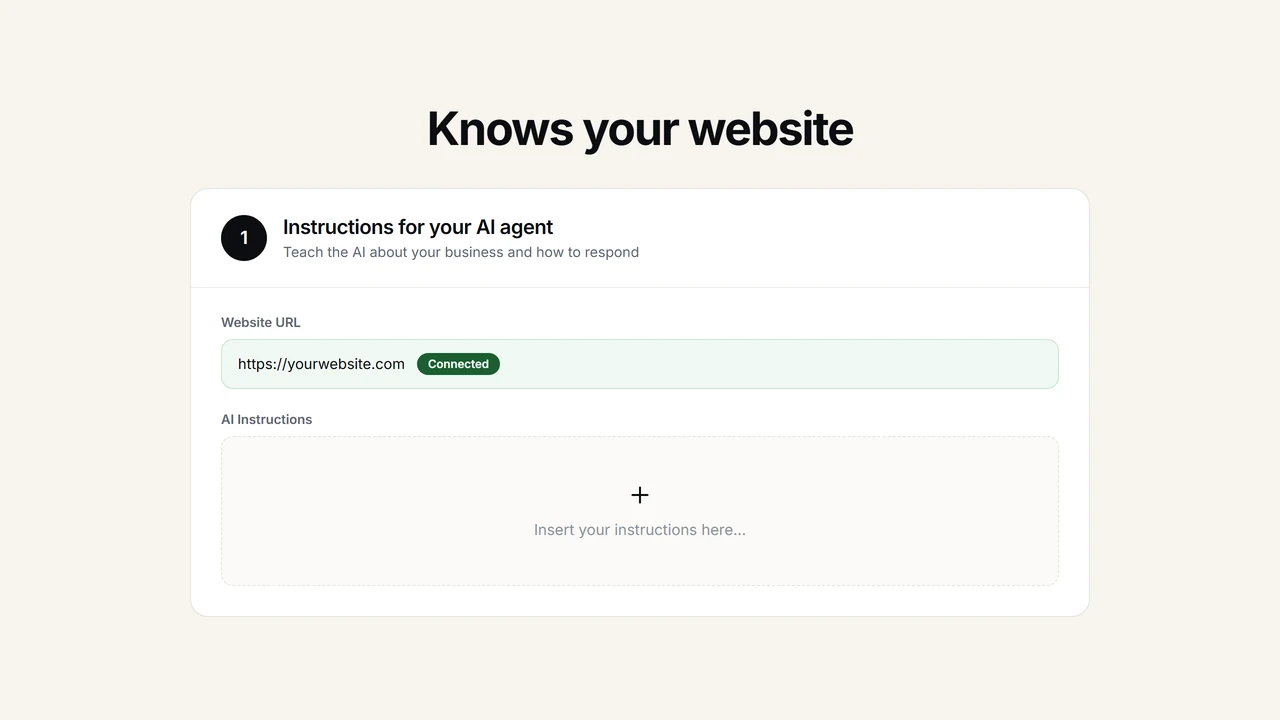
Most chat plugins are built for one platform. A WordPress plugin that needs PHP hooks. A Shopify app that relies on Liquid theme editing. A Wix integration that only works inside their ecosystem. You end up researching compatibility before you can even try the product. Asyntai sidesteps all of that. The entire chat plugin is a single script tag — one line of HTML that loads asynchronously, never blocks your page, and renders a fully functional AI chat widget in the bottom corner. The AI auto-crawls your site, indexes your published pages, and starts answering visitor questions using your content. When you connect a product feed, it renders Dynamic Product Cards — visual cards with images, prices, and buy buttons — directly inside the conversation.
- Platform-agnostic by designThe chat plugin loads from a single script tag. It has no dependencies on your CMS, framework, theme engine, or server-side language. WordPress, Shopify, Wix, Squarespace, Webflow, Joomla, Drupal, Magento, Ghost, Hugo, Jekyll, Next.js, Nuxt, Gatsby, plain HTML — anything that renders in a browser runs the plugin.
- AI answers using your contentOnce you connect your site, the AI crawls every published page — product listings, service descriptions, help articles, policy pages, blog posts — and builds a retrieval index. When a visitor asks a question, the AI finds the relevant content and composes a natural-language answer. No FAQ sheets to write. No decision trees to build.
- Dynamic Product Cards from your catalogConnect a product data feed (JSON, CSV, or any API endpoint) and the chat plugin renders matching products as visual cards: product image, name, price, description, and a buy button. Multiple matches display as a swipeable carousel. Visitors browse products inside the conversation without navigating to a search results page.
Custom Tools, live data, 36 languages — and a free plan to start
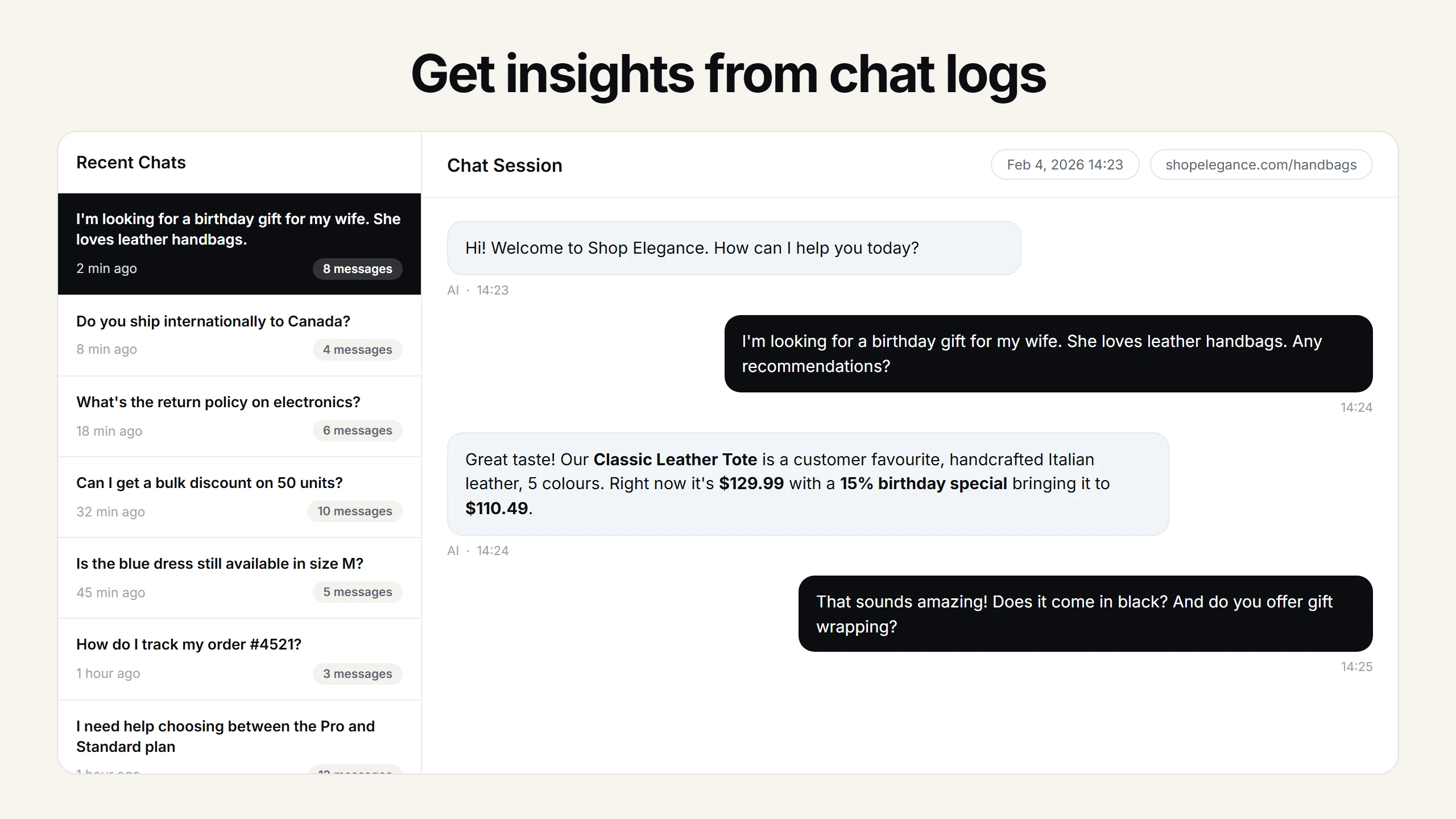
A chat plugin that only answers text questions is a glorified FAQ page. Asyntai goes further. Custom Tools let the AI call your own API endpoints to perform real actions — check order status, look up shipping estimates, verify appointment availability, process return requests. The Real-Time Data Feed keeps your product information current to the minute. Built-in multilingual support covers 36 languages automatically, so a visitor in Tokyo and a visitor in Berlin both get answers in their own language from the same English content. And you can start on the free plan with 50 messages per month — no credit card, no trial expiration.
- Custom Tools for real actionsDefine API endpoints that the AI can call during a conversation. Order status lookups, inventory checks, appointment scheduling, return processing — the chat plugin becomes a self-service portal, not just an answer bot. Each tool you connect adds another action the AI can take without the visitor leaving the chat.
- Real-Time Data Feed for live accuracyPoint Asyntai at a URL that returns your product catalog or service data. Price changes and stock updates reflect immediately. New items appear within 24 hours. The AI always references what you actually sell or offer right now, not a stale snapshot from last week's crawl.
- 36 languages, zero translation workThe chat plugin detects the visitor's browser language and responds accordingly. A Spanish-speaking visitor asks a question in Spanish; the AI searches your English content, finds the answer, and responds in Spanish. You maintain one set of content. The AI handles the language layer across all 36 supported languages.
Add the chat plugin to your website in under five minutes
No developer needed. No platform-specific app to install. Sign up, let the AI crawl your site, copy one snippet, paste it before the closing body tag. The chat plugin loads on every page from that moment forward. Works the same way whether your site runs on WordPress, Shopify, Wix, or a hand-coded HTML file.
- Create a free Asyntai account and enter your website URL. The AI begins crawling your published pages automatically.
- Copy the embed snippet from your Asyntai dashboard — it is a single script tag with your unique site ID.
- Paste the snippet into your website's HTML, just before the closing
</body>tag. On WordPress, use the official plugin instead. On Shopify, paste it into your theme'stheme.liquidfile. On Wix or Squarespace, use their custom code injection setting. - The chat widget appears on every page. Customize colors, greeting message, avatar, and behavior from your Asyntai dashboard — changes apply instantly without touching your site's code again.
<!-- Paste before </body> on any website -->
<script src="https://asyntai.com/widget.js"
data-id="your-site-id" async>
</script>
# One snippet. Any website. AI chat is live.
Website chat plugin — frequently asked questions
Common questions from website owners, developers, and agencies evaluating an AI-powered chat plugin.
Does this chat plugin work on my website platform?
If your website can load a JavaScript snippet, the chat plugin works. It runs on WordPress, Shopify, Wix, Squarespace, Webflow, Joomla, Drupal, Magento, OpenCart, PrestaShop, BigCommerce, Ghost, Hugo, Jekyll, Gatsby, Next.js, Nuxt, Angular, React, Vue, Svelte, and plain HTML sites. The plugin loads from a single script tag with no dependencies on your CMS, framework, or server-side language. There is no compatibility list to check — if the page renders in a browser, the chat plugin works on it.
How does the AI know what to say about my website?
When you connect your site, the AI crawls every published page and builds a retrieval index from your content — product pages, service descriptions, help articles, about pages, blog posts, policy documents. When a visitor asks a question, the AI searches this index, finds the most relevant passages, and composes a natural-language answer. You can also upload additional documents (PDFs, guides, internal knowledge) and connect a Real-Time Data Feed for structured product data. The AI draws from all sources simultaneously and always cites your content, never invents information.
What are Dynamic Product Cards?
Dynamic Product Cards are visual product displays that appear inside the chat conversation. When a visitor describes what they are looking for, the AI searches your product data and renders matching items as cards with the product image, name, price, a short description, and a buy or view button. Multiple matches display as a horizontal carousel the visitor can swipe through. The cards turn text-based chat into a visual product browsing experience. They require a connected Real-Time Data Feed and are available on the Standard plan and above.
What are Custom Tools and what can they do?
Custom Tools let you define API endpoints that the AI can call during a conversation. When a visitor asks something that requires live data or an action — checking order status, looking up shipping estimates, verifying appointment availability, processing a return — the AI calls the relevant tool, receives the response, and incorporates it into its reply. You define the tool's URL, parameters, and description in your dashboard. Custom Tools are available on the Standard plan and above, and there is no limit on the number of tools you can create.
How does multilingual support work?
The chat plugin supports 36 languages. It detects the visitor's browser language and responds in that language automatically. A visitor who writes in French receives a French-language response, even if your website content is entirely in English. The AI handles the translation layer — you maintain one set of content in your primary language, and the AI serves visitors in theirs. Supported languages include English, Spanish, French, German, Portuguese, Japanese, Korean, Chinese, Arabic, Hindi, and 26 others.
Is there a free plan?
Yes. The free plan includes 50 AI-powered messages per month, automatic site crawling, and the full chat widget with customizable appearance. No credit card is required to sign up, and there is no trial expiration — the free plan is permanent. When you need more messages, Dynamic Product Cards, Real-Time Data Feed, or Custom Tools, paid plans start at $39 per month (Starter, 800 messages). Standard ($139/month, 15,000 messages) unlocks product cards, data feeds, and Custom Tools. Pro ($449/month, 50,000 messages) adds higher limits and Real-Time Data Feed Max.
Will the chat plugin slow down my website?
No. The script tag loads asynchronously, which means it never blocks your page from rendering. Your page content, images, and interactive elements load at full speed. The chat widget initializes in the background after your page is ready. The total script size is small, it is served from a CDN, and it caches in the visitor's browser after the first load. Lighthouse, PageSpeed Insights, and Core Web Vitals scores are unaffected by the chat plugin.
Can I customize the appearance of the chat widget?
Yes. From your Asyntai dashboard you can change the widget color scheme, position (left or right corner), greeting message, assistant name, avatar image, and input placeholder text. You can also set the widget to start open or closed, enable or disable specific features like file uploads or transcript downloads, and control which pages the widget appears on. All changes apply instantly without editing your website code — the widget pulls its configuration from your dashboard each time it loads.
What a modern website chat plugin actually needs to do — and why most of them fall short
The phrase "website chat plugin" has been around long enough to accumulate a thick layer of assumptions. For most people, it conjures a small bubble in the corner of a screen, a few canned responses, maybe a form that collects a name and email before connecting the visitor to a human agent who may or may not be available. That model — live chat with a thin automation wrapper — served its purpose for a decade. But visitor expectations have shifted. People now expect to type a question in natural language and get an actual answer, not a menu of predefined options or a "we'll get back to you in 24 hours" holding message. The gap between what visitors expect from a chat plugin in 2026 and what most chat plugins actually deliver is wide enough to cost businesses real revenue.
The root of the problem is architectural. Traditional chat plugins are either live-chat tools (which require humans to be online) or rule-based chatbots (which require someone to anticipate every possible question and write a scripted response for it). Live chat works well for businesses that can staff agents around the clock, but most cannot. Rule-based bots work for a narrow set of predictable questions — store hours, return policies, pricing tiers — but collapse the moment a visitor asks something the script did not anticipate. And visitors are creative. They ask about product combinations. They describe needs instead of naming products. They follow up with context from three messages ago. Rule-based systems cannot handle any of this because they do not reason — they pattern-match.
An AI-powered chat plugin replaces pattern matching with language comprehension. Instead of matching a visitor's message against a library of keywords and triggers, the AI reads the message, understands the intent, searches a knowledge base built from the website's actual content, and composes a fresh response. Every reply is generated, not retrieved from a template. This means the plugin can handle questions it has never seen before, follow multi-turn conversations naturally, and combine information from multiple pages to answer a complex query. The shift from scripted to generative is not incremental — it is the difference between a tool that handles the five questions you expected and a tool that handles the five hundred questions you did not.
Asyntai's website chat plugin is built on this generative foundation, but the part that matters most to website owners is not the AI model — it is the knowledge layer. When you connect your website, the AI crawls every published page and builds a retrieval index. Product descriptions, service pages, help articles, blog posts, pricing tables, policy documents, team bios — anything a visitor can read on your site, the AI can reference in a conversation. You do not need to write FAQ sheets, build dialogue trees, or manually curate a knowledge base. The AI reads your website and learns from it the same way a new employee would, except it does it in minutes and never forgets a page.
This automatic knowledge acquisition is what makes the chat plugin platform-agnostic. Because the AI learns from your published URLs rather than from a CMS integration, the underlying platform is irrelevant. A WordPress site with 200 pages and a hand-coded HTML site with 20 pages go through the same crawl process. A Shopify store with 5,000 products and a Squarespace portfolio site with 30 projects are both indexed the same way. The chat plugin does not need to integrate with your platform's database, call its APIs, or understand its content model. It reads the same HTML that your visitors read. This is why one script tag works everywhere — the plugin's knowledge comes from the web, not from a platform-specific data source.
Where structured data matters — product catalogs with prices, stock levels, and images — the Real-Time Data Feed fills the gap. You provide a URL that returns your product or service data in JSON, CSV, or through an API endpoint. The AI indexes this feed and uses it alongside your crawled content. When a visitor asks about a product, the AI checks both the crawled page content and the structured data feed, giving it access to current pricing and availability that a crawled page might not reflect. Price changes in the feed are reflected immediately. New products appear within 24 hours. Items removed from the feed stop appearing in results. The feed is the accuracy layer; the crawled content is the breadth layer. Together, they give the AI comprehensive and current knowledge.
Dynamic Product Cards are the visual output of that product knowledge. When a visitor describes what they are looking for — "a moisturizer for dry skin under $30" or "a standing desk with a cable management tray" — the AI searches the data feed, finds matching products, and renders them as visual cards inside the conversation. Each card shows the product image, name, price, a brief description, and a buy or view button. When there are several matches, the cards appear as a horizontal carousel. The visitor browses products without leaving the chat, without navigating to a search results page, without the back-button loop that ecommerce search typically requires. The chat plugin becomes a product discovery channel as well as a support tool.
But a chat plugin that only answers questions and shows products is still reactive. The visitor has to know what to ask. Custom Tools make the plugin proactive and transactional. A Custom Tool is an API endpoint you define — a URL, a set of parameters, and a plain-language description of what it does. When the AI determines that a visitor's question requires live data or an action, it calls the relevant tool, receives the response, and weaves the result into its reply. Order status lookups. Shipping cost calculations. Appointment availability checks. Return request submissions. Coupon validation. Each tool you connect extends the chat plugin from an answer engine into a self-service portal that can actually do things for the visitor.
Consider the difference in visitor experience. Without Custom Tools, a visitor who asks "where is my order?" gets a reply like "You can check your order status at our tracking page" with a link. With Custom Tools, the same visitor types "where is my order?" and the AI asks for their order number or email, calls your order-status API, and replies "Your order #4821 shipped on Tuesday via FedEx and is currently in transit — estimated delivery is Thursday." The visitor got the answer they came for without navigating away, without logging into an account portal, without waiting for a human agent. That is the gap between a chat plugin that redirects and a chat plugin that resolves.
Multilingual capability adds another dimension that most chat plugins ignore entirely. Asyntai supports 36 languages out of the box. The AI detects the visitor's language from their message or browser settings and responds in that language, regardless of what language your website content is written in. A German-speaking visitor asks a question in German about a product described in English, and the AI responds in German with accurate product details pulled from the English-language data feed. You do not need a multilingual website. You do not need translated FAQ sheets. The AI handles the language bridge, and it does so fluently — not with the stilted phrasing of machine translation tools, but with natural-sounding responses that read as if your site was natively multilingual.
For businesses that serve international visitors — which, on the internet, is nearly every business — this has a direct revenue impact. A visitor who lands on an English-language ecommerce site and cannot communicate in English will leave. A visitor who lands on the same site and sees a chat widget that speaks their language will ask their question. That question might be about product sizing, shipping to their country, payment methods, or whether a product works for their specific use case. Every one of those questions, answered in the visitor's language, is a potential conversion that would otherwise be lost. The chat plugin turns a language barrier into a non-issue.
Installation simplicity matters more than most plugin vendors acknowledge. Every additional step in the setup process — creating API keys, configuring webhooks, editing theme files, mapping content fields, building dialogue flows — increases the chance that a website owner will abandon the setup before going live. Asyntai reduces the installation to its absolute minimum: sign up, enter your URL (the AI starts crawling immediately), copy one script tag, paste it into your site. On WordPress, there is an official plugin that makes even the paste step unnecessary. On Shopify, you paste the snippet into your theme.liquid file. On Wix, you use the custom code injection setting under Advanced. On Squarespace, you paste it under Code Injection in Settings. On a custom site, you add it before the closing body tag. In every case, the same snippet, the same process, the same result.
Once the snippet is live, all configuration happens from the Asyntai dashboard — not from your website's code. Widget color, position, greeting message, assistant name, avatar, input placeholder, and every behavioral setting are controlled from the dashboard and applied instantly. This means you can rebrand the chat widget, change its greeting, or adjust its behavior without touching your site's codebase, without deploying a new version, without coordinating with a developer. If you move your website from one platform to another — say, from WordPress to Webflow — the chat plugin moves with you by pasting the same snippet. Your conversation history, knowledge base, configuration, and Custom Tools all remain intact because none of them live on your website. They live on Asyntai's platform.
The pricing structure reflects the "start free, scale up" model. The free plan includes 50 messages per month, automatic site crawling, and the complete chat widget with full customization. There is no credit card required and no trial countdown — the free plan does not expire. This makes it practical for small sites, portfolio pages, personal blogs, and businesses that want to evaluate the chat plugin with real visitors before committing to a paid plan. When traffic or feature needs grow, the Starter plan at $39 per month provides 800 messages. Standard at $139 per month unlocks Dynamic Product Cards, Real-Time Data Feed, Custom Tools, and 15,000 messages. Pro at $449 per month extends to 50,000 messages and Real-Time Data Feed Max for large catalogs.
The free tier is not a stripped-down demo. It runs the same AI model, the same retrieval system, the same chat widget as paid plans. A visitor interacting with a free-tier chat plugin gets the same quality of response as a visitor on a Pro-tier widget. The difference is capacity and advanced features, not quality. This matters because the first impression a chat plugin makes — the first answer it gives to the first visitor who types a question — determines whether the website owner keeps it installed. If that first answer is generic, irrelevant, or obviously scripted, the plugin gets removed. If it is specific, accurate, and clearly drawn from the website's own content, the plugin stays.
Performance is the concern that website owners raise most often, and rightfully so. Every script added to a page carries a cost — in load time, in rendering delay, in the dreaded Lighthouse score drop that can affect search rankings. Asyntai's chat plugin loads asynchronously via a single script tag with the async attribute. This means the browser fetches the script in the background without blocking the page from rendering. Your text, images, and interactive elements load at full speed. The chat widget initializes after the page is ready. The script itself is lightweight, served from a CDN, and cached in the visitor's browser after the first load. In testing across thousands of sites, the impact on Lighthouse performance scores, Largest Contentful Paint, and Cumulative Layout Shift is negligible — effectively zero.
Privacy and data handling deserve a direct statement rather than a footnote. The chat plugin does not track visitors across sites, does not sell conversation data, and does not use visitor conversations to train models. Conversation data belongs to the website owner. GDPR-compliant data processing is standard, not an add-on. Website owners can view, export, and delete conversation transcripts from their dashboard. For businesses in regulated industries — healthcare, finance, legal, education — the privacy posture matters as much as the feature set, and Asyntai treats it as a first-class requirement rather than an afterthought.
The category of "website chat plugin" is in transition. The old generation — live chat tools and rule-based bots — will not disappear overnight, but their limitations are increasingly visible to the website owners who use them and the visitors who interact with them. The new generation is AI-native: plugins that understand language, learn from content, render visual product displays, call external APIs, and serve visitors in 36 languages from a single installation. Asyntai sits firmly in this new generation. One snippet, any website, real AI. That is the pitch because that is the product. If your website can load a script tag, this chat plugin will work on it — and it will answer visitor questions better than any FAQ page, rule-based bot, or unmanned live chat window ever could.
The websites that benefit most from an AI chat plugin share a common trait: they have more content than visitors can easily navigate. A service business with 40 pages describing different offerings. An ecommerce store with hundreds of products across dozens of categories. A SaaS company with technical documentation, pricing tiers, and integration guides. A nonprofit with program descriptions, eligibility criteria, and event schedules. In each case, the information the visitor needs exists on the site — but finding it requires knowing where to look. The chat plugin short-circuits that navigation problem. The visitor asks a question in their own words, and the AI finds the answer from wherever it lives on the site. No menu diving. No search bar keyword guessing. No bouncing between pages hoping to land on the right one. The chat plugin turns a 200-page website into a single point of contact that knows every page.