Retail customer experience software that turns every browse into a conversation and every conversation into a sale
Asyntai gives your retail site an AI shopping assistant that answers product questions, checks order status, and guides visitors to the right item — around the clock, in 36 languages.
See AI-powered retail experience on your own site
Enter your store URL and watch the AI answer real product questions pulled directly from your pages
Turn product pages into guided shopping conversations
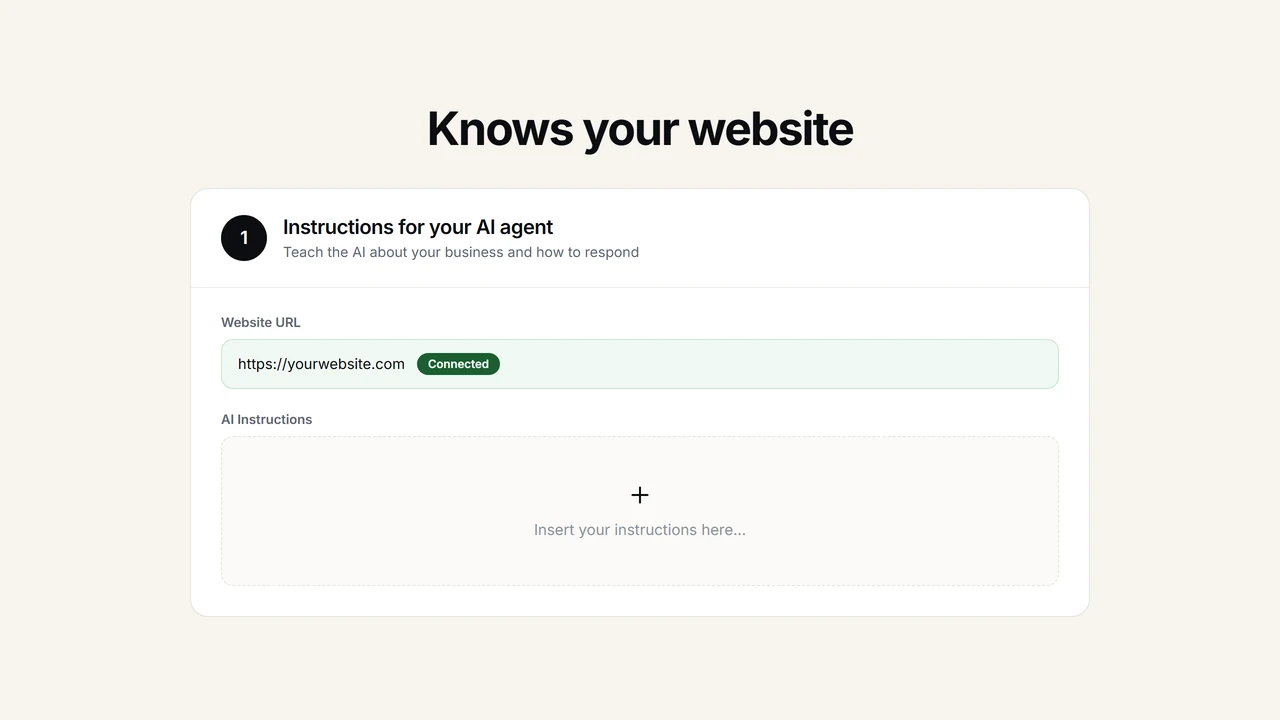
Retail moves on immediacy. A shopper staring at a product page has the same question a customer in a physical store would ask the nearest associate: does this come in my size, when can I get it, what goes well with it? The difference is that the in-store customer gets an answer in seconds and the online visitor gets a search bar and a hope. Retail customer experience software from Asyntai closes that gap by reading your product catalog, sizing charts, shipping policies, return windows, and FAQ pages — up to 50 pages crawled automatically — and using that knowledge to answer shopper questions instantly in the chat widget. No decision trees, no canned responses, no scripting. The AI composes answers from your real content, so every response reflects your actual inventory, pricing, and policies.
- Automatic catalog ingestionProvide your store URL and the AI crawls product listings, category pages, sizing guides, shipping tables, and return policies — building a knowledge layer that mirrors what a well-trained floor associate would know.
- Supplementary document uploadsUpload lookbooks, seasonal promotion briefs, vendor spec sheets, or internal care-instruction guides as PDFs. The AI references them alongside public pages to deliver detailed, accurate answers.
- Store-specific behavioral rulesWrite instructions like "always suggest complementary accessories," "never promise price matching without manager approval," or "recommend the loyalty program when order value exceeds $75." The AI follows every rule on every conversation.
Retail experiences that pull live inventory, track orders, and act on behalf of the shopper
Product knowledge covers the browsing stage. But modern retail shoppers also want real-time answers — is my order shipped, can I change the delivery address, do you have this in stock at the downtown location? With Custom Tools on Standard ($139/month) and Pro ($449/month) plans, the AI calls your own API endpoints mid-conversation to retrieve live inventory counts, shipment tracking, loyalty point balances, or appointment availability — and can trigger actions like return initiations or size exchanges without handing off to a human agent.
- Live inventory and availability checksThe AI queries your inventory system to confirm stock levels, available sizes, colorways, or store-specific availability — giving shoppers a definitive answer instead of a suggestion to call the store.
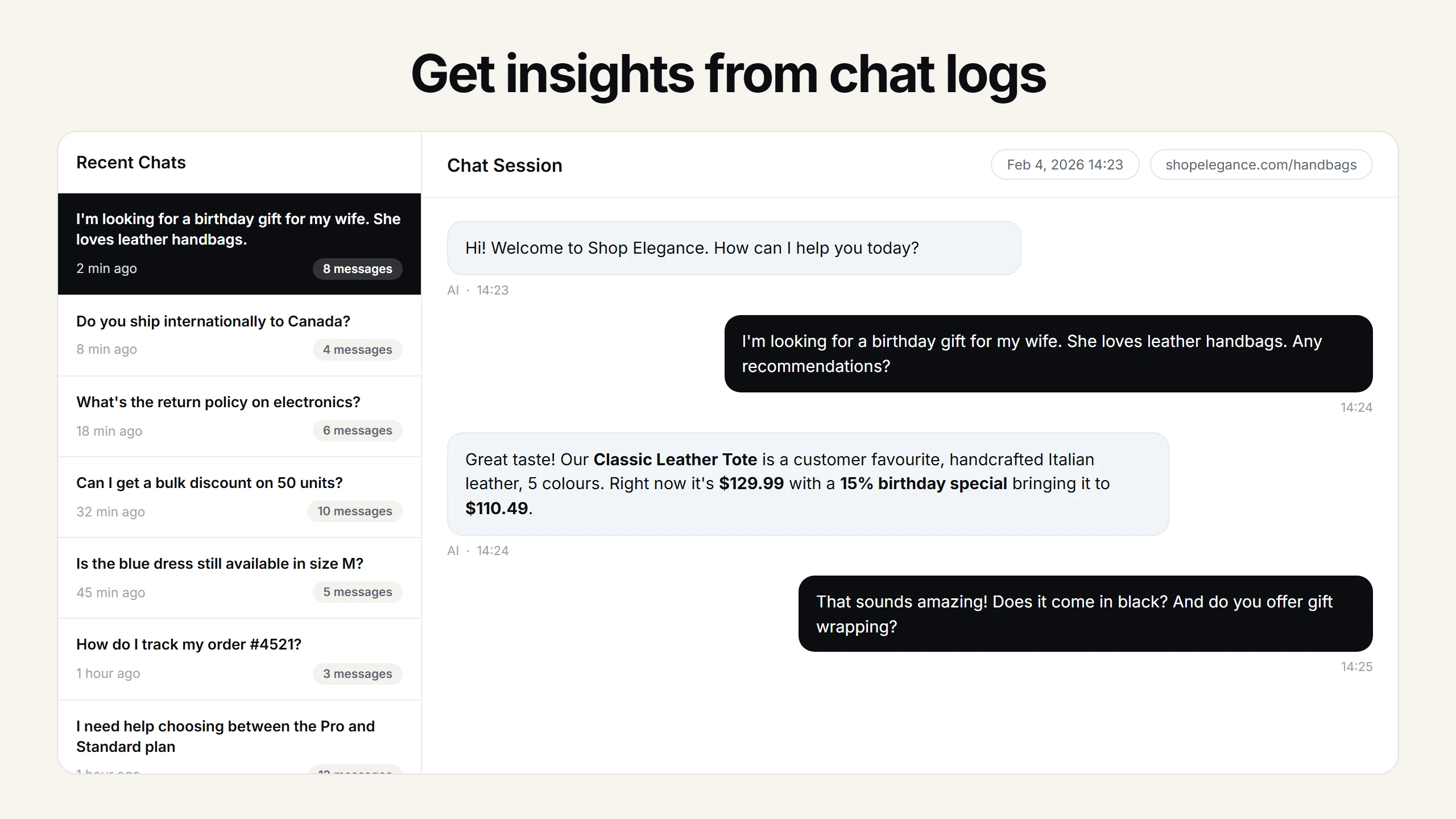
- Order tracking within the chatShoppers ask "where is my order?" and the AI calls your fulfillment API, returning carrier, tracking number, estimated delivery date, and current status — no portal login, no email search required.
- Shopper context for returning customersPush customer data via window.Asyntai.userContext on Standard and Pro plans so the AI knows the visitor's loyalty tier, past purchases, or saved preferences before the conversation begins.
- 36-language auto-detectionA shopper writing in Spanish gets Spanish. One writing in Japanese gets Japanese. The interface and AI responses operate natively across 36 languages — no separate configuration, no translation plugins.
- Seamless escalation to your retail teamWhen a question requires human judgment — a complex return, a product complaint, a custom order — the AI collects contact details, preserves the full transcript, and delivers everything to your dashboard and inbox.
Launch your retail AI assistant before the next shift change
No integration project, no IT tickets, no multi-week vendor onboarding. One JavaScript snippet in your store's header, one content crawl, a few behavioral rules, and your retail site has a shopping assistant that never clocks out.
- Create a free Asyntai account — no credit card, no sales call. The free plan covers 1 site and 50 messages per month at $0, enough to test retail customer experience software on real shoppers.
- Copy your unique snippet from the dashboard and paste it into your store's
<head>section via your CMS, tag manager, or a native plugin for WordPress, Shopify, WooCommerce, Magento, BigCommerce, PrestaShop, or OpenCart. - Point the crawler at your store URL and upload any supplementary documents — sizing guides, care instructions, seasonal promotions. The AI builds its knowledge layer from your actual catalog and policies.
- Scale when ready: Starter at $39/month covers 2 sites and 800 messages, Standard at $139/month covers 3 sites and 15,000 messages with Custom Tools for live inventory and order tracking, and Pro at $449/month covers 20 sites and 50,000 messages with white-label branding.
<script src="https://asyntai.com/widget.js"
data-id="your-site-id" async>
</script>
# Your AI shopping assistant is live. No servers, no maintenance.
Retail Customer Experience Software — FAQs
The questions retail operators and e-commerce managers ask before adding an AI shopping assistant to their storefront.
How does the AI learn about my products?
You provide your store URL and the system crawls up to 50 pages — product listings, category pages, sizing charts, shipping policies, FAQ sections. You can also upload PDFs like lookbooks or vendor spec sheets. The AI uses all of this content to answer shopper questions accurately. There are no decision trees to build and no canned responses to write.
Can the AI check real-time inventory or order status?
Yes, on Standard ($139/month) and Pro ($449/month) plans. Custom Tools let the AI call your own API endpoints mid-conversation — checking stock levels, pulling tracking numbers, verifying store-specific availability, or triggering actions like return initiations. You define the endpoints and the AI decides when to call them based on the shopper's question.
Does it work with my e-commerce platform?
Asyntai works with any platform that allows a JavaScript snippet in the page header — Shopify, WooCommerce, Magento, BigCommerce, PrestaShop, OpenCart, Wix, Squarespace, and custom-built stores. Native plugins are available for the most popular platforms. Installation takes under five minutes.
How does the AI handle shoppers in different languages?
The system auto-detects the shopper's language from their first message and responds natively in 36 languages. A French visitor gets French, a Korean visitor gets Korean. There is no per-language setup, no translation plugin, and no additional cost for multilingual retail support.
What happens during seasonal rushes when traffic spikes?
The AI handles unlimited simultaneous conversations without degradation. Whether ten shoppers ask questions at once or ten thousand, every visitor receives an instant, accurate response. There are no queues, no wait times, and no need to hire seasonal staff for chat coverage. Your only variable is message volume against your plan cap.
Can I control the AI's selling behavior?
Completely. You write behavioral instructions in plain language — promote certain collections, suggest complementary products, avoid discounting without approval, always mention free shipping thresholds, steer clearance conversations toward the current season. The AI follows every rule across every conversation, every language, every hour of the day.
What does pricing look like for retail?
Plans are based on monthly message volume, not seats or agents. Free covers 50 messages for 1 store. Starter is $39/month for 800 messages across 2 stores. Standard is $139/month for 15,000 messages across 3 stores with Custom Tools for inventory and order integrations. Pro is $449/month for 50,000 messages across 20 stores with automatic white-label branding. You receive email warnings before reaching the cap.
Can the AI recommend products the way a store associate would?
Yes. The AI understands your full catalog from the crawled content and can suggest products based on what the shopper describes — occasion, budget, style preference, compatibility with a previous purchase. You can shape these recommendations further with behavioral rules like "always suggest the matching belt when discussing dress shoes."
What happens when the AI cannot help a shopper?
Escalation activates automatically: the AI collects the shopper's name and email, preserves the entire conversation transcript, and delivers everything to your Asyntai dashboard. If email forwarding is enabled, the same package arrives in your team's inbox simultaneously. Your associate picks up the thread with full context — no cold restart for the shopper.
Retail customer experience software — how AI brings the best of in-store service to every screen
Walk into any well-run retail store and you notice the same thing within the first thirty seconds: someone acknowledges you. Not a hard sell, not a clipboard and a questionnaire — just a person near the entrance who makes eye contact, nods, and lets you know they are there if you need anything. That single moment of recognition changes the entire shopping experience. It transforms a browser into a participant. Online retail has never replicated this moment reliably. Pop-ups interrupt. Chat buttons sit silent. Contact forms feel like dropping a note into a void. Retail customer experience software built on AI finally closes the gap — placing an attentive, knowledgeable assistant on every page of your store, ready the instant a shopper has a question, without the shopper having to seek it out.
The parallel to physical retail runs deeper than a greeting. A great floor associate does not just stand there waiting to be flagged down — they read context. They notice when someone picks up a garment, checks the tag, puts it back, and reaches for the next size. They notice when someone circles the same display twice. They intervene with the right information at the right moment: "That runs a half-size small," or "We just got those in the olive colorway, it's in the back." AI-powered retail customer experience software does the same thing digitally. When a visitor lands on a product page and opens the chat, the AI already knows which product they are looking at. It can answer sizing questions, suggest coordinating items, confirm availability, and explain return policies — all drawn from your own catalog content, not a generic script.
Seasonality is the heartbeat of retail, and it is also the operational challenge that makes traditional support models crack. Black Friday does not send a calendar invite — it arrives with a traffic surge that overwhelms your chat queue, your email inbox, and your phone lines simultaneously. Hiring seasonal agents means recruiting, onboarding, and training people who will leave in eight weeks. Retail customer experience software absorbs that surge without flinching. Whether your site handles fifty conversations on a Tuesday in February or five thousand on the first hour of a flash sale, every shopper gets an immediate, accurate answer. The AI does not need onboarding. It does not need a break room. It does not forget the return policy on its second day.
Product discovery is where retail lives or dies online, and it is where static search bars consistently fail. A shopper who types "blue dress for outdoor wedding" into a site search gets a wall of results sorted by relevance algorithms that know nothing about weddings, weather, or formality. The same shopper asking that question in a chat powered by retail customer experience software gets a curated conversation: "Are you thinking cocktail length or maxi? Do you need something with sleeves for an evening ceremony?" The AI narrows the catalog to a handful of genuine options based on the shopper's actual intent, then links directly to those products. Discovery becomes dialogue, and dialogue converts at rates that search-and-scroll cannot approach.
Order tracking is the post-purchase moment where retail brands either build loyalty or bleed it. The shopper who placed an order three days ago does not want to dig through email for a confirmation, find a tracking number, paste it into a carrier website, and interpret a status page written in logistics shorthand. They want to type "where is my order?" and get a plain answer. With Custom Tools on Standard ($139/month) and Pro ($449/month) plans, the AI calls your fulfillment API mid-conversation, retrieves the carrier, tracking number, and estimated delivery date, and presents it in a single clear response. The shopper's next feeling is relief, not frustration — and that feeling becomes the memory they associate with your brand.
Multilingual retail is no longer a luxury for international brands — it is table stakes for any store that ships beyond its own borders. A home goods retailer in Toronto receives traffic from visitors who speak French, Mandarin, Tagalog, and Punjabi. A fashion brand in Berlin attracts shoppers from across the EU writing in Polish, Italian, Dutch, and Greek. Hiring multilingual support agents for each language is economically impossible for most retailers. Retail customer experience software through Asyntai operates natively in 36 languages with automatic detection. The visitor writes in their language, the AI responds in the same language, and the experience feels local regardless of where the store is headquartered. No routing, no translation plugins, no per-language configuration.
The knowledge layer behind effective retail AI is not a database of keywords and canned responses — it is a living representation of your store's actual content. Asyntai crawls up to 50 pages from your website, absorbing product descriptions, pricing tables, size charts, material compositions, care instructions, shipping zones, delivery timelines, and return windows. You supplement the crawl with uploaded documents: vendor spec sheets that list exact fabric weights, internal guides that specify which items qualify for gift wrapping, seasonal promotion briefs that define discount windows and exclusion lists. The AI treats all sources equally when composing answers, drawing from both public and private knowledge to deliver responses as detailed and accurate as those from your most experienced associate.
Behavioral rules transform the AI from a knowledgeable responder into a disciplined brand representative. Retail has nuances that generic automation misses: you might want the AI to always mention your free-shipping threshold when a cart subtotal is close, never promise same-day delivery in certain postal codes, always recommend a care kit when someone buys leather goods, or escalate any conversation that mentions a product defect. These rules are written in plain sentences, not code — and the AI enforces them on every conversation, in every language, at every hour. The consistency is absolute in a way that human teams, across shifts and turnover cycles, cannot replicate.
Returning customers deserve a different experience than first-time browsers, and retail customer experience software on Standard and Pro plans makes that distinction automatic. Your website pushes shopper data into the chat via a JavaScript variable before the conversation begins — loyalty tier, recent order history, saved size preferences, wishlist items, lifetime spend. The AI uses this context naturally. A Gold-tier member asking about a restock gets a different tone and priority than a first-time visitor. A shopper who bought running shoes last month and is now browsing socks gets a suggestion that references their previous purchase. The experience feels personal because it is personal — not because someone wrote a personalization script, but because the AI has real context about the real person it is speaking with.
White-label branding lets the AI disappear into your retail identity. On Pro plans ($449/month), white-labeling is automatic — the chat widget carries your brand name, your colors, your logo, and no mention of Asyntai anywhere the shopper can see. On Standard plans ($139/month), the same branding is available by contacting [email protected]. For multi-brand retailers operating several storefronts under one corporate umbrella, each site gets its own independent knowledge base, behavioral rules, branding, and conversation history. The AI serving your luxury line knows nothing about your outlet brand, and vice versa.
The analytics that emerge from retail customer experience software reveal patterns that traditional e-commerce analytics miss entirely. You see what shoppers actually ask about — which products generate the most questions, which sizing charts cause confusion, which policies trigger frustration, which pages drive the most chat engagement. A surge in questions about a specific product's compatibility signals a gap in the product description. Repeated escalations around return shipping costs suggest that your return policy page needs a rewrite. The AI does not just answer questions — it surfaces the friction points in your shopping experience so you can fix them at the source.
Multi-store deployment is built into the plan structure, not bolted on as an enterprise add-on. A fashion group running three brands, a franchise operation with regional storefronts, or an agency managing retail clients — all benefit from site limits that scale with the plan: 1 on Free, 2 on Starter, 3 on Standard, 20 on Pro. Each store operates independently with its own crawled catalog, uploaded documents, behavioral rules, and conversation archive. Content from one storefront never bleeds into another, ensuring brand separation and product accuracy across every deployment.
Installation does not require a development sprint or an IT procurement cycle. You register an account, copy a JavaScript snippet, and paste it into your store's page header — directly in your CMS, through a tag manager, or via a native plugin for Shopify, WooCommerce, Magento, BigCommerce, PrestaShop, or OpenCart. You provide your URL for automatic content crawling. You upload supplementary documents. You write a handful of behavioral rules in plain sentences. You run test conversations. The whole process fits inside a lunch break. From that point forward, the AI operates your digital shop floor continuously — greeting visitors, answering questions, recommending products, checking orders, and escalating the conversations that genuinely need your team's attention.
Retail customer experience software through Asyntai is free to start — 1 store, 50 messages, no credit card — and designed to prove its value on real shopper traffic before you commit a dollar. Paid plans begin at $39/month for Starter, scaling through Standard at $139/month with Custom Tools for inventory and order integrations, to Pro at $449/month for high-volume multi-store retail operations. The distance between where your online shopping experience sits today and where it could operate with an AI associate on every page is shorter than a shift change, and the pricing page is the fastest way to see which tier fits your traffic.