Magento chatbot built for catalogs that outgrow simple stores
Asyntai ships an official Magento 2 extension that drops AI chat onto every storefront page. It absorbs your product data, policy content, and custom knowledge — then fields buyer questions about configurable products, tier pricing, and stock across store views, in 36 languages, around the clock.
See the Magento chatbot handle your own catalog
Paste your Magento store URL and watch the assistant answer real product and policy questions from your storefront
An assistant that understands configurable products, not just flat listings
Magento stores carry catalogs that would overwhelm a generic chat tool — thousands of SKUs, configurable products with dozens of attribute combinations, grouped and bundled items, tier pricing for wholesale buyers. The Magento chatbot absorbs all of it and answers at the attribute level, not the product-page level.
- Configurable and grouped products stay structuredSize, colour, material, and custom attributes remain separate fields, so the chatbot resolves "is the 220V version available in black?" without guessing from page text.
- Tier pricing and customer-group logicIf your catalog exposes wholesale tiers or customer-group pricing, the chatbot references the data it has — not a single retail price scraped from the frontend.
- Multi-store, multi-language catalogsMagento's store-view architecture means the same SKU can carry different descriptions per locale. The chatbot works with the content your storefront actually renders for each audience.
Turn browsing sessions into pipeline, not just pageviews
Magento merchants sell to audiences that research before they commit — wholesale buyers comparing MOQs, procurement managers vetting specifications, retail shoppers weighing configurator options. The Magento chatbot meets each of them mid-decision and moves the conversation toward action.
- Proactive engagement on high-intent pagesAuto-trigger opens the chat after a configurable delay on product and category pages, intercepting the pause before a buyer closes the tab or switches to a competitor.
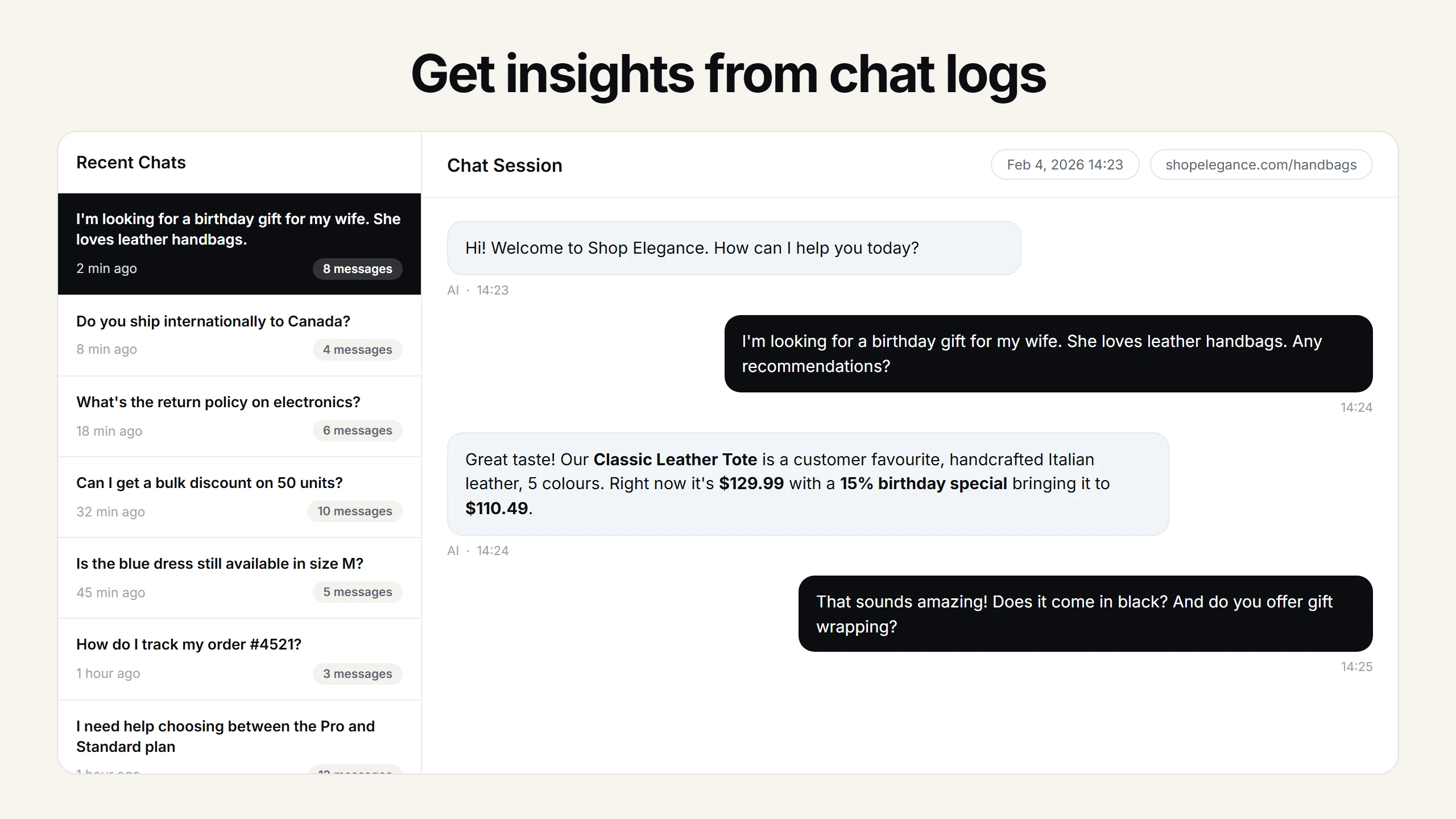
- Lead capture with full conversation contextThe chatbot asks for email or phone mid-conversation. Captured leads arrive in your Asyntai dashboard with the complete transcript, plus optional instant email alerts to your sales team.
- Analytics that reveal catalog frictionSee which product categories trigger the most questions, which attributes confuse buyers, and which policy gaps send them elsewhere — then fix upstream instead of answering forever.
Native Magento 2 extension — Composer or manual, your call
Asyntai ships a proper Magento 2 extension that lives in app/code, registers through module.xml, and appears in your Admin Panel sidebar. Install it via Composer or upload the package manually, enable the module, and authenticate through the admin screen. No theme edits, no pasted snippets, no third-party JS hacks.
- Sign up for a free Asyntai account at asyntai.com.
- Install the Asyntai_Chatbot module — either via Composer or by extracting the package to app/code/Asyntai/Chatbot/ and running setup:upgrade.
- In your Magento Admin Panel, open the Asyntai AI Chatbot menu item, click "Get started," and authenticate through the popup.
- Done. The Magento chatbot is live on every storefront page, answering from your catalog and content.
composer require asyntai/magento-ai-chatbot
# Enable and upgrade
php bin/magento module:enable Asyntai_Chatbot
php bin/magento setup:upgrade
php bin/magento cache:flush
# Or extract manually to app/code/Asyntai/Chatbot/
# then run the same enable + upgrade commands.
Magento chatbot — FAQs
Straight answers for Magento merchants evaluating AI chat for their storefront.
Does the extension work with both Magento Open Source and Adobe Commerce?
Yes. The Asyntai_Chatbot module targets Magento 2.4.0 and above, which covers Magento Open Source, Adobe Commerce on-premises, and Adobe Commerce on cloud. If your instance runs 2.4.x and can execute standard module:enable and setup:upgrade commands, the extension installs cleanly.
How does the chatbot learn my catalog — does it use the Magento API?
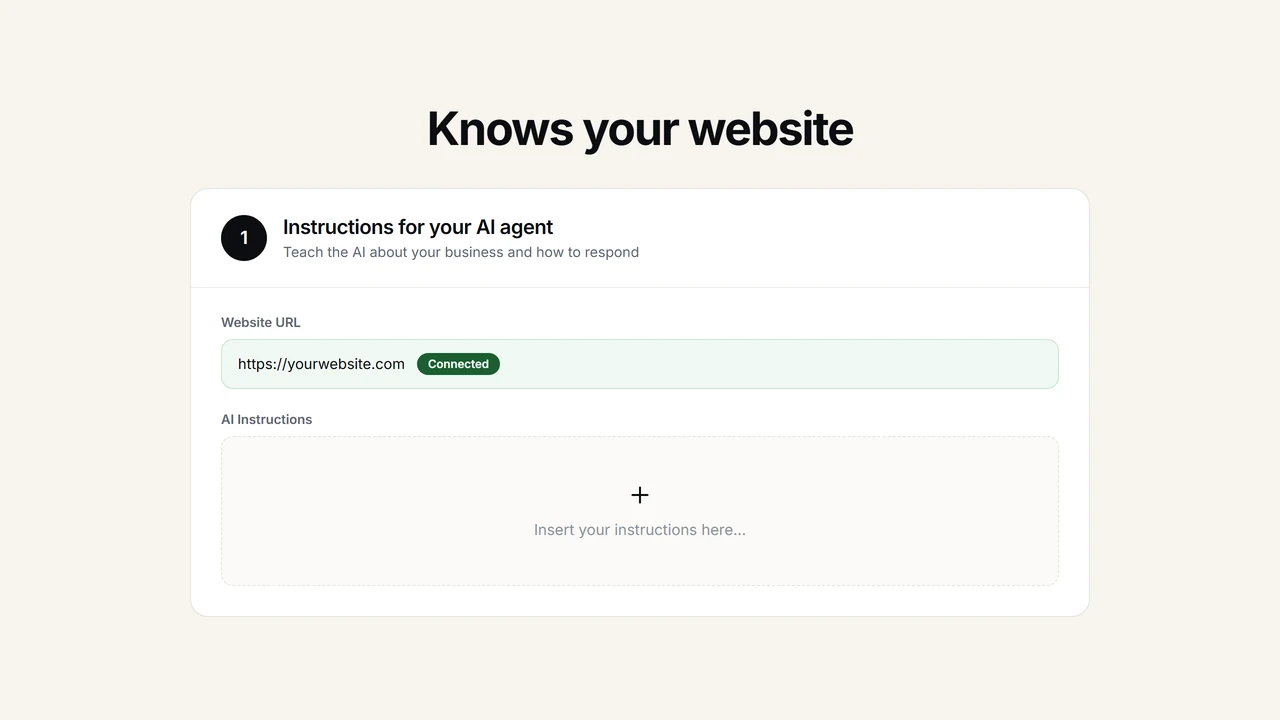
The chatbot crawls your public storefront pages to absorb product data, category structure, CMS pages, and policy content. You can supplement that with uploaded PDFs, internal docs, or pasted text in the Asyntai knowledge base — spec sheets, wholesale terms, seasonal notices, anything you want the assistant to know that is not publicly visible. Custom instructions let you shape tone and behavior on top of the ingested content.
Can it handle configurable products with many attribute combinations?
Yes. Magento configurable products often carry dozens of size-colour-material combinations, and the chatbot treats each visible option as part of its knowledge. When a buyer asks "do you have the industrial shelf in 120 cm, black steel?", the assistant checks against the product data it has absorbed rather than paraphrasing the page description generically.
Will it slow down my storefront?
The widget script loads asynchronously after the browser has finished rendering the page, so it never blocks your critical rendering path. Magento's own full-page cache, Varnish, and CDN layers continue working exactly as before. The chatbot adds negligible weight to your front-end performance profile.
Does the chatbot support multiple store views and languages?
The widget interface is localized into 36 languages, and the AI detects the buyer's language from their first message. A German buyer gets German replies, a Japanese buyer gets Japanese, an Arabic buyer gets Arabic — regardless of which store view they are on. If you run separate store views per locale, the chatbot works across all of them from a single Asyntai site connection.
What does it cost?
The free plan gives you 50 messages per month and 1 site — enough to test the chatbot on a staging store or a low-traffic storefront. Paid plans start at $39 per month for 800 messages. Site limits scale with the tier: Free 1, Starter 2, Standard 3, Pro up to 10. Merchants running multiple Magento installations — a B2C storefront plus a B2B portal, for example — can train a separate chatbot on each under a single Pro account.
Can I pass logged-in customer data to the chatbot?
On Standard and Pro plans, you can push a User Context object through the widget's JavaScript API — customer name, account tier, company name, or any attribute your theme exposes on the frontend. The chatbot then personalizes replies using that context. Nothing is pulled automatically; you control exactly what gets passed and what stays private.
How do I uninstall or temporarily disable the chatbot?
To disable without uninstalling, open Admin Panel, go to Asyntai AI Chatbot, and click Reset — the widget disappears from the storefront immediately. To fully remove the module, run module:disable Asyntai_Chatbot followed by setup:upgrade, or remove the package via Composer. Both paths are clean and leave no orphaned database tables or frontend artifacts.
Why a Magento store needs a different kind of chatbot
Magento occupies a tier of ecommerce that most chat tools were never designed for. The merchants who choose Magento — whether the open-source edition or Adobe Commerce — do so because their catalog, their pricing logic, or their multi-store requirements outgrew the template-driven platforms. They carry thousands of SKUs with configurable attribute sets that produce hundreds of viable combinations per product. They serve wholesale accounts alongside retail buyers, sometimes on the same domain through customer-group segmentation. They operate store views in four or five languages, each with localized content and currency. Bolting a consumer-grade chat bubble onto that infrastructure and expecting it to answer buyer questions intelligently is like handing a pocket calculator to an engineer and asking them to run structural analysis. The tool needs to match the complexity it sits on top of.
That mismatch is what most Magento merchants discover within the first week of trialing a generic chat widget. A buyer on a B2B storefront asks whether the 304-grade stainless bracket is available in packs of fifty at the tier-three price, and the chatbot responds with a vague summary of the product description. A retail shopper on the German store view asks about return windows, and the bot replies in English because it was never told the storefront serves multiple locales. A procurement manager asks for the datasheet on a configurable industrial pump, and the assistant hallucinates specifications because it was trained on scraped HTML that flattened every attribute into a single block of text. These are not edge cases on a Magento store. They are Tuesday.
Asyntai approaches Magento differently because it was built to sit on platforms where catalogs have depth. The Magento chatbot absorbs your storefront content — product pages, category listings, CMS blocks, policy pages, blog posts — and holds it as structured knowledge that the AI reasons over during conversations. When a buyer asks a question that touches product attributes, the assistant draws from the actual data it ingested, not a fuzzy pattern match against rendered HTML. Configurable products with size, voltage, material, and finish options stay as separate attribute dimensions in the chatbot's understanding, which is why it can answer "is the matte-black 48-inch version in stock?" with specificity rather than a restatement of the product overview paragraph.
Beyond the catalog, the knowledge base accepts anything you feed it. Internal documents that never appear on the storefront — a wholesale price list, a hazardous-materials shipping policy, an extended warranty matrix, a seasonal fulfillment memo — can be uploaded as PDFs or pasted directly. The chatbot treats all of it as part of what it knows, and custom instructions on top let you direct behavior with plain language: always ask for country before quoting lead times, always suggest the compatible accessory when someone asks about a main unit, never disclose margin or cost data. The net effect is an assistant whose knowledge boundary matches your store's actual information perimeter, not just whatever a crawler happened to parse last Thursday.
Installation follows Magento conventions instead of fighting them. Asyntai ships an official Magento 2 extension — the Asyntai_Chatbot module — that registers through module.xml, injects the widget via a layout handle, and manages its configuration through an Admin Panel menu item. You install it with Composer or by extracting the package into app/code/Asyntai/Chatbot/, then run the standard module:enable, setup:upgrade, and cache:flush sequence that every Magento developer already knows by heart. Once the module is active, you open the Asyntai AI Chatbot screen in the admin sidebar, click "Get started," authenticate through a popup, and the chatbot goes live across every storefront page. No theme file edits. No manually pasted JavaScript. No third-party dependency that breaks on the next Magento patch. The module supports Magento Open Source 2.4.0 and above, Adobe Commerce on-premises, and Adobe Commerce on cloud.
Multi-store architecture is where the gap between Magento and simpler platforms shows up most clearly, and it is also where the chatbot earns its keep. A Magento installation commonly runs two, three, or more store views — English and French for a Canadian merchant, a retail storefront and a wholesale portal for a manufacturer, separate brand microsites for a holding company. The Asyntai widget interface is translated into 36 languages, and the AI detects the buyer's language from their opening message, so a French-speaking buyer on the French store view gets French replies and a Polish buyer browsing the English view still gets Polish. You do not configure translation per store view on the chatbot side; the language layer is independent and automatic. For merchants running Pro plans with up to 20 sites, each Magento store or store view can connect as its own Asyntai site with separately trained knowledge, or a single site connection can serve the entire multi-view installation — whichever topology fits your content architecture.
The buyers who shop on Magento stores tend to research more deliberately than impulse-driven retail shoppers. They compare specifications across product lines, verify compliance certifications, check minimum order quantities, and confirm lead times before they commit. A chatbot that waits passively in the corner misses these deliberation windows entirely. Asyntai's auto-trigger opens the chat proactively on product and category pages, catching the pause between research and decision. On a B2B storefront, that pause often lasts thirty seconds while a procurement officer scans the attribute table — and a well-timed "Can I help you find the right configuration?" converts browsing into a conversation that either ends at the cart or produces a qualified lead. The proactive pattern is configurable per page type and delay, so you tune aggressiveness by audience segment rather than blanketing every URL.
Lead capture on a Magento store serves a dual purpose that it does not on smaller platforms. Retail leads follow the familiar pattern: a shopper is interested but not ready, the chatbot asks for an email, and the transcript lands in your Asyntai dashboard for follow-up. But on a B2B Magento storefront, a captured lead often represents an entire procurement opportunity — a facilities manager who needs 200 units of a configurable item, a distributor evaluating your product line for regional resale, an operations team comparing your lead times against a current supplier. The full conversation transcript, attached to the lead record and optionally forwarded to your sales inbox in real time, gives reps the context to respond intelligently instead of opening cold when the buyer already spent five minutes explaining requirements to the chatbot.
Conversation analytics accumulate a data layer that most Magento merchants have never had visibility into. Which product categories generate the most pre-sale questions? Which configurable attributes confuse buyers most often — is it the voltage selector, the material grade, the regional compliance variant? Which CMS policy pages fail to answer the questions buyers actually arrive with? A month of chatbot data typically reveals three or four product pages where the description needs rewriting, a shipping policy that belongs in the checkout flow rather than buried in a footer link, and at least one configurable product whose attribute labels are misleading enough to generate repeat support requests. The Magento chatbot does not just deflect questions — it maps the friction surface of your storefront and hands you a prioritized improvement list that compounds over time as better content reduces future question volume.
Pricing is structured so the Magento chatbot makes financial sense for the mid-market stores that Magento typically serves. The free tier — 50 messages per month, 1 site — lets you validate the assistant on a staging environment or a low-traffic storefront without a commitment. Paid plans begin at $39 per month for 800 messages, and higher tiers accommodate the volumes that B2B portals and high-traffic storefronts produce during trade-show seasons and promotional cycles. Site allocations scale across the tiers: Free 1, Starter 2, Standard 3, Pro up to 10. A manufacturer running a retail Magento store, a wholesale B2B portal, and a clearance microsite fits comfortably on a Pro plan with each storefront answering from its own catalog and policies. When monthly usage approaches the cap, Asyntai sends email warnings in advance so you can upgrade before the widget pauses new AI replies — and even when paused, the widget remains visible on the page rather than disappearing.
There is a practical boundary between what the Magento chatbot should handle and what deserves human attention. The assistant excels at the broad volume of catalog, specification, availability, policy, and configuration questions that eat hours of sales and support time across every shift. It answers in any of the 36 supported languages at any hour, which matters acutely for Magento merchants selling across time zones — a buyer in Seoul at 2 AM your time gets the same depth of response as a buyer in your home city at noon. The narrow slice of interactions that genuinely require a human — a disputed invoice, a custom engineering request, a contract negotiation — get captured as leads with the full conversation transcript, preserving context for your team to pick up without asking the buyer to repeat themselves. The division is clean: the AI handles breadth, your team handles depth, and neither side wastes time on what the other does better.
Taken together, the Magento chatbot becomes part of the storefront infrastructure rather than an afterthought layered on top. A native Magento 2 extension keeps the installation and upgrade path inside the workflow your development team already maintains. Deep catalog absorption means the assistant answers at the attribute and configuration level where Magento's complexity actually lives. Thirty-six languages and automatic detection keep international buyers engaged without per-locale chatbot configuration. Proactive triggering catches the deliberation windows that B2B and considered-purchase retail buyers naturally produce. Lead capture feeds your pipeline with context-rich records instead of anonymous bounced sessions. And conversation analytics turn every week of chat data into a storefront improvement roadmap. Set it up once on your Magento 2 instance and what you gain on every product page is the resource that brick-and-mortar showrooms take for granted — a knowledgeable associate who never clocks out, never misquotes a spec, and never loses patience with the forty-seventh question about lead times this week.