One platform, every brand, every market — AI agents that scale with your organization
Asyntai is the enterprise AI agent platform built for multi-site, multi-language operations. Deploy distinct AI agents for each brand, product line, or region — each with its own knowledge base, Custom Tools, and escalation rules. Centralized analytics. 36 languages. Live in hours per site, not quarters per rollout.
See how an enterprise AI agent handles real questions
Enter any of your websites and watch the AI agent answer questions using your actual content — then imagine that across every site in your portfolio
Separate agents per brand, unified control from one dashboard
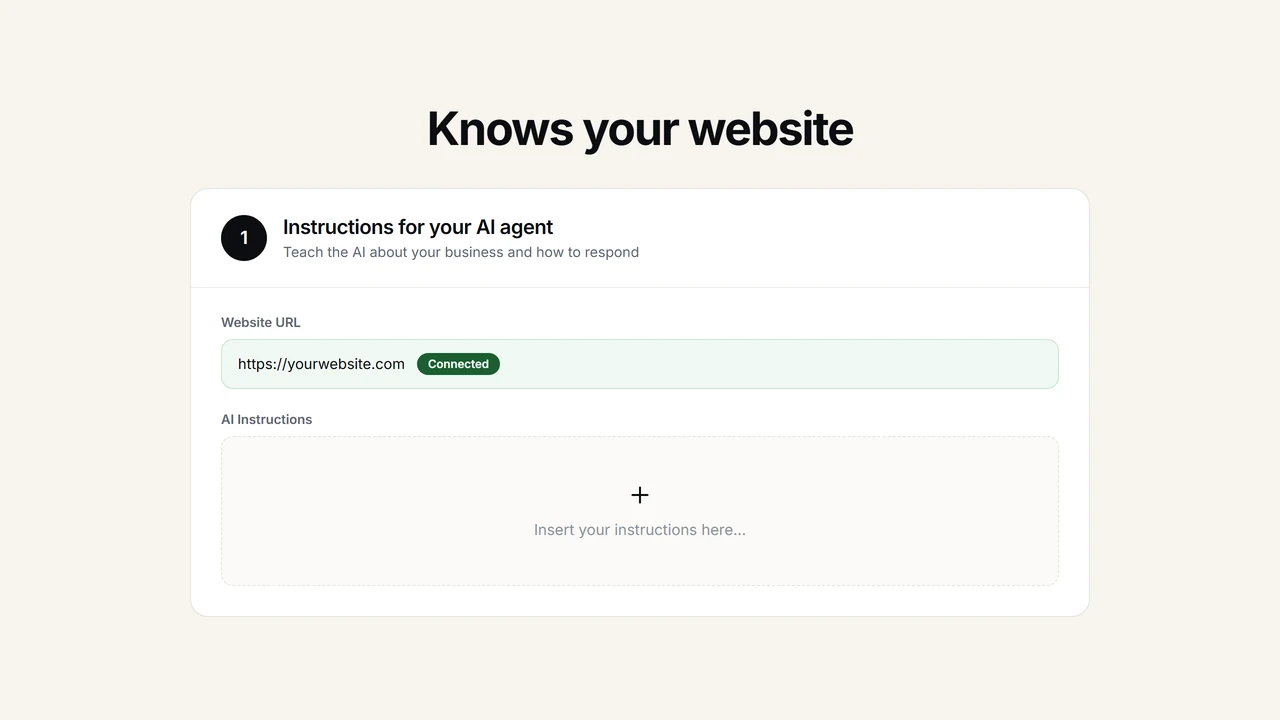
Enterprise organizations run multiple brands, product lines, and regional sites — each with different knowledge, different tone, different escalation paths. Asyntai's Pro plan supports up to 20 sites under one account, each with its own crawled knowledge base, custom instructions, and branding. Your compliance team sees every conversation across all agents from a single dashboard. No per-site vendor negotiations. No separate contracts per division.
- Independent knowledge bases per siteEach agent crawls and learns from its own site. Your electronics brand's agent knows product specs and warranty terms. Your apparel brand's agent knows sizing guides and care instructions. No knowledge bleed between agents, no confused cross-brand answers.
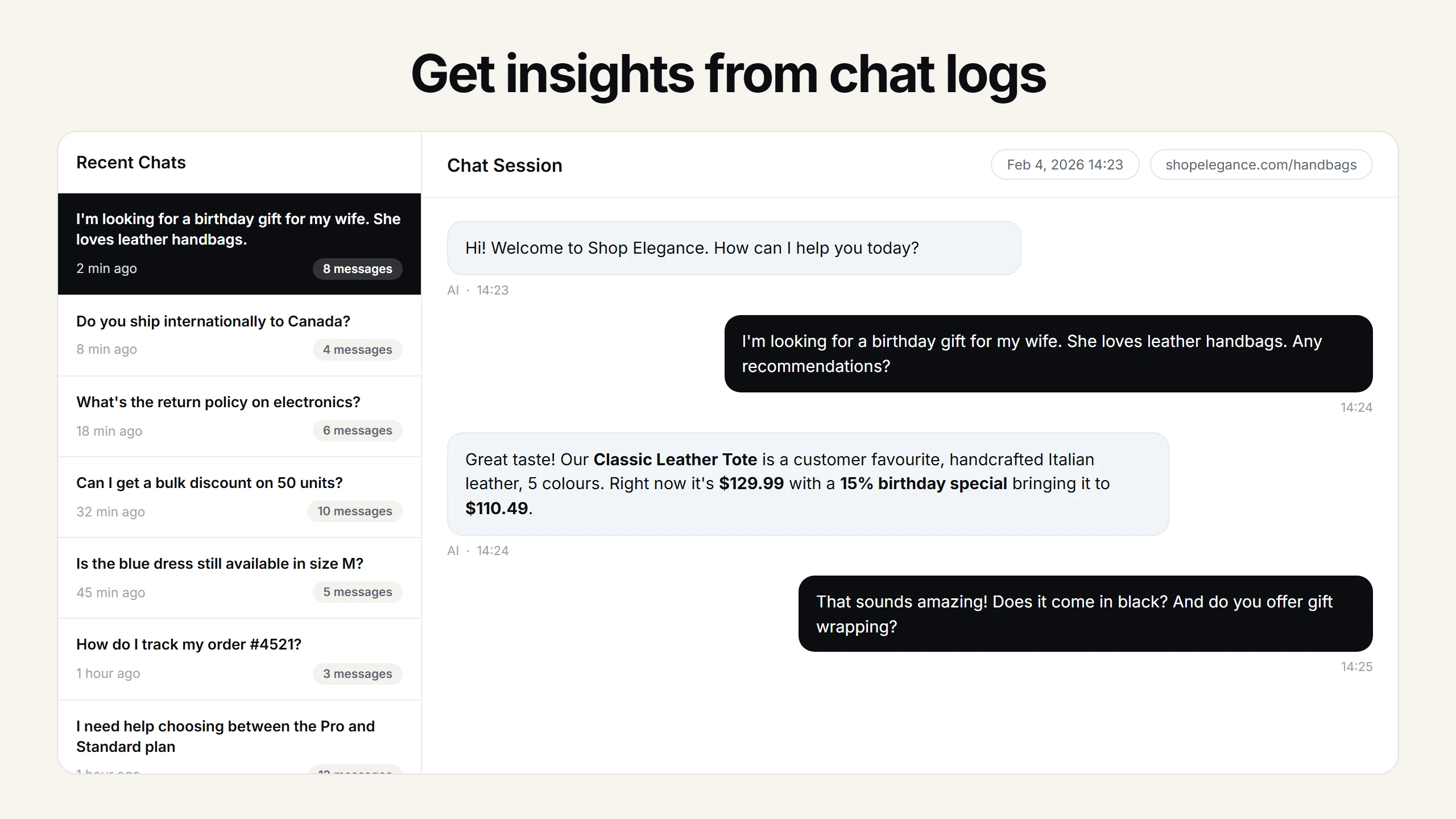
- Centralized conversation analyticsEvery conversation across all agents flows into one dashboard. See which brands generate the most inquiries, which topics drive escalations, and where your knowledge gaps are — without logging into ten different platforms.
- Team access with shared administrationInvite team members to manage agents, review conversations, and adjust settings. Your UK support lead configures the UK agent while your North America lead configures theirs — all under one organizational account with shared billing and unified reporting.
Custom Tools, 36 languages, and API access — per agent, per site
Each agent in your fleet is fully autonomous. It calls your APIs through Custom Tools specific to that brand or region. It answers in any of 36 languages — the same German agent handles a French visitor without a separate deployment. Custom branding matches each site's look. And the Asyntai API lets your internal systems pull conversation data, trigger actions, and integrate agent intelligence into your broader enterprise stack.
- Custom Tools scoped per agentYour electronics site's agent calls your product catalog API. Your SaaS site's agent calls your subscription management endpoint. Each agent gets its own set of tools — the right capabilities for the right context, with no cross-contamination between business units.
- 36 languages without 36 deploymentsA single agent handles visitors in Arabic, Japanese, German, Portuguese, and 32 other languages. No separate language-specific bots. No translation vendor. Global teams get native-language support from day one — the AI handles the translation layer while your knowledge base stays in your source language.
- API access for enterprise integrationPull conversation logs, analytics, and agent data into your data warehouse, BI tools, or internal dashboards. The Asyntai API gives your engineering team programmatic access to everything the platform captures — so AI agent intelligence feeds your broader decision-making infrastructure.
Deploy your first enterprise agent in under an hour
Enterprise AI agent platforms are notorious for six-month implementation timelines and dedicated integration teams. Asyntai deploys per site in hours — not because it cuts corners, but because the complexity lives in the platform, not in your setup process. One snippet per site. Knowledge base crawled automatically. Custom Tools connected via dashboard forms.
- Add the Asyntai snippet to your first site's
<head>tag — the agent immediately crawls your content and builds its knowledge base. - Configure custom branding, escalation rules, and AI instructions specific to that site's brand voice and policies.
- Connect Custom Tools by pasting your API endpoints — order lookups, account checks, inventory queries — scoped to that brand's systems.
- Repeat for each additional site. Each agent is independent — different knowledge, different tools, different branding — all managed from one dashboard.
<script src="https://asyntai.com/widget.js"
data-id="your-site-id" async>
</script>
</head>
# Same snippet. Each site gets its own agent.
Enterprise AI agent platform — FAQs
Common questions from IT leaders, procurement teams, and operations executives evaluating AI agent platforms for enterprise deployment.
What security measures protect enterprise conversations and data?
All data is encrypted in transit (TLS 1.2+) and at rest. Conversations are stored per-site with strict tenant isolation — one brand's data is never accessible from another brand's agent or dashboard view. Custom Tool calls execute server-side, so customer browsers never contact your internal APIs directly. Auth headers for your endpoints are stored encrypted and never exposed in client-side code. Conversation logs are accessible only to authorized team members on your account, and you can review or delete them at any time from the dashboard.
Do you offer an SLA for uptime and response times?
Asyntai maintains 99.9%+ uptime across its infrastructure. The platform is built on redundant cloud infrastructure with automatic failover. Agents typically respond in seconds, including Custom Tool API calls to your endpoints. For enterprise accounts on the Pro plan, priority support is available with faster response times for technical issues. Detailed uptime history is available on request.
Does Asyntai support SSO or enterprise identity providers?
Dashboard access is currently secured with email-based authentication and team invitation controls. Enterprise SSO (SAML/OIDC) integration is on the product roadmap. For organizations that require centralized identity management today, team access controls allow you to manage who has access to agent configuration and conversation data, with the ability to revoke access instantly.
Where is our data stored and can we choose the region?
Asyntai's infrastructure is hosted on major cloud providers with data centers in multiple regions. Conversation data, knowledge base content, and Custom Tool call logs are stored in secured databases with encryption at rest. For organizations with specific data residency requirements, contact our team to discuss available options for your deployment. Data export is available at any time through the dashboard or API.
How does multi-brand deployment work — do we need separate accounts?
No. A single Pro plan account supports up to 20 sites, each functioning as a fully independent agent. Each site gets its own knowledge base (crawled from that specific domain), its own Custom Tools (connected to that brand's APIs), its own escalation rules, its own branding, and its own AI instructions. An electronics brand agent and an apparel brand agent operate with zero knowledge overlap. All conversations across all agents appear in one unified dashboard for central oversight, but each agent is operationally isolated.
What is the realistic deployment timeline per site?
Most enterprise sites go live within hours, not weeks. The snippet installation takes minutes. Knowledge base crawling completes within the hour for most sites (larger sites with thousands of pages may take a few hours). Custom Tool configuration — connecting your API endpoints — takes 10-15 minutes per tool if the endpoints already exist. The total deployment time per site is typically measured in hours. Rolling out across 10 sites can be done in a single business week, not a fiscal quarter.
How does pricing work for multi-site enterprise deployment?
The Pro plan at $449/month includes up to 20 sites and 50,000 messages across all agents. That is a single invoice, not $449 per site. Each site shares the message pool — so if one brand is seasonal and another is steady, your allocation flexes naturally. There are no per-seat fees for team members, no per-tool fees for Custom Tools, and no per-language surcharges. Compare that to enterprise chatbot platforms that charge five or six figures annually before implementation costs.
What compliance frameworks does Asyntai align with?
Asyntai is built with data protection principles at its core. Conversation data is encrypted, access-controlled, and exportable. The platform supports GDPR-compliant data handling — you can delete individual conversations or all data associated with a visitor. Custom Tool calls are logged for audit trails. For organizations with specific compliance requirements (SOC 2, HIPAA, industry-specific regulations), contact our team to discuss how the platform's controls map to your framework. Detailed security documentation is available under NDA for enterprise procurement processes.
Why enterprise AI agent deployment is broken — and how a platform approach fixes it
Enterprise organizations have a chatbot problem that gets worse the more successful the company becomes. Every new brand acquisition, every international expansion, every product line extension creates another customer-facing surface that needs intelligent support. And every one of those surfaces has historically required its own chatbot deployment — its own vendor negotiation, its own implementation project, its own integration timeline, its own maintenance burden. A company with eight brands across four regions doesn't have one chatbot problem. It has thirty-two chatbot problems, and each one takes three to six months to solve.
The enterprise AI agent platform model exists because this fragmented approach doesn't scale. What scales is a single platform where each brand, each region, each product line gets its own fully autonomous AI agent — with its own knowledge, its own tools, its own personality — but all managed from one dashboard, one billing relationship, one integration pattern. That's the architectural shift that separates a platform from a collection of individual chatbot installations, and it's the reason enterprises are re-evaluating their entire conversational AI stack.
The core problem with traditional enterprise chatbot deployment is time. Not just elapsed time — though six months from contract signature to first live conversation is standard for most enterprise vendors — but the compounding time cost across sites. Each deployment is treated as a bespoke project. A solutions architect scopes the integration. A project manager coordinates between your IT team and the vendor's implementation team. Your developers build custom connectors for your CRM, your order management system, your knowledge base. The vendor's team configures intent detection, builds conversation flows, maps escalation paths. QA cycles follow. UAT follows. Training follows. And then you go live on one site, and the process starts over for the next brand.
Asyntai compresses this because the complexity lives in the platform, not in your implementation. When you add a site to your Asyntai account, you paste a JavaScript snippet into the page header — the same snippet pattern used by analytics tools, marketing pixels, and every other SaaS widget that deploys in minutes. The agent immediately crawls your site, builds a knowledge base from your actual content, and starts answering questions. No intent mapping. No conversation flow design. No training data curation. The AI reads your content and responds from it — the same way a new support hire would read your help docs and then answer customer questions, except the AI does it in minutes instead of weeks and doesn't forget anything.
The per-site knowledge isolation is architecturally critical for enterprise use. When a consumer electronics company and a fashion brand operate under the same parent company, their customers have fundamentally different questions, different vocabularies, different expectations. The electronics customer asks about HDMI compatibility and firmware updates. The fashion customer asks about fabric composition and size charts. If both agents drew from a shared knowledge base, the electronics agent might surface fashion care instructions in response to a product question, or vice versa. Asyntai eliminates this by crawling each site independently and maintaining completely separate knowledge bases. Each agent knows exactly what its site contains and nothing else. There is no knowledge bleed between brands, no accidental cross-contamination, no need for manual tagging to keep content separated.
Custom Tools — the feature that lets the AI call your API endpoints mid-conversation — are scoped per site for the same reason. Your electronics brand's agent might call a product compatibility API, a warranty verification endpoint, and a repair scheduling system. Your fashion brand's agent might call an inventory availability API, a size recommendation engine, and a return processing endpoint. These are different systems with different schemas and different business logic. On a traditional enterprise platform, connecting each brand's tools would be a separate integration project. On Asyntai, each tool is a dashboard form — name, description, endpoint URL, parameters, optional auth header. A single developer can configure Custom Tools for ten brands in a single afternoon, because the pattern is identical even though the endpoints are completely different.
The multilingual dimension is where the enterprise platform approach delivers its sharpest advantage over fragmented deployments. An enterprise with customers in Germany, Japan, Brazil, and the Middle East would traditionally need either separate language-specific chatbots (multiply your deployment count by your language count) or a single multilingual bot that requires translated training data for every language (multiply your content curation cost by your language count). Asyntai eliminates both multiplication factors. Each agent handles all 36 supported languages from a single deployment, using a single knowledge base in your source language. A Japanese visitor asks a question in Japanese. The AI understands the question, retrieves the relevant English-language content from the knowledge base, and composes the answer in Japanese. The same agent serves your German visitors in German, your Arabic visitors in Arabic, and your Portuguese visitors in Portuguese — without any language-specific configuration, training data, or content translation. One agent per site, all languages served.
For global enterprises, this collapses a deployment matrix that would otherwise be unmanageable. Consider a company with 5 brands selling in 12 countries across 8 languages. The traditional approach — brand-specific, language-specific chatbot deployments — creates a matrix of 40 separate instances to build, train, and maintain. On Asyntai, it's 5 agents. Period. Each agent handles all 8 languages (and 28 more, if your market expands). The operational difference between maintaining 40 chatbot instances and 5 AI agents is not incremental. It's the difference between a dedicated chatbot team and a single person checking the dashboard once a day.
Custom branding per site is a requirement that enterprise platforms take for granted but individual chatbot deployments often handle poorly. Each brand has its own visual identity — colors, logos, tone of voice. A luxury brand's support widget should feel premium and understated. A youth-oriented brand's widget should feel energetic and casual. On Asyntai, each site's agent gets independent branding: widget colors, avatar, greeting message, placeholder text, and AI personality instructions. A customer interacting with your luxury brand's agent never sees your budget brand's aesthetic. The agents share infrastructure but present entirely separate identities.
Conversation analytics across the fleet give enterprise leaders something they rarely have: a unified view of customer intent across all brands. When you can see that "order status" accounts for 34% of conversations across your electronics brand, 28% across your apparel brand, and 51% across your home goods brand, you know where to invest in proactive communication. When you can compare escalation rates between brands — the electronics agent escalates 12% of conversations while the fashion agent escalates 22% — you know which knowledge base needs enrichment. When you can track resolution rates by language, you know whether your Japanese customers are getting the same quality experience as your English-speaking customers. This cross-brand, cross-language intelligence doesn't exist when each brand runs its own chatbot on its own platform with its own reporting dashboard.
Team access controls matter at enterprise scale in ways they don't for a single-site deployment. A brand manager for the electronics division should be able to configure that agent's AI instructions and review its conversations — but shouldn't necessarily have access to the fashion division's conversation data. An IT administrator should be able to manage Custom Tool configurations across all agents. A VP of Customer Experience should see analytics across the entire fleet without needing credentials on ten separate platforms. Asyntai's team access model supports this kind of organizational structure: invite team members, and everyone operates within a single platform rather than managing separate vendor relationships per brand.
Email notifications and conversation logging address the enterprise compliance angle directly. Every conversation across every agent is logged with full transcripts, including Custom Tool calls and their responses. When a customer claims the AI gave them incorrect shipping information, you can pull the exact conversation, see what data the tool returned, and verify whether the agent represented it accurately. Email notifications alert your team when conversations are escalated, when specific topics are flagged, or when volume spikes indicate an emerging issue. For regulated industries, the audit trail is complete: who asked what, what data was retrieved, what the agent said, and when a human was brought in.
The cost structure of a platform approach versus fragmented deployment is where enterprise procurement teams pay closest attention. A traditional enterprise chatbot vendor charges per-site licensing fees, per-seat fees for human agents, implementation fees per deployment, and often per-language surcharges. A five-brand, eight-language deployment can easily reach six figures annually in licensing alone, before implementation costs that frequently match or exceed the first year's licensing. Asyntai's Pro plan — $449 per month, up to 20 sites, 50,000 messages, unlimited team members, all 36 languages, Custom Tools included — represents a fundamentally different cost structure. The total annual cost for a full enterprise deployment is under $2,400, compared to the $100,000+ that traditional vendors charge for comparable coverage. Even accounting for the differences in white-glove onboarding and dedicated account management, the pricing gap is two orders of magnitude.
The deployment speed advantage compounds over time. When an enterprise acquires a new brand — a common occurrence in consumer goods, hospitality, and retail — adding that brand's AI agent to the Asyntai platform takes hours, not months. The snippet goes on the new site. The knowledge base crawls. Custom Tools connect to the new brand's systems. The agent goes live in the new brand's visual identity. There is no new vendor evaluation, no new contract negotiation, no new integration project. The platform absorbs new brands the same way a cloud hosting provider absorbs new applications — the infrastructure is already there, and each new tenant is incremental, not architectural.
Where enterprise buyers often hesitate is on the question of whether a platform built for speed can handle enterprise complexity. The answer depends on what "complexity" means. If complexity means six-month implementation timelines, dedicated integration teams, custom middleware, and bespoke conversation flow design — then Asyntai is deliberately not complex. It replaces that complexity with a model where the AI reads your content, calls your APIs, follows your rules, and answers in the customer's language. The intelligence is in the platform, not in the configuration. If complexity means handling diverse brands with different knowledge, different tools, different escalation paths, different languages, and different branding — all from a unified control plane with centralized analytics and team-based access — then yes, the platform handles that. It just does it in hours instead of quarters.
The enterprise AI agent platform category is still forming. Most organizations are running first-generation chatbots that were deployed two or three years ago, before large language models made knowledge-base-to-answer and tool-calling architectures practical. Those chatbots were built on intent classification and decision trees — technologies that required extensive manual configuration and broke down at scale. Replacing them with an AI agent platform that reads content, calls APIs, and handles 36 languages natively isn't an upgrade. It's a generational shift. And the organizations that move first don't just get better customer support. They free up the implementation resources, vendor management overhead, and per-site maintenance burden that their current chatbot infrastructure demands — resources that can be redirected toward the business problems that actually require human judgment.
The practical question for any enterprise evaluating an AI agent platform is straightforward: how many customer-facing sites do you operate, how many languages do your customers speak, and how many months would your current vendor take to deploy across all of them? If the answer is "more than two sites, more than one language, and more than we'd like" — then the platform approach isn't just more efficient. It's the only approach that doesn't collapse under its own weight as the organization grows. Asyntai is built for exactly that trajectory: start with one site today, add the rest this week, and manage the entire fleet from the same dashboard you used on day one. No re-architecture. No re-negotiation. No re-implementation. Just more agents, more languages, more resolution — from the same platform.