A customizable chat widget that looks like you built it from scratch
Change colors, position, avatar, welcome message, button shape, and chat window behavior from a visual dashboard. No CSS to write, no developers to hire — your brand, your rules, live in minutes.
See the customizable widget in action on your site
Drop your URL below. The AI reads your website content, picks up your brand palette, and builds a working chatbot you can start customizing immediately.
A chat widget that clashes with your site is worse than no widget at all
Visitors notice when something does not belong. A chat bubble in the wrong shade of blue, a greeting that sounds nothing like your brand voice, a widget that obscures your call-to-action button — these details chip away at trust before a single conversation starts. Most chat widgets give you a color picker and call it customization. Asyntai gives you a visual dashboard where every visible element is yours to control: primary and secondary colors, button shape, chat window position, avatar image, greeting text, placeholder copy, and the overall personality of the AI assistant. Every change previews in real time so you see the result before visitors do. The customization works the same on every plan — Free gives you 50 messages per month to test it, Starter at $39/month handles 800 messages across 2 sites, Standard at $139/month supports 15,000 messages and 3 sites, and Pro at $449/month scales to 50,000 messages and 20 sites. You are not paying for the ability to make the widget look right. You are choosing how much capacity you need.
- Colors and branding that match your design systemSet your primary color, accent color, text color, and background to match your website exactly. The widget header, send button, user message bubbles, and launcher all inherit your palette. If your brand uses #1a2b3c for headings and #e74c3c for buttons, your chat widget uses those same values. No more generic purple bubbles on your carefully designed green-and-white site. Upload your logo or a custom avatar to replace the default icon — visitors see your brand, not ours.
- Position, size, and launch behavior you controlPlace the widget on the left or right. Set it to open automatically after a delay, open on page load, or stay collapsed until the visitor clicks. Choose whether the greeting appears as a teaser bubble above the launcher or inside the chat window. Adjust the chat window dimensions to fit your layout. On mobile, the widget adapts automatically but you control whether it uses a full-screen view or a compact overlay. Every setting is a toggle or a slider — no code required.
- Welcome messages and personality that sound like your teamWrite the greeting visitors see when the chat opens. Set the placeholder text inside the input field. Name the assistant — "Support," "Alex," "Sales Team," whatever fits your brand voice. Write custom instructions that shape how the AI responds: formal or casual, concise or detailed, whether to ask follow-up questions or go straight to answers. The widget does not just look like your brand — it speaks like your brand.
Customize what the widget knows, how it behaves, and who it serves
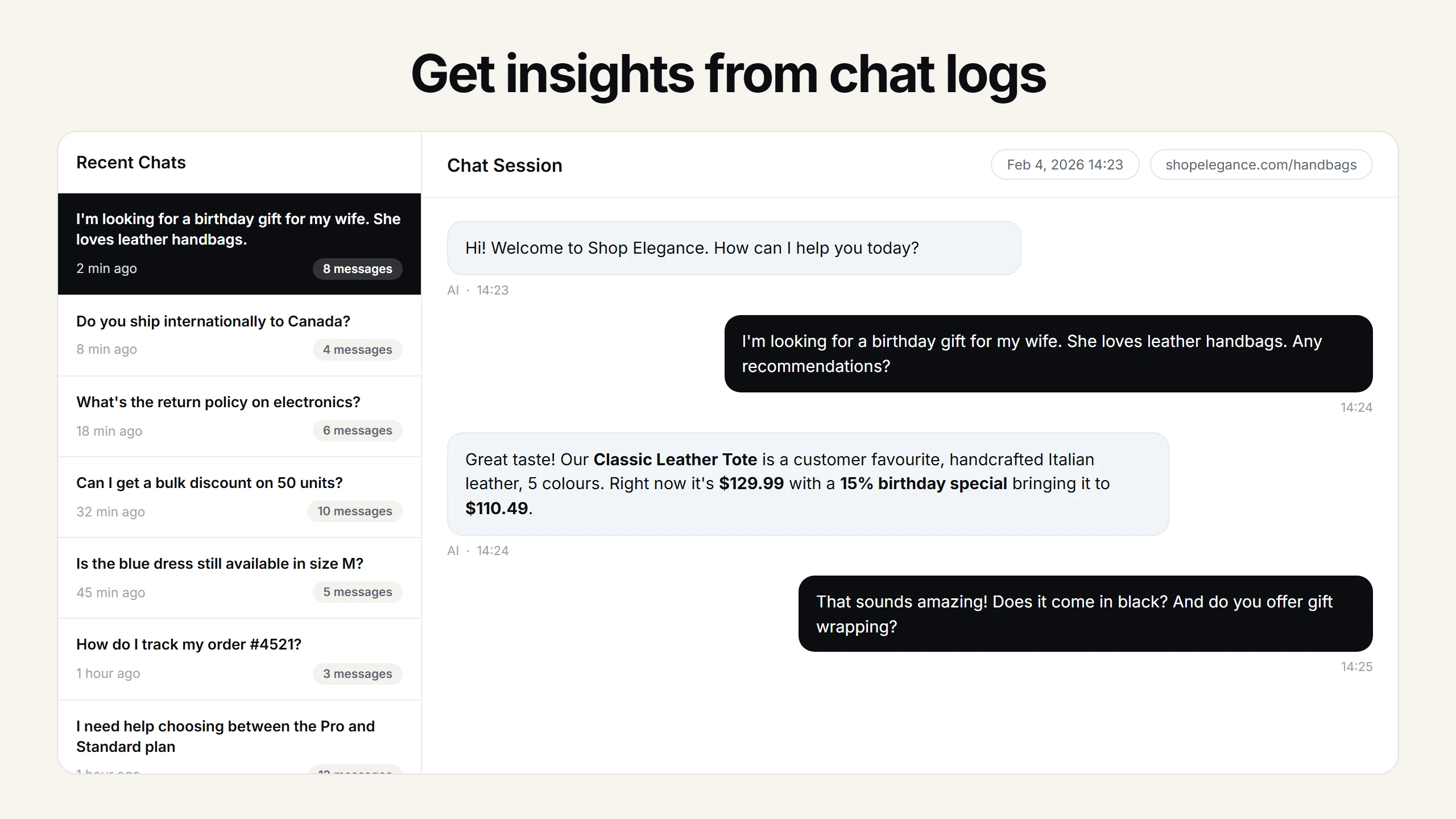
Visual customization gets visitors to trust the widget. Behavioral customization makes the widget actually useful. Asyntai lets you control both from the same dashboard — the appearance settings shape what visitors see, and the content and behavior settings shape what the AI does. On Standard ($139/month) and Pro ($449/month) plans, Custom Tools let the widget pull live data from your own systems during conversations, turning it from a branded FAQ into an interactive service portal that happens to match your color scheme.
- White-label branding on every planRemove the Asyntai attribution badge from the chat widget so nothing breaks the illusion. The widget carries your name, your colors, and your avatar with no third-party branding visible to visitors. Agencies managing widgets for multiple clients deploy distinct-looking chatbots from a single account on the Pro plan — each site gets its own identity, its own knowledge base, and its own styling.
- Custom behavioral rules in plain EnglishTell the AI how to act by writing instructions in natural language. "Always greet returning visitors by name if available." "Never discuss pricing — redirect them to the sales team." "When someone asks about returns, collect their order number before answering." "Keep answers under three sentences unless the visitor asks for more detail." These instructions shape every conversation without touching any code. Update them anytime from the dashboard.
- Multilingual greetings and automatic language switchingSet greetings in any of the 36 supported languages — or let the AI detect the visitor's language and respond accordingly. A visitor who types in German gets a German response drawn from your English website content. No translated site needed. If your audience spans markets, the widget adapts without separate configurations for each language.
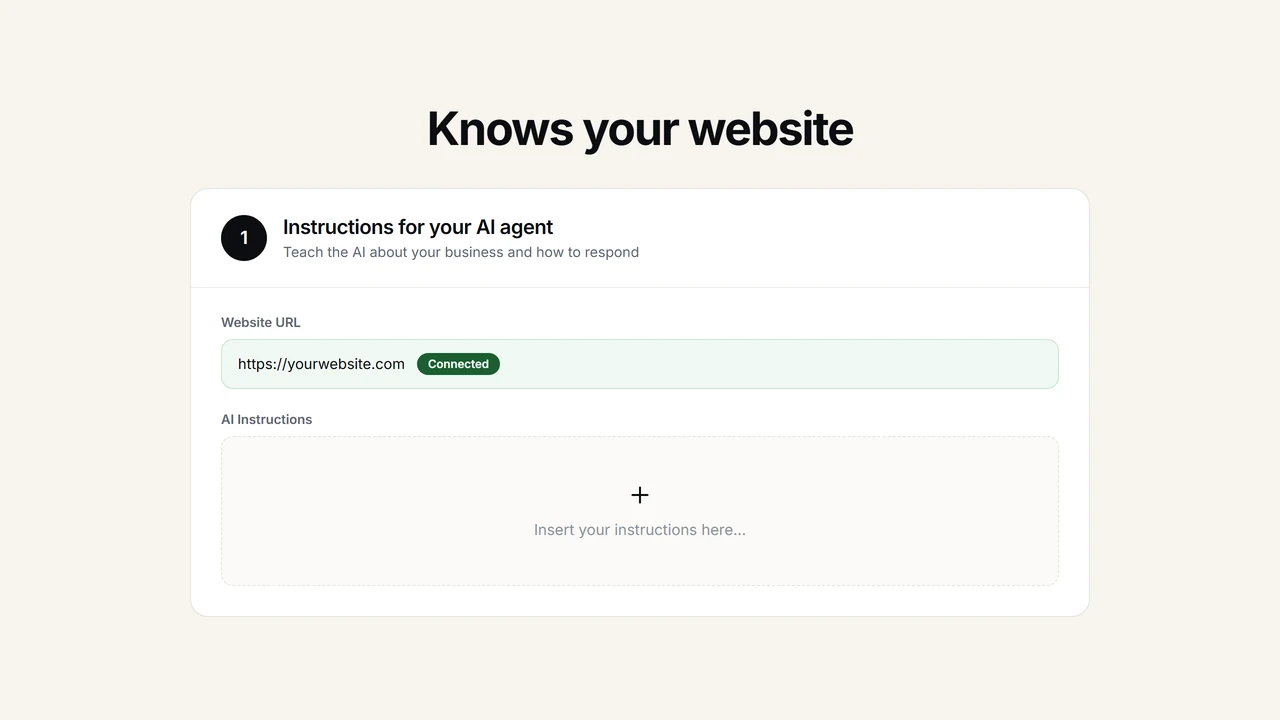
- Knowledge base you curateThe AI reads your website — up to 50 pages crawled automatically — and answers using that content. Upload additional documents for topics your site does not cover. Remove pages you do not want the AI referencing. The knowledge base is yours to shape, and the AI stays within its boundaries. It does not invent answers from general knowledge — it uses what you gave it.
- Live data through Custom ToolsOn Standard and Pro plans, connect your own API endpoints so the widget can look up order status, account details, appointment availability, or inventory levels mid-conversation. The visitor asks "Where is my order?" and the widget checks your system and responds with a real tracking update — all inside a chat window that looks like it was built by your own engineering team.
Get a branded chat widget live on your site
Sign up, paste your URL, style the widget in the visual dashboard, and embed one script tag. The whole process takes about fifteen minutes — most of that is choosing the perfect shade of blue.
- Sign up at asyntai.com/pricing — Free gives you 50 messages to test with full customization access. Starter ($39/month) handles 800 messages across 2 sites. Standard ($139/month) and Pro ($449/month) add Custom Tools for live data lookups.
- Add your website URL. The AI crawls up to 50 pages and builds a knowledge base from your content — product descriptions, FAQ answers, company information, policies, and anything else published on your site.
- Open the customization dashboard. Set your brand colors, upload your avatar, write your greeting, choose the widget position, and configure behavioral instructions. Every change previews live so you see exactly what visitors will see.
- Copy the embed script and paste it into your website. Works on WordPress, Shopify, Squarespace, Wix, and any platform that supports a script tag. Your branded chat widget appears immediately.
<script src="https://asyntai.com/widget.js"
data-id="your-site-id" async>
</script>
# One script tag. Your colors, your logo, your voice.
Customizable chat widget — FAQs
Common questions about styling, branding, and configuring the Asyntai chat widget to match your website.
Do I need to know CSS or JavaScript to customize the widget?
No. Every customization option — colors, position, avatar, greeting, button shape, behavioral rules — is accessible through a visual dashboard with toggles, color pickers, text fields, and dropdowns. You see a live preview of every change before saving. If you happen to know CSS and want pixel-level control, you can add custom CSS overrides, but the dashboard handles everything most sites need without writing a single line of code.
Can I use different widget styles on different pages of my site?
The widget configuration applies per site. If you want visually different widgets on different sections of your website — say, a sales-focused widget on product pages and a support-focused widget on the help section — you would set them up as separate sites in your dashboard, each with its own styling and knowledge base. The Starter plan supports 2 sites, Standard supports 3, and Pro supports 20.
Can I remove the Asyntai branding from the widget?
Yes — white-label branding is available, letting you remove the Asyntai attribution so the widget shows only your brand identity. Visitors see your name, your colors, and your avatar with no indication of the underlying platform.
How do I match the widget to my exact brand colors?
The dashboard includes a color picker that accepts hex values. If your brand guidelines specify #2d3436 for primary text and #00b894 for accent buttons, enter those exact values and the widget matches your design system precisely. The header, send button, message bubbles, and launcher icon all inherit your chosen colors. You can also set separate colors for the visitor message bubbles and the AI response bubbles.
Does customization affect how the AI answers questions?
Visual customization (colors, position, avatar) does not change the AI behavior at all. Behavioral customization — custom instructions, knowledge base content, document uploads — directly shapes how the AI responds. You control both independently. You can make the widget look casual and fun while the AI maintains a formal tone, or vice versa. The visual layer and the intelligence layer are separate settings in the same dashboard.
Can I customize the widget for multiple languages?
Yes. The widget supports 36 languages with automatic detection. You can set custom greetings for specific languages, and the AI automatically responds in whatever language the visitor uses. Your website content can stay in one language — the AI handles translation on the fly. The placeholder text, greeting message, and assistant name can all be customized, and the AI adapts its language to match the visitor.
What happens if I change my website design later?
Update the widget styling anytime from the dashboard — change colors, swap your avatar, rewrite the greeting — and the changes go live immediately. No re-embedding required. The script tag stays the same; the widget pulls its current configuration from your dashboard settings each time it loads. Rebrands, seasonal themes, or design refreshes take about two minutes to apply.
Can I control when and how the widget appears?
Yes. Set the widget to open automatically after a time delay, display a teaser message above the collapsed launcher, or stay hidden until the visitor clicks. You choose the launcher position (left or right), and whether the chat window opens as a panel or an overlay. On mobile, you control whether it goes full-screen or stays compact. These behavioral settings are separate from the visual styling and can be changed independently.
Is the customization the same on the Free plan as on paid plans?
All visual customization features — colors, position, avatar, greeting, button style, behavioral instructions — are available on every plan including Free. The Free plan gives you 50 messages per month and 1 site. The difference between plans is message volume, number of sites, and access to advanced features like Custom Tools (Standard and Pro). You are not paying for the right to customize — you are choosing the capacity that matches your traffic.
Why a customizable chat widget is the difference between a tool your visitors trust and one they ignore
The first thing a visitor notices about a chat widget is not what it says — it is whether it belongs. A floating bubble in the wrong color, with a generic robot icon and a canned "How can I help you?" greeting, sends a signal that the site owner bolted on a third-party tool without thinking about it. The effect is subtle but measurable: visitors are less likely to engage with a widget that looks like an afterthought than one that feels like it was designed alongside the rest of the site. This is not vanity. This is the same principle that makes a mismatched font on a restaurant menu feel slightly off, even if nobody can articulate why. The chat widget occupies prime real estate — the bottom corner of every page — and it either reinforces your design choices or undermines them. There is no neutral position.
Most widget platforms treat customization as a feature tier — basic colors on the free plan, advanced branding on the expensive plan, white-label only on enterprise. Asyntai takes a different approach. Every visual customization option is available on every plan, including Free. The reasoning is pragmatic: a widget that clashes with your site does not generate conversations, and a widget that does not generate conversations is worthless regardless of how many AI features it has. Giving every user access to full visual customization means every deployed widget looks deliberate, which means more visitors engage, which means more value delivered on every plan from Free through Pro.
The visual dashboard replaces the workflow that used to require a front-end developer and a back-and-forth design review. Color pickers accept hex values from your brand guidelines. A position toggle switches the widget between left and right corners. An upload field takes your logo or a custom avatar image. Text fields let you write the greeting, the placeholder copy, and the assistant name. A behavior panel controls when the widget opens — on click, after a delay, on page load — and whether a teaser message hovers above the launcher to invite engagement. Every change renders in a live preview pane so you see exactly what visitors will see on desktop and mobile, without deploying anything. The entire styling process takes ten to fifteen minutes, and most of that time is spent deciding between your primary brand color and the slightly darker variant.
Position and launch behavior are customization details that most site owners overlook until they cause a problem. A widget in the bottom-right corner works on most sites, but a site with a persistent "Back to top" button or a cookie consent banner in the same corner creates a collision that annoys visitors on mobile. Moving the widget to the left corner — a one-click change in the dashboard — eliminates the conflict. Similarly, a widget that auto-opens on a landing page where the visitor has not scrolled yet feels intrusive, but the same auto-open behavior on a support documentation page where visitors are actively looking for answers feels helpful. Asyntai lets you configure these behaviors per site, so the widget appears at the right moment in the right location for each context. No JavaScript event listeners to write. No conditional logic to maintain. A toggle and a delay slider.
Welcome messages deserve more attention than they typically receive. The default greeting on most chat widgets — "Hi! How can I help you today?" — is so generic that visitors read it the same way they read cookie consent banners: as noise to be dismissed. A greeting that references what the visitor is actually looking at changes the dynamic. "Looking for something specific? I know this entire catalog — ask me about sizes, materials, or shipping." That sentence does three things: it sets expectations about the AI's knowledge, it gives the visitor a reason to type, and it sounds like a real shopkeeper rather than a templated bot. Writing this takes thirty seconds in the Asyntai dashboard. Adjusting it based on how visitors respond takes another thirty seconds. The cost of getting it wrong is zero; the cost of leaving the default is an open rate that stays stubbornly low.
Brand voice goes beyond the greeting. The custom instructions panel is where you shape how the AI speaks throughout an entire conversation — not just the first message. Write "Keep responses under three sentences unless the visitor asks for more detail" and every answer becomes concise. Write "Use a warm, conversational tone — no corporate jargon" and the AI drops the stiffness that makes chatbot interactions feel robotic. Write "Always address the visitor by name if they have provided it" and the widget starts building rapport the way a skilled salesperson does. These instructions work because the AI interprets them as behavioral rules, not keyword triggers. You are shaping a communication style, not programming a decision tree. And because instructions are written in plain English, the person who understands your brand voice best — your marketing lead, your founder, your head of customer experience — can write them directly without translating their intent into code.
Multilingual customization solves a problem that trips up companies serving diverse markets. A German-speaking visitor landing on your English website does not need a separate German version of the site to have a conversation in German. The AI detects the language of the incoming message and responds in the same language, pulling accurate answers from your English content. Set a German greeting for visitors whose browsers indicate a German language preference, and the entire experience feels localized — the greeting is in German, the conversation is in German, the answers reflect your actual content — even though your website is monolingual English. Thirty-six languages work this way, with no additional configuration per language beyond an optional custom greeting. For companies selling across borders in Europe or serving multilingual communities in North America, this turns one widget deployment into a service that reaches every visitor in their preferred language.
White-label branding matters for agencies and consultants who deploy widgets on client sites. A digital agency managing five client websites does not want "Powered by Asyntai" on each one — they want the widget to look like part of the deliverable. Removing the attribution badge makes the widget appear native to the client's site, which preserves the agency's positioning as the builder and operator of the tool. On the Pro plan, which supports 20 sites, an agency can deploy uniquely branded widgets for each client — different colors, different avatars, different greetings, different knowledge bases — all managed from a single Asyntai dashboard. Each client sees only their own widget, styled to their brand, with no indication that it shares infrastructure with the agency's other deployments.
Custom Tools extend what "customization" means beyond the visual layer. On Standard ($139/month) and Pro ($449/month) plans, you can connect the chat widget to your own backend systems through API endpoints. A furniture store connects its inventory system so the widget can answer "Is this sofa available in navy?" with a real-time stock check. A SaaS company connects its billing API so the widget can tell a customer their next invoice date. A property management company connects its maintenance system so tenants can check repair request status through the chat. These integrations make the widget not just look like part of your site but act like part of your site — pulling live data from your systems during conversations. The visitor experiences a seamless branded tool. Behind the scenes, the widget is calling your APIs on demand.
Mobile customization is handled automatically, but with controls you can override. The widget detects screen size and adjusts its layout — the launcher shrinks slightly, the chat window goes full-width, the keyboard pushes the conversation up without clipping messages. You choose whether the mobile chat opens as a full-screen overlay or stays as a floating panel. The color scheme, avatar, and greeting carry over from the desktop configuration. Because mobile visitors are often on slower connections, the widget loads asynchronously and does not block page rendering — your site stays fast, and the widget appears when it is ready. For sites where mobile traffic dominates (most of them, in 2026), this ensures the branded experience holds up on the screens where it matters most.
The knowledge base is the customization that visitors never see but always feel. The AI reads your website content — up to 50 pages crawled automatically when you add your URL — and builds a knowledge base that grounds every answer. Upload supplementary documents for topics your site does not cover in depth: detailed product specifications, internal FAQ documents, policy PDFs, onboarding guides. Remove pages you do not want the AI drawing from. The result is a chat widget that does not just look like it belongs on your site — it knows your site as well as your best employee does. When a visitor asks about your return policy, they get your return policy, not a generic response about standard retail return practices. This grounding in your specific content is what makes the customization feel complete. The widget matches your brand visually and substantively.
Seasonal and campaign-driven changes are trivially easy because the styling is decoupled from the embed code. Running a Black Friday promotion? Change the widget greeting to "Black Friday deals are live — ask me what is on sale." Swap the widget accent color to match your promotional banner. When the promotion ends, revert both changes in thirty seconds. Launch a new product and update the greeting to mention it: "New: the Alpine collection is here. Ask me about materials, sizing, or delivery." These micro-adjustments keep the widget feeling current and relevant, which keeps engagement rates high. The script tag on your site never changes — every update flows through the dashboard configuration automatically.
For companies evaluating chat widgets, the customization depth of a platform reveals something about its philosophy. A widget that limits you to three colors and a text field sees itself as the product and your brand as a container. A widget that gives you control over every visible element and every behavioral rule sees itself as infrastructure and your brand as the product. Asyntai is the second kind. The goal is not for visitors to notice the chat widget — it is for visitors to notice how helpful and well-designed your website is. The widget succeeds when it disappears into the site experience, answering questions, capturing leads, and guiding visitors without ever drawing attention to itself as a separate tool. Full customization is how that disappearing act works.
Start customizing with the free plan — 50 messages, full styling access, no credit card. See how the widget looks on your site in fifteen minutes.