A chatbot widget for your website that actually knows your business
Most chatbot widgets land on a site and immediately start guessing. Asyntai flips the sequence: it absorbs your pages, documents, and behavior rules first, then surfaces as a lightweight widget that fields visitor questions with grounded, on-brand replies across 36 languages.
Watch it work against your own pages
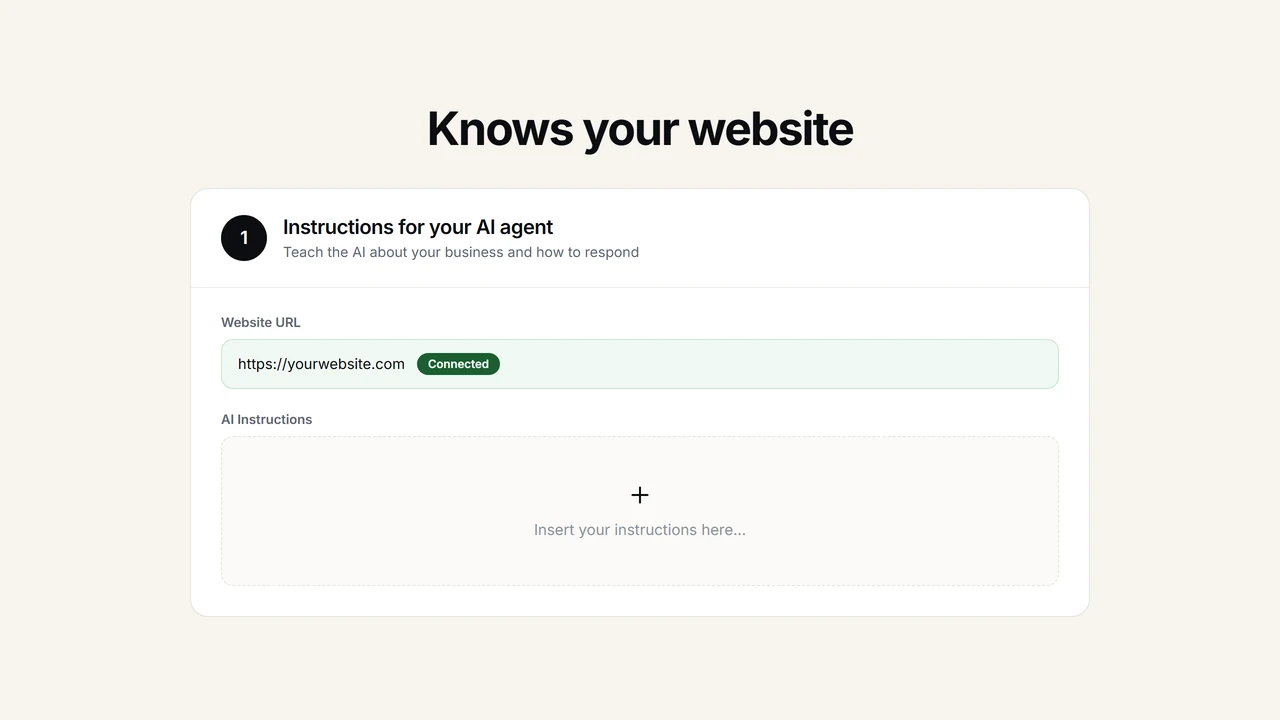
Feed your domain into the box and the chatbot widget pulls real answers from your published content in seconds
Answers from your exact pages, not generic web knowledge
The moment you connect a domain, Asyntai's crawler walks every publicly reachable URL and distills the content into a retrieval index. Pair that with private uploads — pricing PDFs, internal SOPs, product spec sheets — and the chatbot widget draws from both pools every time a visitor types a question.
- Full-domain crawl in minutesPublic pages, blog entries, product listings, policy documents — everything with a URL gets indexed so the widget never falls back on generic filler.
- Private uploads stay privateSupplier rate cards, internal handbooks, seasonal promo details — upload them as PDFs or pasted text; the widget references them without ever publishing them on your site.
- Behavioral guardrails via plain sentencesWrite instructions like "Route bulk-order conversations toward the wholesale inquiry form" and the chatbot widget respects them on every single exchange.
Turn casual browsing sessions into captured pipeline
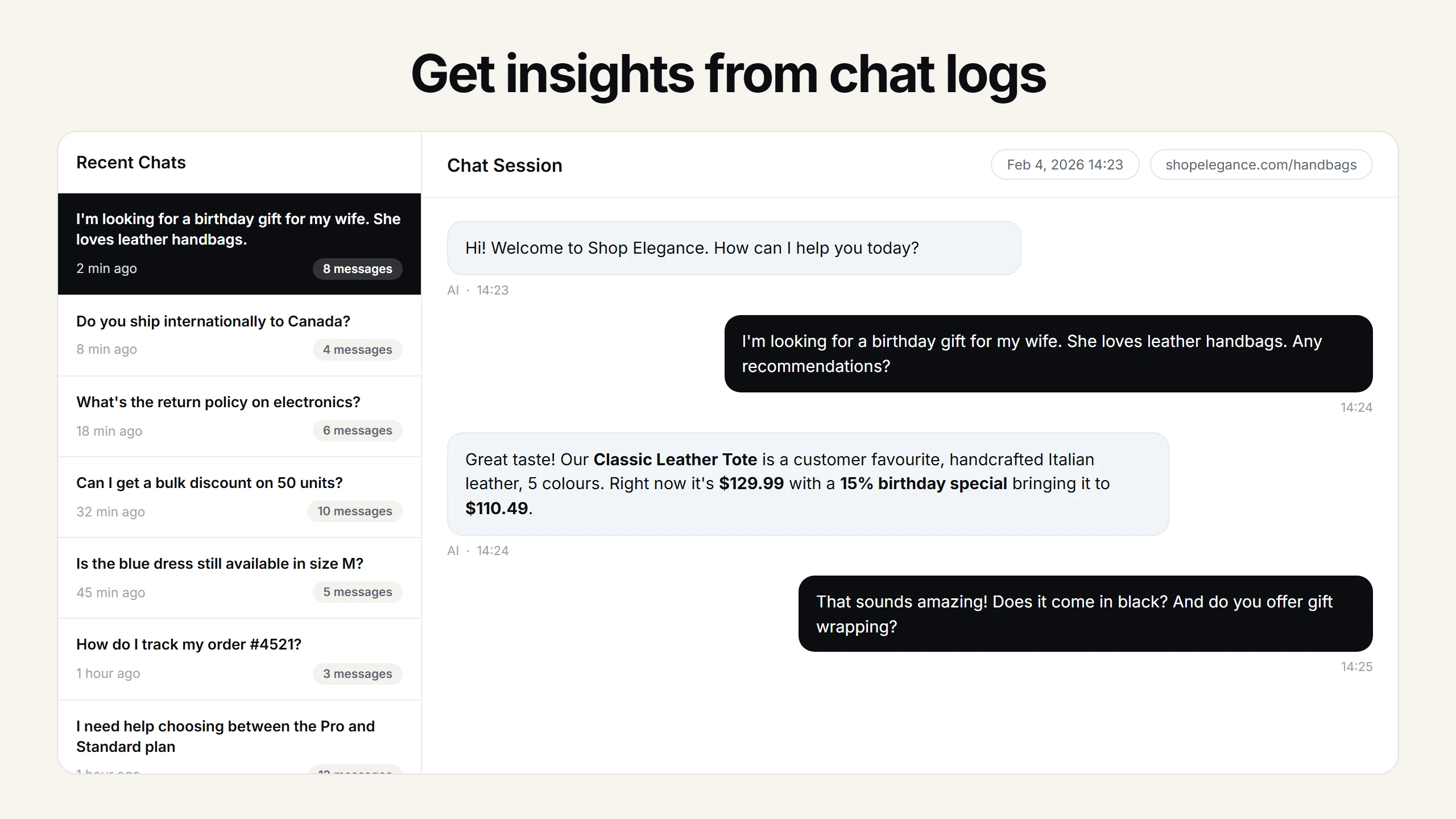
A chatbot widget sitting on your website is wasted if it only answers factual questions. Asyntai goes further: it identifies moments where a visitor hesitates, collects an email when escalation is needed, and files the full transcript as a qualified lead inside your dashboard.
- In-conversation lead captureWhen the discussion reaches a complexity the bot cannot close alone, it prompts for an email, saves the thread, and delivers the package to your Asyntai lead panel — with optional forwarding straight into your inbox.
- Transcript-rich lead recordsEvery lead carries the full conversation history so whoever follows up already understands the visitor's exact problem — no cold "how can we help?" opener needed.
- Topic and language analyticsSee which subjects visitors raise most, which languages they prefer, and which pages trigger the longest sessions — then feed those insights back into your content strategy.
Embed the chatbot widget on your website in four steps
The install is a single asynchronous script tag — the same mechanism you already use for analytics pixels and tracking libraries. No build step, no dependency, no framework lock-in.
- Register a free Asyntai account and enter the domain where you want the chatbot widget to appear.
- Copy the generated script snippet from the Install tab — it already carries your unique site identifier baked in.
- Drop the snippet into your site's header via your CMS settings panel, a header injection plugin, or the raw template file.
- Reload in an incognito window. The chatbot widget appears in the corner, already trained and ready to field questions.
<script src="https://asyntai.com/widget.js"
data-id="your-site-id" async>
</script>
# Async load — zero render-blocking impact.
# Widget active on every page of the domain.
Chatbot widget for website — common questions
Practical answers for site owners evaluating whether an AI chatbot widget belongs on their domain.
Does the chatbot widget slow down my website at all?
The tag fires in async mode once the browser has finished rendering your own markup, so it stays entirely out of the critical paint path. Visitors see your above-the-fold content at full speed; the chat launcher fades in quietly once the browser is idle. There is no measurable impact on time-to-interactive for the rest of your page.
Can I restrict the chatbot widget to specific pages instead of the entire site?
Yes. Through conditional snippet placement — load the script only on pages that match certain URL patterns using your CMS or tag manager rules — you can confine the widget to your pricing section, support portal, product catalog, or any subset of the site you choose.
What happens if a visitor speaks a language my site does not cover?
The widget identifies which language the visitor writes in — starting from their very first sentence — and responds natively in that tongue. Even if your site content exists only in English, a Spanish-speaking visitor receives Spanish answers synthesized from the English source material. This works across all 36 supported languages without any configuration on your part.
How does lead capture work inside the chatbot widget?
When a thread drifts into territory the AI cannot handle on its own — a bespoke project quote, a complex integration question, a request for human follow-up — the widget asks the visitor for an email address. The full transcript plus the email are saved as a lead in your Asyntai dashboard. Enable email forwarding and the same package arrives in your team's inbox ready for personal follow-up.
Is the chatbot widget compatible with single-page applications and JavaScript frameworks?
Yes. The widget bootstraps once on initial page load and persists across client-side route changes in React, Vue, Next.js, Nuxt, Angular, SvelteKit, and similar frameworks. The chat state carries over seamlessly so a visitor navigating between SPA routes never loses their conversation thread.
Can I use the chatbot widget to surface personalized answers for logged-in users?
Standard and Pro tiers unlock a User Context capability. Your page writes a window.Asyntai.userContext JSON payload before the launcher appears, filling it with whichever visitor attributes matter to you — name, membership tier, order history summary, account type. The AI factors that context into every reply, so a returning customer gets different treatment from a first-time browser.
How many websites can one Asyntai account cover?
Free covers a single domain. Moving to Starter adds a second, Standard grants three, and Pro extends coverage to ten. Each domain gets its own isolated training corpus, personality instructions, and widget styling, so a marketing agency can run chatbot widgets on several client sites from a single account without any data bleed between them.
What does the free plan actually include?
One connected website, up to 50 visitor messages per month, the full crawl-and-train pipeline, all 36 UI languages, and complete lead capture with dashboard analytics. No credit card is required at sign-up. The free tier is designed to let you validate the chatbot widget on your real traffic before committing to a paid plan.
Chatbot widget for website — why the right widget changes the economics of visitor engagement
Somewhere between the golden age of live-chat staffing desks and the current moment where every SaaS vendor claims "AI-powered," the humble chatbot widget acquired a credibility problem. Visitors see a floating bubble in the bottom corner, click it expecting help, and get funneled into a flowchart that was clearly authored by someone who never actually visited the site as a customer. The result is a brief exchange that ends with "I'll connect you with a human" or, worse, silence. That pattern trained an entire generation of internet users to treat chat widgets with justified skepticism. Rebuilding trust requires a fundamentally different approach — one where the widget genuinely understands the site it lives on.
Asyntai exists to close that gap. Instead of asking a site owner to manually construct decision trees or populate FAQ databases, the platform begins with a full crawl of the target domain. Every publicly accessible URL — product pages, blog posts, pricing tables, return policies, about-us narratives, knowledge-base articles — feeds into a semantic index the model searches whenever a new visitor message arrives. The chatbot widget does not operate from a static script; it composes each response by pulling relevant passages from the crawled corpus and generating a coherent reply that addresses the visitor's actual intent. When the public crawl misses something — internal documents restricted behind a login wall, supplier agreements, seasonal promotion calendars — you upload them as PDFs or raw text through the Asyntai dashboard, and they merge into the same index without replacing anything the crawler already gathered.
Language coverage deserves its own paragraph because it shifts the value proposition for any website that draws international traffic. The chatbot widget ships with 36 languages baked into its interface layer, and the underlying model picks up whichever tongue a visitor writes in from the very first sentence — no language selector, no browser-header sniffing. A French tourist on an English-language hotel site types in French and gets back a fluent French response woven from the English pages the crawler indexed. A Japanese developer exploring documentation published only in English gets a Japanese explanation of the same material. No additional configuration is needed per language — the detection and generation happen automatically, which means a single chatbot widget deployment covers linguistic diversity that would otherwise require a multilingual support team or, more realistically, would simply go unaddressed.
Installation is deliberately mundane. The widget ships as one asynchronous JavaScript tag — five attributes, no external stylesheet, no npm package, no build pipeline. You paste it into whatever header-injection mechanism your platform provides: a WordPress header plugin, Shopify theme settings, Squarespace code injection, Webflow custom code, a raw HTML template, a tag manager container. The script bootstraps on page load, fetches the latest widget configuration from the Asyntai CDN, and renders the launcher icon. Because the load is async, the host page's own content reaches the visitor's screen unimpeded; the chat launcher materializes only after the browser has finished its primary work. Site owners running aggressive caching — Varnish, Cloudflare, CDN edge caches — find that the cached HTML already includes the script tag, and since the widget pulls its live config client-side, cache invalidation is never triggered by changes made in the Asyntai dashboard.
The conversion mechanics built into the widget distinguish it from chatbot tools that treat every conversation as an end in itself. Asyntai monitors the trajectory of each thread. When the discussion veers into territory the AI cannot resolve with confidence — a bespoke pricing negotiation, a partnership proposal, a complaint that requires human empathy — the widget pivots to lead capture. It requests an email from the visitor, packages the full dialogue with timestamps, and drops the bundle into your lead queue on the dashboard. If email forwarding is enabled, the transcript also arrives in your team's inbox within seconds. The follow-up human inherits full context: what the visitor asked, what the AI answered, where the thread stalled, and which page the conversation originated on. That context eliminates the cold-start friction that plagues most inbound lead workflows, where the first human reply is invariably "Could you tell me more about what you need?" — a question the visitor already answered in chat.
Personalization via User Context opens a second tier of utility for sites that authenticate visitors. Higher-tier subscribers (Standard, Pro) gain access to a personalization hook: the host page writes a JSON object to window.Asyntai.userContext prior to chat-launcher render. That object can carry whatever the site chooses to expose — a customer name, a membership tier, a recent order number, an account creation date, a loyalty point balance. The model threads those details into its decision-making on every exchange. A gold-tier member asking about return windows gets an answer that references the extended return policy attached to their tier. A trial user asking about advanced features hears about the upgrade path relevant to their current plan. The data stays client-side and travels only into the conversation context; no server-to-server integration is required, which means the implementation is a few lines of inline JavaScript rather than an API integration project.
Multi-site management matters for agencies and operators running several properties. One Asyntai subscription can govern several connected domains — the Free plan hosts a single property, Starter opens a second slot, Standard brings the total to three, and Pro extends to ten. Every domain retains a walled-off knowledge corpus, distinct behavioral rules, and a separately branded chat appearance. A digital agency running a law firm site, a dental practice site, and a boutique hotel property sets up three wholly distinct chatbot voices under a single login. The law firm chatbot speaks in measured, hedged language. The dental clinic chatbot is warm and reassuring. The hotel chatbot is enthusiastic and detail-oriented about amenities. No content leaks between them, and billing consolidates under one invoice rather than three separate subscriptions.
Analytics give the chatbot widget a feedback loop that most static FAQ pages lack entirely. Every conversation lands in the dashboard tagged by topic cluster, visitor language, originating page URL, and resolution status — did the thread end in a satisfactory answer, an escalation to lead capture, or an unresolved drop-off? Over weeks, patterns crystallize. You discover that visitors consistently ask about a shipping threshold your site never mentions explicitly. You notice that German-speaking visitors account for twelve percent of chat volume even though your site has no German content. You observe that dialogues kicked off from one specific product listing generate leads at triple the homepage rate. Those signals feed directly into content decisions, pricing page rewrites, and localization priorities in a way that Google Analytics alone never surfaces because GA tells you what visitors clicked, not what they asked.
Behavioral instructions give site owners a steering wheel rather than a black box. The Asyntai control panel provides an open text area where you write natural-language directives governing how the chatbot widget responds. "When someone asks about enterprise pricing, collect their company name and team size before quoting a number." "Never speculate about competitor products." "If a visitor mentions accessibility requirements, link them directly to the ADA compliance statement at /accessibility." These are not keyword triggers mapped to scripted outputs — they function as strategic guardrails the model balances against crawled material when formulating each reply. The effect is a chatbot that sounds like it was briefed by your team rather than dropped in from an external vendor.
Pricing sits at a level that removes the "let me get budget approval" friction for most small and mid-market teams. A zero-cost entry tier gives you a single site and 50 monthly messages — room enough to validate the widget on production traffic and sanity-check the tone before committing budget. Upgrading to Starter at thirty-nine dollars per billing cycle pushes the allowance to 800 messages and unlocks a second domain. Standard and Pro tiers push the envelope further with additional domains, User Context for logged-in personalization, and higher message volumes. For a business already paying for hosting, a domain, an email service, and a handful of SaaS subscriptions, adding a chatbot widget that actively converts traffic fits within the existing operational budget rather than requiring a new procurement cycle.
Deploying a chatbot widget on a website is ultimately a bet that visitor engagement matters enough to invest in doing it well. The low-effort version — a rule-based bot with ten canned answers — satisfies compliance checkboxes but rarely moves commercial needle. The high-effort version — a human support desk staffed across time zones and languages — delivers results but at a cost only enterprise budgets can absorb. Asyntai occupies the space between those extremes: an AI-grounded widget that understands the site it sits on, speaks the visitor's language without prompting, captures leads with full context when conversations exceed its reach, and feeds actionable analytics back to the team. The installation takes a single line of code. The ongoing maintenance is limited to updating your behavioral instructions when business rules change and reviewing conversation analytics when you want to improve. Everything else — the crawling, the language detection, the retrieval, the generation, the lead routing — runs without intervention, which is exactly how a chatbot widget on a working website ought to behave.