Chatbot builder for lead generation — turn website visitors into conversations, conversations into leads
Build an AI chatbot that engages website visitors in real conversation instead of pushing them toward a static form. The AI answers their questions using your website content, asks follow-ups that qualify them, and collects their contact information naturally within the chat.
See how AI captures leads on a real website
Enter a website URL and watch the AI engage visitors, answer product questions, and collect contact information through natural conversation
Reads your website and answers prospect questions like a sales rep who studied every page
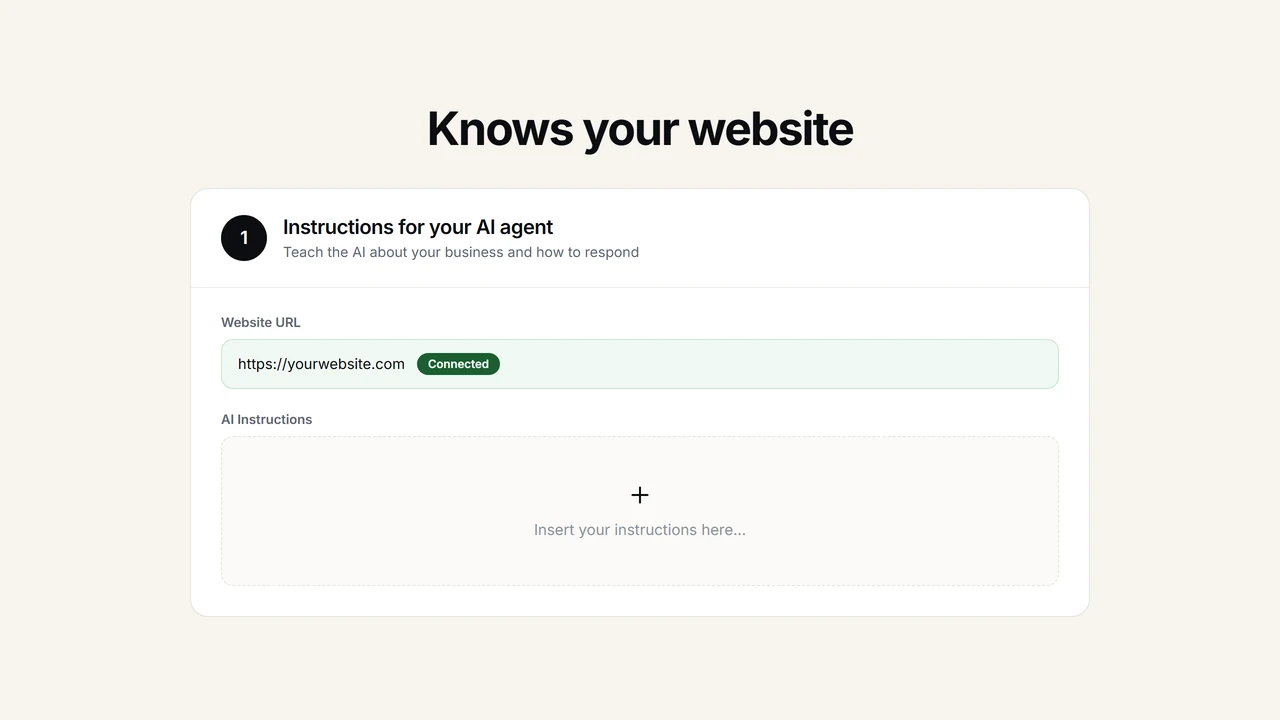
Most lead generation chatbots are glorified forms — they ask scripted questions in a fixed order regardless of what the visitor actually wants. Asyntai is different. It crawls up to 50 pages of your website and builds a knowledge base the AI uses to have real conversations about your product or service. When a visitor asks a question, the AI answers it accurately using your own content. That answer builds trust. Trust keeps the visitor in the conversation. And a visitor who stays in the conversation is far more likely to share their contact information than one who is immediately pushed toward "fill out this form."
- Answers product and service questions with real specificsThe AI reads your pricing pages, feature lists, case studies, and FAQs — then uses that information to answer visitor questions accurately. A prospect asking "do you integrate with Shopify?" gets a factual answer drawn from your integrations page, not a vague "let me connect you with sales." The conversation stays productive because the AI actually knows your product.
- Qualifies leads through natural follow-up questionsInstead of a rigid form with fields for name, company, and phone number, the AI asks qualifying questions that feel like a real conversation: "What are you currently using for that?" "How many people are on your team?" "When are you looking to make a decision?" The visitor answers naturally, and you receive a lead with context that a form would never capture.
- Speaks every visitor's language automaticallyThe AI detects each visitor's language and responds accordingly — 36 languages supported. A prospect browsing your site in German gets a German-language conversation about your product. A visitor from Brazil chats in Portuguese. Your lead capture works across every market your website serves, without building separate funnels for each language.
Captures leads that contact forms miss entirely
Contact forms have a fundamental problem: they ask for information before providing any value. A visitor lands on your site, has questions, sees a form that says "fill this out and someone will get back to you within 24 hours," and leaves. They wanted answers, not a promise. An AI chatbot reverses this dynamic — it gives value first by answering the visitor's questions, then asks for contact information once the visitor is engaged and sees a reason to continue the conversation.
- Engages visitors the moment they arriveMost website visitors leave within 30 seconds without interacting with anything. The AI chatbot provides an immediate point of engagement — a conversation starter that invites questions. A visitor who types their first question is already more invested than one who scanned a page and bounced. That initial engagement is the hardest part of lead capture, and the AI handles it around the clock.
- Collects contact information within the flow of conversationAfter the AI has answered a question or two, it naturally asks for an email address or phone number: "I can send you a detailed comparison — what's the best email to reach you?" or "Would you like one of our team members to walk you through this? What's your email?" The request feels like a logical next step, not a demand.
- Captures leads at 2 AM that you would have lost entirelyProspects research purchases on their own schedule — evenings, weekends, lunch breaks. Without AI, a visitor at 11 PM on a Tuesday has two options: fill out a form and wait, or leave. With AI, they have a full conversation, get their questions answered, and share their information because the AI earned it. Monday morning, your sales team has a lead with complete context instead of a cold form submission.
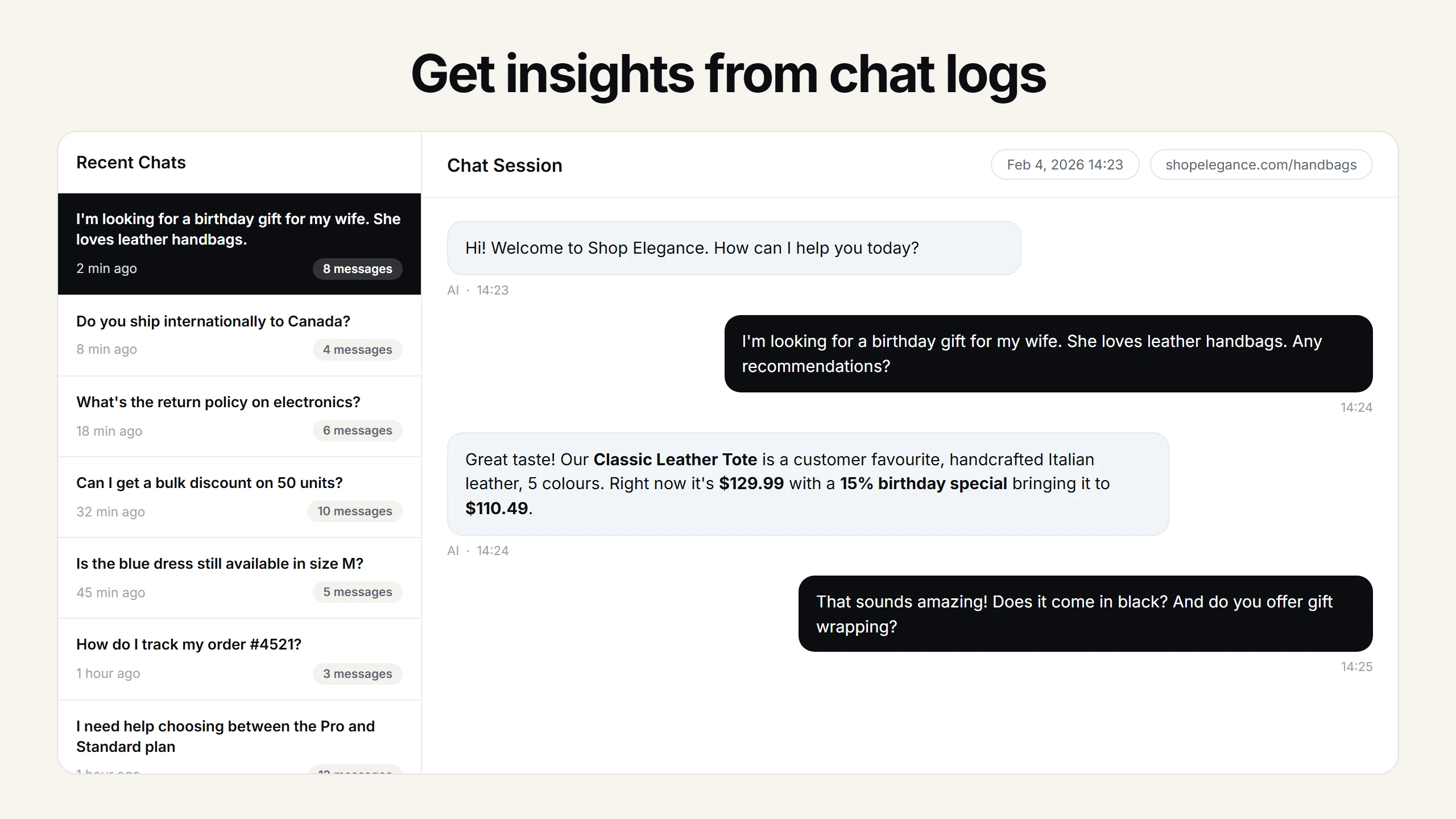
- Delivers leads with conversation context, not just form fieldsEvery lead captured by the AI comes with a full conversation transcript accessible in the Asyntai dashboard. Your sales rep does not just see "John, [email protected], interested in Enterprise plan." They see the entire conversation — what John asked, what he cares about, what objections he raised, what competitor he mentioned. The first outreach email writes itself because you know exactly what John wants to hear.
Build your lead generation chatbot in minutes
No coding, no flowcharts, no decision trees. Point the AI at your website, write your lead capture instructions in plain English, and paste one snippet. The AI reads your content and starts engaging visitors immediately.
- Sign up at Asyntai and enter your website URL. The AI crawls your site — product pages, pricing, case studies, FAQ, about page — and builds its knowledge base automatically. Up to 50 pages.
- Copy the script tag from your Asyntai dashboard.
- Paste the snippet into the <head> section of your website. Works with any platform — WordPress, Webflow, Squarespace, Shopify, Wix, or custom-built sites.
- Write custom instructions for lead capture — for example, "after answering two questions, ask the visitor for their email so we can send a proposal" or "always ask what they are currently using before collecting contact info."
<script src="https://asyntai.com/widget.js"
data-id="your-site-id" async>
</script>
</head>
# Visitors become leads, automatically.
Chatbot builder for lead generation — FAQs
Common questions from businesses evaluating AI chatbots for lead capture and qualification.
How is this different from a traditional chatbot builder with decision trees?
Traditional chatbot builders require you to map out every possible conversation path — if the visitor says X, show response Y, then branch to Z. That works for simple flows but breaks down quickly when visitors ask unexpected questions. Asyntai uses AI that reads your website content and responds to any question intelligently. There are no decision trees to build or maintain. You write instructions in plain English — "ask for an email after answering their first question" — and the AI handles the rest, regardless of what the visitor asks.
Where do captured leads go?
Every conversation is stored in your Asyntai dashboard, where you can review the full transcript, see what the visitor asked, and access any contact information they shared. You can filter conversations by date, review lead quality, and export data. On the Standard plan ($139/month) and Pro plan ($449/month), you can also use Custom Tools to push lead data directly to your CRM or email marketing platform via REST API in real time.
Can I control what questions the AI asks to qualify leads?
Yes. Custom instructions let you define your qualification criteria in plain English: "Ask every visitor what industry they work in and how many employees their company has." "If someone asks about enterprise pricing, collect their company name, email, and phone number." "Always ask what solution they currently use before suggesting ours." The AI follows these rules in every conversation while keeping the interaction conversational and natural.
Will the AI make promises about my product that are not true?
The AI answers strictly from your published website content and your custom instructions. It does not invent features, fabricate pricing, or make commitments you have not authorized. If a visitor asks about something not covered on your website, the AI says it does not have that information and offers to connect them with your team. You control the boundaries — the AI stays within them.
How much does this cost?
The Free plan gives you 50 messages per month on one website — enough to test the chatbot on your site and see how visitors interact with it. The Starter plan at $39/month covers 800 messages across 2 websites. Most growing businesses fit on the Standard plan at $139/month with 15,000 messages and 3 websites. Agencies and businesses with multiple brands use the Pro plan at $449/month for up to 20 websites and 50,000 messages.
Do I need technical skills to set this up?
No. You paste one JavaScript snippet into your website — the same level of effort as adding Google Analytics. The AI reads your website content automatically, so there is no data entry, no training files to upload, and no conversation flows to design. Custom instructions are written in plain English. If you can edit your website's HTML or use a tag manager, you can deploy Asyntai.
How does the AI handle visitors who are not ready to buy?
Not every visitor is a sales-qualified lead, and the AI does not force them into a lead capture flow. If someone asks a simple question and gets their answer, the AI lets the conversation end naturally. If the visitor engages further — asking about pricing, comparing features, discussing implementation — the AI recognizes buying signals and collects contact information at the right moment. You can customize this behavior through instructions: "Only ask for email if the visitor asks about pricing or mentions a timeline."
Can the chatbot work alongside my existing contact form?
Yes. The AI chatbot runs independently of your existing forms. Many businesses keep their contact form as a fallback while the AI chatbot handles the majority of visitor engagement. Over time, you can compare conversion rates between the two — most businesses find the AI chatbot captures significantly more leads because it provides value before asking for information, while the form just asks.
What kind of businesses get the best results with this?
Any business where the sales cycle involves questions before purchase. B2B software companies, consulting firms, agencies, financial services, real estate, SaaS companies, professional services — anywhere a prospect needs information before committing. The AI works particularly well when your website has rich content the AI can draw from. The more detailed your product pages, pricing information, and case studies, the better the AI can engage and qualify visitors.
Why AI chatbots outperform contact forms for lead generation — and what most businesses get wrong
The contact form has been the default lead capture mechanism on business websites for two decades, and it has always been a compromise. The business wants information from the visitor. The visitor wants information from the business. The contact form serves only the business side of that exchange — it collects a name, email, and maybe a message, then promises someone will "get back to you." The visitor gives up their information and receives nothing in return except a wait. It should not surprise anyone that contact form conversion rates hover in the low single digits. The form is asking for something without offering anything.
An AI chatbot inverts this equation. The visitor arrives at your website with questions — how does your product work, what does it cost, do you serve my industry, how is this different from the competitor I looked at yesterday? The AI answers those questions immediately, using information from your own website. The visitor gets value. They get answers. They get the feeling that this company is responsive and knowledgeable. And after two or three exchanges, when the AI asks "would you like me to have someone from our team reach out with a customized proposal? What's your email?" — the visitor says yes, because the AI earned it.
The qualification problem is where most lead generation efforts waste the most money. Marketing spends to drive traffic to the website. Some fraction of visitors fill out the contact form. Sales picks up those form submissions and starts reaching out. Half the leads are unqualified — wrong industry, wrong budget, wrong timeline, or they just wanted a free resource and had no buying intent. The sales rep burns hours chasing leads that were never going to convert. An AI chatbot qualifies visitors during the conversation itself. By the time the visitor shares their email, the AI has already asked what they are looking for, what they currently use, and when they need a solution. The lead arrives pre-qualified, with context attached.
Consider the difference between these two lead submissions. Lead A: "John Smith, [email protected], Message: I'm interested in your product." Lead B: A full conversation transcript where John asked about Shopify integration (you have it), mentioned he is currently using a competitor and is frustrated with their pricing, said his team has 15 people, and asked about implementation timeline because they want to switch by Q3. Lead B is not just a better lead — it is a lead your sales rep can close on the first call because they already know what John wants, what he is unhappy with, and when he needs to move. That context comes from the AI conversation, and it is available in the Asyntai dashboard.
The after-hours dimension of lead capture is consistently undervalued. Business websites receive traffic around the clock, but most B2B companies have sales teams that work roughly 9-to-5. A prospect researching solutions at 9 PM on a Wednesday — a serious buyer, carving out personal time to evaluate options — visits your site, reads your product page, has a question about enterprise pricing, sees a contact form, and decides to "come back tomorrow." They do not come back. They visit a competitor's site 10 minutes later and if that site has a chatbot that answers their pricing question immediately, the competitor gets the lead. The AI chatbot ensures your website converts visitors at 9 PM the same way it does at 9 AM.
The no-code aspect matters more than it initially appears. Traditional chatbot builders — the drag-and-drop flowchart kind — position themselves as "no-code," but they require significant effort to build effective conversation flows. You need to anticipate every question a visitor might ask, create branching logic for each path, write response templates, and continuously update the flows as your product changes. With Asyntai, you write custom instructions in plain English: "After answering two questions, ask for the visitor's email and company name." The AI handles everything else — adapting to whatever the visitor asks, using your website content for accurate answers, and following your lead capture rules naturally within the conversation.
Multilingual lead capture is where the gap between AI chatbots and traditional tools becomes a canyon. If your website attracts visitors from multiple countries — and almost every SaaS company, consultant, and agency does — a traditional chatbot requires you to build separate conversation flows for each language. Or more likely, you just do not bother, and every non-English-speaking visitor hits a language wall. The AI detects each visitor's language automatically and responds in kind — 36 languages supported. A visitor from Japan asks about your consulting services in Japanese. A prospect from Spain inquires about pricing in Spanish. Your lead generation works globally without you building a single additional flow.
The conversation data itself becomes a strategic asset over time. After a month of AI-powered lead capture, you have hundreds of real visitor conversations showing exactly what prospects ask about, what concerns they raise, what competitors they mention, and where they get stuck. This is qualitative market research delivered as a byproduct of lead capture. You discover that 30 percent of visitors ask about a feature you buried on page three of your website. You learn that prospects consistently compare you to a competitor you had not prioritized in your positioning. You find that visitors from the healthcare vertical have compliance questions your website does not address. Each insight improves your website, your messaging, and your product roadmap.
Sales team adoption is smoother than with most lead generation tools because the value is immediately obvious. A sales rep opens the Asyntai dashboard, sees a new conversation from last night, reads the transcript, and knows exactly what the prospect wants before picking up the phone. Compare that to a CRM notification that says "New form submission: Jane Doe, [email protected], Message: Tell me more about your product." One lead gets a personalized, informed outreach call. The other gets a generic "thanks for your interest" email. The close rate difference between those two approaches compounds over every lead, every month.
The objection handling capability of an AI chatbot is something most businesses do not anticipate. When a visitor asks "how is this different from [competitor]?" or "why is this so expensive?" or "what happens if I do not like it?" — the AI does not panic or deflect. If your website has comparison pages, a pricing rationale, or a refund policy, the AI uses that content to address the objection directly. The visitor gets a real answer. Their concern is addressed. They stay in the conversation. A contact form cannot handle objections — it can only collect them as a note that someone will eventually read.
The economics of AI-powered lead capture are straightforward. A business spending $5,000 per month on paid advertising to drive website traffic might see a 2 percent form conversion rate. Out of 5,000 visitors, 100 fill out the form, and maybe 20 of those are genuinely qualified. The cost per qualified lead is $250. If an AI chatbot increases the effective conversion rate to 4 percent by engaging visitors who would have bounced — and improves lead quality by qualifying during the conversation — you get 40 qualified leads from the same traffic spend. Your cost per qualified lead drops to $125. The Starter plan at $39 per month or the Standard plan at $139 per month pays for itself within the first week.
Custom instructions are where you encode your sales process into the AI without building a single flowchart. "If a visitor mentions they have more than 50 employees, prioritize the Enterprise plan in your answers." "Always ask what CRM they currently use." "If someone asks about pricing, share the public pricing and then ask if they would like a custom quote — collect their email if yes." "Never discuss discounts — tell the visitor a team member can discuss custom pricing." These rules shape every conversation without restricting the AI's ability to answer unexpected questions. The AI stays intelligent and adaptive while following your lead capture playbook.
The comparison with live chat is worth addressing because businesses often ask "why not just use a live chat tool?" Live chat works — when someone is available to respond. The moment a visitor sends a message and sees "average wait time: 8 minutes" or "our team is currently offline," the conversion opportunity evaporates. AI eliminates the availability constraint entirely. Every visitor gets an immediate, knowledgeable response whether it is 2 PM on a Tuesday or 11 PM on a Saturday. And unlike a live chat agent who handles one conversation at a time, the AI handles hundreds of concurrent conversations without degradation in response quality or speed.
Privacy and trust concerns come up often, and the answer is simple. The AI uses your published website content to answer questions. It does not access visitor data beyond what they voluntarily share in the conversation. All conversations are encrypted in transit and at rest. Visitor information is stored in your Asyntai dashboard where you control access. The AI does not sell, share, or use visitor data for any purpose other than the conversation your business initiated. For businesses in regulated industries, this matters — the AI operates within boundaries you define.
What the AI does not do is worth stating clearly. It does not replace your sales team. It does not negotiate contracts. It does not process payments. It does not make guarantees you have not authorized. What it does is the work your sales team cannot physically do — engage every single website visitor at the moment they arrive, answer their specific questions, qualify their intent, and deliver a warm lead with full context. The first conversation a prospect has with your business is no longer limited by headcount, time zones, or availability. It is limited only by the quality of your website content and the instructions you give the AI.