Chat plugin for Magento that reads your entire catalog — configurable products and all
Most chat plugins paste a widget onto your Magento storefront and call it a day. Asyntai's chat plugin for Magento does something different: it absorbs your catalog data, understands configurable products with dozens of attribute combinations, and answers buyer questions with AI-generated responses grounded in your actual inventory. When a visitor asks about a specific size-color-finish variant, the plugin pulls the answer from your product data — not a canned response tree. Connect it to Magento's REST API through Custom Tools and it checks live stock, tracks orders, and processes returns without your team touching a ticket.
See the chat plugin working on your Magento store
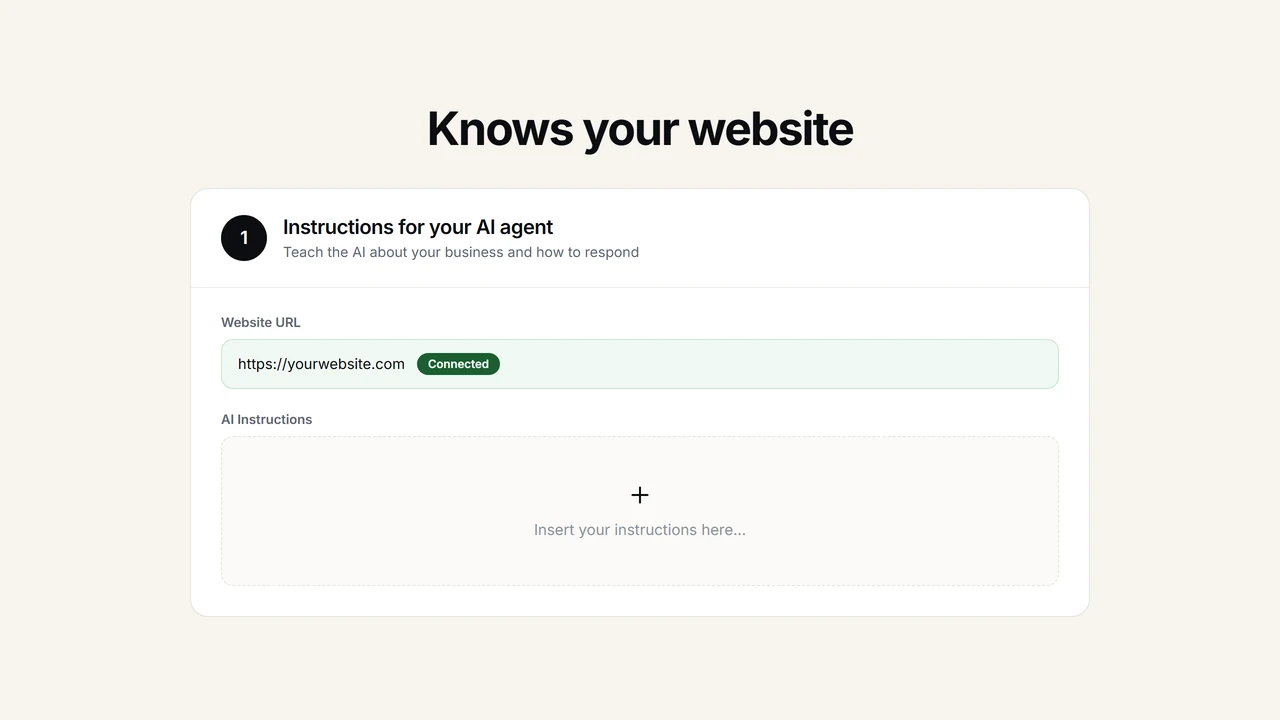
Enter your Magento or Adobe Commerce URL and watch the AI answer product questions using your own catalog data
Understands configurable, bundle, and grouped products — not just flat SKU lists
Magento catalogs are architecturally different from what simpler platforms produce. A single configurable product can carry fifty attribute combinations across size, color, material, and voltage. Bundle products let buyers assemble custom kits. Grouped products link related items under a parent listing. Generic chat plugins flatten all of this into page text and lose the structure. Asyntai's chat plugin for Magento preserves it. The AI reasons about attributes as separate dimensions, so when a buyer asks "is the brushed-nickel version available in 36-inch?" the response reflects your actual product structure — not a paraphrase of the product description. Pair that with Dynamic Product Cards and the AI surfaces matching items as visual cards with images, prices, and direct links, right inside the chat conversation.
- Configurable products stay structuredSize, color, material, voltage, and custom attributes remain discrete fields in the AI's understanding. The chat plugin resolves attribute-level questions — "do you carry this motor in 220V single-phase?" — without collapsing the product into a generic paragraph.
- Dynamic Product Cards in every conversationWhen the AI identifies matching products, it renders them as visual cards with product image, name, price, description, and a link to the product page. Multiple results appear as a swipeable carousel. Buyers browse visually inside the chat instead of navigating back to category pages.
- AI search across the full catalogVisitors describe what they need in plain language — "heavy-duty shelf bracket rated for 200 kg" or "gift set under $50 with free shipping." The AI searches your catalog data, understands the intent behind the words, and returns the closest matches as product cards. No keyword guessing required.
REST API integration, B2B support, and multi-store awareness
A chat plugin that only answers from crawled pages hits a wall the moment a buyer asks something that requires live data — current stock for a specific variant, order tracking, return eligibility, or customer-specific pricing. Asyntai's Custom Tools bridge that gap. You connect endpoints from Magento's REST API, and the AI calls them mid-conversation to fetch real-time answers. A buyer asks "where is my order?" and the AI checks the order status API. A B2B customer asks about tier pricing, and the AI pulls the applicable rate. The chat plugin becomes an active participant in your store operations, not a passive FAQ reader.
- Custom Tools call Magento's REST APIDefine endpoints for order lookup, inventory checks, return initiation, or any custom API route your store exposes. The AI decides when to call each tool based on the conversation, fetches the data, and weaves the result into a natural response. Standard and Pro plans.
- B2B catalogs and customer groupsMagento's customer-group pricing, requisition lists, and company account structures create buyer interactions that consumer-grade chat tools cannot handle. The chat plugin works with User Context data pushed from your storefront to personalize responses by account tier, company, or customer group.
- Multi-store and multi-website supportRun one Magento installation with three websites and five store views? The chat plugin operates across all of them. Each store view can connect as its own Asyntai site with separate knowledge bases, or share a single connection. The AI detects the buyer's language automatically — 36 languages supported.
Add the chat plugin to Magento in under ten minutes
No Composer packages, no module registration, no setup:upgrade commands. Asyntai's chat plugin for Magento installs as a lightweight JavaScript snippet. Add it to your theme's default_head_blocks.xml layout file, paste it into a CMS static block, or inject it through Google Tag Manager. The widget loads asynchronously and never blocks page rendering. Works with Magento Open Source 2.x, Adobe Commerce, and Hyva themes.
- Sign up for a free Asyntai account and copy your unique widget snippet from the dashboard.
- Open your Magento theme's default_head_blocks.xml (typically at app/design/frontend/YourVendor/YourTheme/Magento_Theme/layout/) and add the snippet inside a referenceBlock for head.additional.
- Alternatively, paste the snippet into a CMS static block and add it to your layout via XML, or deploy through Google Tag Manager.
- Flush the Magento cache (bin/magento cache:flush) and the chat plugin appears on every storefront page.
<page xmlns:xsi="http://www.w3.org/2001/XMLSchema-instance">
<body>
<referenceBlock name="head.additional">
<block class="Magento\Framework\View\Element\Text">
<arguments>
<argument name="text" xsi:type="string">
<script src="https://asyntai.com/widget.js"
data-id="your-site-id" async></script>
</argument>
</arguments>
</block>
</referenceBlock>
</body>
</page>
Chat plugin for Magento — FAQs
Questions Magento merchants ask before adding an AI chat plugin to their storefront.
How does the chat plugin differ from a basic live chat widget?
A basic live chat widget routes messages to a human agent — when nobody is online, the visitor waits or leaves. Asyntai's chat plugin for Magento is AI-powered: it answers using your content immediately, around the clock, in 36 languages. It understands product attributes, shows Dynamic Product Cards with images and prices inside the conversation, and can call your Magento REST API through Custom Tools to check stock, track orders, or look up customer-specific pricing. Live chat requires staffing. This chat plugin requires product data.
Does it work with configurable and bundle products?
Yes. The AI preserves the attribute structure of configurable products — size, color, material, voltage, and any custom attributes your catalog uses. When a buyer asks about a specific combination, the AI references the attribute data rather than paraphrasing the product description. Bundle products and grouped products are handled the same way: the AI understands the parent-child relationship and can discuss individual components or the bundle as a whole.
How does the chat plugin get my product data?
The AI crawls your public Magento storefront — product pages, category listings, CMS pages, and policy content. For structured product data with real-time pricing, you can connect a Real-Time Data Feed: a URL (JSON, CSV, or API endpoint) that returns your catalog. You can also upload files to the knowledge base — spec sheets, wholesale terms, internal docs. The AI searches across all sources when answering. Custom Tools add a third layer: live API calls to Magento's REST API for data that changes by the minute, like inventory counts or order status.
Will the chat plugin slow down my Magento storefront?
No. The widget script loads asynchronously after your page has finished rendering. It does not interfere with Magento's full-page cache, Varnish, or CDN layers. The script weighs under 50 KB gzipped and makes no blocking requests during page load. Lighthouse scores remain unaffected. The chat plugin adds a floating button to the corner of each page — it does not inject itself into your theme's DOM or modify any Magento layout blocks at render time.
Can I connect it to Magento's REST API for order tracking?
Yes, through Custom Tools on Standard and Pro plans. You define an API endpoint — for example, your Magento REST route for order status — and the AI calls it when a buyer asks about their order. The same mechanism works for inventory lookups, return eligibility checks, shipping estimates, or any custom endpoint your store exposes. You control which endpoints the AI can access and what data it returns to the buyer. No code changes to your Magento backend are required — Custom Tools consume existing REST endpoints.
Does it support B2B and wholesale storefronts?
Yes. Magento B2B features — customer-group pricing, company accounts, requisition lists, negotiable quotes — produce buyer interactions that generic chat tools ignore. The chat plugin accepts User Context data pushed from your storefront JavaScript, so you can pass the buyer's customer group, company name, or account tier. The AI then personalizes responses accordingly. Combined with Custom Tools calling your pricing or inventory API, the chat plugin can serve B2B buyers with account-specific information without exposing data meant for other customer groups.
Does it work with Hyva themes and headless Magento?
The chat plugin loads via a standalone JavaScript snippet that is independent of your theme's frontend framework. It works with Luma, Blank, Hyva, and any custom theme. For headless Magento setups using a React or Vue storefront (like Vue Storefront or Scandi PWA), add the same snippet to your frontend's HTML shell or index template. The widget renders its own UI and does not depend on Magento's RequireJS, KnockoutJS, or any theme-specific JavaScript.
What does the chat plugin cost?
The chat plugin works on all plans, including Free (100 messages per month, 1 site). Dynamic Product Cards and Real-Time Data Feed require Standard ($139/month, 15,000 messages) or Pro ($449/month, 50,000 messages). Custom Tools for REST API integration are also Standard and above. Most Magento merchants start on Free to validate the plugin on a staging store, then move to Standard once they connect their data feed and API endpoints.
Why Magento stores need a chat plugin that goes beyond canned responses
The average Magento catalog is not a list of products. It is an interconnected graph of configurable parent items, simple child SKUs, bundle assemblies, grouped product families, and custom attribute sets that produce combinatorial complexity no other mainstream ecommerce platform demands. A single configurable product in a Magento store can generate sixty purchasable variants across size, color, material, and regional compliance options — each with its own price, stock level, and image set. Bundle products let buyers assemble their own kits from selectable components with quantity constraints. Grouped products link a drill, a battery pack, and a charger under one listing so buyers can pick quantities independently. This is the catalog architecture that Magento merchants chose because no simpler platform could handle it. And it is exactly the architecture that most chat plugins ignore entirely.
Generic chat widgets approach a Magento storefront the same way they approach a five-page brochure site: scrape some text, index it loosely, and pattern-match against visitor questions. That strategy works when your product data is flat — a name, a price, a paragraph of description. It collapses the moment a buyer asks a question that requires understanding product structure. "Do you carry the HD-900 bracket in 316 stainless?" is not a keyword search. It is a question about a specific attribute value on a configurable product, and answering it correctly requires knowing that the HD-900 is a configurable parent with child SKUs differentiated by material grade, and that 316 stainless is one of the available options. A chat plugin that flattened the product page into a text blob will either hallucinate an answer or punt with "please contact our sales team" — both of which cost you the buyer's trust at the exact moment they were ready to commit.
Asyntai's chat plugin for Magento was built with this structural complexity in mind. The AI absorbs your catalog data and preserves the relationships between parent products, child variants, attribute sets, and product types. When a buyer engages the chat and asks about a configurable product, the AI treats size, color, material, and every custom attribute as separate dimensions — not as words in a paragraph. The response to "is the matte-black 48-inch version in stock?" draws from structured product knowledge, not a fuzzy match against page content. This is not a trivial distinction. For merchants whose catalogs live in Magento specifically because those catalogs are too complex for Shopify or WooCommerce, the ability of the chat plugin to reason at the attribute level is the difference between a useful tool and an expensive widget that confuses buyers more than it helps them.
Dynamic Product Cards extend this structural awareness into a visual experience. When the AI identifies products that match a buyer's query, it renders them as rich cards inside the chat conversation — product image, name, price, a short description, and a direct link to the product page. Multiple matches appear as a horizontal carousel the buyer can swipe through. This transforms the chat from a text exchange into a product browsing interface. A buyer who asks "show me all your stainless steel shelving rated for 150 kg per metre" gets a carousel of matching products with images and prices, right there in the conversation. They compare visually, click the one they want, and land on the product page ready to configure and add to cart. The journey from question to product page shrinks from five clicks and three back-button presses to a single tap on a product card.
But catalog knowledge alone does not cover everything a buyer needs during a purchasing decision on a Magento store. Buyers ask questions that require live data: "Is this in stock in the Toronto warehouse?" "Where is my order?" "Am I eligible for the tier-three price on this item?" "Can I return a custom-engraved product?" These are questions that cannot be answered from crawled page content because the answers change by the hour. This is where Custom Tools transform the chat plugin from a knowledge assistant into an operational interface. Custom Tools let you connect endpoints from Magento's REST API — or any API your infrastructure exposes — so the AI can fetch live data during a conversation. You define the endpoint, the parameters, and what data comes back. The AI decides when to call each tool based on the buyer's question, makes the API call, and incorporates the response into its reply.
The implications for Magento merchants are substantial. An order tracking Custom Tool means a buyer types "where is order #100042589?" and the AI calls your /rest/V1/orders endpoint, retrieves the status and tracking number, and tells the buyer their package shipped yesterday via FedEx with an estimated delivery of Thursday. An inventory check tool lets the AI confirm that yes, the 220V single-phase variant of the industrial pump has eight units in stock at the regional distribution center. A return eligibility tool checks the order date against your return window and tells the buyer whether their item qualifies before they fill out a form. Each tool you connect removes a class of questions from your support queue and resolves them instantly, around the clock, in whatever language the buyer speaks.
B2B is where Magento's complexity and Asyntai's capabilities converge most dramatically. Adobe Commerce's B2B module adds company accounts, customer-group pricing tiers, requisition lists, negotiable quotes, and purchase approval workflows — features that exist because B2B buyers operate under constraints that retail shoppers never encounter. A procurement officer at a construction company does not browse your catalog casually. They arrive with a bill of materials, specific grade requirements, quantity targets, and a budget approved by someone who is not in the conversation. The chat plugin meets this buyer with the depth they expect. User Context — customer name, company, account tier, customer group — gets pushed from your storefront JavaScript to the chat widget, and the AI uses it to personalize responses. Combined with Custom Tools calling your pricing API, the chat plugin can tell a tier-two wholesale customer their specific unit price for a 500-piece order of a configurable product, without exposing retail pricing or another customer group's rates.
Installation follows the path of least resistance for Magento developers. Instead of a Composer package that requires module registration, dependency resolution, and the full setup:upgrade cycle, the chat plugin deploys as a JavaScript snippet. The recommended approach is adding it to your theme's default_head_blocks.xml layout file — a standard Magento layout XML file that injects content into the head of every page. You create a referenceBlock targeting head.additional, add a Text block with the Asyntai script tag, and flush the cache. The widget appears on every storefront page. For merchants who prefer not to edit theme files, the same snippet works inside a CMS static block referenced by layout XML, or through Google Tag Manager. The widget loads asynchronously, adds no blocking requests to your critical rendering path, and weighs under 50 KB gzipped. It works with Luma, Blank, Hyva, and any custom theme because it renders its own UI independently of your theme's JavaScript framework — no RequireJS modules, no KnockoutJS bindings, no Alpine.js dependencies.
Multi-store architecture is native to Magento, and the chat plugin respects it without requiring parallel configuration. A Magento installation running three websites with five store views — English retail, French retail, German retail, English wholesale, Spanish wholesale — does not need five separate chat plugin installations. A single Asyntai site connection serves all store views. The AI detects the buyer's language from their first message and responds in that language, drawing from the same catalog knowledge. A French-speaking buyer on the French store view gets French responses with product cards showing French-locale pricing. A German buyer browsing the English store view still gets German responses because the language layer operates independently of the store view. For merchants who want separate knowledge bases per store view — different product selections for retail versus wholesale, for instance — each store view can connect as its own Asyntai site on the Pro plan.
The economic argument for an AI chat plugin on a Magento store differs from the argument on simpler platforms because the cost of unanswered questions is higher. A Shopify store selling t-shirts loses a $25 sale when a visitor bounces. A Magento store selling industrial equipment loses a $12,000 purchase order. A B2B Magento portal loses not just a single order but a customer relationship that represents $200,000 in annual volume. The chat plugin's value scales with the average order value and the complexity of the pre-sale conversation. On stores where buyers need to confirm specifications, verify compatibility, check bulk pricing, and validate lead times before they commit, an AI assistant that handles those interactions instantly — at 2 AM on a Saturday, in Korean, for a configurable product with forty-seven attribute combinations — captures revenue that would otherwise evaporate into a "contact us" form that gets answered on Monday morning.
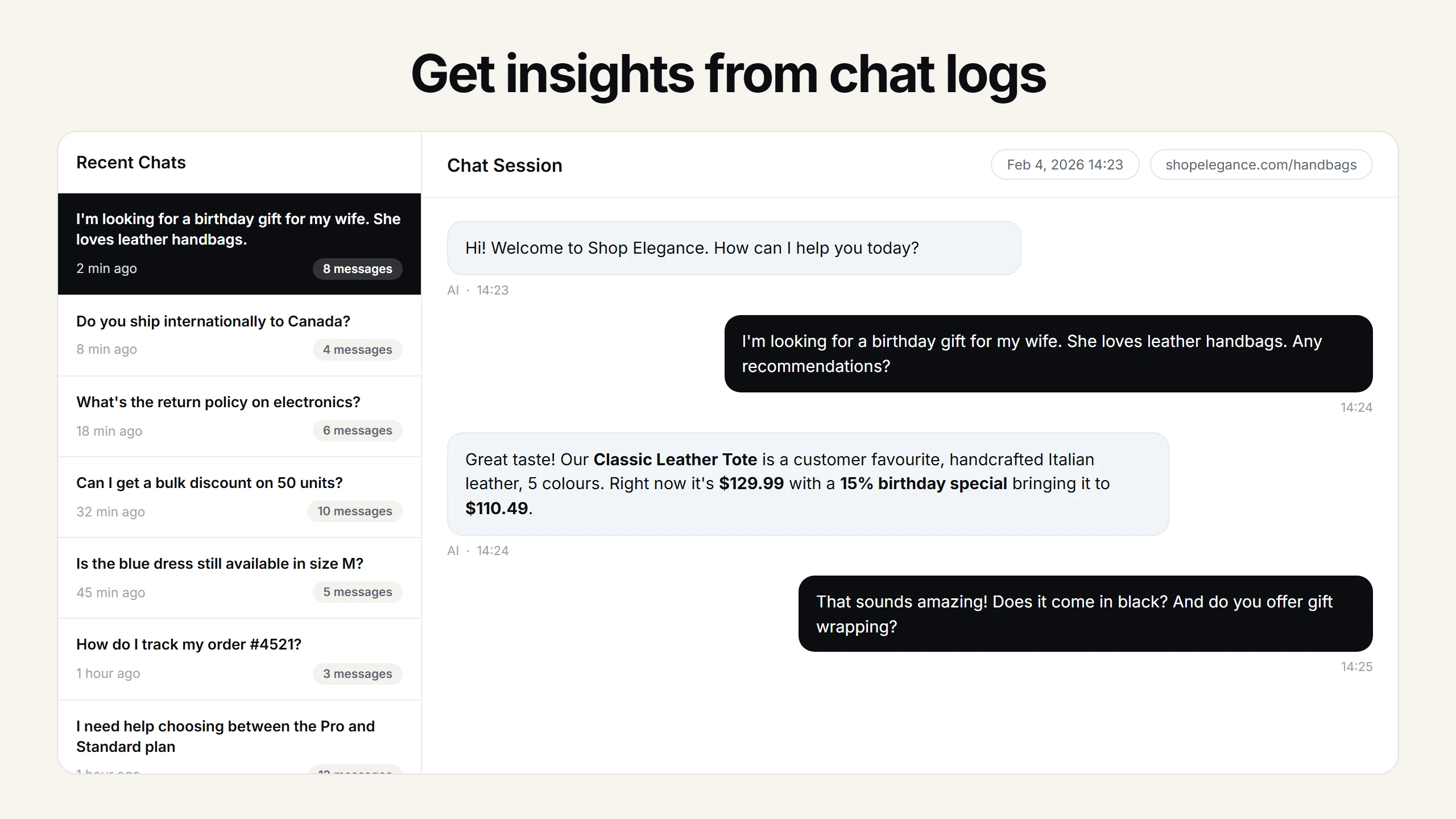
Conversation analytics add a layer of visibility that most Magento merchants discover they were missing. After a month of chat plugin data, patterns emerge: buyers consistently ask about a material grade that is not prominently displayed on the product page. A specific bundle product generates confusion because the default component selection does not match what most buyers want. Shipping policy questions spike on checkout pages because the delivery timeline is buried in a CMS block three clicks deep. These patterns translate directly into storefront improvements — better attribute labels, reordered bundle defaults, a shipping estimator on the product page — that reduce question volume over time. The chat plugin does not just answer questions. It maps where your storefront fails to communicate, and every improvement you make from that data compounds into fewer support interactions and higher conversion rates.
The distinction between Asyntai's chat plugin and the live chat widgets that Magento merchants typically evaluate comes down to what happens when nobody is online. A live chat widget without an agent behind it is a contact form with extra steps. The visitor types a question, sees "Our team is offline," and leaves. Asyntai's chat plugin has no offline state because the AI is always available. At 3 AM on a holiday weekend, a procurement manager in a different time zone gets the same depth of response they would get at noon on a Tuesday — product specifications, Dynamic Product Cards, order tracking through the REST API, responses in their language. The plugin does not replace your sales team. It covers the 128 hours per week when your sales team is not at their desks, and it handles the repetitive catalog and policy questions that consume their time during the 40 hours they are.
Magento merchants invest heavily in their catalog infrastructure — ERP integrations, PIM systems, custom attribute sets, multi-warehouse inventory, tiered pricing matrices. That investment produces the richest product data in ecommerce, and most of it sits behind the storefront, invisible to visitors unless they know exactly where to look and what to click. The chat plugin makes that investment accessible. Every attribute you defined, every product relationship you configured, every pricing tier you set up becomes part of what the AI can communicate to buyers in real time. The catalog you built for operational precision becomes the catalog your buyers can actually navigate — through a conversation that meets them where they are, understands what they need, and shows them the products that match. That is what a chat plugin for Magento should do: convert your catalog complexity from a liability visitors struggle with into an advantage that closes sales.