The best website chat plugin is the one that actually understands your visitors
Most chat plugins follow scripts. Asyntai's AI reads your entire website, understands every page, and holds real conversations with your visitors — answering questions, showing products as visual cards, and taking actions through Custom Tools. It works on any website, installs in minutes, supports 36 languages out of the box, and starts free. Not a chatbot that parrots canned responses. An AI assistant that answers using your content.
See why teams call it the best website chat plugin
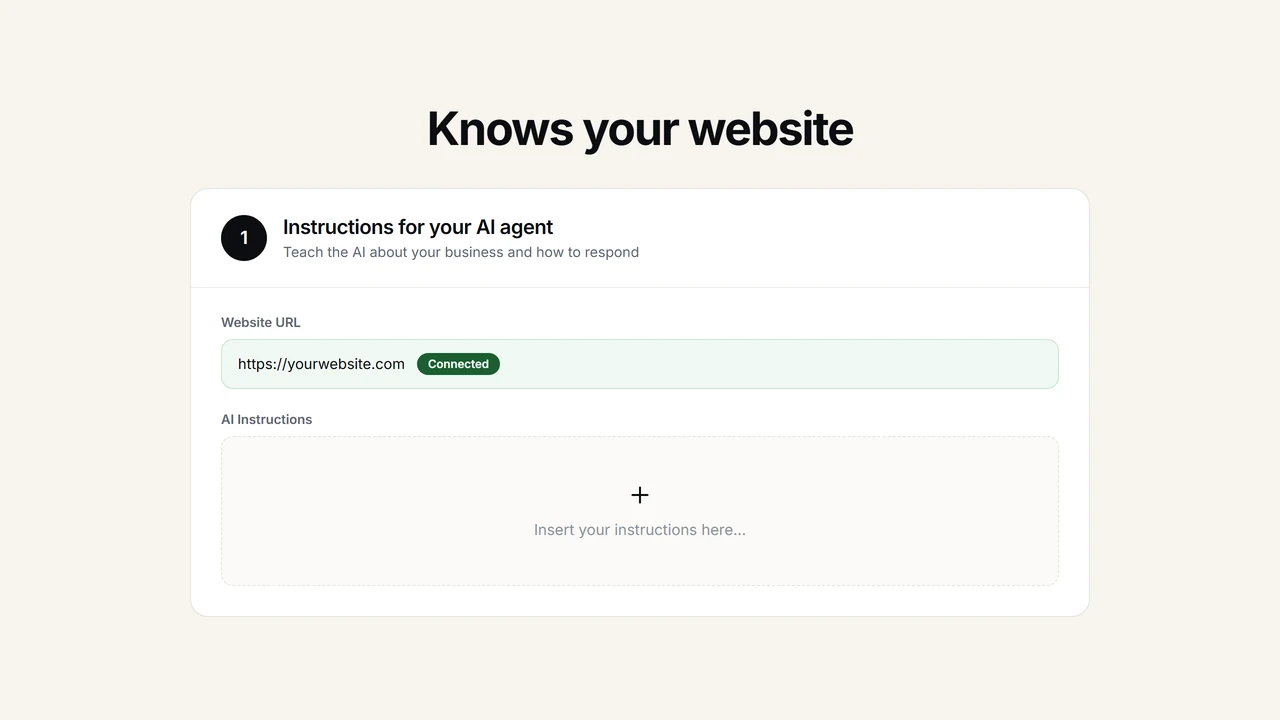
Enter your website URL and watch the AI learn your content and start answering visitor questions immediately
An AI that reads your site and speaks your visitors' language
Rule-based chat plugins force you to write scripts for every possible question. If a visitor asks something you didn't anticipate, the bot fails. Asyntai takes the opposite approach: it auto-crawls your website, reads every page you publish, and uses that knowledge to answer any question a visitor might ask — in natural language, across 36 languages, without you writing a single rule. When you connect a product data feed, the AI goes further: it searches your catalog in real time and displays matching products as Dynamic Product Cards with images, prices, and buy buttons. The best chat plugin is one that gets smarter the more content you have, not one that gets harder to maintain.
- Auto-crawl means zero manual setupPoint Asyntai at your website and the AI crawls every public page — product listings, service descriptions, FAQs, policies, blog posts, team bios. It builds its knowledge base automatically. When you update a page, the AI picks up the changes on the next crawl. You never manually enter Q&A pairs or build decision trees.
- Dynamic Product Cards inside the conversationWhen a visitor asks about products, the AI searches your catalog and displays results as rich visual cards — product image, name, price, description, and a direct link to buy. Multiple results appear as a swipeable carousel. Products are merchandised inside the chat, not on a separate page. The visitor goes from question to purchase without leaving the conversation.
- Natural conversation in 36 languagesThe AI understands and responds in 36 languages automatically — no translation plugins, no separate bots per language. A French visitor gets answers in French. A Japanese visitor gets answers in Japanese. The AI reads your English content and responds in the visitor's language. One plugin, every market.
Works on every platform and pays for itself from day one
The best website chat plugin should not care what platform you use. Asyntai works on WordPress, Shopify, Squarespace, Wix, custom-built sites, and everything in between — anywhere you can paste a script tag or install a plugin. Setup takes minutes, not days. The free plan gives you a fully functional AI chat widget with 50 messages per month, so you can test it on your actual site with real visitors before spending anything. Paid plans start at $39/month and scale with your traffic. No per-seat pricing, no feature gates that cripple the free tier, no bait-and-switch.
- Platform-agnostic by designAsyntai loads via a single JavaScript snippet that works independently of your site's framework. Official plugins exist for WordPress, Shopify, and 30+ other platforms, but even without a plugin, a single line of code adds the widget to any website. It doesn't conflict with page builders, themes, or other scripts.
- Free plan with real AI capabilitiesThe free plan includes 50 AI-powered messages per month, full auto-crawl of your website, and the complete chat widget with customizable appearance. It's not a demo or a trial — it's a permanent free tier that gives small sites and teams evaluating the plugin everything they need to see the value before upgrading.
- Custom Tools turn chat into actionBeyond answering questions, the AI can call your own API endpoints to perform real actions — check order status, look up shipping estimates, process returns, verify account details. Custom Tools let the chat plugin do what a human support agent does, without the queue. Available on Standard and Pro plans.
Install the best chat plugin on your site in under five minutes
No developer needed. Sign up, let the AI crawl your site, paste one line of code (or install a platform plugin), and your visitors get an AI assistant that answers using your own content. The whole process takes less time than writing your first chatbot script.
- Sign up at Asyntai and enter your website URL. The AI begins crawling your pages immediately — products, services, FAQs, policies, everything public.
- Customize the chat widget appearance — colors, greeting message, position, avatar — to match your brand. Preview it live before publishing.
- Add the widget to your site: paste the script tag into your HTML, or install the official plugin for WordPress, Shopify, or your platform of choice.
- Optionally connect a Real-Time Data Feed for live product data, and enable Dynamic Product Cards to show visual product results inside the chat.
<!-- Paste before </body> on any page -->
<script src="https://asyntai.com/widget.js"
data-id="your-site-id" async>
</script>
# One line. Any website. AI that answers using your content.
Best website chat plugin — FAQs
Common questions from teams evaluating chat plugins for their website, comparing AI-powered and rule-based options.
What makes an AI chat plugin different from a rule-based chatbot?
A rule-based chatbot follows scripts you write. You define questions and map them to answers, build decision trees, and hope visitors ask things you anticipated. When they don't — and they usually don't — the bot fails and hands off to a human or displays a generic "I don't understand." An AI chat plugin like Asyntai takes a fundamentally different approach. It reads your entire website, understands the content, and generates answers to any question a visitor asks — even questions you never thought of. There are no scripts to write, no decision trees to maintain, no keyword triggers to configure. The AI reasons about what the visitor is asking and answers using the content on your site. It handles phrasing variations, follow-up questions, and topic changes naturally because it understands language, not just pattern matches.
Does the chat plugin work on my website platform?
Yes. Asyntai works on any website that can include a JavaScript snippet — which is effectively every website. There are dedicated plugins for WordPress, Shopify, and 30+ other platforms that make installation a one-click process, but even on a fully custom-built site, adding the widget is a single script tag pasted before the closing body tag. The widget loads asynchronously, so it doesn't slow your page down. It works alongside any theme, page builder, or frontend framework. If your site loads in a browser, the plugin works on it.
How does the AI learn about my website's content?
When you sign up and enter your URL, the AI automatically crawls your website — every public page, product listing, FAQ, blog post, and policy page. It reads the content and builds a knowledge base from it. You don't need to manually enter Q&A pairs, upload documents, or tag pages. The crawl happens automatically and updates on a regular schedule, so when you publish new content or update existing pages, the AI picks up the changes. You can also upload additional files (PDFs, documents) and connect a Real-Time Data Feed for structured product data with current prices and stock levels.
What are Dynamic Product Cards?
Dynamic Product Cards are visual product displays that appear inside the chat conversation. When a visitor asks about products — "do you have running shoes under $100" or "show me your best-selling coffee blends" — the AI searches your product data and presents matching items as rich cards with product image, name, price, short description, and a button linking to the product page. Multiple products display as a horizontal carousel the visitor can swipe through. They turn the chat from a text-only exchange into a visual shopping experience. Product Cards pull data from your Real-Time Data Feed, crawled product pages, or uploaded catalogs — any source the AI has access to.
Can the chat plugin do more than answer questions?
Yes. With Custom Tools, the AI can call your own API endpoints to perform real actions during the conversation. Check order status by order number. Look up shipping estimates for a visitor's region. Verify whether a product is available in a specific size or color. Process a return request. Check appointment availability. Any action your backend can handle via an API, the AI can trigger through a Custom Tool. The visitor describes what they need in plain language, and the AI figures out which tool to call, gathers the required information conversationally, and returns the result. Custom Tools are available on Standard and Pro plans.
How does the plugin handle multiple languages?
Asyntai supports 36 languages out of the box. The AI automatically detects the visitor's language and responds in that language — no configuration required. Your content can be in English (or any other language), and the AI will answer visitors in French, Spanish, German, Japanese, Arabic, or any of the supported languages. The language detection happens per-conversation, so your French visitors get French responses and your English visitors get English responses from the same widget. You don't need separate bots, translation plugins, or multilingual content on your site.
What does the free plan include?
The free plan includes 50 AI-powered messages per month, automatic website crawling, the full chat widget with customizable colors and branding, and support for all 36 languages. It's a permanent free tier, not a trial — there's no expiration date and no credit card required. It gives you everything you need to evaluate the plugin on your live site with real visitors. When you're ready for more messages, Real-Time Data Feed for live product data, Dynamic Product Cards, or Custom Tools, paid plans start at $39/month (Starter with 800 messages) and scale up to Pro at $449/month (50,000 messages).
Will the chat plugin slow down my website?
No. The widget loads asynchronously via a single script tag, which means it doesn't block your page from rendering. Your page loads first, and the chat widget appears once it's ready — visitors see your content immediately while the widget initializes in the background. The script is lightweight, cached by the browser after the first load, and served from a CDN. It doesn't inject heavy CSS frameworks or modify your page's DOM structure. Performance-focused sites routinely score the same on page speed tests with and without the widget installed.
What separates the best website chat plugin from everything else — and why AI changes the equation
The market for website chat plugins has never been more crowded. There are dozens of options, each promising to help you engage visitors, capture leads, and reduce support tickets. But the vast majority of these plugins share the same fundamental architecture: rule-based logic. You write scripts, build decision trees, map keywords to responses, and hope that your visitors ask questions you anticipated. For simple use cases — "What are your hours?" or "How do I reset my password?" — this approach works well enough. The trouble starts when visitors ask something you didn't plan for, phrase a question differently than expected, or need help with something that spans multiple topics. Rule-based plugins hit a wall, and the visitor either gets a frustrating dead-end or gets routed to a human agent who may not be available.
AI-powered chat plugins represent a fundamentally different approach. Instead of following scripts, the AI reads and understands your website content — every page, every product listing, every FAQ, every blog post — and uses that understanding to answer visitor questions in natural language. There are no decision trees to build. No keyword mappings to maintain. No flow diagrams to debug when a conversation goes sideways. The AI reasons about what the visitor is asking and generates a relevant answer from your content. This distinction — understanding versus pattern matching — is what separates the best website chat plugin in 2026 from the legacy tools that came before it.
Asyntai is built on this AI-first principle. When you connect your website, the AI auto-crawls every public page and reads the content like a new employee would read through your company's knowledge base. It understands your products, your services, your policies, your pricing, your brand voice — everything that's published on your site. When a visitor opens the chat widget and asks "Can I return a product after 30 days?", the AI doesn't search for the keyword "return" in a database of scripted answers. It locates your return policy page, reads the relevant section, and explains the policy in conversational language. If your policy says 14 days, it says 14 days. If it says 30 days for unused items and 7 days for sale items, it explains the nuance. The answer comes from your content, delivered in the visitor's language.
This auto-crawl capability eliminates the single biggest bottleneck in deploying a chat plugin: content creation. With rule-based tools, you don't just install a plugin — you build a chatbot. You write dozens or hundreds of scripted responses. You create intent categories and train them with example phrases. You build conversation flows with branching logic. For a mid-size business with 50 product pages, a dozen service descriptions, and a handful of policy pages, this setup process can take weeks. And the moment you update your website — new product, revised pricing, changed policy — you have to update the chatbot separately, or it starts giving outdated answers. With an AI plugin that crawls your site, the setup is: sign up, enter your URL, wait for the crawl, and start. When you update your site, the AI picks up the changes automatically. The plugin stays in sync with your website because it reads your website.
But answering questions from crawled content is only the baseline. The best website chat plugin needs to handle the full range of visitor interactions — and for ecommerce sites, that means product discovery. When a visitor says "I'm looking for a birthday gift for a ten-year-old who likes science," they're not searching for a keyword. They're describing a need, and they expect the chat to understand it. Asyntai handles this through Dynamic Product Cards. When you connect a Real-Time Data Feed — a URL that returns your product catalog as JSON, CSV, or via an API endpoint — the AI can search your product data in real time and display matching items as visual cards inside the chat. Each card shows the product image, name, price, a short description, and a button linking to the product page. Multiple matches appear as a swipeable carousel. The visitor doesn't get a list of links. They get a curated, visual shopping experience inside the conversation.
Dynamic Product Cards transform the chat plugin from a question-answering tool into a sales channel. Consider the difference: a visitor asks "do you have wireless headphones under $80?" On a rule-based plugin, this question either matches a scripted response (unlikely, unless you've written one for every possible product query) or falls through to a generic "I'm not sure, would you like to speak with someone?" With Asyntai, the AI searches your product feed, finds headphones priced under $80, and displays them as product cards with images and prices. The visitor can compare options, ask follow-up questions ("which one has the best battery life?"), and click through to purchase — all within the chat. That's a sale that a rule-based plugin cannot make because it doesn't understand the question, doesn't have access to live product data, and can't render visual results.
The Real-Time Data Feed behind Product Cards solves the freshness problem that plagues product recommendation tools. The feed is read on each relevant query, so price changes, stock updates, and new additions reflect immediately. If you drop the price on a product for a flash sale at 9 AM, a visitor who asks about that product at 9:01 AM sees the new price. If an item goes out of stock, it stops appearing in card results. New products added to the feed are indexed within 24 hours. This is fundamentally different from systems that rely on periodic batch indexing, which routinely serve stale prices during sales events — exactly when accuracy matters most. The Standard plan supports feeds up to 200,000 characters; Real-Time Data Feed Max on the Pro plan handles up to 10,000,000 characters, which accommodates catalogs of roughly 25,000 products.
Language support is another area where AI chat plugins leave rule-based tools behind. Most traditional plugins are English-first, with multilingual support bolted on as a translation layer — you write scripts in English, translate them to other languages, and maintain parallel sets of content for each language. For a business serving visitors in five languages, that's five times the scripting work. Asyntai supports 36 languages natively. The AI detects the visitor's language automatically and responds in that language, even if your website content is only in English. A German visitor asks a question in German, the AI reads your English content, and responds with an accurate answer in German. A Korean visitor gets Korean. An Arabic visitor gets Arabic. One widget, one knowledge base, 36 languages — with no translation work on your part.
Custom Tools push the boundary of what a chat plugin can do beyond answering questions and showing products. With Custom Tools, the AI can call your own backend API endpoints to perform real actions during a conversation. A returning customer asks "Where's my order?" The AI asks for the order number, calls your order tracking API via a Custom Tool, and returns the current status — without the visitor navigating to a separate tracking page or waiting for a support agent. A visitor asks "Is this jacket available in medium?" The AI calls your inventory API and answers with real-time stock data. A subscriber asks "Can you update my shipping address?" The AI collects the new address conversationally and pushes it to your system through a Custom Tool. Each tool you connect extends the AI's capabilities. The chat plugin stops being passive — it becomes an active participant in your customer experience, handling tasks that previously required human agents or separate self-service portals.
Installation is deliberately minimal. The plugin loads via a single JavaScript snippet — a script tag with your site ID that you paste before the closing body tag on your pages. For platforms with dedicated plugins (WordPress, Shopify, and 30+ others), it's a one-click install from your Asyntai dashboard. The widget loads asynchronously, meaning it doesn't slow your page down — your content renders first, and the chat widget appears once it's ready. It works with any theme, any page builder, any frontend framework. There are no dependencies, no CSS conflicts, no DOM modifications. If your site loads in a browser, the plugin works on it. The entire process — sign up, crawl, customize, install — takes less time than writing your first chatbot script would on a rule-based platform.
Customization goes beyond picking a color scheme. You control the widget's appearance — colors, position, avatar, greeting message, font sizes — to match your brand identity. You write AI Instructions that guide the AI's behavior: what tone to use, which topics to emphasize, what questions to deflect to your human team, how to handle sensitive subjects. You set up conversation starters — suggested questions that appear when the widget opens, guiding visitors toward the topics they're most likely to need help with. You can restrict the AI's knowledge to specific pages if you want it to answer only about certain products or services. The plugin molds to your business, not the other way around.
The economics of an AI chat plugin deserve scrutiny because they flip the traditional support cost model. With rule-based plugins, your ongoing cost is primarily human: someone has to write and maintain scripts, handle the conversations the bot can't, and update content when your site changes. The scripting work scales with your product catalog and the diversity of questions visitors ask. With an AI plugin, the knowledge base maintains itself through auto-crawl, the AI handles the long tail of visitor questions that rule-based bots miss, and human agents are reserved for genuinely complex issues that require judgment or empathy. The result is that the AI plugin handles a much larger share of conversations end-to-end, which means fewer handoffs, shorter resolution times, and lower cost per conversation as your volume grows.
Asyntai's pricing reflects this model. The free plan includes 50 messages per month — enough for small sites or for evaluating the plugin with real traffic. The Starter plan at $39/month includes 800 messages. Standard at $139/month includes 15,000 messages plus Real-Time Data Feed, Dynamic Product Cards, and Custom Tools. Pro at $449/month includes 50,000 messages with the highest data feed capacity. There are no per-agent seats, no per-conversation charges, no hidden fees for multilingual support or widget customization. The pricing is straightforward: pick the plan that matches your message volume and feature needs, and everything in that plan works without restrictions.
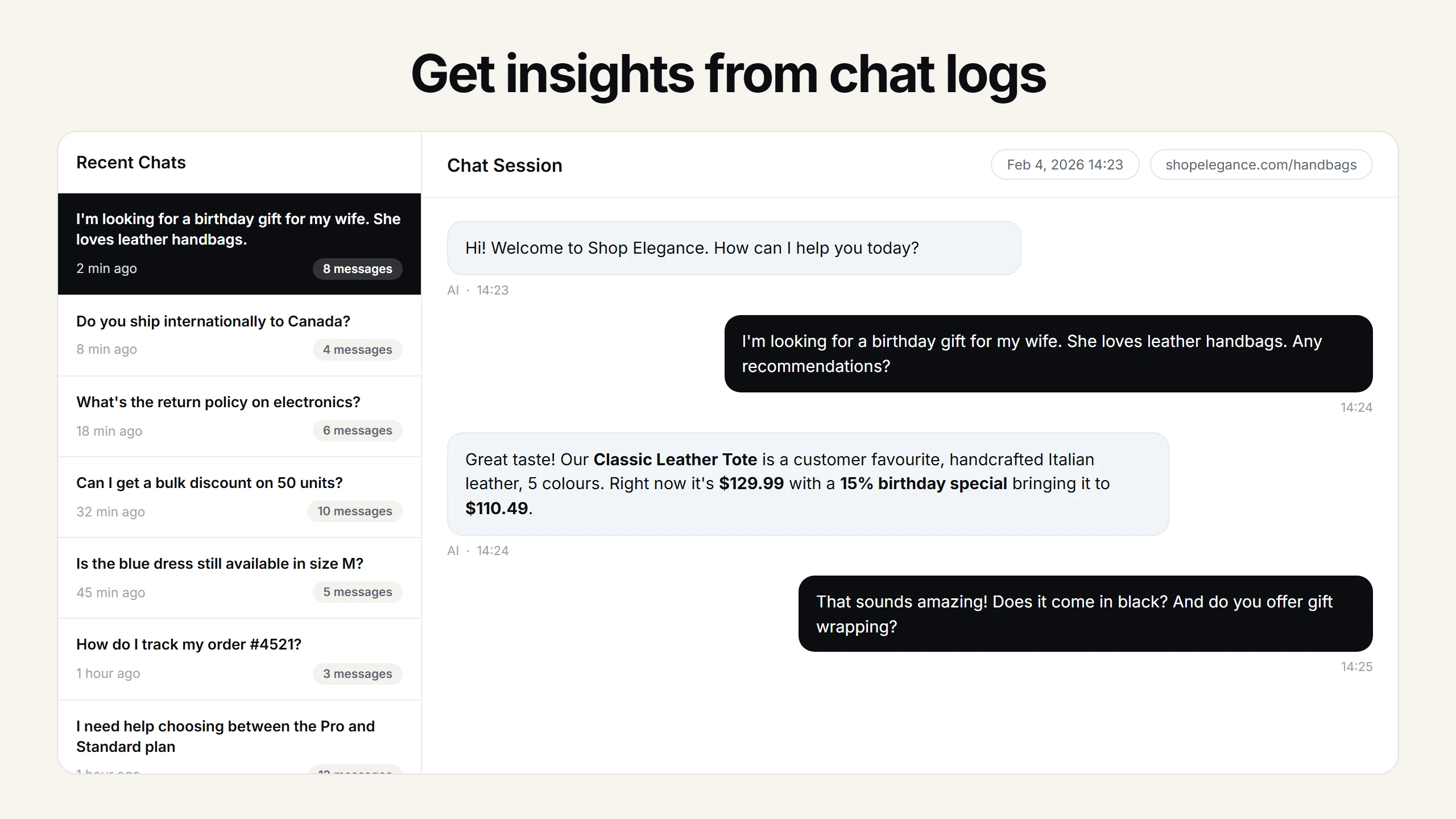
Security and data handling matter for any plugin that interacts with your visitors. The chat widget communicates over HTTPS. Conversation data is stored securely and associated with your account. Visitor interactions are visible in your Asyntai dashboard, where you can review conversations, see which questions visitors ask most, and identify content gaps on your site. The AI doesn't share your content with other customers or use your data to improve models for others. Your knowledge base — crawled pages, uploaded files, data feeds — is isolated to your account and used exclusively to answer your visitors' questions.
The argument for AI-powered chat over rule-based chat often comes down to a single observation: visitors don't ask questions the way you expect them to. They use slang, abbreviations, run-on sentences, misspellings, and descriptions instead of product names. They ask one question and then immediately pivot to a completely different topic. They reference something from three messages ago. They ask questions that span two different pages on your site — "what's the difference between your Standard and Pro plans, and does the cheaper one include the thing I saw on your integrations page?" Rule-based chatbots choke on this because they need exact or near-exact matches to trigger scripted responses. AI handles it because it understands language, maintains context across a conversation, and can synthesize information from multiple sources to form a coherent answer.
The difference becomes most visible at scale. A small site with 10 products and 5 common questions can make a rule-based chatbot work — the finite number of permutations means you can script your way to reasonable coverage. But a site with 500 products, 30 pages of content, and visitors asking questions in 8 languages? The scripting surface area explodes. Every new product, every updated policy, every new language adds another layer of maintenance. With an AI plugin, the surface area doesn't matter because the AI reads the content directly. Add 100 new products? The AI crawls them. Update your shipping policy? The AI reads the new version. Launch in a new market with a different language? Already covered. The plugin scales with your content, not with your chatbot engineering effort.
The chat plugin's value shows up in metrics that matter to business owners: deflection rate (percentage of conversations resolved without human handoff), response accuracy (how often the AI gives the correct answer), average resolution time (how long it takes to answer a visitor's question), and — for ecommerce — product discovery rate (how often a visitor who interacts with the chat ends up viewing or purchasing a product). AI-powered plugins consistently outperform rule-based tools on all four metrics because they handle the long tail of questions that rule-based bots deflect or mishandle. That long tail — the unusual phrasing, the multi-part question, the follow-up that changes context — is where most visitor frustration happens and where most support cost hides.
The best website chat plugin in 2026 is not the one with the most connectors, the slickest flow builder, or the longest feature list. It's the one that understands what your visitors are asking, answers accurately from your own content, shows products visually when relevant, takes action through API integrations, and works in whatever language your visitor speaks — all without requiring you to write scripts, build flows, or maintain parallel knowledge bases. That's the bar. Asyntai meets it with an AI-first architecture, auto-crawl content ingestion, Dynamic Product Cards, Custom Tools, 36-language support, and pricing that starts at zero. The plugin installs in minutes, learns your site on its own, and starts helping visitors immediately. The best chat plugin is the one you don't have to build — you just have to install it.