An AI widget for website that does more than just chat
Asyntai delivers an AI widget for your website that combines intelligent conversation, automatic lead capture, multilingual fluency, and visitor analytics into a single embeddable component. Answering from your own content, deployed through one script tag.
Preview the AI widget running on your website
Paste your site address and the widget will demonstrate how it responds using your actual content
An AI widget is not a chatbot with better branding
Chatbots answer questions. An AI widget for your website does that and more: it identifies visitor intent, captures qualified leads mid-conversation, delivers insights about what your audience is actually looking for, and operates across 36 languages without configuration per locale. It is a functional layer, not just a conversation window.
- Conversation and capture in one surfaceThe widget fields questions and collects contact details in the same flow. Visitors share their email naturally during the dialogue rather than filling out a separate form.
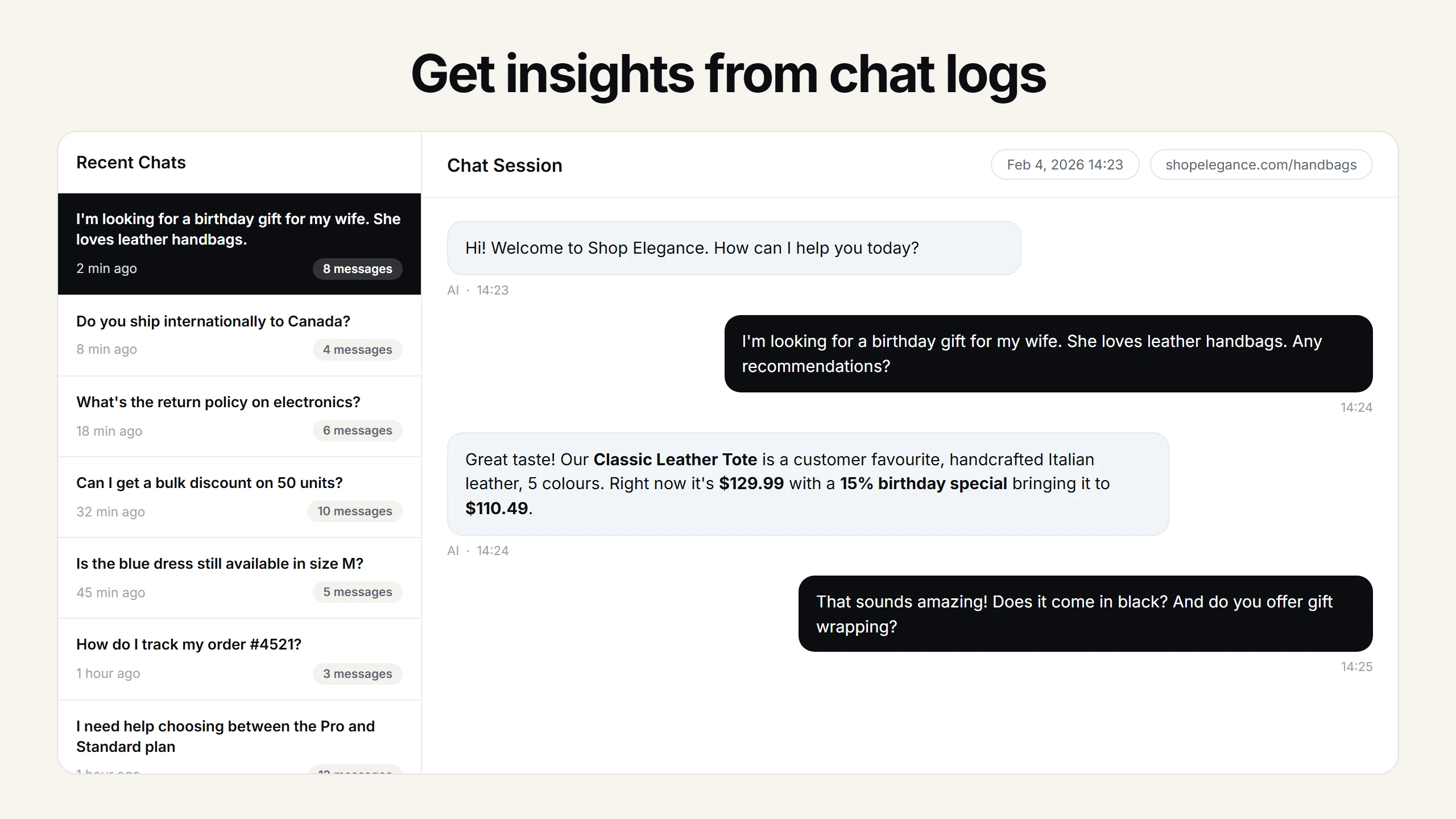
- Visitor intent visible in your dashboardEvery conversation reveals what the visitor was trying to accomplish — pre-purchase research, support inquiry, pricing comparison, feature evaluation. Patterns emerge within the first week.
- Multilingual by default across the full interfaceThirty-six language localizations ship with the widget. The AI matches the visitor's language automatically, so international audiences are served from one installation.
Answers from your website, not the open internet
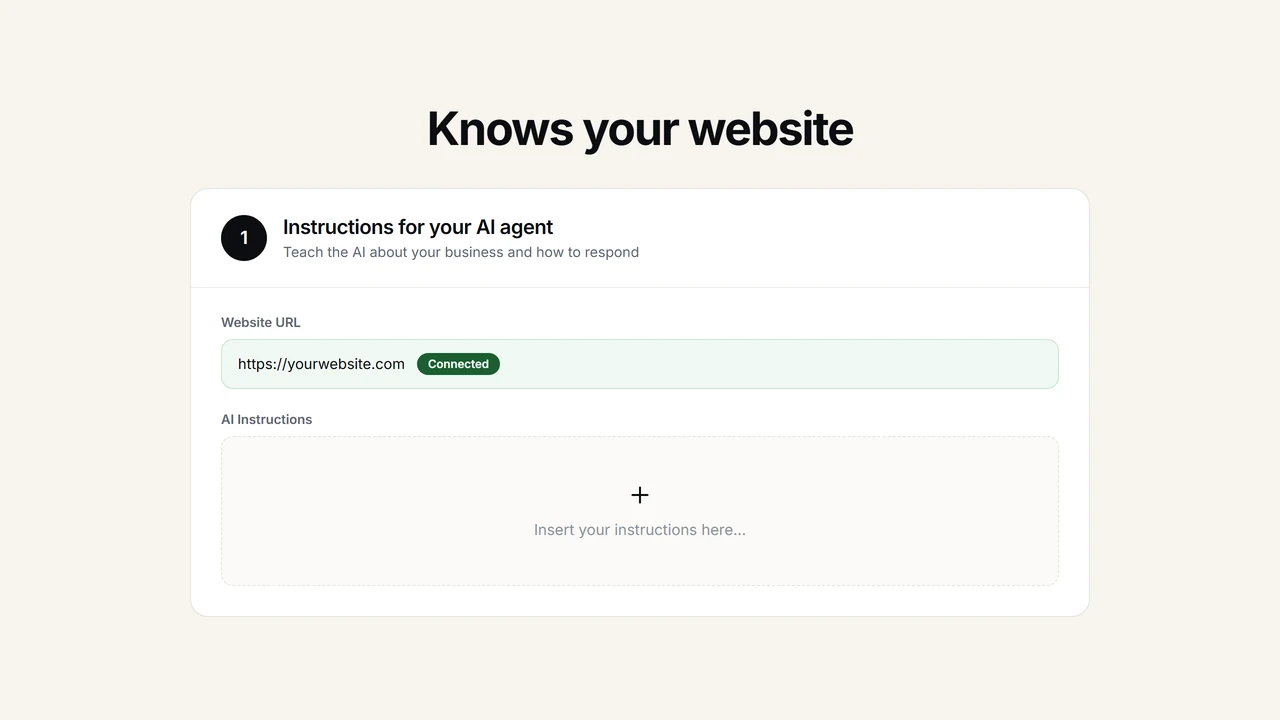
An AI widget is only as reliable as its knowledge source. Asyntai ingests your published pages, your uploaded documents, and your written instructions — then restricts every response to that foundation. No hallucinated product features, no invented policies, no borrowed facts from competitor sites.
- Automatic site ingestion on signupProvide your URL and the system reads your pages — services, products, pricing, blog posts, policies, documentation — building the knowledge layer the widget draws from.
- Private document integrationOperational manuals, internal pricing tables, vendor agreements, onboarding sequences — upload as PDFs or paste directly. The widget references them alongside public content.
- Contextual awareness for known visitorsStandard and Pro plans support window.Asyntai.userContext, letting your site push customer-specific data so the widget delivers personalized answers to logged-in users.
Embed the AI widget on any website in minutes
The AI widget installs identically to a tracking pixel or analytics tag — a single asynchronous script in your site header. It functions on every major platform without requiring specialized plugins or backend modifications.
- Create a free Asyntai account and locate your personalized embed code in the setup panel.
- Place the code inside the
<head>tag of your website through your CMS settings, a header injection plugin, or direct template editing. - Enter your website URL to trigger automatic content ingestion, and attach any confidential documents the widget should draw upon.
- Configure appearance preferences and compose behavioral directives, then conduct several test dialogues before making the widget visible to visitors.
<script src="https://asyntai.com/widget.js"
data-id="your-site-id" async>
</script>
</head>
# AI widget active across your entire site.
AI widget for website — frequently asked questions
Practical questions teams raise when evaluating an AI widget for their website.
How does an AI widget differ from a standard chatbot?
A chatbot is primarily a conversation interface. An AI widget encompasses conversation but also includes lead capture, visitor intent analysis, multilingual automation, and content-grounded intelligence in a single embedded component. Think of the chatbot as one function inside the broader widget capability set.
Will the AI widget function on my particular website platform?
Yes. The widget deploys as an asynchronous JavaScript tag, so it operates identically on WordPress, Shopify, Squarespace, Webflow, Wix, Ghost, HubSpot CMS, Magento, Joomla, Drupal, custom-coded sites, and any platform that permits script injection in the page header. Dedicated plugins are also offered for several popular systems.
What kind of content does the AI widget use to form its responses?
The widget draws from two pools: the pages it ingests by crawling your website URL, and any documents you upload privately. It does not use general internet knowledge or data from other customers. Custom instructions further shape how the widget applies that content — defining tone, setting boundaries on topics, and specifying when to escalate rather than attempt an answer.
Can the widget capture leads without disrupting the conversation?
Yes. When the AI determines that a question requires human follow-up, it requests contact details within the conversational flow. Visitors experience a natural transition rather than a redirect to a separate form page. The captured lead — including the full dialogue transcript — appears in your Asyntai dashboard and optionally in your email inbox.
Is multilingual support automatic or does it require separate setup per language?
Entirely automatic. The widget interface is pre-localized in 36 languages. The AI detects the visitor's language from their initial message and replies in that language from that point onward. There is no per-language configuration step, no translation file to maintain, and no additional charge for non-English interactions.
Can the AI widget display different responses to identified versus anonymous visitors?
Absolutely, through the User Context capability included with Standard and Pro subscriptions. When your page code populates window.Asyntai.userContext with logged-in visitor attributes — name, plan tier, purchase history, account status — the widget tailors its responses accordingly. Anonymous visitors receive general answers derived from your public content.
What does the AI widget cost per month?
The free tier includes 100 widget interactions monthly on one website. Starter plans begin at $39 per month and include 2,500 interactions with support for two websites. Standard and Pro tiers offer higher volumes and additional site slots. Billing is based on interaction count, not team size or visitor traffic.
Can a single account deploy AI widgets across multiple websites?
Yes. Free accounts support one website. Starter permits two, Standard three, and Pro up to ten. Each deployment maintains an isolated knowledge base, separate behavioral rules, independent branding settings, and its own conversation archive — ensuring that a widget on one property never bleeds information into another.
AI widget for website — why the category is broader than chat
When most people hear "AI widget for website," they picture a chat bubble in the bottom corner. That mental model is understandable — the chat interface is the most visible part — but it undersells what the component actually does when designed well. A properly built AI widget is a multi-function layer embedded on your site that happens to present itself through a conversational interface. Behind that interface sits content ingestion, natural language comprehension, lead qualification, multilingual routing, visitor behavior signaling, and an escalation pipeline that connects the digital surface to your human team. Reducing all of that to "chatbot" is like calling a smartphone a calculator because it has a calculator app.
The broader framing matters for anyone deciding what to install on their website, because it changes the evaluation criteria. If you are shopping for a chatbot, you compare conversation quality and maybe customization options. If you are shopping for an AI widget, you evaluate the entire capability surface: how does it ingest knowledge, how does it capture leads, how does it handle languages, what does the analytics layer reveal, how cleanly does it escalate, and how deeply can it integrate with your visitor's logged-in context? Asyntai is built to satisfy the wider evaluation, which is why describing it as a chat window misses the functional depth underneath.
Content ingestion is the foundation the widget's intelligence rests on. Without accurate, comprehensive knowledge about your business, the AI behind the widget will either hallucinate plausible-sounding nonsense or retreat into vague deflections — both of which actively harm visitor trust. Asyntai's ingestion process begins when you provide your website URL: the system crawls every reachable page, absorbing product details, service descriptions, pricing structures, policy documents, help articles, blog posts, and FAQ entries into a structured knowledge layer. That crawl can be re-triggered whenever your site content changes significantly — a new product line, revised pricing, updated terms. For content that lives off your public site — internal operations manuals, vendor-specific shipping guides, seasonal promotion rules, staff onboarding materials — you upload PDFs or paste text directly. The widget treats uploaded content with exactly the same authority as crawled pages, weaving both into responses seamlessly.
Lead capture is where the AI widget diverges most clearly from a basic chat interface. A traditional chatbot answers questions; when it fails, the conversation ends. An AI widget recognizes the moments when a visitor's question signals buying intent or requires human follow-up, and transitions naturally into contact collection within the same dialogue. The visitor is not redirected to a form page, not asked to start over in a different channel, not abandoned with a "we will get back to you" placeholder. Instead, the AI asks for an email or phone number as part of the ongoing conversation, explains what happens next, and routes the complete transcript — every message exchanged, every piece of context gathered — to your dashboard and optionally to your email inbox. For teams measuring lead volume, this in-conversation capture consistently outperforms standalone contact forms because it removes the friction of switching contexts.
Visitor intent analysis is a byproduct that becomes a primary benefit over time. Every conversation the widget handles reveals what a visitor was trying to accomplish on your site — researching a purchase, comparing your offering to a competitor, seeking post-purchase support, evaluating a specific feature, or simply trying to find information your site buries in the wrong place. When those conversations accumulate across hundreds or thousands of visitors, patterns emerge that no survey tool or heat map can replicate. You discover that your pricing page generates ten times the chat engagement of your features page, indicating unclear information. The Asyntai dashboard organizes these patterns by frequency, topic cluster, and language, converting raw conversation data into a prioritized list of website improvements.
Multilingual operation is one of the clearest reasons to think about the widget as a layer rather than a chat window. A chat window in a single language serves one segment of your audience. An AI widget with 36 language localizations and automatic language detection serves your entire global audience from one installation. The interface elements — buttons, placeholders, system prompts — render in the visitor's browser language. The AI detects the visitor's typing language from their first message and continues in that language throughout the conversation. A visitor arriving from a Spanish search result receives Spanish. A visitor arriving from a Japanese social media link receives Japanese. There is no toggle to flip, no URL parameter to set, no duplicate widget installation per locale. For websites with internationally distributed traffic, this removes one of the most expensive barriers to serving non-English audiences: the need to hire or outsource multilingual human agents.
Personalization through the User Context mechanism transforms the widget from a generic answering machine into an informed concierge for known visitors. On Standard and Pro plans, your website's front-end code populates a JavaScript variable — window.Asyntai.userContext — with whatever customer attributes are relevant: account tier, subscription renewal date, most recent order identifier, loyalty points balance, preferred product category, geographic region. When the widget initializes, it reads that variable and incorporates the data into its conversational awareness. A returning Pro subscriber asking about feature limits receives an answer calibrated to the Pro tier. A customer with an open order asking about delivery timelines receives an answer that references their specific order status. The data flows in one direction only — from your site into the widget — so you retain complete control over what the AI knows about each visitor without exposing backend systems to external API calls.
Visual customization ensures the widget feels native to your site rather than like an imported foreign object. The Asyntai dashboard exposes controls for primary accent color, launcher corner positioning, avatar imagery, welcome message copy, input placeholder text, and mobile-specific display behavior. Every adjustment previews in real time before committing to production. Tone customization operates through written instructions rather than dropdown menus: "respond with warmth and occasional humor for a lifestyle brand," "maintain strictly professional language for a financial services site," "keep answers concise and reference documentation links when available for a developer-facing product." These instructions shape every response the widget generates, producing a voice that sounds deliberate rather than generically pleasant.
Escalation architecture is the safety net that makes deploying an AI widget responsibly viable. No knowledge base is complete, no set of behavioral instructions anticipates every possible visitor question, and no AI should attempt to handle situations requiring genuine human judgment — refund disputes involving substantial amounts, complaints with legal implications, sales negotiations at enterprise scale, emotionally charged service failures. The widget's escalation mechanism activates when the AI recognizes that a conversation has crossed into territory its instructions designate for human handling. It collects the visitor's contact information, preserves the full transcript, and delivers the package to your Asyntai dashboard. Enabling email notifications sends the same data to your team's inbox in real time. The human who picks up the conversation starts with complete context about what was discussed and why the AI chose to escalate, eliminating the cold-restart problem that plagues naive bot-to-human handoffs.
Multi-site deployment extends the widget's utility beyond a single-property use case. Agencies managing a portfolio of client websites need distinct widget instances — each drawing on different content, each branded to a different visual identity, each governed by different behavioral rules. Retail groups operating several storefronts need the same separation. SaaS companies maintaining a marketing site, a documentation portal, and an application dashboard need independent configurations. Asyntai's plan tiers accommodate this: one site on the free plan, two on Starter, three on Standard, and ten on Pro. Each site is a fully isolated deployment with its own knowledge base, its own instruction set, its own appearance configuration, and its own conversation archive. Nothing crosses between properties, ensuring that knowledge base content from one client or brand never influences responses on another.
Pricing for the AI widget follows a per-interaction model that aligns cost with actual usage rather than team size or raw traffic volume. The free tier accommodates 100 interactions per month — sufficient for a small site testing the widget or running it on a single high-value landing page. Paid plans begin at $39 monthly for 2,500 interactions, scaling upward for higher-volume sites. Each AI-generated response counts as one interaction. Email alerts notify you as usage approaches the monthly threshold, providing lead time to adjust the plan before the widget pauses. Compared to per-seat pricing models common in live chat and help desk tools, interaction-based pricing avoids penalizing team growth and instead scales proportionally to the value the widget delivers.
The businesses that extract the most value from an AI widget tend to share a common profile: their websites receive meaningful visitor traffic, a substantial portion of that traffic has questions that existing content could answer, and the team behind the site cannot realistically staff human responses around the clock or across every language their audience speaks. SaaS companies with global trial funnels fit this profile. E-commerce operations with product catalogs and frequent shipping inquiries fit it. Professional service firms receiving scope and qualification questions outside business hours fit it. Educational institutions fielding repetitive admissions and enrollment queries fit it. In each case, the AI widget fills a gap that previously existed as silent visitor attrition — unanswered questions leading to abandoned sessions, unmade purchases, and unconverted prospects.
Installing the widget is deliberately the least complicated part of the process. You create an account, copy a snippet, and insert it into your site header. You enter your URL and the system ingests your content. You attach private documents if relevant. You write behavioral instructions in plain language and adjust visual settings in the dashboard. You run test conversations, then activate the widget for visitors. Most teams finish in under ninety minutes. The real work begins afterward: reviewing conversation analytics to identify content gaps, refining instructions based on real visitor interactions, and gradually expanding the knowledge base to cover new topics as they surface. The widget is the visible surface; the ongoing intelligence curation behind it is what determines whether visitors experience a helpful AI layer or a frustrating dead end.