AI-powered chatbots for business: turn every website visit into a conversation that converts
An AI chatbot that reads your website, answers customer questions in real time, captures leads while you sleep, and speaks 36 languages — live on your site in under five minutes.
Watch the AI handle questions from your actual website
Drop your business URL below. The AI crawls your pages — services, pricing, location info, FAQs — and starts answering visitor questions using your own content.
Every unanswered question on your website is revenue walking out the door
Most business websites work like a billboard on a highway. People slow down, glance at it, and keep driving. The information is there — your hours, your services, your phone number — but visitors have specific questions that static pages cannot answer. "Do you offer same-day appointments?" "Can I bring my dog to the patio?" "What is the cancellation policy for group bookings?" These are not obscure requests. They are the exact questions that separate a visitor who buys from one who bounces. And they land on your site at 9 PM on a Tuesday, at 6 AM before work, on a Sunday afternoon — times when nobody is sitting at a desk waiting to respond. Contact forms collect dust. Phone calls go to voicemail. Live chat tools demand a human operator you do not have. Meanwhile, the visitor who had a credit card ready found their answer on a competitor's site instead. An AI-powered chatbot breaks this pattern by reading the content already on your website and using it to hold real conversations with your visitors. Not canned responses from a decision tree. Not a FAQ page reformatted as chat bubbles. An actual dialogue where the visitor asks a question in their own words and gets a specific, accurate answer drawn from your pages — your services, your policies, your pricing, your unique way of doing business.
- Visitors get instant answers instead of hunting through pagesA potential customer wondering whether your restaurant accommodates large parties does not want to read your entire menu page to find out. They want to ask and get a straight answer. The AI reads your site content — event info, private dining options, group policies — and responds conversationally, the way a helpful front desk employee would. No page-hopping, no dead ends.
- Leads get captured in the conversation, not after itWhen a visitor is engaged enough to ask questions, they are already interested. The AI recognizes buying signals and naturally collects contact information — name, email, phone, what they need — during the conversation itself. Your team opens the dashboard to find qualified leads with full context: what the person asked, what they care about, and how to follow up.
- After-hours traffic stops being wasted trafficFor most businesses, more than half of website visits happen outside office hours. Evenings, weekends, holidays — the times when people are free to browse are the times when nobody is available to respond. The AI chatbot covers every hour of every day with the same quality of response, turning late-night browsers into Monday-morning leads.
Connect your business systems and let the chatbot pull live data mid-conversation
Answering questions from your website content handles the majority of visitor inquiries. But some questions need live data — appointment availability, order status, inventory levels, account details. Custom Tools — available on Standard ($139/month) and Pro ($449/month) plans — let the AI chatbot call your own APIs during a conversation to retrieve real-time information from your booking system, CRM, or database.
- Real-time appointment and availability checksConnect your booking system as a Custom Tool. When a visitor asks "do you have any openings this Saturday?", the AI queries your calendar and responds with actual available time slots — not a generic "call us to book." The visitor gets an answer in seconds, and your front desk never picks up the phone.
- Order and service status lookupsCustomers asking "where is my order?" or "is my car ready?" no longer need to call. A Custom Tool connected to your order management or service tracking system lets the AI answer with specifics: tracking numbers, estimated completion times, next steps. Your team handles fewer status-check calls per day.
- Personalized responses using customer dataWhen a returning customer identifies themselves, the AI can look up their account through a Custom Tool and tailor the conversation — referencing past orders, loyalty status, or preferences. The experience shifts from generic FAQ answers to something that feels like talking to someone who knows them.
- Lead qualification that goes beyond contact captureCustom Tools let the AI ask qualifying questions and route leads based on the answers. A visitor interested in commercial services gets tagged differently than one asking about residential options. Budget ranges, timelines, project sizes — the AI collects whatever your sales process needs and passes it along structured, not as a free-text chat transcript.
- Automatic language matching across 36 languagesThe AI detects each visitor's preferred language and responds in kind — whether they type in Spanish, Japanese, Arabic, or any of 36 supported languages. Your website content does not need to be translated. The AI reads your English pages and delivers answers in the visitor's language automatically, at no extra cost on every plan.
Get your AI-powered chatbot live in minutes
No developers, no IT tickets, no complex setup. Sign up, point the AI at your website, and paste one line of code. That is the entire process.
- Choose a plan at asyntai.com/pricing — the Free tier gives you 1 site and 50 messages per month, enough to test with real visitor traffic before spending a dollar.
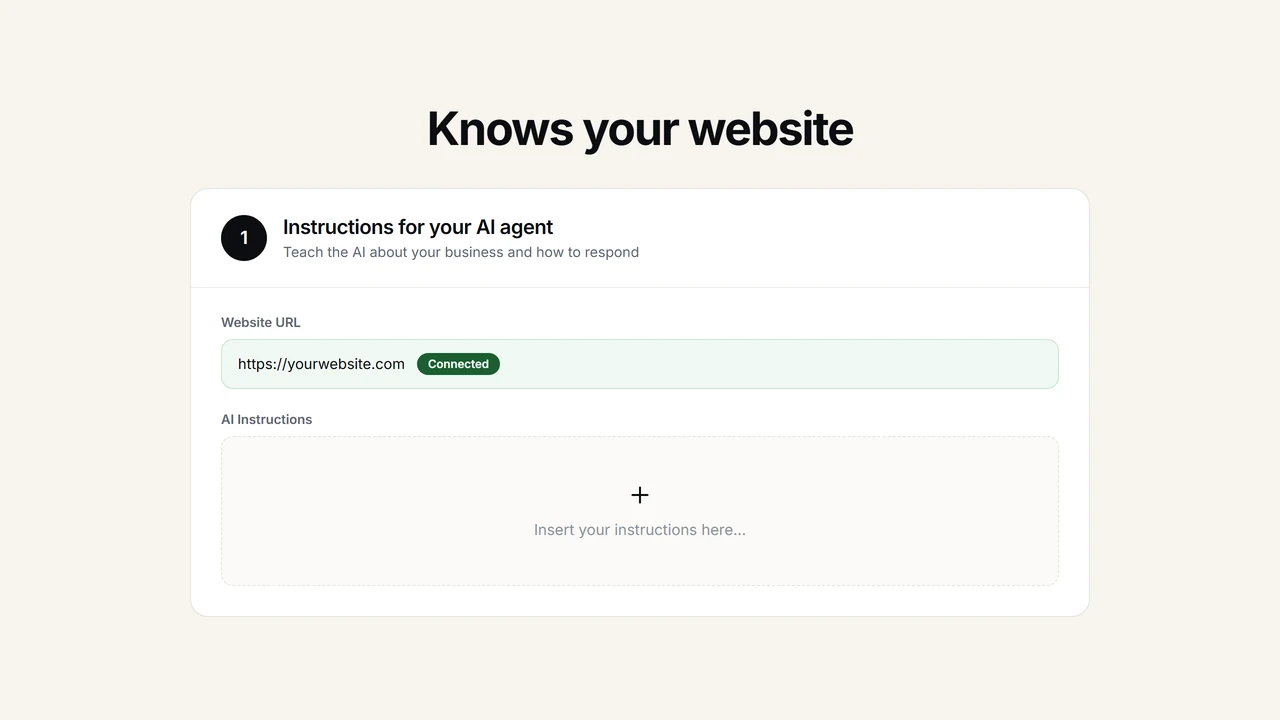
- Enter your business website URL in the dashboard. The AI crawls up to 50 pages — your services, pricing, about page, FAQ, location info, team bios — and builds its knowledge base from your existing content automatically.
- Customize the chat widget to match your brand. Pick your colors, upload your logo, set a greeting message, and write any behavioral rules in plain English — like "always suggest booking a consultation" or "redirect billing questions to our support email."
- Copy the embed script and paste it into your website HTML. Works on WordPress, Shopify, Wix, Squarespace, and 30+ other platforms. The chatbot appears on your site immediately and starts answering visitor questions.
<script src="https://asyntai.com/widget.js"
data-id="your-site-id" async>
</script>
# One script tag. Works on any website.
# Live in under 5 minutes.
AI-powered chatbots for business — FAQs
Common questions from business owners evaluating AI chatbots for their websites.
How does the chatbot know what to say about my business?
When you add your website URL, the AI crawls up to 50 pages and reads your content — services, pricing, policies, FAQs, team info, location details. It uses this content to answer visitor questions in natural conversation. There is no manual programming or decision-tree building. If the information is on your website, the chatbot can discuss it. You can also upload additional documents — price lists, menus, policy guides — to cover anything your website does not mention.
Will it sound robotic or generic to my customers?
No. The AI generates responses specifically from your content, so the answers reflect your business — your services, your pricing, your policies. You can also write behavioral instructions in plain English to shape the tone: "Be friendly and casual," "Always mention our satisfaction guarantee," or "Use the customer's first name when possible." The result is a conversation that sounds like your best front desk employee, not a scripted phone tree.
What happens when the AI cannot answer a question?
You control the fallback behavior. Common configurations include: collecting the visitor's name and email so your team can follow up, displaying your phone number for urgent matters, or redirecting specific topics to particular departments. The AI captures the conversation and lead information regardless, so no inquiry disappears — even when the chatbot cannot fully resolve it on its own.
Can I use it on more than one website?
Yes. The Free plan covers 1 site. Starter ($39/month) covers 2 sites with 800 messages shared between them. Standard ($139/month) covers 3 sites with 15,000 messages. Pro ($449/month) covers up to 20 sites with 50,000 messages — ideal for businesses with multiple locations or brands. Each site gets its own knowledge base and widget customization.
Does it work with my website platform?
Yes. The chatbot installs via a single JavaScript snippet that works on any website that allows custom HTML — WordPress, Shopify, Wix, Squarespace, Webflow, custom-built sites, and 30+ other platforms. You paste one line of code into your site, and the widget appears. No plugins to install, no server-side changes, no developer needed.
How does multilingual support work?
The AI detects each visitor's language automatically and responds in that language. It supports 36 languages. A Spanish-speaking visitor asking questions on your English website gets answers in Spanish — the AI reads your English content and translates its response on the fly. You do not need to create translated versions of your website. This is included on every plan at no additional cost.
What are Custom Tools and do I need them?
Custom Tools let the chatbot call your business systems — booking platforms, CRMs, order databases — during a conversation to retrieve live data. Most businesses start without them, since answering from website content covers the majority of visitor questions. When you are ready to add real-time capabilities like appointment lookups or order tracking, Custom Tools are available on Standard ($139/month) and Pro ($449/month) plans. Setup is done through a form in your dashboard — no coding required.
What does it cost?
Free: $0/month — 1 site, 50 messages. Starter: $39/month — 2 sites, 800 messages. Standard: $139/month — 3 sites, 15,000 messages, Custom Tools. Pro: $449/month — 20 sites, 50,000 messages, Custom Tools, white-label branding. All plans are month-to-month with no contract. Start free and upgrade when you see the value.
How quickly can I get this running?
Most businesses have the chatbot live on their website within 5 to 10 minutes. You sign up, add your URL (the AI reads your site automatically), customize the widget appearance, and paste the embed code. The chatbot starts answering visitor questions immediately. If you add Custom Tools for live data integration later, that takes additional setup time, but the core chatbot works right away.
AI-powered chatbots for business: your website finally talks back
There is a moment that plays out on nearly every business website, dozens of times a day, and it is completely invisible to the business owner. A visitor arrives — maybe from a Google search, maybe from an ad, maybe from a friend's recommendation. They browse the homepage, click through to the services page, scan the pricing. They are interested. They have a question. Something specific — "do you offer this service on weekends?" or "what is the difference between these two packages?" — and they look for a way to ask it. They find a contact form. They consider filling it out, but they know the response will not come for hours or days, and by then they will have moved on. So they leave. The tab closes. The business never knows they existed.
This is not a niche problem affecting a handful of underperforming websites. This is the default experience on the vast majority of business websites worldwide. The site presents information. The visitor has a question that the information did not quite answer. There is no mechanism for a real-time conversation, so the visitor either calls — which they increasingly will not do — or they leave. The business has spent money on hosting, design, SEO, and advertising to bring that visitor to the site, and the final step in the funnel is a static page that cannot talk.
An AI-powered chatbot fills that gap by turning your website into something that can hold a conversation. Not a chatbot that forces visitors through a scripted decision tree — "press 1 for sales, press 2 for support" — but one that understands the question being asked and answers it using the specific content on your specific website. When a visitor asks about weekend availability, the chatbot checks your hours page and responds. When someone asks whether you serve a particular area, the chatbot references your service area information and gives a direct answer. The visitor gets what they came for, and your business gets a lead instead of a bounce.
The economics are straightforward in a way that most marketing tools are not. Consider the cost of a single missed lead. If your average customer is worth $500 over their lifetime — a modest number for most service businesses — and your website loses three qualified visitors per day to unanswered questions, that is $1,500 per day in potential revenue slipping through the cracks. You will never see it in any report because you never captured those visitors. They never filled out the form. They never called. They just left. An AI chatbot that converts even one of those three visitors per day pays for itself many times over, regardless of which plan you are on.
The setup process is deliberately simple because complexity is what killed the last generation of chatbot tools. Older systems required you to build conversation flows — branching decision trees that took days to map out and broke the moment a visitor asked something you had not anticipated. The AI approach inverts this entirely. You give it your website URL, it reads up to 50 pages of your content, and it is ready to answer questions. There is no flow to design, no rules engine to configure, no IT project to scope. You paste a script tag on your site and the chatbot is live. If a dentist, a plumber, a law firm, and a bakery all did this at 9 AM, all four would have working chatbots before lunch — each one answering questions about their specific business, from their specific website content.
The after-hours dimension deserves attention because it represents the largest pool of wasted traffic for most businesses. Analytics consistently show that a significant share of website visits happen outside business hours — evenings, weekends, early mornings. These are not random bots. These are real people, browsing from their couch after dinner or checking options on their phone during a commute. They have questions and they have intent, but your business is closed. A contact form is the best most sites offer, and the response time — typically 12 to 48 hours — is long enough for the visitor to forget they were interested. The AI chatbot responds in seconds, regardless of the time or day. A visitor at 11 PM on a Saturday gets the same quality conversation as one at 2 PM on a Wednesday.
Lead capture works differently in a conversational context than it does on a static form. A contact form says "fill this out and we will get back to you" — it is a request for the visitor's time with no immediate return. A chatbot conversation provides value first. The visitor asks a question, gets a useful answer, asks a follow-up, gets another useful answer. By the time the chatbot suggests "would you like us to send you more details by email?" or "can I book a time for you to come in?", the visitor has already received something and is more willing to share their contact information. The result is not just more leads, but better-qualified leads — people who engaged in a substantive conversation rather than blindly submitting a form.
Multilingual capability matters for any business operating in a diverse community, and the way the AI handles it eliminates a problem that has been expensive to solve by other means. Your website might be in English, but your customers speak Spanish, Mandarin, Arabic, French, or any number of other languages. The AI detects the visitor's language automatically — no buttons to click, no dropdown menus — and responds in that language. It reads your English content and delivers the response in whatever language the visitor used. This is not a translation page bolted onto your site. It is a live conversation in the visitor's preferred language, available on every plan, drawing from the same content that powers your English chatbot.
Custom Tools push the chatbot from answering questions to performing tasks. The base chatbot answers anything covered by your website content — services, pricing, hours, policies, locations. But when a visitor asks "do you have availability this Thursday at 3 PM?" or "what is the status of my repair?", that requires live data from your business systems. Custom Tools, available on Standard and Pro plans, let the AI call your own APIs mid-conversation. Connect your booking system, and the chatbot checks real availability. Connect your CRM, and it retrieves customer-specific information. Connect your order system, and it provides real-time status updates. Each integration is configured through a form in your dashboard — you define the API endpoint, what triggers it, and what the AI should extract from the conversation to use as parameters.
Behavioral customization through plain-English instructions means the chatbot adapts to your business norms, not the other way around. You write rules like "if someone asks about pricing, always mention our free consultation offer" or "do not discuss competitor products" or "for medical questions, advise the visitor to consult with our clinic directly." These are not programming statements — they are sentences that the AI follows in every conversation. You can change them at any time from your dashboard. A seasonal promotion? Add an instruction to mention it. A service temporarily unavailable? Add a rule to redirect those questions. The chatbot's behavior stays aligned with what is actually happening in your business.
The scale question matters differently for businesses of different sizes. A solo consultant with a personal website needs a chatbot that handles a modest volume of inquiries and captures leads while they are in meetings. A multi-location retail operation needs a chatbot on every store's page, each one answering questions about that location's specific hours, inventory, and services. The plan structure accommodates both. The Free tier lets a solo operator test the chatbot with real traffic — 50 messages, one site, zero cost. The Pro tier at $449/month gives a growing enterprise 20 sites, 50,000 messages, and white-label branding that removes any third-party logos from the widget. The path from one to the other is a slider in the dashboard, not a migration project.
Consistency is an underappreciated advantage of AI-powered chatbots over human-staffed chat. Human operators vary — in knowledge, in mood, in accuracy, in response time. A new hire gives different answers than a veteran. The Monday morning shift has a different tone than the Friday afternoon shift. The AI chatbot gives the same accurate, policy-consistent answers every time, because it draws from the same content and follows the same instructions regardless of when the conversation happens. This does not mean it replaces the need for human judgment in complex situations — it means the routine, repetitive questions get handled reliably, and your team's time goes toward the interactions that genuinely require a human touch.
Installation across different website platforms is a solved problem, not a technical challenge. The chatbot deploys through a single JavaScript snippet — one line of code that you paste into your website's HTML. WordPress users add it through a simple plugin or by pasting it into their theme header. Shopify merchants add it via the theme editor. Wix, Squarespace, and Webflow all have designated spots for custom code. If your site can load a script tag, it can run the chatbot. Over 30 platforms are supported, and the process is the same for all of them: copy, paste, save. The widget appears on your site and begins answering questions immediately.
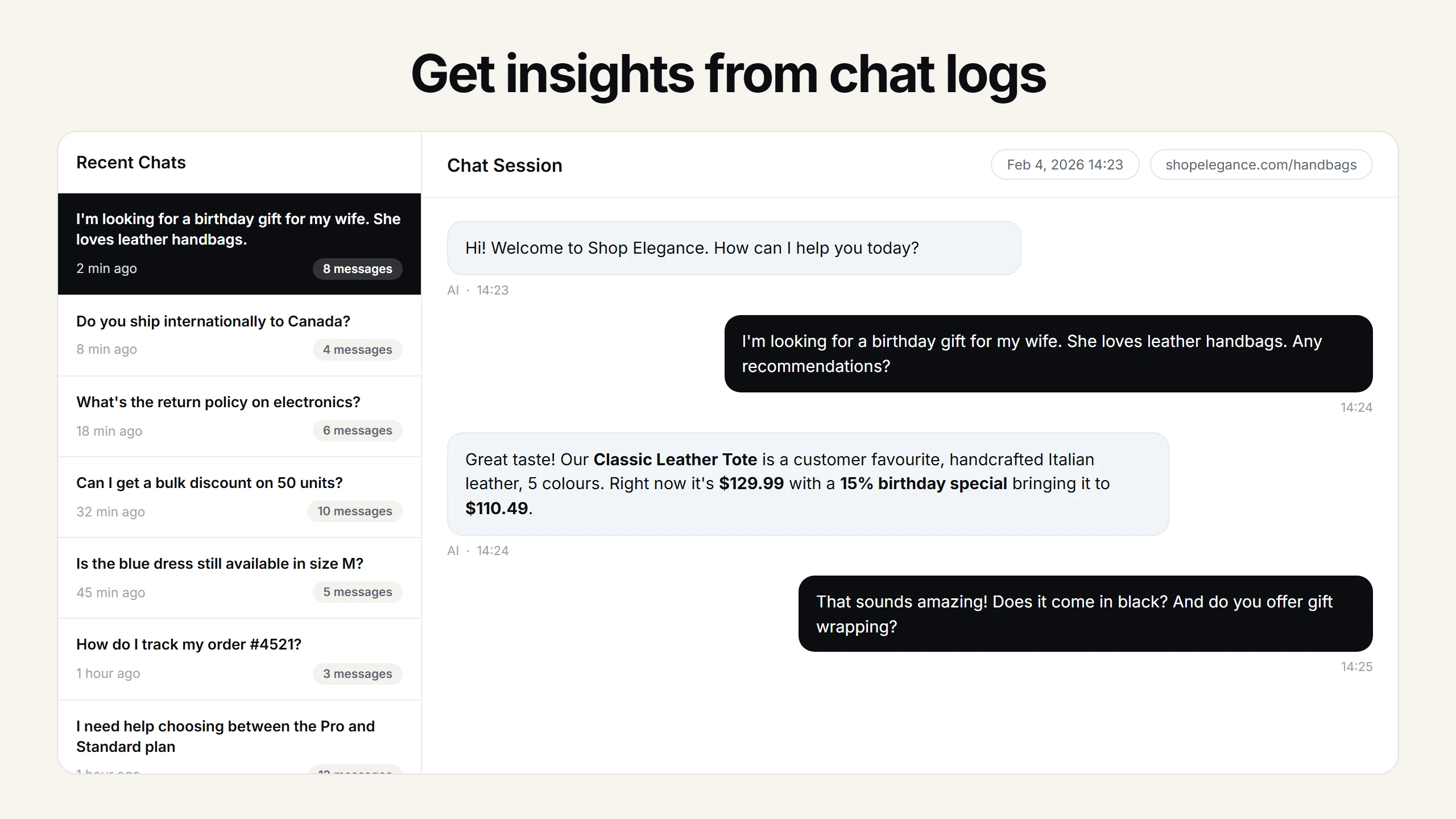
Data and conversation history are available in your dashboard from the first message. Every conversation is logged with the visitor's questions, the AI's responses, any contact information collected, and a timestamp. You can review conversations to see what visitors are asking, identify common questions your website does not answer well, and spot opportunities you might be missing. This is not just a chatbot — it is a window into what your website visitors actually want to know, which is information that no analytics tool based on page views can provide.
The competitive reality is that visitors now expect a real-time response when they interact with a business online. They do not distinguish between large corporations and local shops — they expect the same responsiveness from both. An AI-powered chatbot gives a five-person company the same always-on, multilingual, instant-response capability that was previously available only to enterprises with dedicated support teams. The playing field levels not because the technology is exotic, but because it is simple: your website content, delivered as a conversation, available every hour of every day.
Ready to turn your website into a conversation? Start with the Free plan — 1 site, 50 messages, no credit card — and see how the AI handles real visitor questions from your business. Upgrade to Standard when you are ready for Custom Tools and live data integration.