Your organization already has the answers — the AI just makes them findable
Asyntai retrieves knowledge from your website pages, uploaded documents, and internal files, then delivers precise answers to anyone who asks — in 36 languages, around the clock.
See how the AI surfaces answers from your own content
Enter your URL below and watch the AI retrieve relevant information from your pages to answer real questions
Stop losing institutional knowledge to scattered files and departed colleagues
Every organization accumulates expertise across dozens of locations — website pages, PDF manuals, policy documents, help articles, shared drives. When someone needs an answer, they either search through all of it or interrupt the one colleague who happens to remember. Asyntai solves this by crawling up to 50 pages from your site and indexing any uploaded documents alongside them, creating a unified knowledge layer the AI references every time a question arrives. Visitors on your website get instant, accurate responses drawn from your actual content. Internal teams stop repeating themselves. The knowledge that lives inside your organization becomes permanently accessible instead of locked in filing cabinets or one person's memory.
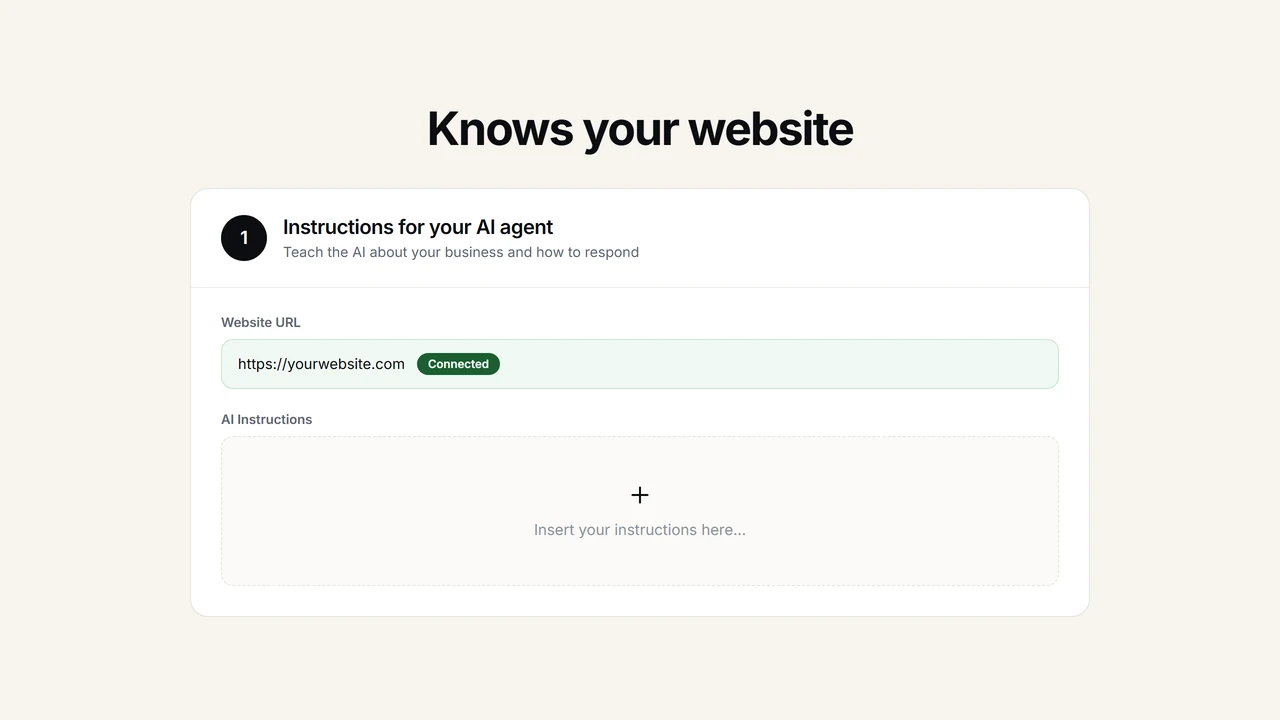
- Automatic website ingestionProvide your URL and the AI crawls product pages, help articles, policy sections, blog posts, and team bios — building a retrieval layer from the content you already publish.
- Private document uploadsUpload internal PDFs, procedure manuals, onboarding guides, or compliance documents. The AI references them alongside public content without ever exposing them to visitors.
- Plain-language behavioral rulesWrite instructions like "only share pricing with logged-in users" or "always recommend contacting legal for contract questions." The AI enforces these boundaries on every conversation.
Knowledge that reaches into your systems for real-time answers
Static documents cover the what and the why. But some questions demand live data — account status, order progress, appointment availability, inventory counts. Custom Tools on Standard ($139/month) and Pro ($449/month) plans let the AI call your own API endpoints during a conversation, pulling current information from your backend and delivering it within the chat. The result is organizational knowledge that stays accurate to the minute, not just to the last time someone updated a document.
- Real-time data retrievalThe AI calls your endpoints to fetch order status, membership details, inventory levels, or booking availability — answering with current data instead of static text.
- Action execution within conversationsConfigure tools that let the AI trigger workflows like scheduling appointments, initiating returns, or creating support tickets directly from the chat interface.
- Visitor context awarenessPush user-specific data via window.Asyntai.userContext on Standard and Pro plans so the AI knows the visitor's account type, purchase history, or membership tier before the conversation begins.
- 36-language auto-detectionThe AI detects each visitor's language from their first message and responds accordingly. A French visitor receives French, a Korean visitor receives Korean — no separate configuration required.
- Contextual escalationWhen a question exceeds the AI's knowledge or triggers a guardrail, the system collects contact details, preserves the full transcript, and delivers everything to your dashboard and inbox.
Make your organizational knowledge accessible before the day is over
No integration project, no knowledge-base migration, no months of content tagging. One script tag, one crawl of your existing content, a few behavioral rules, and your organization's expertise is available to anyone who asks.
- Create a free Asyntai account — no credit card, no procurement process. The free plan covers 1 site and 50 messages per month at $0, enough to validate contextual knowledge retrieval on your real content.
- Copy your unique snippet from the dashboard and paste it into your site's
<head>section via your CMS, tag manager, or a native plugin for WordPress, Shopify, WooCommerce, Magento, Joomla, Drupal, or Odoo. - Point the crawler at your URL and upload private documents — manuals, procedures, compliance docs, onboarding materials. The AI builds its knowledge layer from everything you provide.
- Scale when ready: Starter at $39/month covers 2 sites and 800 messages, Standard at $139/month covers 3 sites and 15,000 messages with Custom Tools, and Pro at $449/month covers 20 sites and 50,000 messages with white-label branding.
<script src="https://asyntai.com/widget.js"
data-id="your-site-id" async>
</script>
# Your organizational knowledge is now conversational. No servers to manage.
AI Contextual Organizational Knowledge — FAQs
Common questions from teams evaluating AI-powered knowledge retrieval for their organization.
How does the AI learn our organizational knowledge?
The AI does not learn in the traditional sense — it retrieves. You provide your website URL and the system crawls up to 50 pages, indexing the content for retrieval. You can also upload PDFs, text documents, and internal guides. When a question arrives, the AI searches this indexed content and composes an answer from the most relevant passages. There are no models to retrain, no datasets to curate — the knowledge stays in your documents and pages, and the AI pulls from them in real time.
Can the AI access private internal documents without exposing them publicly?
Yes. Uploaded documents are stored securely and used exclusively by the AI when composing responses. The documents themselves are never displayed to visitors. You control what knowledge the AI can reference through behavioral rules — for example, restricting internal pricing matrices to logged-in users only or preventing the AI from sharing HR policy details with external visitors.
What types of content can the AI retrieve from?
The AI works with any text-based content: website pages, help articles, blog posts, PDF documents, policy manuals, FAQ sections, product catalogs, procedure guides, and pasted text. It indexes all sources into a single retrieval layer, so a visitor's question can be answered from a combination of your public website and uploaded private documents simultaneously.
Does the AI fabricate answers when it lacks information?
No. The AI draws exclusively from your crawled pages and uploaded documents. When a question falls outside the available knowledge — or when a behavioral rule restricts the topic — the AI acknowledges the limitation and transitions to collecting contact details for human follow-up rather than inventing a response.
How does multilingual knowledge retrieval work?
The AI detects each visitor's language automatically and responds in kind across 36 supported languages. Your content can be in English (or any language), and the AI will retrieve the relevant information and deliver the answer in the visitor's language. There is no per-language configuration and no additional cost for multilingual coverage.
Can the AI pull live data from our backend systems?
On Standard ($139/month) and Pro ($449/month) plans, Custom Tools let the AI call your own API endpoints mid-conversation. This means it can fetch order status, check account details, verify appointment availability, or trigger actions like booking confirmations — delivering real-time answers alongside the static knowledge from your documents and pages.
How is pricing structured?
Plans are based on monthly message volume. Free covers 50 messages for 1 site at $0. Starter is $39/month for 800 messages across 2 sites. Standard is $139/month for 15,000 messages across 3 sites with Custom Tools. Pro is $449/month for 50,000 messages across 20 sites with white-label branding. The system pauses at the cap rather than generating surprise charges.
Can we use this for both external visitors and internal teams?
Absolutely. Many organizations deploy the AI on their public-facing website for customer questions and on an internal portal or intranet for employee inquiries. Each site operates independently with its own knowledge base, behavioral rules, and access controls. Site limits depend on your plan — up to 20 on Pro.
How quickly can we go live?
Most organizations have the AI retrieving from their content within an afternoon. Create an account, paste one snippet into your site header, provide your URL for crawling, upload any supplementary documents, write behavioral rules, and test with sample questions. There is no vendor onboarding, no IT project, and no minimum commitment.
AI contextual organizational knowledge — why the smartest organizations are making their expertise conversational
Somewhere inside every organization sits a person everyone calls when nobody else knows the answer. They remember the edge case from three years ago. They know which clause in the vendor agreement covers the situation. They recall the exact procedure for handling a complaint that falls between two departments. This person is indispensable — and that is precisely the problem. When they go on vacation, knowledge goes dark. When they leave the company, institutional memory walks out the door with them. AI contextual organizational knowledge exists to solve this fragility: not by replacing the expert, but by ensuring the expertise they represent is captured, indexed, and retrievable by anyone at any hour.
The underlying challenge is not a shortage of information. Most organizations drown in it. Product specifications live on the website. Shipping policies occupy a PDF last updated six months ago. Return procedures exist in a shared document three folders deep. The employee handbook sits in a drive nobody bookmarks. Warranty terms appear on a page visitors rarely find through navigation. The information exists — it simply cannot be found at the moment someone needs it. What Asyntai does is straightforward in concept and transformative in practice: it crawls your published pages, indexes your uploaded documents, and then retrieves the relevant passages whenever a question arrives, composing an answer that draws from your actual organizational content.
Retrieval is the operative word, and it matters. The AI does not memorize your content, generate responses from a generic model, or hallucinate plausible-sounding answers from nothing. It searches through the specific pages and documents you have provided, identifies the passages most relevant to the question, and synthesizes a response from that material. If the answer is not in your content, the AI says so and offers to connect the visitor with a human. This retrieval-based approach means the accuracy of the AI is directly tied to the quality and completeness of your knowledge — which is something you already control.
Consider what this means for the visitor experience. A prospective customer lands on your website at eleven on a Saturday night with a question about compatibility between two of your products. Without organizational knowledge retrieval, they either leave or submit a contact form that will not receive a response until Monday. With it, they type their question into the chat widget, the AI searches your product documentation and spec sheets, and thirty seconds later they have a precise, sourced answer. The sale that would have evaporated over the weekend completes instead. Multiply this across hundreds of after-hours visitors per month and the revenue impact compounds rapidly.
The internal applications are equally compelling. A new hire in their second week needs to process an unusual refund. The procedure is documented — somewhere. In a traditional organization, they interrupt a senior colleague, who interrupts their own work, and walks through the steps from memory. With AI contextual knowledge deployed on an internal portal, the new hire types the question, the AI retrieves the procedure from the uploaded operations manual, and the answer arrives in seconds. The senior colleague is never interrupted. The new hire builds confidence through independent problem-solving. The organization scales its expertise without scaling its headcount.
Language barriers dissolve in a way that static documentation cannot achieve. Your operations manual may be written in English, but the AI delivers its contents in 36 languages through automatic detection. A warehouse manager in Stuttgart asks about the procedure in German and receives a German response derived from the English source document. A customer service representative in São Paulo poses the same question in Portuguese and receives the identical procedure, rendered in Portuguese. The knowledge stays consistent across languages because it originates from one source — your documents — and the AI handles the linguistic bridge. No translation vendors, no parallel document sets, no version-control headaches across language editions.
Behavioral rules add a governance layer that raw documents cannot provide on their own. Knowledge retrieval tells the AI what it can say; behavioral rules tell it what it must not do and how to handle sensitive boundaries. You write them in plain sentences: "never share internal pricing tiers with visitors who are not logged in," "always direct employment inquiries to the careers page," "escalate immediately if someone mentions a data breach," "do not discuss pending litigation." These constraints bind every conversation the AI handles, in every language, at every hour. The consistency is absolute — no forgotten instructions during a busy shift, no new employee who has not yet learned which topics require caution.
Custom Tools on Standard and Pro plans push organizational knowledge beyond what documents alone can cover. Documents capture the permanent: policies, procedures, specifications, guidelines. But visitors increasingly ask questions that require current data — order status, account balances, appointment availability, subscription renewal dates. Custom Tools let the AI call your own API endpoints mid-conversation, retrieving live information and delivering it alongside the static knowledge base. A visitor asks when their order ships, and the AI calls your fulfillment system instead of quoting a generic shipping policy. The answer is specific, current, and useful — which is what organizational knowledge should always be.
Personalization through visitor context deepens the retrieval further. On Standard and Pro plans, your site pushes data about the current visitor — account type, purchase history, loyalty tier, geographic region — into the chat session before the conversation begins. The AI incorporates this context when formulating responses. A premium-tier customer asking about support options receives information about priority channels available to their tier. A visitor from a region with specific regulatory requirements receives region-appropriate answers. The organizational knowledge adapts to the person asking, not just the question being asked.
Escalation design is where responsible knowledge retrieval separates itself from dangerous automation. Not every question should be answered by AI. Some require human judgment — contract negotiations, complaint resolution, situations with legal implications, requests that fall outside documented procedures. Asyntai handles these boundaries through configurable escalation: when the AI encounters a question beyond its indexed knowledge, when a behavioral rule triggers, or when the visitor explicitly requests a person, the system collects contact details, preserves the complete transcript, and delivers everything to your dashboard and inbox. The human who picks up sees the full conversation history, understands the context, and never asks the visitor to start over.
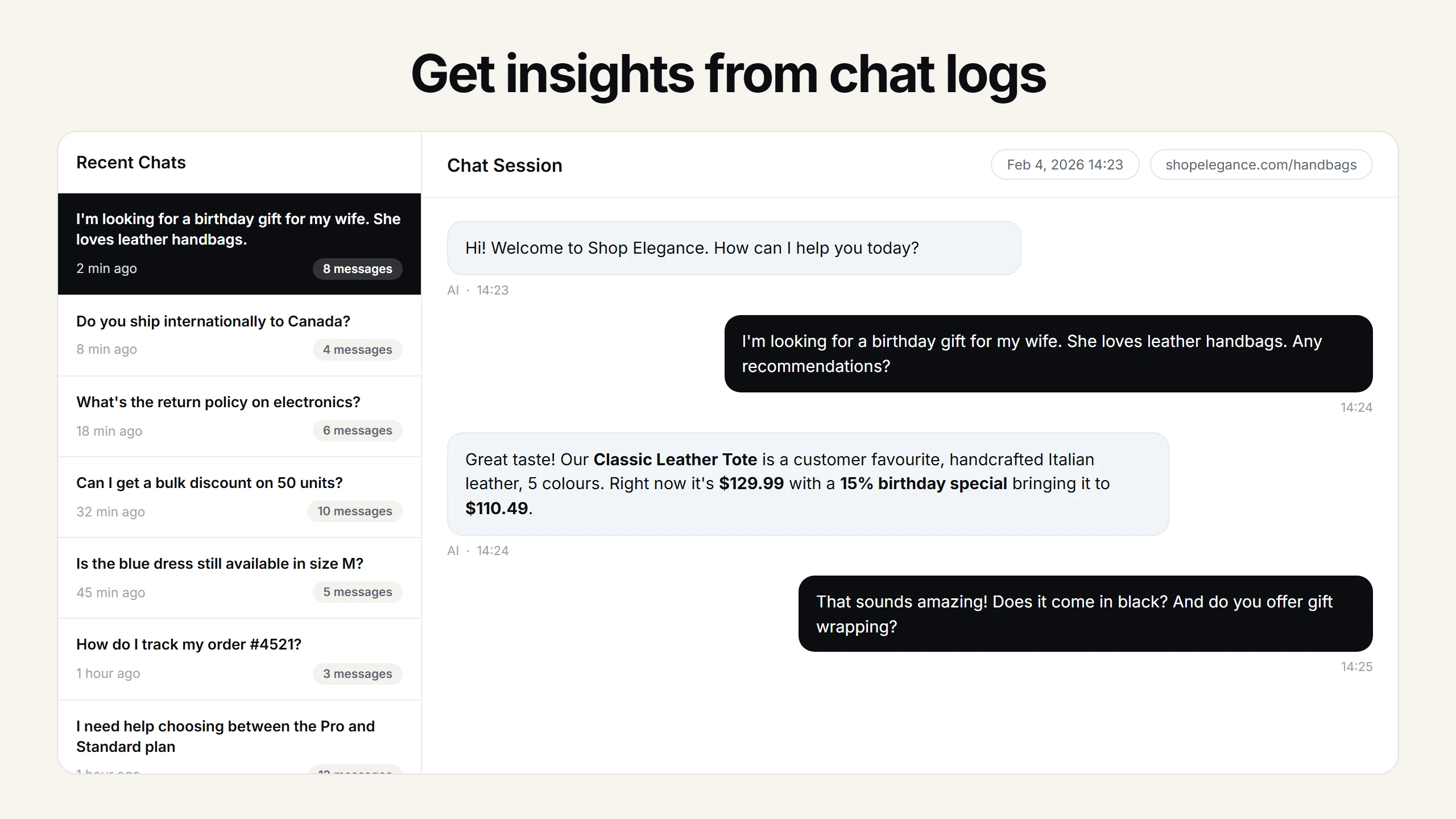
The analytics that accumulate from AI-driven knowledge retrieval serve a diagnostic purpose that search logs and page views cannot match. Traditional analytics tell you which pages received traffic. Knowledge retrieval analytics tell you which questions your visitors actually have — and where your content fails to answer them. A spike in escalations around a particular product feature signals a documentation gap. Frequent questions about a process that is documented but phrased differently than visitors expect suggests a rewrite. Over weeks and months, these patterns become a roadmap for strengthening your organizational knowledge at its source. The AI does not just deliver answers — it reveals which answers are missing.
Multi-site deployment serves organizations whose knowledge is distributed across properties. A university with separate sites for admissions, financial aid, and housing needs each AI instance to reference only the knowledge relevant to its domain. A company with distinct product lines needs brand separation between knowledge bases. Site limits scale with the plan — 1 on Free, 2 on Starter, 3 on Standard, 20 on Pro — and each site maintains its own crawled content, uploaded documents, behavioral rules, and conversation archive. There is zero knowledge bleed between properties.
White-label branding on Pro plans (and by request on Standard, via [email protected]) removes Asyntai's identity from the widget entirely. The chat interface carries your organization's name, colors, and logo — nothing else. For consultancies deploying the AI on client sites, for agencies managing multiple brands, or for enterprises where third-party branding is not permitted, white-label deployment ensures the knowledge experience feels native to the organization it serves.
The organizations that extract the most value from AI contextual knowledge share a common profile: they have substantial documented expertise, a steady stream of questions from visitors or employees, and too few people to answer them all in real time. Whether that is a software company whose visitors ask the same integration questions week after week, a healthcare provider whose patients need procedure information outside office hours, a university whose prospective students ask identical admissions questions every cycle, or a services firm whose employees waste hours searching for internal procedures — the pattern is identical. The knowledge exists. The questions are predictable. The only missing piece is a retrieval layer that works continuously.
Asyntai is free to start — 1 site, 50 messages, no credit card — and designed to prove its value on your actual content before you spend anything. Paid plans begin at $39/month for Starter, scaling through Standard and Pro as your volume and knowledge complexity grow. The distance between scattered documents and conversational expertise is shorter than most organizations expect, and the pricing page shows exactly how each tier maps to your needs.