AI chatbot SaaS that actually reads your site before it speaks
Asyntai is an AI chatbot SaaS built on retrieval-grounded generation. Every answer pulls from the pages and documents you feed it — no hallucinated product specs, no off-brand tangents, no ML expertise required on your end.
See the AI chatbot SaaS respond to your real content
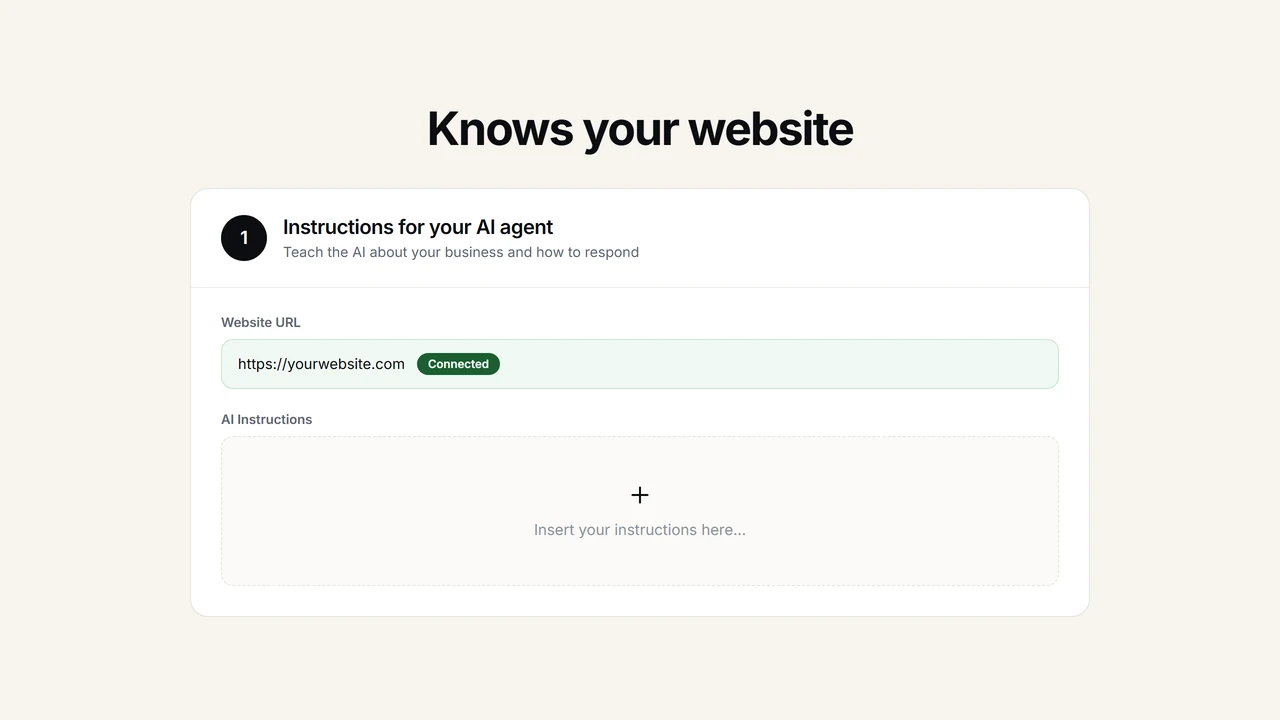
Paste a URL and the platform will crawl the page, then answer visitor-style questions using only what it found
Replies anchored to your content, not the model's imagination
Generic chatbots guess. Asyntai retrieves. When a visitor asks a question, the AI chatbot SaaS pulls the relevant paragraphs from your crawled pages and uploaded files, then composes a response that stays within those boundaries. The result is an answer your support team would recognize as correct.
- Content-first retrieval pipelineBefore the language model generates a single word, the platform ranks your indexed material against the visitor's question and feeds only the highest-scoring passages into the prompt context.
- No training data to prepareYou never build a labeled dataset or hire annotators. Point the crawler at your domain, upload supplementary documents, and the knowledge base assembles itself within minutes.
- Guardrails that keep answers on topicCustom instructions let you define what the AI should and should not discuss, so the chatbot declines gracefully instead of inventing an answer outside its scope.
Skip the fine-tuning queue and the prompt-engineering hire
Most AI chatbot projects stall at the machine-learning step: collecting examples, formatting training sets, waiting days for a fine-tune run, then discovering the output still drifts. Asyntai removes that entire phase. The hosted platform handles retrieval, ranking, and generation behind the scenes while you control tone and scope through plain-language settings.
- Tone shaped by written instructions, not weightsDescribe how you want the assistant to sound in a few sentences — formal, friendly, terse — and those instructions wrap every generated reply without a single epoch of training.
- Knowledge updates without retrainingChanged a pricing page or published a new help article? Trigger a re-crawl and the AI chatbot SaaS absorbs the update on the next conversation, no redeployment step in between.
- Model improvements delivered automaticallyWhen the underlying language model gets faster or more accurate, the upgrade rolls out across every tenant. You inherit better AI without touching a configuration file.
Activate the AI chatbot SaaS with a single snippet
The entire deployment is one asynchronous script tag placed in your site header. If your CMS supports plugins, Asyntai also distributes ready-made packages across the major ecosystems — WooCommerce, Drupal, Shopify, Joomla, WordPress, Magento, Odoo, and beyond — so you can pick whichever path your workflow prefers.
- Register a free Asyntai account — email only, no payment method, no approval queue.
- Copy the tenant-specific script tag from your dashboard and drop it into your site header, or use the dedicated CMS extension if one exists for your stack.
- Point the crawler at your domain and optionally upload PDFs, policy docs, or product catalogs to expand the knowledge base.
- Watch the first AI-grounded conversations roll in, refine custom instructions and visual styling, then let the platform operate on its own.
<script src="https://asyntai.com/widget.js"
data-id="your-tenant-id" async>
</script>
</head>
# Retrieval-grounded AI. Your content, your rules.
AI Chatbot SaaS — FAQs
Practical questions teams ask when evaluating an AI chatbot SaaS against building a retrieval stack internally.
What makes this an "AI chatbot SaaS" rather than a regular chatbot?
The distinction is in the generation layer. A rule-based chatbot follows decision trees you script manually. An AI chatbot SaaS uses a large language model to compose replies dynamically from your indexed content. Asyntai grounds every response in the specific pages and documents you provide, so the output reads like a knowledgeable human wrote it — not like a flowchart picked the closest canned answer.
Does the AI hallucinate or make things up?
Retrieval grounding dramatically reduces hallucination compared to a raw language model. The platform constrains the AI to passages it actually found in your knowledge base, and custom instructions let you tell it to say "I don't have that information" rather than speculate. No system is perfect, but the architecture is specifically designed to keep answers within the boundaries of your content.
Do we need a machine-learning engineer to set this up?
No. The entire setup is browser-based: sign up, paste a snippet or install a plugin, feed the crawler a URL, and optionally upload documents. There is no model to train, no embeddings to tune, and no vector database to operate. The SaaS handles the full AI pipeline from indexing through response generation.
How does pricing work for the AI tier?
The same way as any Asyntai plan — based on monthly conversation volume, not on AI usage separately. A zero-cost plan ships with 50 monthly conversations and every AI feature unlocked. Paid plans begin at $39 per month covering 800 messages. There is no per-query AI surcharge layered on top of the subscription.
Can the AI chatbot SaaS handle multiple websites from one account?
Yes. Site allowances grow with each tier: a single property on the free plan, two with Starter, three at the Standard level, and as many as ten under Pro. Every property maintains its own knowledge base, design settings, and captured-lead inbox while billing consolidates under a single subscription.
How does the platform handle visitors who write in different languages?
Asyntai supports 36 languages at the interface and reply level. Language detection happens automatically on the very first message a visitor sends, and the reply arrives in the same language, drawing from whatever content the platform has indexed. A single tenant can serve a German visitor at noon and a Japanese visitor an hour later without any language configuration changes on your part.
Can the chatbot recognize logged-in users and personalize responses?
With the User Context capability, unlocked at the Standard tier and above, your site pushes a JavaScript object through window.Asyntai.userContext before the conversation begins. You control exactly which visitor attributes to share — name, plan, order history, whatever your front end already knows — and the AI references that context when composing replies.
Where do leads captured by the AI chatbot go?
Every qualified lead appears in your Asyntai dashboard alongside the full conversation transcript. You can also enable email notifications that forward each lead to a team inbox the moment it is captured. The platform does not auto-sync into external CRMs — teams that need contacts inside another system export from the dashboard or route the email notification into their existing intake workflow.
AI chatbot SaaS — why grounded generation changes the conversation
Bolting an AI model onto a website used to require a team that could talk fluently about embedding dimensions, cosine similarity thresholds, and prompt injection mitigations. That barrier kept AI chatbots locked inside companies large enough to staff an applied-ML function. The emergence of AI chatbot SaaS flattens the playing field: a hosted platform absorbs the retrieval infrastructure, the model orchestration, and the ongoing tuning work, then exposes the whole capability as a monthly subscription anyone with a browser can configure. What used to demand a quarter of engineering time now takes an afternoon of point-and-click decisions.
The phrase "AI chatbot" has been diluted by years of marketing. Plenty of products calling themselves AI chatbots are glorified flowchart engines wearing a conversational skin. They match keywords to canned responses, and the moment a visitor phrases a question in an unexpected way the bot falls over. Genuine AI chatbot SaaS replaces that brittle logic with a language model that actually comprehends the question and synthesizes an answer from the material it has been given. The qualitative difference for the visitor is night and day: instead of being railroaded through a decision tree, they get a fluid reply that addresses exactly what they typed.
Grounding is what separates a useful AI chatbot from a liability. An ungrounded model draws on its general training data, which means it might cheerfully cite a return policy it learned from some other retailer or invent a feature your product has never offered. Retrieval-grounded generation constrains the model to the specific pages, PDFs, and documents the site owner has provided. Every response the AI chatbot SaaS delivers traces back to material the business controls, which is how you get accuracy without the ongoing cost of manually reviewing and approving every answer.
One common misconception buyers carry into evaluations is that an AI chatbot must be fine-tuned on their data to perform well. Fine-tuning adjusts the model's internal weights using a curated training set — a process that demands labeled examples, compute time, and periodic retraining whenever the underlying information changes. Retrieval-augmented generation sidesteps that entire exercise. Instead of baking knowledge into the weights, the platform fetches the relevant content at query time and passes it alongside the visitor's question. The practical upside is immediacy: update a pricing page on your site, trigger a re-crawl, and the next visitor conversation reflects the change without a training pipeline ever running.
The operational simplicity of an AI chatbot SaaS deserves a closer look, because the gap between "simple to demo" and "simple to operate at month six" is where most tools disappoint. With Asyntai, the day-to-day consists of three surfaces: a dashboard for analytics and lead review, a settings panel for tone instructions and visual styling, and a knowledge-base manager where you add or remove source material. There is no terminal to SSH into, no log aggregator to monitor, no model version to pin. The vendor carries the infrastructure pager, and the tenant operator carries the content decisions — a division of labor that maps naturally to how small and mid-size teams are actually staffed.
Language breadth is another dimension where the SaaS model outperforms a self-built stack by a wide margin. Asyntai supports thirty-six languages with automatic detection at the message level. A visitor in Seoul types in Korean and receives a Korean reply; a visitor in Lisbon types in Portuguese and the same tenant responds in Portuguese — all without the site owner toggling a locale setting or maintaining parallel knowledge bases. Replicating that scope internally means handling tokenization quirks, UI string localization, and detection logic across dozens of languages, a project most teams would never prioritize even if they had the engineering bandwidth.
Personalization through the User Context feature illustrates how an AI chatbot SaaS can punch above its weight class on relevance. Unlocked from the Standard subscription onward, the User Context mechanism lets a merchant's front-end code inject a structured JavaScript payload into the chatbot session before the visitor sends a single word. That object might contain a customer's name, subscription tier, recent order ID, or any other attribute the site already has in scope. The AI incorporates those facts into its replies, so a returning buyer asking about a delayed shipment gets an answer that acknowledges their specific order rather than a boilerplate guide to the returns portal. Building this plumbing on a DIY stack is straightforward in isolation; maintaining it as prompt templates evolve and model providers rotate is the recurring tax the SaaS absorbs.
Cost predictability is woven into the subscription model in a way that matters more than it seems during a trial. AI inference is not free — tokens flow, compute bills accumulate — and teams building their own chatbots often discover that monthly API costs fluctuate with traffic in ways their budgeting process cannot accommodate. An AI chatbot SaaS wraps that variable cost inside a fixed line item. Asyntai's paid plans open at thirty-nine dollars a month for 800 messages, with the free tier offering 50 messages at zero cost so a team can pilot with real traffic before committing. If conversation volume approaches the plan ceiling, the platform sends email warnings with enough runway to upgrade cleanly rather than scramble after an unexpected invoice.
Installation flexibility rounds out the practical picture. The deployment artifact is a single asynchronous JavaScript snippet placed in the site header — the same mechanism whether the site runs on WordPress, Shopify, Squarespace, a static HTML host, or a custom framework. For teams that prefer a managed install, Asyntai distributes dedicated extensions across WooCommerce, Drupal, Shopify, Joomla, WordPress, Magento, Odoo, and additional ecosystems. Switching CMS providers does not strand the chatbot: the tenant, its knowledge base, its conversation history, and its captured leads all persist server-side. Only the installation method changes, and the new snippet is just as portable as the old one.
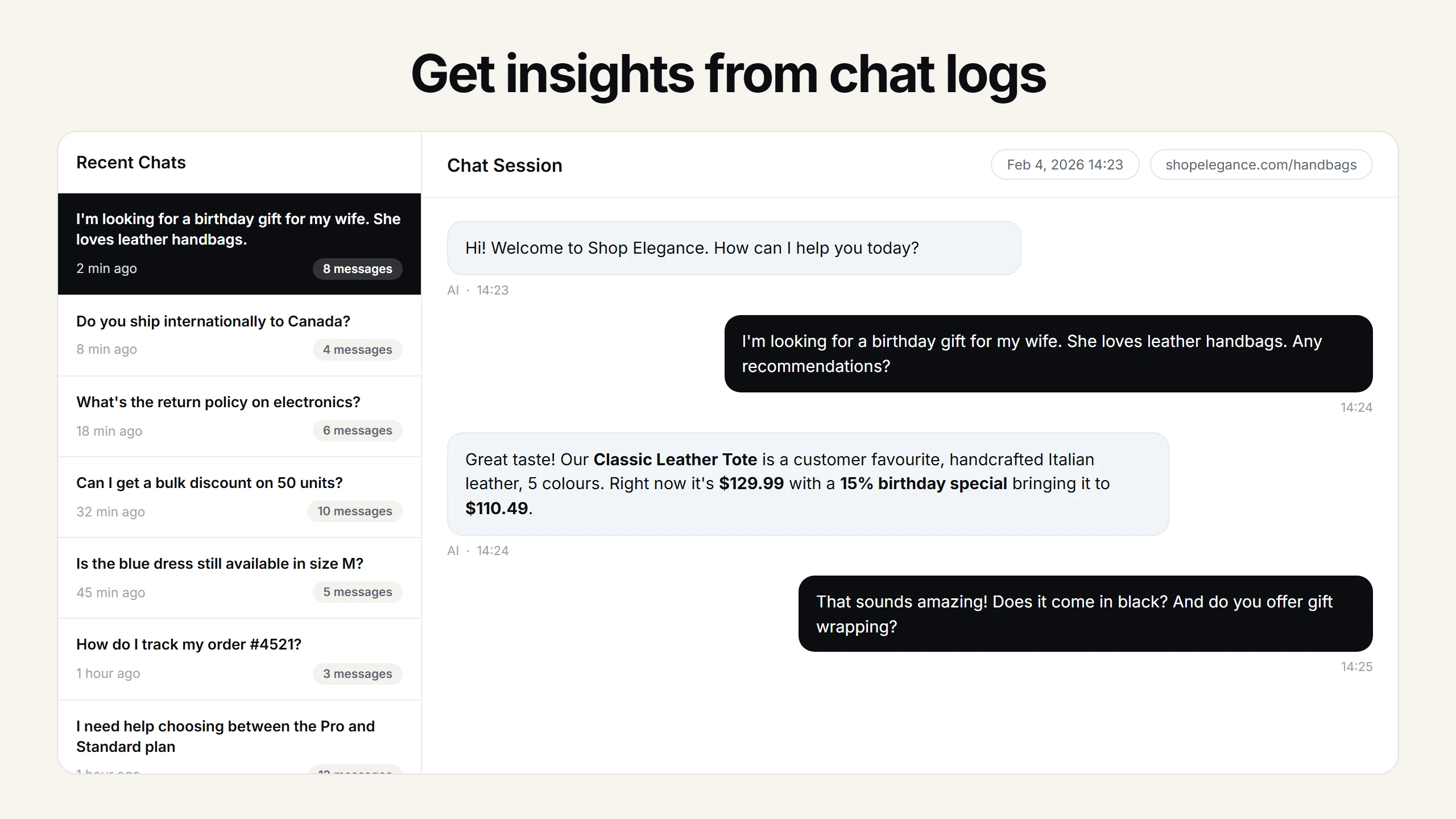
Lead capture within an AI chatbot SaaS operates differently from a traditional form because the qualification happens inside the conversation itself. The AI can ask clarifying questions, gauge purchase intent from the dialogue, and collect contact details at a natural point in the exchange rather than interrupting with a static pop-up. Every qualified contact appears inside the Asyntai lead panel with the complete conversation thread preserved, and optional email alerts relay each new capture to a team inbox the instant it is recorded. There is no automatic synchronization with external CRMs — the platform keeps its scope tight deliberately, letting teams export or route leads through whatever intake workflow they already maintain.
Reliability concerns for any SaaS ultimately reduce to a question of trust in the vendor's uptime discipline. Because the AI chatbot runs on Asyntai's hosted infrastructure, the tenant operator does not carry the burden of model-provider outages, index corruption, or retrieval-pipeline failures. If the language model vendor changes an API contract at midnight, the SaaS team patches the integration layer before the first business-hours conversation. That invisible maintenance is part of what the subscription funds, and for a team that already has a full product roadmap of its own, not owning that pager is worth more than the dollar amount suggests.
Analytics within an AI chatbot SaaS close the feedback loop that most self-built systems leave open. Asyntai's dashboard surfaces conversation volumes, resolution patterns, popular questions, and lead-capture rates without requiring a separate analytics integration or a data warehouse query. That visibility lets a product or support lead answer the question "is the chatbot actually helping?" with data rather than anecdote, and the same metrics provide the justification a budget holder needs when the renewal conversation arrives. On a DIY stack, building that reporting surface is an entire workstream that competes with every other dashboard the engineering team has been asked to create.
Evaluating whether an AI chatbot SaaS fits a particular organization usually comes down to three criteria: content complexity, traffic profile, and team structure. If the product or service generates genuine questions — not just "what are your hours" but nuanced queries about compatibility, policies, or use cases — then a grounded AI chatbot adds meaningful value over a static FAQ. If traffic includes off-hours visitors, international audiences, or seasonal spikes that a staffed chat team cannot cover economically, the always-on nature of the SaaS fills the gap without the fixed cost of additional headcount. And if the team lacks dedicated ML or DevOps capacity, the hosted model eliminates the steepest barrier to deploying conversational AI in the first place.
The reversibility argument matters for budget holders who have been burned by long procurement cycles before. Spinning up an Asyntai tenant takes minutes, running a serious pilot takes a few weeks, and removing the snippet from the header returns the site to exactly where it was before in one release cycle. There is no data migration to undo, no contract termination clause, no orphaned infrastructure to decommission. That low exit cost is the structural reason more teams now default to evaluating an AI chatbot SaaS before considering a custom build — the downside of trying is negligible, and the upside of succeeding is a permanent reduction in repetitive support load.