Embed an AI chat widget on your website — any platform, one snippet
Asyntai puts a content-grounded AI chat widget on your website regardless of how it was built. Paste a JavaScript snippet into the header, and visitors start getting real answers drawn from your own pages, documents, and rules — in 36 languages, around the clock.
Preview the AI chat widget running on your website
Enter your URL below and watch the widget field questions using content from your actual pages
One embed method covers every website technology on the market
Whether your website runs on a hosted builder, an open-source CMS, a headless framework, or raw HTML files on a CDN, the AI chat widget embeds the same way: a single async JavaScript tag placed inside the page header. No server-side dependencies, no framework adapters, no version-locked plugins.
- Hosted builders and SaaS CMSesWix, Squarespace, Webflow, HubSpot CMS, and similar builders each expose a custom-code header field. Paste the tag there once and the widget appears on every published page without touching the design editor.
- Self-hosted CMSes and ecommerce enginesWordPress, WooCommerce, Shopify, Magento, Drupal, Joomla, Moodle, OpenCart, PrestaShop, Ghost — the snippet drops into a header plugin, a theme template, or the platform's built-in injection point.
- Custom-built and framework sitesReact, Vue, Next.js, Nuxt, Astro, Gatsby, Rails, Django, Laravel, static generators — if the output includes an HTML head section, the widget runs. No build-step changes required.
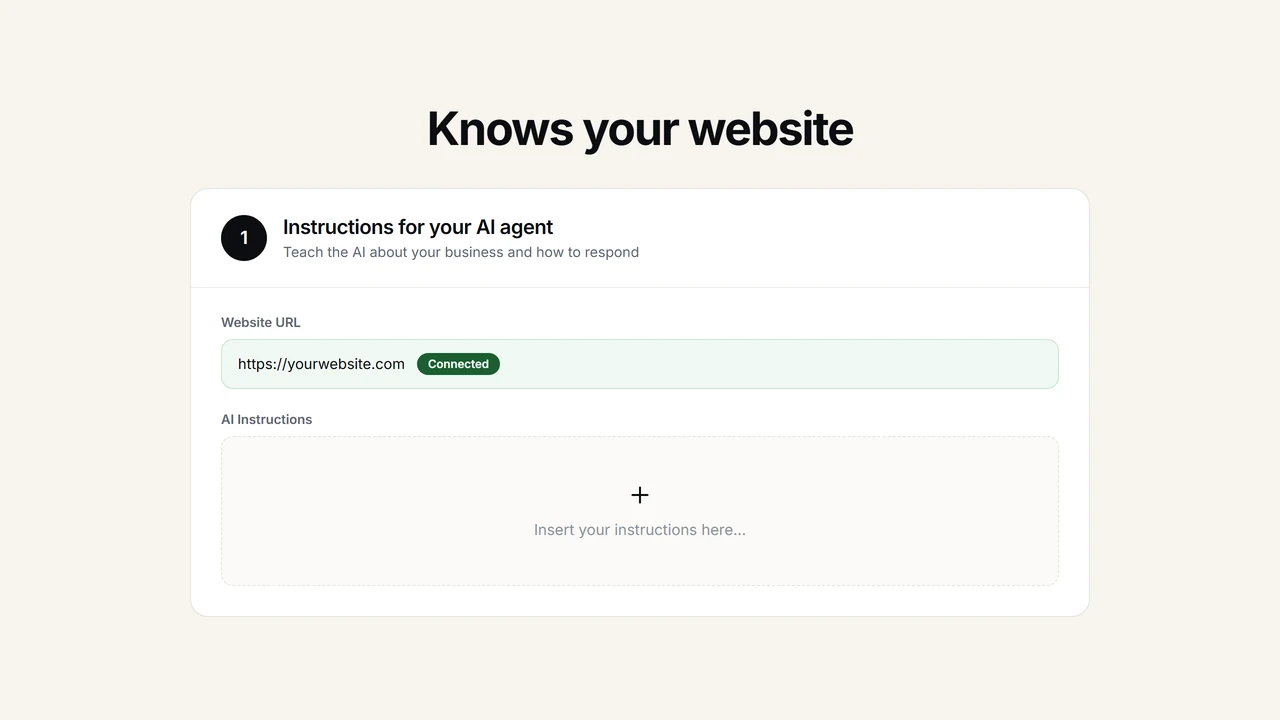
The widget reads your website so it can speak for your business
On signup, point the widget at your domain and it crawls every reachable page — product listings, service descriptions, pricing tables, blog articles, policy documents. Add private files as PDFs and write plain-English behavior rules. The result is an AI chat widget that answers visitors from your verified content, not from general internet knowledge.
- Automatic page ingestionThe crawler walks your sitemap and internal links, pulling text from every accessible URL into the knowledge layer. When you publish new content, re-crawl and the widget picks it up immediately.
- Private document layerUpload internal pricing sheets, onboarding playbooks, partner agreements, or technical specs as PDFs. The AI references them alongside public pages but never exposes them raw to visitors.
- Behavioral guardrails in plain EnglishWrite rules like "decline to discuss competitor pricing" or "always suggest scheduling a call for projects over $5,000." Every conversation on every page follows these constraints automatically.
How to embed the AI chat widget on your website
The embedding process mirrors adding any third-party tag — Google Analytics, a pixel, a consent banner. Place the snippet before the closing </head> tag and the widget activates site-wide.
- Register a free Asyntai account, enter your website URL, and copy the generated snippet containing your unique site ID.
- Open your website's header area — the CMS custom-code field, a header-injection plugin, or the raw template file — and paste the snippet.
- Save and reload any page in an incognito window. The launcher icon should appear in the corner within seconds.
- Return to the dashboard to adjust colors, write behavioral instructions, upload private documents, and test a handful of sample conversations before announcing the widget to visitors.
<script src="https://asyntai.com/widget.js"
data-id="your-site-id" async>
</script>
</head>
# Widget embedded. Every page on the site now has AI chat.
AI chat widget for website — FAQs
Practical questions site owners confirm before embedding the widget on a live website.
Which website platforms can I embed the AI chat widget on?
Any platform that permits a script tag in the page header. That covers WordPress, Shopify, WooCommerce, Wix, Squarespace, Webflow, Ghost, HubSpot CMS, Magento, Drupal, Joomla, Moodle, OpenCart, PrestaShop, BigCommerce, and every custom-built site regardless of backend language or framework. The widget does not depend on server-side hooks, so the underlying tech stack is irrelevant to compatibility.
How does the widget learn what my website is about?
When you connect your domain, the crawler traverses your publicly accessible pages and indexes the text content. Product descriptions, service pages, blog posts, FAQ sections, pricing tables, and policy pages all become part of the widget's knowledge base. You can supplement this with uploaded PDFs or pasted text for content that is not publicly available, such as internal pricing matrices or process guides.
Will visitors who speak different languages receive answers in their language?
Yes. The widget interface is localized into 36 languages, and the AI identifies the visitor's language from whatever they type first. A visitor writing in Italian receives Italian responses, one writing in Vietnamese receives Vietnamese, one writing in Turkish receives Turkish — all from the same embedded widget without separate language configurations or translation files.
Can the embedded widget recognize returning or logged-in visitors?
On Standard and Pro plans, yes, through the User Context feature. Your website populates a JavaScript object with details about the signed-in visitor — their name, subscription level, recent activity, or any other fields you choose — and the widget uses that data to personalize responses. You decide exactly what to expose; nothing is accessed from your backend without your code explicitly passing it.
What happens to conversations the widget cannot fully resolve?
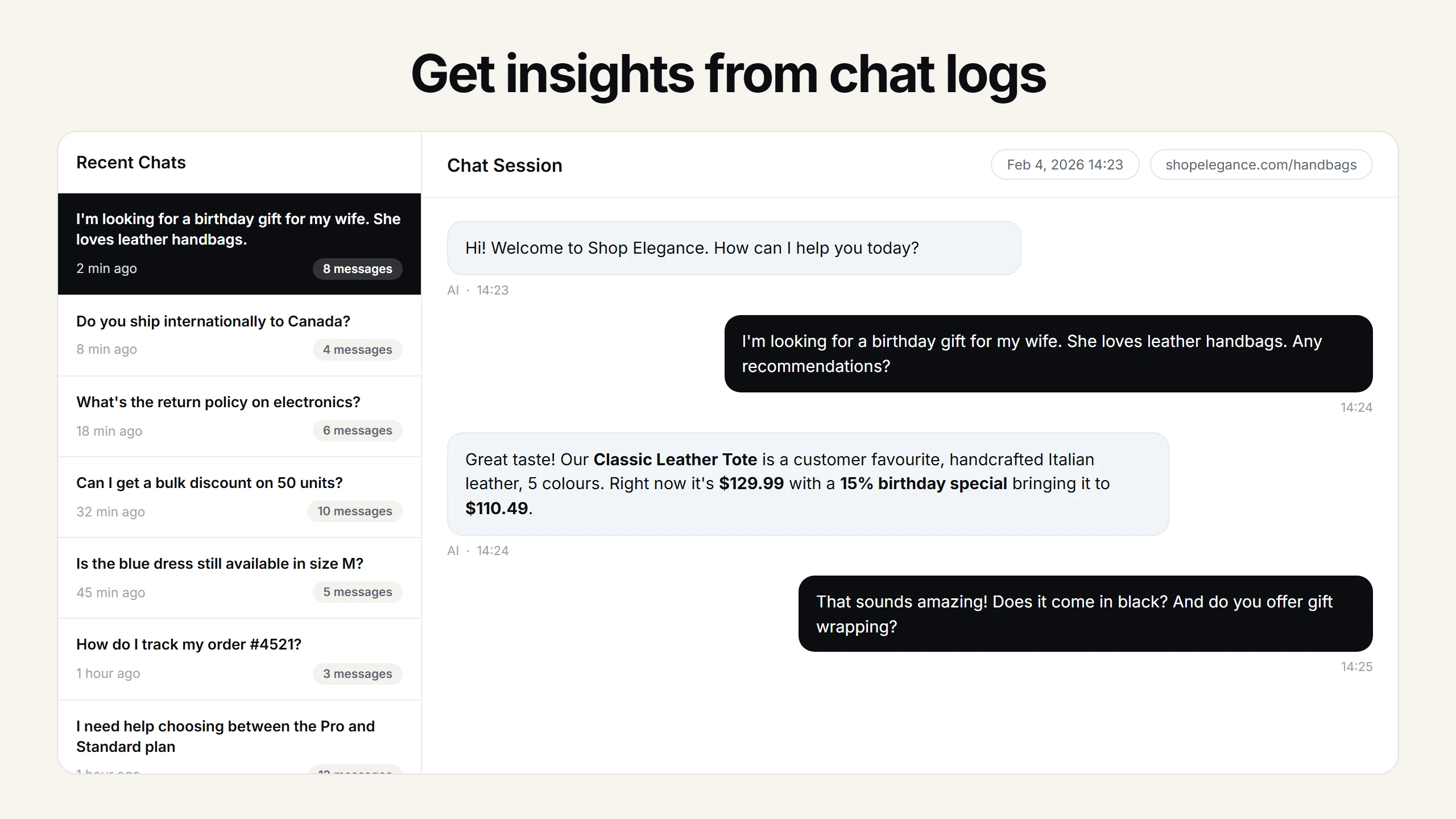
The widget collects the visitor's name and email, preserves the entire conversation transcript, and delivers the bundle to your Asyntai dashboard. If email notifications are enabled, your team receives the same transcript in their inbox immediately. The visitor experiences a smooth handoff rather than a dead end, and your team picks up the thread with full context already attached.
Can I embed the widget on more than one website from the same account?
Yes. The free plan covers a single website. Starter supports two, Standard three, and Pro up to ten. Each website gets its own independently indexed widget — separate crawled content, separate uploaded documents, separate visual styling, separate behavior rules — managed from one unified dashboard with a site switcher.
How much does it cost to run the AI chat widget on my website?
The free tier includes 50 AI-powered messages per month at no charge, which is sufficient for low-traffic websites or an evaluation period. Paid plans open at $39 per month for 800 messages and coverage for two websites. Higher tiers increase both the monthly message allocation and the number of websites you can cover. Usage alerts arrive by email before you reach the cap.
Does embedding the widget require ongoing maintenance or updates?
No. The widget script is hosted on Asyntai's infrastructure, so improvements, security patches, and new capabilities ship automatically without you touching the embed code. The only ongoing work is optional: refining behavior rules, re-crawling after major content updates, or reviewing conversation analytics to improve your site based on what visitors actually ask.
How to put an AI chat widget on your website — and what to expect once it is there
Embedding an AI chat widget on a website used to be an engineering project. Two years ago, even the simpler tools in the category required configuring webhook endpoints, mapping conversation flows, writing intent libraries, and maintaining a separate content repository that mirrored the site's actual pages. The result was a widget that took weeks to go live and drifted out of sync with the website every time someone updated a product listing or revised a policy paragraph. The current generation of AI chat widgets has eliminated most of that overhead. Asyntai, for example, embeds through a single JavaScript tag, reads the website's own published content as its knowledge source, and starts responding to visitor questions the same afternoon you paste the snippet. The shift from "project" to "afternoon task" is what makes the category newly relevant for small teams, solo operators, and mid-size businesses that previously wrote off embedded chat as too heavy to maintain.
The embedding itself is deliberately mundane. Every modern website — whether it runs on a hosted builder, a self-managed CMS, a headless framework, or hand-coded HTML — provides a mechanism for placing third-party scripts in the page header. Wix calls it Custom Code. Squarespace calls it Code Injection. Webflow puts it under Project Settings. WordPress exposes it through theme files, header-footer plugins, or a functions.php hook. Shopify surfaces it in the theme.liquid file. Ghost, HubSpot CMS, Drupal, Joomla, Magento, OpenCart, Moodle, BigCommerce, PrestaShop — each platform has its own label for the same concept: a place where you drop in a tag, save, and every page on the site inherits the result. The AI chat widget uses that identical pathway. If you have embedded a tracking pixel, a consent banner, or an analytics library before, you already know the motions involved.
What happens after the tag is in place matters more than the tag itself. On your first login to the Asyntai dashboard, you enter the domain you want the widget to cover. The crawler begins walking your sitemap and following internal links, pulling the text layer from every reachable page — service descriptions, product detail pages, blog posts, help articles, pricing breakdowns, return policies, team bios, whatever you have published. That crawled content becomes the foundation the AI draws on when a visitor types a question. If your pricing page says "$49 per seat, billed annually," the widget will cite that number precisely rather than generating a plausible guess. If your FAQ section addresses refund windows, the widget will relay the exact terms. Grounding responses in the site's own language is what separates a useful embedded widget from a novelty that erodes visitor trust after the first inaccurate answer.
Platform coverage is worth mapping out concretely because "works on any website" is a claim many vendors make and few deliver without caveats. The Asyntai AI chat widget has been verified to embed cleanly on WordPress (classic editor and block editor themes), WooCommerce storefronts, Shopify Online Stores (Basic through Plus), Wix free and premium sites, Squarespace personal through business tiers, Webflow hosted projects, Ghost self-hosted and Pro, HubSpot CMS free and Starter, Drupal 9 and 10, Joomla 4 and 5, Magento Open Source and Adobe Commerce, OpenCart 3 and 4, PrestaShop, Moodle, BigCommerce, and static sites generated by Jekyll, Hugo, Eleventy, Astro, Gatsby, and Next.js. The common denominator across all of these is nothing more than the ability to include a script tag in rendered HTML — which is a capability every production website possesses by definition.
Multilingual handling is the dimension that surprises most site owners once they look at their visitor analytics by geography. A website receiving organic search traffic from twelve countries inevitably attracts visitors who prefer to interact in their own language. Traditional approaches to this — translated microsites, multilingual helpdesk staffing, per-language chatbot instances — scale poorly and cost heavily. The AI chat widget addresses the problem at the conversation level: the interface renders in 36 languages automatically based on the visitor's browser locale, and the AI detects the language of the first message to set the reply language for the rest of the session. A site published entirely in English can serve Portuguese, Korean, Arabic, Finnish, or Hindi visitors through the same single embedded widget. No translated pages to maintain, no language-detection middleware to build, no per-locale configuration files to keep in sync.
The visual identity of the embedded widget matters because visitors judge credibility within seconds. A color palette that clashes with the surrounding page, a launcher icon that looks imported from a different design system, or a greeting tone that contradicts the site's editorial voice creates friction that undermines trust. Asyntai's dashboard exposes the full set of visual and tonal controls — accent color, launcher corner, custom avatar, welcome copy, input placeholder, and separate mobile behavior options — all previewing live before reaching visitors. On phones, the widget defaults to a compact, dismissible bubble rather than a full-screen overlay, preserving the content underneath and letting the visitor toggle the conversation without losing their scroll position. The mobile setting is configurable per-site, so a documentation portal can use a larger chat surface while a landing page keeps the minimal footprint.
Personalization through User Context elevates the embedded widget from a public-facing FAQ tool to a context-aware interface for authenticated visitors. On Standard and Pro plans, your website can populate a window.Asyntai.userContext object before the widget script executes — passing in the visitor's display name, plan tier, account creation date, last order reference, loyalty points balance, or any other session-relevant fields. The AI weaves these details into its responses naturally: "Based on your Business plan, you have access to the advanced reporting dashboard — here is how to enable it." Because the data is pushed from your site's front end rather than pulled through an API, there are no credentials to manage, no OAuth flow to maintain, and no risk of the widget accessing more user data than you intended. You control the payload on every page load.
Lead capture, viewed through the lens of a website operator, is the revenue-justifying function of the embedded widget. Most websites lose the majority of their engaged visitors to silent exits: someone reads a service page, has a question they cannot find the answer to, and closes the tab instead of hunting for a contact form. The AI chat widget intercepts that moment. The visitor asks their question inside the widget, the AI either resolves it (keeping the visitor engaged) or recognizes it needs human attention and asks for an email address. Every captured contact lands in the Asyntai dashboard with the full conversation transcript attached, and an optional email notification mirrors the same data into your team's inbox within seconds. The difference between a lead with context — "this person was comparing your Standard and Pro tiers and wanted clarity on API access" — and a bare email from a contact form changes follow-up conversion measurably.
Analytics from the embedded widget accumulate into a feedback loop that most website operators have never had access to before. Traditional web analytics tell you which pages visitors viewed and where they dropped off; they do not tell you what questions visitors had on those pages. Conversation data from the AI chat widget fills that gap directly. After a month of live traffic, the Asyntai dashboard surfaces patterns: which pages generate the highest chat volume, which questions recur weekly, which topics the widget resolves confidently versus which it escalates, and what language distribution your actual visitor base exhibits. That information becomes an editorial roadmap — rewrite the shipping FAQ because sixty visitors a week ask the same question, expand the pricing comparison because the widget keeps getting asked for a side-by-side breakdown, add a Spanish-language landing page because twelve percent of chat volume originates from Spanish-speaking visitors. The widget is not only answering questions; it is cataloguing the gaps in the website's own content.
Ongoing maintenance is negligible by design. The script loads from Asyntai's hosted infrastructure, so capability updates and security patches ship automatically without you touching the embed code. The only periodic task is re-crawling your website after significant content changes, triggered with a single button press. The cost structure matches how website traffic actually scales: a free tier of 50 messages per month on one site, no payment information required, lets any operator validate the widget before spending anything. At $39 per month, the Starter tier covers 800 messages and two websites. Standard adds a third website slot and a higher message ceiling. Pro extends to ten websites, serving agencies, franchise operators, and businesses running separate domains for different product lines. Usage notifications arrive before the monthly cap is reached, ensuring the widget never disappears during a traffic surge without warning.
The practical trajectory for most teams follows a recognizable arc. Week one: embed the snippet, set the brand colors, write three or four behavioral rules, and monitor the first real visitor conversations. Week two: refine the welcome message based on what visitors actually respond to, upload an internal document or two that fills a knowledge gap, and tighten a rule that produced an overly verbose answer. Week three: review the conversation analytics dashboard, identify the top recurring question, and update the corresponding page on the website so fewer visitors need to ask it. Month two onward: the widget runs in the background, capturing leads that would have evaporated, answering the repetitive questions that previously consumed human hours, and feeding a continuous stream of visitor-intent data back into the site's content strategy. The embedded AI chat widget becomes infrastructure — not a feature you think about daily, but a layer your website quietly depends on to do its job around the clock.