An AI chat bot widget that actually understands what your visitors are asking
Powered by large language models, this chat widget reads your website content and holds real conversations — understanding context, following up intelligently, and answering from your own pages instead of generic scripts.
Watch the AI reason through a real question
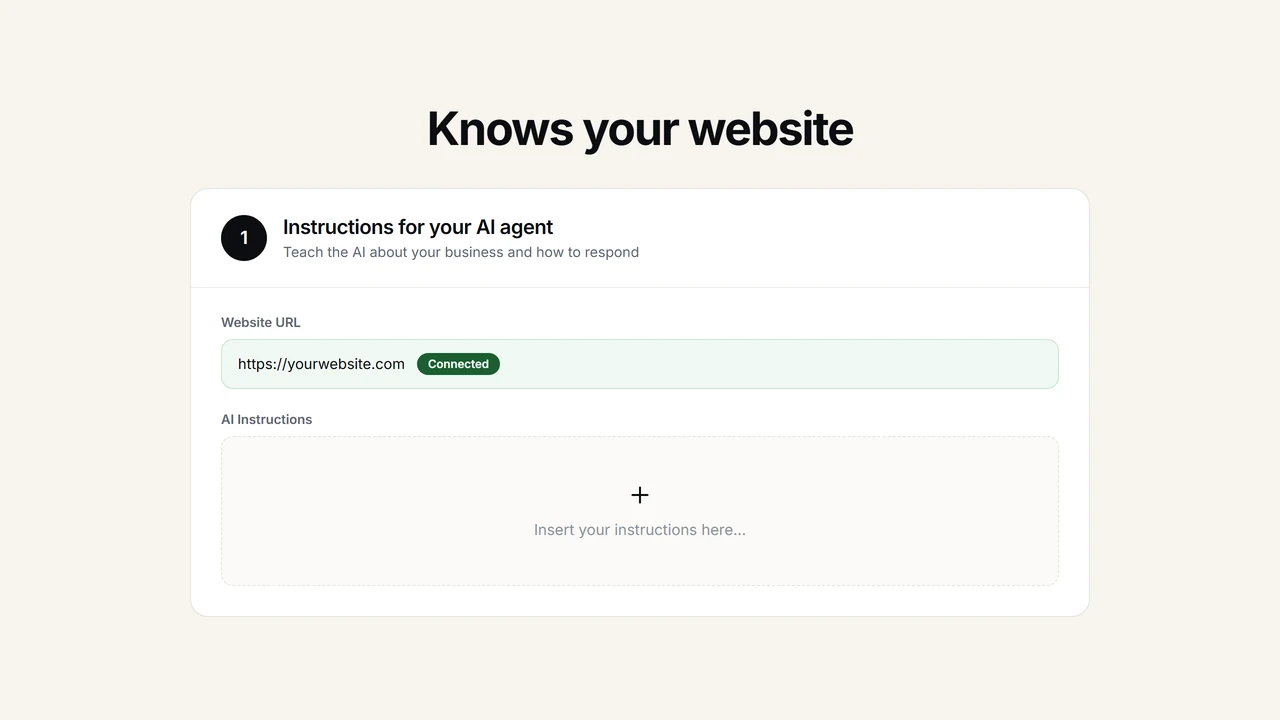
Enter your website URL below. The AI reads your pages, understands the relationships between your content, and builds a working chatbot that can hold nuanced conversations — not just match keywords.
The difference between a chatbot that searches and one that thinks
Traditional chatbot widgets work by matching keywords. A visitor types "return policy" and the widget searches for a page with those words, then pastes the result. That works for simple lookups — until the visitor asks something more nuanced. "I bought a jacket last week but I removed the tags already, can I still return it?" is not a keyword problem. It requires reading the return policy, understanding the specific clause about tags and packaging, and applying that clause to the visitor's situation. Large language models do this naturally. They read your website content — every page, every paragraph, every detail — and build a working understanding of what your business offers, how your policies work, and what your services include. When a visitor asks a question, the AI does not search for matching words. It reasons about the question, finds the relevant information across your content, and constructs an answer that directly addresses what the visitor actually wants to know. This is what makes an AI chat bot widget fundamentally different from anything that came before it. Asyntai brings this intelligence to any website with a single script tag. The Free plan gives you 50 messages per month on 1 site to see the difference firsthand. Starter at $39/month handles 800 messages across 2 sites. Standard at $139/month scales to 15,000 messages on 3 sites and adds Custom Tools for live data lookups. Pro at $449/month covers 50,000 messages and 20 sites.
- Contextual understanding, not keyword matchingThe AI reads your full website content and understands how pieces relate to each other. When a visitor asks "do you offer evening appointments?" the chatbot does not just search for the word "evening." It reads your hours page, your booking page, and your services page, then synthesizes an answer that accounts for different services having different availability. It understands that your dental cleaning hours differ from your emergency consultation hours because it read both pages and grasped the distinction.
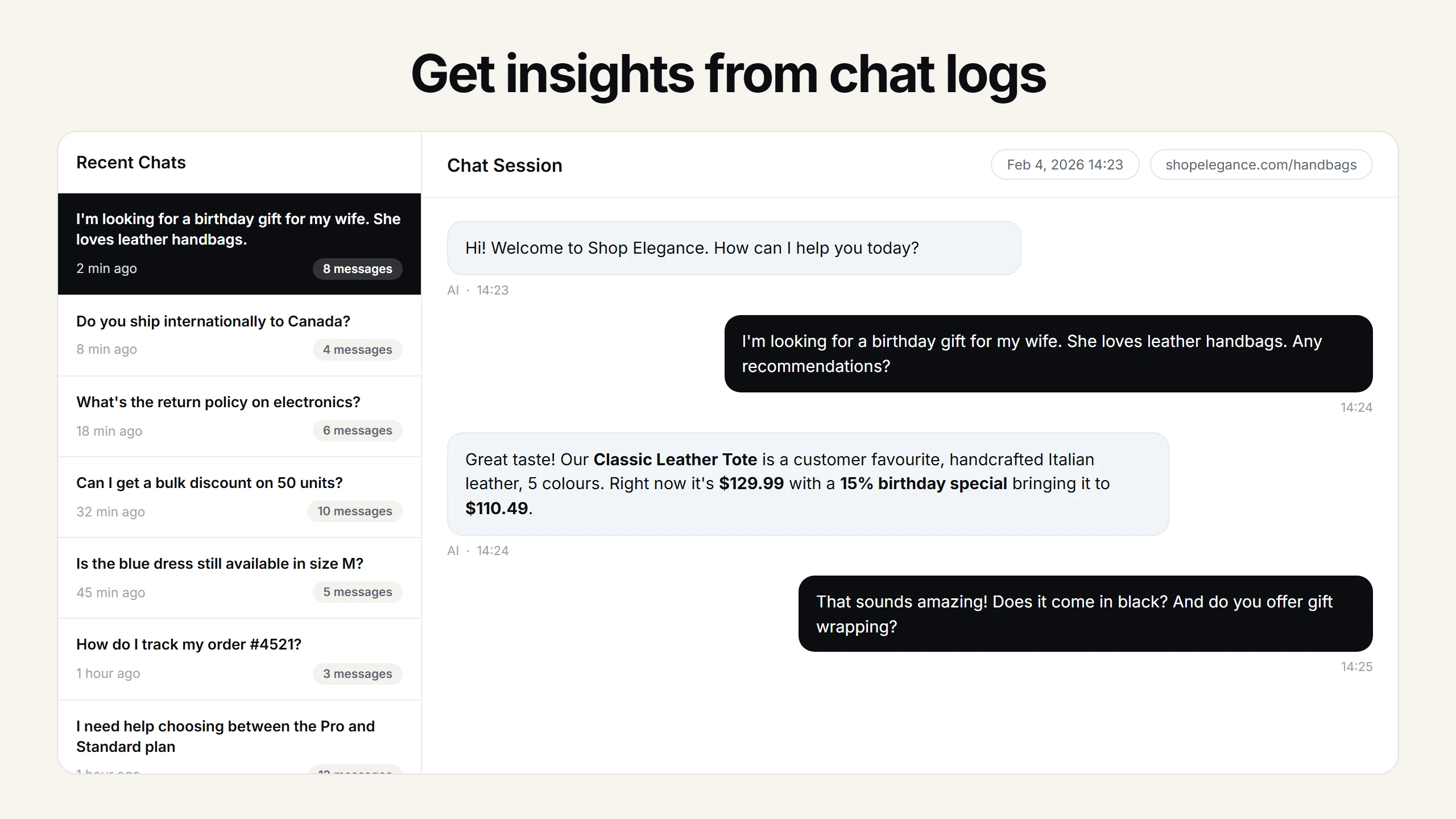
- Multi-turn memory that follows the conversationReal questions rarely fit in a single message. A visitor asks about your consulting services, then follows up with "how much does that cost?" and then "can I do it remotely?" Each follow-up depends on what came before. The AI maintains full context across the conversation — it knows "that" refers to consulting, remembers the service tier being discussed, and answers the remote question in the right context. No repetition needed, no starting over, no "I did not understand your question."
- Answers grounded in your actual contentThe AI does not generate answers from general knowledge or broad language patterns. Every response is grounded in what your website actually says. If your pricing page lists three service tiers, the chatbot describes those three tiers — not a guess based on what similar businesses charge. If your FAQ addresses a specific scenario, the chatbot references that scenario accurately. The answers come from your content, which means they are as accurate as the information you have published.
Give the AI access to your systems and watch it solve real problems
Reading your website content gives the AI a foundation of knowledge about your business. Custom Tools, available on Standard ($139/month) and Pro ($449/month) plans, extend that intelligence to your live systems. The AI can call your APIs mid-conversation — checking inventory, looking up orders, querying availability — and weave the results into a natural response. The visitor gets a real answer, not a redirect to another page or a phone number to call.
- Inventory and availability checksA visitor asks "do you have the blue version in medium?" and the AI calls your inventory system, checks stock in real time, and responds with the current status. If it is out of stock, the chatbot can suggest alternatives based on what is available — combining its understanding of your product catalog with live inventory data to give a genuinely helpful answer.
- Order status and shipment trackingConnect your order management system and the AI handles "where is my order?" conversations end to end. The visitor provides their order number or email, the AI retrieves the current status — processing, shipped, out for delivery — and responds with the details. No support ticket created, no agent pulled away from complex issues, no visitor waiting for a reply email.
- Appointment and booking lookupsFor service businesses, the AI can check your scheduling system to answer availability questions. "Do you have anything open this Thursday afternoon?" gets a real answer based on actual calendar data, not a generic "check our booking page" redirect. The visitor stays in the conversation and gets the information they need to decide.
- Account and membership detailsMembers and returning customers often have questions about their specific situation — remaining credits, subscription renewal dates, loyalty points. The AI queries your system with the visitor's identifier and responds with their actual data. "You have 3 sessions remaining on your current package, and your renewal date is July 15th" is the kind of precise answer that builds trust.
- Dynamic pricing and quotingIf your pricing depends on variables — square footage, quantity, service level, location — the AI can collect the inputs conversationally and call your pricing API to return an accurate estimate. The visitor describes what they need, the chatbot asks clarifying questions, and the response includes real numbers calculated from your actual pricing logic.
Add the AI chat bot widget to your website
One script tag, no coding, no API keys to manage. The AI reads your site and starts answering questions within minutes.
- Sign up at asyntai.com/pricing — the Free plan gives you 50 messages to experience the AI's reasoning firsthand. Starter ($39/month) handles 800 messages. Standard ($139/month) and Pro ($449/month) add Custom Tools for live data access.
- Enter your website URL. The AI reads up to 50 pages — product descriptions, service pages, policies, FAQs, team bios — and builds a deep understanding of your business content. Not an index. A genuine comprehension of what your site says.
- Upload any additional documents — pricing guides, onboarding manuals, technical specs — that contain information not on your public website. The AI incorporates these into its knowledge alongside your web content.
- Copy the embed script from your dashboard and paste it into your site. Compatible with any platform — WordPress, Shopify, Squarespace, Wix, custom-built sites. The chat widget appears immediately and starts handling conversations.
<script src="https://asyntai.com/widget.js"
data-id="your-site-id" async>
</script>
# One script tag. Intelligent conversations 24/7.
AI chat bot widget — FAQs
Common questions about how the AI understands your content, the accuracy of its answers, and what you can control.
How does the AI understand my website content?
When you add your website URL, the AI reads up to 50 pages of your site — text, structure, headings, lists, descriptions. It processes this content through a large language model that builds a working understanding of what your business does, what you offer, how your policies work, and how different pieces of information relate to each other. This is not keyword indexing. The AI grasps meaning, so when a visitor asks a question in their own words — even if those words do not appear anywhere on your site — the chatbot can still find and deliver the right answer from your content.
Will the AI make things up or give wrong answers?
The AI is grounded in your website content. When a visitor asks a question, the system retrieves the relevant sections from your pages and instructs the AI to answer using that specific information. If your content does not cover the topic, the chatbot says so rather than guessing — you can configure exactly how it handles unanswered questions, whether that means collecting the visitor's contact information, suggesting they call you, or offering related information that might help. The grounding mechanism is what separates this from general-purpose AI that generates answers from broad knowledge.
Can I control what the AI says and how it behaves?
Yes. You write custom instructions in plain English that shape the AI's personality, boundaries, and behavior. "Always recommend scheduling a consultation for projects over $10,000." "Never discuss competitor products." "If someone asks about custom enterprise pricing, collect their email and company size." The AI follows these instructions across every conversation. You can also set the chatbot's name, greeting message, and tone — professional, friendly, concise, or detailed.
How does the chatbot handle follow-up questions and multi-turn conversations?
The AI maintains full context throughout a conversation. If a visitor asks about your premium service package, then follows up with "what is included?" and then "how does that compare to the basic option?" the chatbot tracks the thread — it knows "that" refers to the premium package and provides a relevant comparison. This multi-turn understanding is built into the language model, not bolted on as a feature. The AI naturally follows conversational flow the way a knowledgeable staff member would.
Does the AI work in languages other than English?
Yes — 36 languages with automatic detection. A visitor types in Japanese, and the chatbot responds in Japanese, drawing answers from your English-language website content. The AI handles the translation internally while keeping the factual accuracy of your original content. No separate translated website or chatbot configuration needed. This is particularly useful for businesses that serve international customers or operate in multilingual communities.
What are Custom Tools and how do they make the AI smarter?
Custom Tools let the AI call your business APIs during a conversation. Instead of only answering from static website content, the chatbot can check live inventory, look up order status, query appointment availability, or retrieve account details — all mid-conversation, all in natural language. The visitor asks "is the 10oz bag of Colombian roast in stock?" and the AI calls your inventory endpoint and answers with current availability. Custom Tools are available on Standard ($139/month) and Pro ($449/month) plans.
How quickly can I get the AI chat bot widget running?
Most businesses have a working chatbot within 15-20 minutes. Sign up, enter your website URL, wait for the AI to read your pages (usually under two minutes for most sites), customize the appearance, and paste the script tag on your site. The chatbot is live immediately. If you want to add Custom Tools for live data access, those take additional setup time depending on your API — typically 30-60 minutes per integration.
What happens when the AI encounters a question outside its knowledge?
You define this behavior through custom instructions. The most common approach is for the chatbot to acknowledge it does not have that specific information and offer to connect the visitor with your team — collecting their name, email, and question as a lead in your dashboard. Some businesses configure topic-specific fallbacks: pricing questions route to the sales team, technical questions offer a link to the support portal, and general inquiries collect contact details for follow-up. The AI handles the boundary gracefully rather than guessing.
Can I add the widget to multiple websites?
Yes. The Free plan covers 1 site, Starter ($39/month) covers 2 sites, Standard ($139/month) covers 3 sites, and Pro ($449/month) covers up to 20 sites. Each site gets its own knowledge base built from its own content, its own custom instructions, and its own conversation history. A business with separate sites for different brands, locations, or product lines can run independent AI chatbots on each, all managed from a single dashboard.
AI chat bot widgets: when the machine reads your website and genuinely understands it
There is a moment in every conversation with a well-built AI chatbot where the visitor stops testing and starts trusting. It usually happens on the second or third question — after the first answer was surprisingly accurate, the visitor sends a follow-up that requires understanding context, and the chatbot handles it without missing a beat. "You mentioned the deluxe package includes a site survey — how long does the survey usually take?" The AI remembers what it said about the deluxe package, locates the site survey details from a different page of the website, and responds with the relevant timeframe. The visitor did not expect that. They expected to be asked to repeat themselves, or to be pointed at a FAQ page, or to hit a dead end and be told to call during business hours. Instead, the conversation just continued — naturally, accurately, helpfully. That moment is what separates an AI chat bot widget from every chatbot generation that came before it.
The shift happened when large language models became practical for business applications. Previous chatbot technologies — rule-based systems, decision trees, intent classifiers, keyword matchers — all shared a fundamental limitation: they could only handle questions they had been explicitly programmed to answer. Build a rule for "what are your hours?" and it works. But "are you open late on Fridays?" falls through the cracks unless someone anticipated that exact phrasing and built a separate rule. Scale that across every possible way a visitor might ask about hours, and then multiply by every topic a business covers, and the programming burden becomes impossible. Most chatbots ended up handling fifteen to twenty questions well and fumbling everything else. The fumbling eroded trust so quickly that visitors learned to ignore the chat widget entirely. Language models eliminated this bottleneck. Instead of programming answers to anticipated questions, you give the AI your website content and it develops a working understanding of everything you have published. Questions it has never seen before — phrased in ways nobody anticipated — get answered accurately because the AI understands the underlying content, not just the expected phrasings.
Understanding context is the capability that changes everything about how a chat widget performs. Consider a visitor on a catering company's website who asks: "We are planning a corporate event for about 80 people, mostly vegetarian, and we need it delivered to our office downtown on a Saturday." A keyword-based chatbot sees "corporate event," "vegetarian," "delivery," and "Saturday" as separate signals. It might return the corporate catering page, or the vegetarian menu page, or the delivery policy page — but it cannot synthesize them. The AI reads the same question and understands it as a single, specific scenario that draws on multiple pieces of the company's content: the corporate catering packages, the vegetarian menu options, the delivery radius, the weekend availability policy, and the minimum order requirements. It assembles an answer that addresses the complete question, noting which packages fit 80 guests, highlighting the vegetarian options available for corporate events, confirming whether downtown falls within the delivery zone, and mentioning any Saturday-specific considerations. One question, one comprehensive answer, drawn from five different pages of content.
Ambiguity is where AI intelligence becomes most visible. Humans ask imprecise questions constantly — "how much does it cost?" without specifying what "it" refers to, "can you do custom work?" without defining "custom," "is this good for beginners?" without clarifying which product or service. A rigid chatbot either picks one interpretation and runs with it — often wrong — or responds with a frustrating "I did not understand your question." The AI handles ambiguity the way a thoughtful employee would. If the context from earlier in the conversation makes the reference clear, the AI uses that context. If the question is genuinely ambiguous, the chatbot asks a clarifying question: "Are you asking about the cost of individual sessions or the monthly membership?" This is not a programmed fallback — the AI recognizes the ambiguity in real time and responds appropriately. It does what a person standing behind the counter would do, which is ask a sensible follow-up question rather than staring blankly.
The grounding mechanism is what makes AI chat bot widgets trustworthy for businesses that cannot afford inaccurate answers. A general-purpose AI model has vast knowledge about the world, but that knowledge is broad and occasionally wrong in the specifics. A law firm does not want its chatbot answering questions about their practice areas using general legal knowledge — they want answers based on what their website actually says about their services, their jurisdictions, and their case types. Asyntai solves this by retrieving the relevant content from the business's own pages before the AI formulates a response. The language model's intelligence is applied to the business's specific content, not to the model's general knowledge. The result is an AI that reasons like an expert but only knows what you have told it. It will not invent services you do not offer, quote prices you did not publish, or describe policies you never wrote. The intelligence is real; the knowledge is yours.
Follow-up questions reveal the depth of AI understanding more than any other interaction pattern. When a visitor asks three or four questions in sequence, each building on the last, the conversation becomes a real test of comprehension. "What roofing materials do you work with?" followed by "which one lasts the longest?" followed by "what does that one cost for an average-sized roof?" followed by "and that includes removal of the old roof?" — each question makes sense only in the context of the previous answers. The AI tracks this progression naturally. It knows "that one" refers to the material it identified as longest-lasting, and "that" in the final question refers to the price it just quoted. This is not a parlor trick. It is the basic requirement for a conversation to feel real, and it is the capability that was missing from every previous generation of chatbot technology. Without it, visitors had to restate their question from scratch every time they followed up, which is not a conversation — it is a series of disconnected searches.
Tone and register matter more than most businesses realize when a chatbot represents their brand. A high-end architecture firm and a neighborhood pizza shop both want helpful chatbots, but the voice should be completely different. The AI adapts to the tone established in your website content and your custom instructions. If your website uses formal, precise language — "our firm specializes in sustainable commercial architecture with a focus on biophilic design principles" — the chatbot mirrors that register. If your website is casual and direct — "we make great pizza and we deliver fast" — the chatbot matches that energy. You can also shape tone explicitly through instructions: "Be warm and encouraging," or "Be concise and professional — no exclamation marks." The AI's language model naturally adjusts its output to fit the parameters you set, producing responses that feel like they belong on your website rather than sounding like a generic assistant pasted onto it.
Multilingual intelligence goes beyond word-for-word translation. When a visitor types in Spanish on an English-language website, the AI does not simply translate the question to English, look up the answer, and translate it back. It understands the question in Spanish, reasons about the relevant content, and formulates a response in Spanish that reads naturally — with proper grammar, appropriate phrasing, and cultural fluency. The response references the same products, services, and policies from the English website, but the language feels native. This matters because machine-translated text is obvious and off-putting. Visitors can tell when they are reading a clunky translation versus a response written with genuine fluency. Asyntai supports 36 languages with automatic detection, meaning the chatbot identifies the visitor's language from their first message and responds accordingly. No configuration needed per language, no separate chatbots for each locale.
The economics of AI intelligence in a chat widget have crossed a threshold that makes this practical for businesses of every size. Five years ago, running a language model capable of nuanced conversation would have required infrastructure that only large enterprises could afford. Today, the Free plan on Asyntai gives any business 50 messages per month to deploy an AI chatbot that reasons about content, handles multi-turn conversations, and responds in 36 languages — at no cost. Starter at $39/month covers 800 messages for growing businesses. Standard at $139/month handles 15,000 messages and adds Custom Tools for live data integration. Pro at $449/month scales to 50,000 messages across 20 sites. The intelligence is the same across every plan — the AI that answers your hundredth message reasons with the same depth as the one answering your first.
Custom Tools represent the frontier where AI intelligence meets operational data, and the combination is more powerful than either alone. A chatbot that reads your website content can answer "what sizes does this jacket come in?" by referencing the product page. A chatbot with Custom Tools can answer "do you have this jacket in medium in the navy color?" by querying your inventory system in real time. The AI provides the conversational intelligence — understanding the question, knowing which product the visitor means, formulating a natural response — and the Custom Tool provides the live data. Together, they handle questions that previously required a human employee with access to internal systems. Available on Standard and Pro plans, Custom Tools connect to any API endpoint your business exposes, from inventory databases to booking platforms to CRM systems.
Privacy and data control are legitimate concerns when AI is involved, and the architecture addresses them directly. The chatbot reads your website content — pages you have already published publicly — and stores it as a knowledge base accessible only through your authenticated dashboard. Visitor conversations are encrypted in transit and at rest. When Custom Tools query your APIs, the calls go directly from Asyntai's servers to your endpoints over HTTPS, and no data from those API responses is retained beyond the conversation transcript. You own your data, you can export it, and you can delete it at any time. The AI's intelligence comes from the language model's reasoning capability, not from collecting or sharing your business data.
The gap between what visitors expect from a chat widget in 2026 and what most chat widgets actually deliver is enormous. Visitors expect to type a question in natural language and receive an accurate, relevant answer. Most chat widgets deliver a keyword search dressed up as a conversation, or a decision tree that forces the visitor to navigate someone else's logic instead of just asking their question. An AI chat bot widget closes that gap entirely. The visitor types whatever they want, however they want to say it, and the AI understands the intent, finds the relevant content, and responds with a genuine answer. No "did you mean?" prompts, no "please select from the following options," no robotic redirects to pages the visitor already tried to read. Just a conversation that works the way conversations are supposed to work.
Every website has content that visitors do not read. Service descriptions sit in long pages that visitors skim. Policy details live in documents that visitors never open. Pricing structures are explained in tables that visitors glance at without absorbing. The AI reads all of it — thoroughly, precisely, and permanently. When a visitor asks a question, the chatbot draws on content the visitor would never have found on their own: the paragraph buried halfway down the services page, the footnote in the pricing table, the specific clause in the terms and conditions. The AI surfaces relevant information that was always there but practically invisible to the browsing visitor. Your website becomes more valuable because the content you already created actually reaches the people who need it.
The intelligence of the AI is not a black box you have to trust blindly. Every conversation appears in your Asyntai dashboard with full transcripts, so you can read exactly what the chatbot said and verify its accuracy. If the AI gives an answer you want to adjust, you add a custom instruction and the behavior changes for all future conversations. If you notice a topic where the AI lacks information, you add content to your website or upload a document, and the knowledge base expands. The feedback loop is concrete and fast — you see what the AI says, you decide whether it meets your standard, and you adjust. Over time, the chatbot becomes sharper and more aligned with how your business actually communicates, because you are actively shaping the boundaries of its intelligence.
See the intelligence for yourself — start with the free plan, 50 messages, no credit card. Enter your website URL and watch the AI reason through your visitors' real questions. Or jump to Standard for Custom Tools and live data access.