Add a chatbot to WordPress — it takes less time than writing a blog post
Most WordPress owners expect a weekend project. It takes four minutes. Asyntai reads your published pages, learns your business, and starts answering visitors — through a plugin install or a single line in your theme.
See what the chatbot would say on your WordPress site
Enter your URL and watch the AI pull answers straight from your existing pages — no setup required for the preview
The gap between expectation and reality is enormous
People budget days for this. They open tabs about webhook integrations, API credentials, and conversation flow builders. Then they discover that adding a chatbot to WordPress with Asyntai skips all of that. There is no flow to design, no decision tree to map, no developer to brief. The AI retrieves answers directly from the pages you have already written — your services page, your FAQ, your product descriptions, your about page — and turns them into conversational replies the moment a visitor asks. The official WordPress plugin lives at /plugins/wordpress/ and handles the entire embed through a standard install-and-activate sequence. The alternative is a single script tag in your theme. Both paths end in the same place: a working chatbot that knows your business because it already read your website.
- Plugin install through WordPress adminDownload the ZIP from /plugins/wordpress/, upload through Plugins, activate, connect. The chatbot appears on every page without editing a template.
- Or one line in functions.phpPrefer the snippet path? A single script tag in your child theme's functions.php does the same job. Either route takes under five minutes.
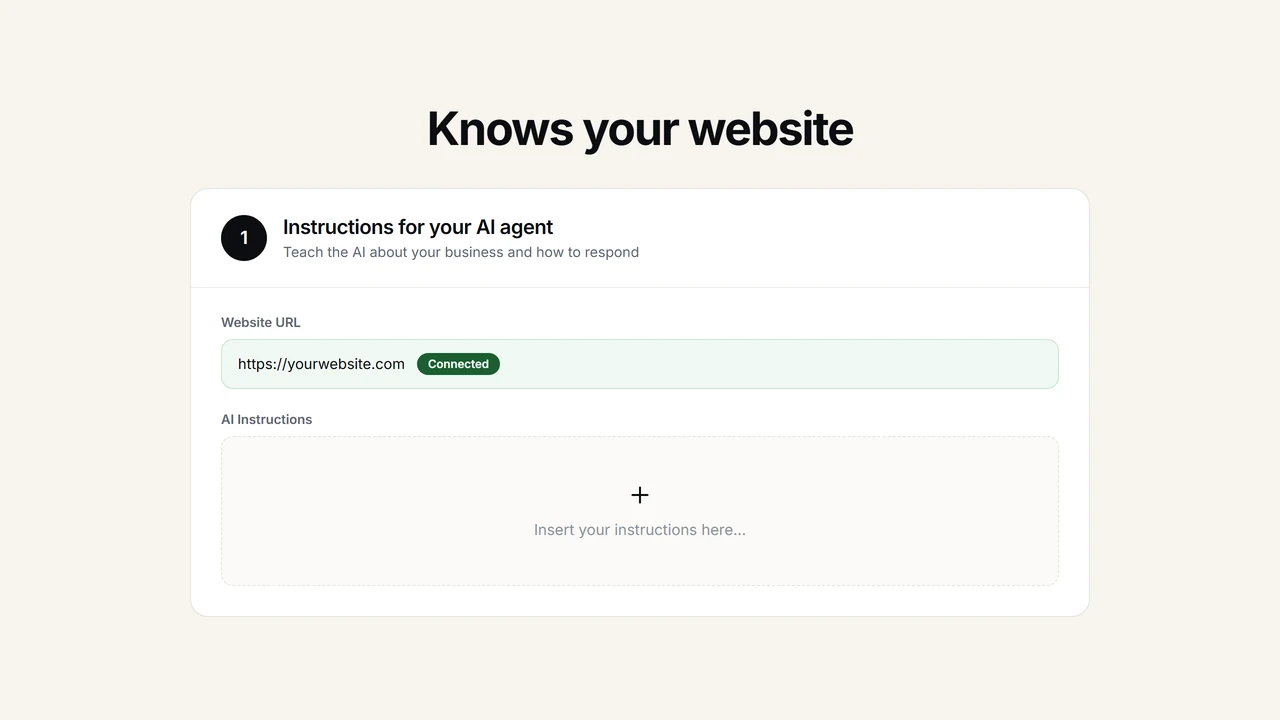
- AI reads your site automaticallyPoint it at your domain and the crawler walks up to 50 pages — pulling content from posts, pages, products, and policies to build its knowledge base.
A chatbot that acts, not just answers
Answering visitor questions from your published content is where every chatbot starts. Where Asyntai pulls ahead is Custom Tools — available on the Standard plan ($139/month) and Pro plan ($449/month) — which let the chatbot call your own endpoints to look up live data or trigger real actions. Check order status, book appointments, process return requests, pull inventory levels — all inside the chat window, without the visitor ever leaving your WordPress site.
- Live data lookupsConnect your order management or booking system as a Custom Tool endpoint. The chatbot queries it mid-conversation and gives the visitor a real answer, not a link to another page.
- Action triggersRefund requests, appointment rescheduling, warranty claims — define the endpoint and the chatbot handles the visitor-facing workflow end to end.
- 36-language auto-detectionA German visitor types in German and gets German replies. A Korean visitor gets Korean. No translation plugin needed on your WordPress side — the AI handles it natively.
- White-label brandingRemove Asyntai branding so the chatbot looks entirely yours. Automatic on Pro; available on Standard by emailing [email protected].
- Lead capture with full contextWhen the chatbot cannot fully resolve a question, it collects the visitor's email alongside the complete conversation transcript — so your follow-up starts with context, not from scratch.
Four steps — then your WordPress chatbot is live
Whether you choose the plugin at /plugins/wordpress/ or the functions.php snippet below, the entire process fits inside a coffee break. Here is the snippet path laid out step by step.
- Create an Asyntai account — the Free plan costs $0, covers 1 site and 50 messages per month, and requires no credit card.
- In your Asyntai dashboard, enter your WordPress site URL. The crawler reads up to 50 pages and builds the chatbot's knowledge base automatically.
- Copy the script tag from the Install section. Open your child theme's
functions.phpand add it usingwp_heador paste it via a header injection plugin. - Visit any page on your WordPress site. The chatbot launcher appears in the corner, ready to answer. Upgrade anytime: Starter at $39/month adds 2 sites and 800 messages, Standard at $139/month covers 3 sites and 15,000 messages, Pro at $449/month handles 20 sites and 50,000 messages.
<script src="https://asyntai.com/widget.js"
data-id="your-site-id" async>
</script>
# Or skip the snippet entirely —
# install the official WordPress plugin
# from /plugins/wordpress/ instead.
Add chatbot to WordPress — FAQs
Quick answers to the questions WordPress site owners ask before going live.
Do I need to know PHP to add the chatbot?
No. The official WordPress plugin at /plugins/wordpress/ installs through the standard Plugins menu — upload the ZIP, activate, connect your account. If you prefer the snippet route, you paste a pre-written script tag into a header injection plugin like WPCode. Neither path requires writing or understanding PHP.
Will it slow down my WordPress site?
The script loads asynchronously and weighs under 30 KB. It does not block page rendering, does not add database queries to your WordPress install, and does not interfere with caching plugins like WP Super Cache or W3 Total Cache. Your PageSpeed score stays the same.
How does the chatbot know about my business?
When you enter your domain, the Asyntai crawler visits up to 50 published pages — services, pricing, blog posts, policies, WooCommerce products — and indexes the content. The AI retrieves from that index every time a visitor asks a question. You can also upload PDFs for content that is not publicly accessible on the site.
What happens if I update my WordPress content?
Trigger a re-crawl from the Asyntai dashboard whenever you publish or revise a page. The chatbot picks up the new content within minutes and starts using it in conversations immediately. No reinstall, no code change, no cache purge required.
Can it handle visitors who speak different languages?
Yes — 36 languages are supported natively. The AI detects the visitor's language from their first message and replies in that same language, even if your WordPress content exists only in English. No multilingual plugin is needed on the WordPress side.
Does it work with Elementor, Divi, and other page builders?
The chatbot injects as a floating overlay after your page has fully rendered, so it works with every page builder — Elementor, Divi, WPBakery, Beaver Builder, Brizy, Gutenberg blocks, and custom-built themes. It does not interact with or modify your page layout.
What does the free plan include?
One connected WordPress site, 50 visitor messages per month, the full AI chatbot with lead capture and analytics, and no credit card requirement. It is enough to validate the chatbot on real traffic and review conversation quality before upgrading.
Can I remove the Asyntai branding?
On the Pro plan ($449/month), white-labeling is automatic — the chatbot appears under your brand only. On the Standard plan ($139/month), white-labeling is available by emailing [email protected] to have it enabled manually.
Adding a chatbot to WordPress — why the hardest part is deciding to do it
There is a strange inertia around adding a chatbot to a WordPress site. Not because the task is difficult — it demonstrably is not — but because the expectation of difficulty keeps people from starting. Years of exposure to enterprise chat solutions, developer-only APIs, and conversation flow builders have created a mental model where "chatbot" translates to "project." Something that needs a scope document, a sprint allocation, maybe a third-party integration consultant. The reality in 2026 is that adding an AI chatbot to a WordPress site is closer in complexity to installing a contact form plugin than to building a software feature. The distance between those two mental models — project versus plugin — is what keeps most WordPress sites chatbot-free long after their owners first considered the idea.
Consider what a WordPress site looks like to a first-time visitor who has a question. They land on a page, read enough to be interested, and then hit a gap: something they want to know that the page does not answer directly. Maybe it is whether the service covers their region. Maybe it is whether the product ships internationally. Maybe it is a pricing nuance that sits in a paragraph on a different page they have not found yet. The visitor's options at that moment are a contact form, an email address, or leaving. The contact form requires them to compose a message, hit send, and wait hours or days. The email requires the same plus the overhead of opening their mail client. Leaving requires nothing, which is why it wins most of the time. A chatbot collapses that entire friction gap into a text field that gives an answer in seconds. The visitor gets what they need; the site keeps the visit alive. That is not a technology upgrade — it is a conversion fix.
The mechanics of adding the chatbot to WordPress are blunt in their simplicity. Asyntai distributes an official WordPress plugin at /plugins/wordpress/ that follows the upload-activate-connect pattern every WordPress administrator already knows from installing Yoast, WooCommerce, or Wordfence. Download the ZIP, open Plugins in your WordPress admin, click Upload, activate the plugin, and press the connect button that links it to your Asyntai account. From that point forward, the chatbot appears on every page of your site without a single line of code having been written. The alternative path — for site owners who keep their plugin count deliberately low — is a script tag added to the child theme's functions.php or pasted into a header injection utility. Same outcome, different vehicle. Either way, the elapsed time from "I want a chatbot" to "visitors are getting answers" is measured in minutes, not days.
What makes this particular chatbot worth adding is the part that happens after the install, and it happens without you. The AI crawler visits your WordPress site's published pages — your homepage, your services breakdown, your pricing table, your FAQ, your blog archive, your WooCommerce product listings if you have them — and indexes the content into a retrieval system. When a visitor asks a question, the AI searches that index, finds the relevant passages, and composes a natural-language answer grounded in your actual words. It does not invent information. It does not hallucinate product features you do not offer. It retrieves what you have written and re-phrases it conversationally. The difference between this and a traditional FAQ widget is the difference between handing someone a filing cabinet and handing them a knowledgeable colleague who has read every document in the cabinet.
Behavioral steering is where most chatbot solutions ask you to become a part-time prompt engineer. Asyntai replaces that with a plain-text instructions field. You type sentences the way you would brief a new team member: "Always recommend the premium package first." "If someone asks about refunds, link to the refund policy page." "Do not discuss competitor products." "Collect an email address when someone asks for a custom quote." Those sentences shape every reply the AI generates. There is no syntax, no conditional logic, no node graph. If you can write an internal memo, you can steer the chatbot. When your business rules change — a seasonal discount, a new service offering, a temporary policy adjustment — you update the instructions in the dashboard and the chatbot reflects the change on the very next conversation.
Language coverage is a dimension WordPress site owners rarely think about until they check their analytics and realize a meaningful slice of traffic reads in a language the site does not serve. Asyntai handles 36 languages without any configuration on your part. The AI detects the visitor's language from their opening message and responds in kind. A Turkish visitor on an English WordPress blog receives Turkish answers sourced from the English content. A Portuguese visitor on a French WooCommerce store gets Portuguese replies. You do not install a translation plugin, you do not maintain parallel instruction sets, you do not manage language-specific chatbot profiles. The multilingual layer is built into the AI itself, which means the day you add the chatbot to WordPress is also the day your site becomes conversationally accessible to visitors in three dozen languages.
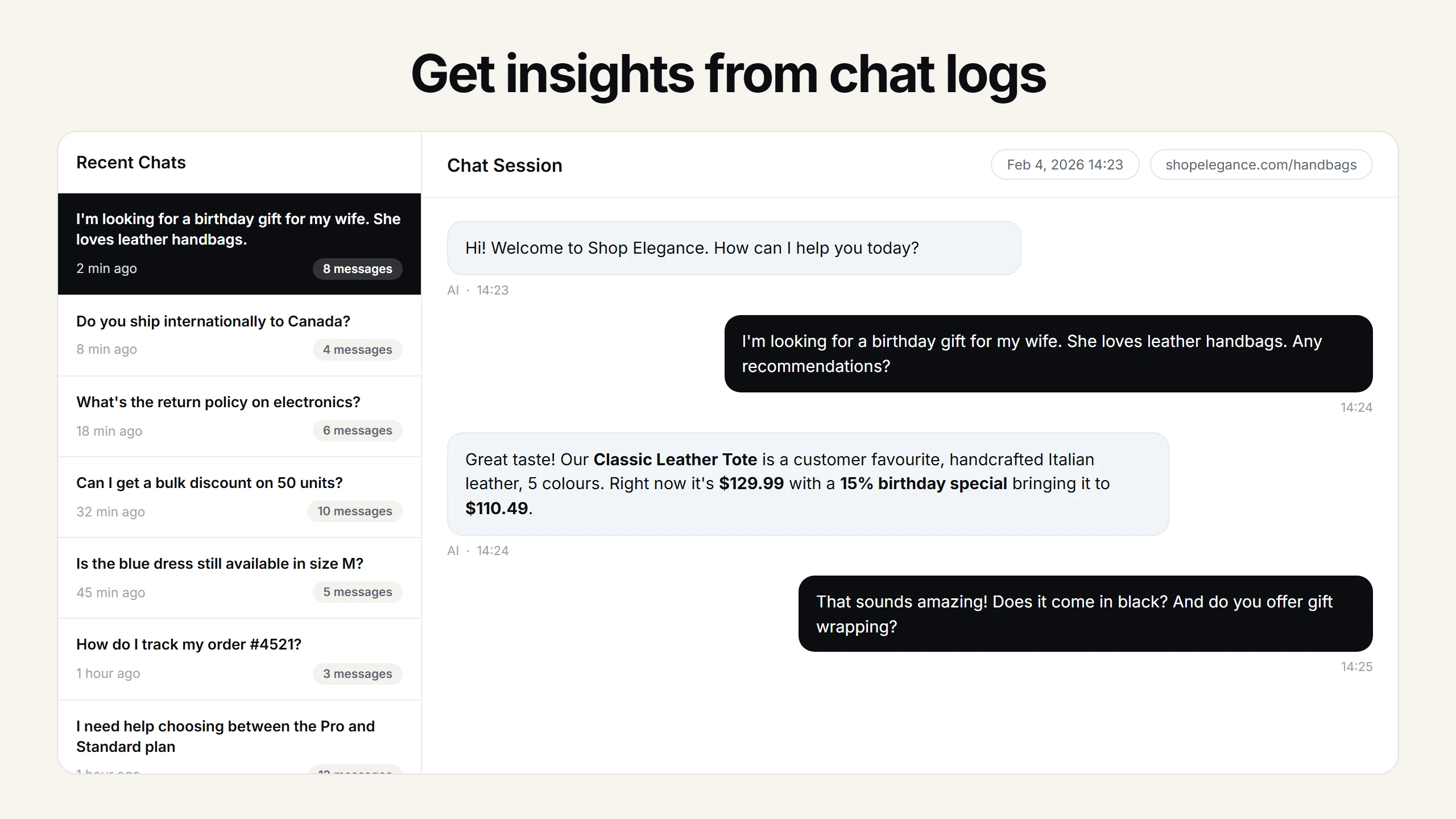
Lead capture is where the chatbot transitions from helpful utility to business tool with measurable ROI. Not every conversation ends with a clean answer — some visitors need a custom proposal, a callback, a human judgment on a complex request. When the chatbot reaches that boundary, it collects the visitor's name and email and wraps the entire conversation transcript into a lead record. That record appears in the Asyntai dashboard and, optionally, lands in your email inbox in real time. The critical detail is context: the follow-up person opens a lead that already contains the question, the chatbot's attempt at an answer, and whatever additional details the visitor shared. Compare that to a contact form submission that reads "Hi, I have a question about your services" and you see why the chatbot generates warmer, more actionable leads.
For WooCommerce stores specifically, adding a chatbot to the WordPress site means the AI absorbs your product catalog alongside your informational pages. Visitors can ask about sizing, material, compatibility, shipping timelines, and return policies and receive answers pulled from your actual product descriptions and policy pages. The chatbot can surface product cards with images and prices inside the conversation, which means a visitor who types "do you have anything in navy blue under fifty dollars" gets shown matching products without navigating to a search results page. For stores where the bounce rate on product pages is higher than it should be, this conversational layer often recovers sessions that would otherwise end in a silent exit.
On the Standard and Pro plans, Custom Tools extend the chatbot beyond retrieving static content into performing live actions. You define API endpoints — your order management system, your booking platform, your CRM — and the chatbot calls them mid-conversation. A returning customer asks "where is my order" and the chatbot queries your fulfillment API and returns a tracking number. A prospect asks "do you have availability next Thursday" and the chatbot checks your calendar endpoint and offers a slot. This turns the chatbot from an information desk into a functional assistant that completes tasks visitors would otherwise need a phone call or a separate login portal to accomplish. Standard runs $139 per month; Pro runs $449 per month and adds automatic white-label branding along with higher message and site limits.
Analytics round out the picture by turning every conversation into a data point about your WordPress audience. The Asyntai dashboard logs every chat thread, tags it by topic and outcome, and surfaces the patterns over time. After a month you can see which questions come up most often, which pages generate the most chat activity, and which topics the chatbot resolves fully versus escalates to a lead. That last metric is the editorial roadmap hiding inside your chat data: if thirty visitors this month asked about a topic your site barely covers, that topic needs a dedicated page. If a specific product generates repeat questions about compatibility, the product description needs a specifications section. The chatbot does not just answer questions — it catalogues the questions your WordPress site fails to answer on its own.
Privacy and data handling are concerns WordPress site owners raise consistently, and the answer is straightforward. Asyntai does not access your WordPress admin, your database, your user table, or your file system. The crawler reads publicly accessible pages — the same pages Google indexes. Uploaded documents stay within the Asyntai platform and are used solely for the chatbot's retrieval index. Conversation data is stored securely and accessible only through your Asyntai dashboard. The chatbot operates as a client-side widget that loads from an external CDN, similar in architecture to how analytics scripts or advertising pixels load — it sits on top of your pages without reaching into the WordPress backend.
Pricing is structured so that validating the chatbot costs nothing. The free plan gives you one WordPress site, 50 messages per month, and full access to the chatbot's core features — content retrieval, lead capture, analytics, and 36-language support — with no credit card on file. That volume handles a small blog or a low-traffic services site comfortably for several weeks, which is enough time to read real conversations and decide whether the chatbot earns its keep. Starter at $39 per month doubles the site count and pushes the message limit to 800. Standard at $139 per month adds Custom Tools, three sites, and 15,000 messages. Pro at $449 per month scales to twenty sites and 50,000 messages with automatic white-label branding included.
The before-and-after of a WordPress site with a chatbot is not dramatic in the way a redesign is dramatic. The homepage looks the same. The navigation has not changed. The theme is untouched. What changes is invisible from the outside and obvious from the inside: visitors who had questions are getting answers instead of bouncing. Leads are arriving with context instead of cold. Support requests that used to require a human reply within business hours are being handled at midnight on a Saturday. Pages that quietly confused visitors are being flagged by the analytics. None of that required a developer, a project plan, or a weekend of work. It required four minutes and the willingness to stop treating "add a chatbot" as a bigger task than it actually is.
If you have been putting this off, the fastest way to start is the free plan — no card, no commitment, one site, 50 messages. Install the plugin from /plugins/wordpress/ or paste the snippet into functions.php, point the crawler at your domain, and let the first few real conversations tell you whether it belongs on your site. For most WordPress owners, the answer becomes obvious within the first week. See all plans and pick the tier that matches your traffic when you are ready to scale.