Add AI to your website and turn every page into an intelligent surface
Asyntai layers real artificial intelligence onto whatever website you already run. Visitors get instant, content-grounded answers in 36 languages. Your team gets captured leads, conversation analytics, and documentation feedback — all from a single snippet installation.
See what AI looks like on your actual website
Enter your URL and watch the intelligence layer answer questions using your real published content
When you add AI to a website, it comprehends your entire site — not just a FAQ list
Adding AI to a website is fundamentally different from adding live chat or a scripted bot. The AI reads every published page, absorbs uploaded documents, and follows rules you write in plain language — producing answers that reflect your actual business, not generic platitudes generated from training data.
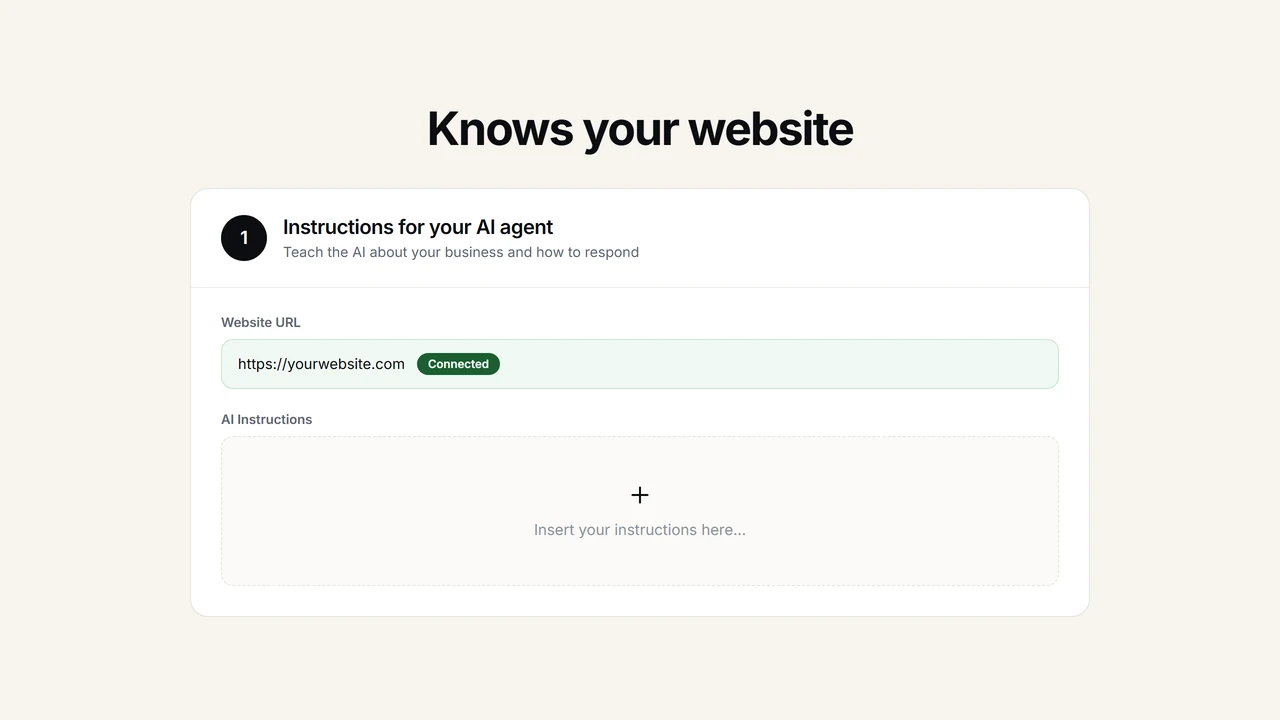
- Full-site comprehension on signupPoint Asyntai at your domain and the AI reads your pages end to end — services, products, pricing, team bios, policies, blog posts. It builds a working model of your business from the content that already exists.
- Private knowledge stacked on topInternal documents, pricing matrices, partner agreements, onboarding playbooks — upload them as PDFs or text and the AI uses them alongside your public content when formulating responses.
- Behavioral directives in everyday language"Recommend a consultation when visitors mention budgets above $50k." "Never compare our product to named competitors." "If someone asks about enterprise licensing, collect their company name and escalate." The AI follows these instructions consistently across every conversation.
Add AI to your website and it does more than chat — it captures leads, surfaces gaps, and informs your roadmap
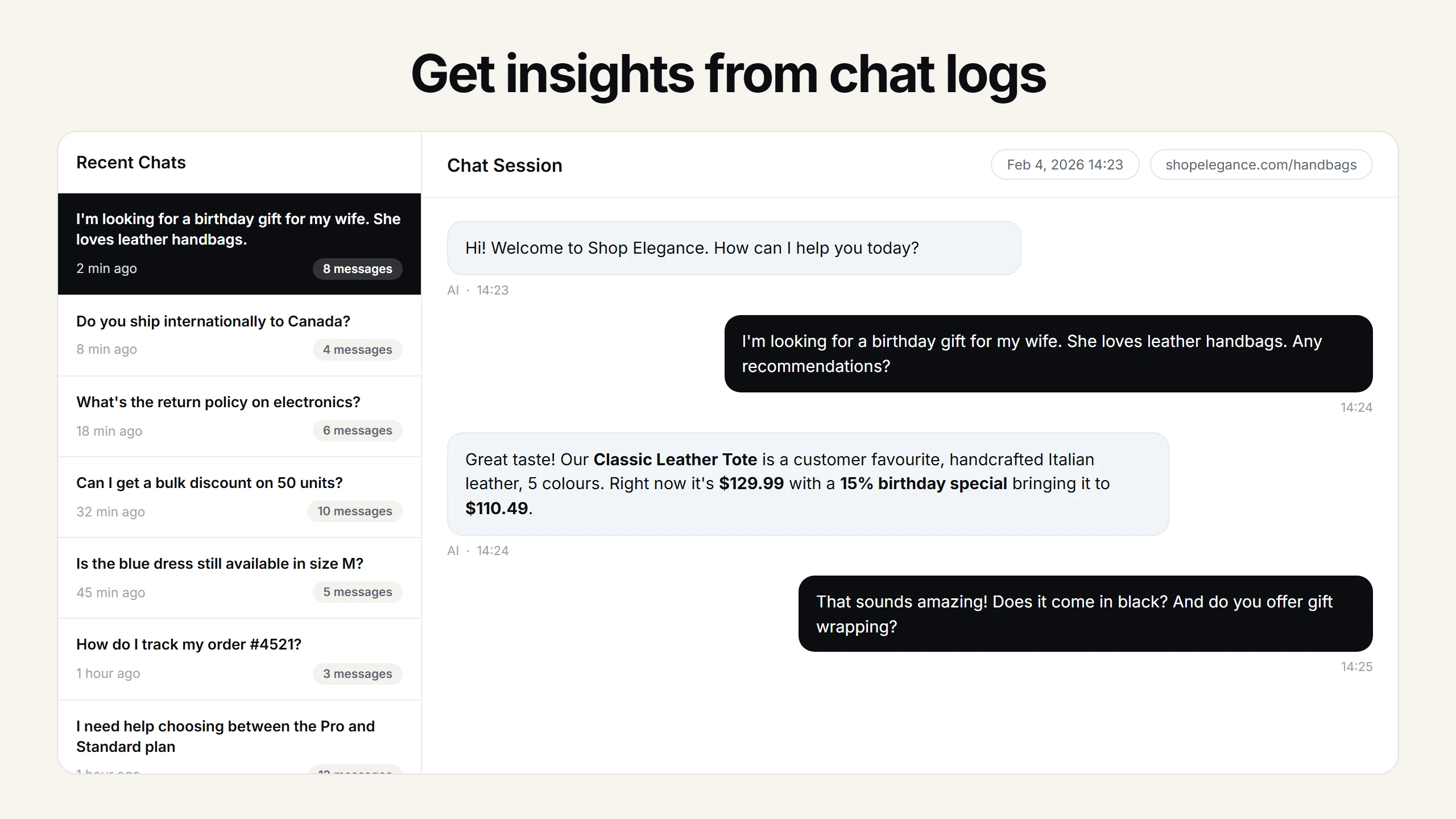
When you add AI to your website, the visible part is the conversation interface. The invisible part — often more valuable — is the data exhaust: which questions visitors ask, which pages confuse them, where your content has gaps, and which visitors convert from anonymous browsers into identified contacts.
- Automatic lead capture during natural conversationWhen a visitor's question exceeds the AI's scope, it collects their email and optionally phone number alongside the full transcript. Leads arrive in your dashboard and inbox with richer context than any static form could produce.
- Content gap reportingQuestions the AI cannot resolve are grouped thematically in the dashboard. Each cluster represents a page you should write or a section you should expand — a continuous editorial roadmap generated by your own visitors.
- Language and geographic reach visibilitySee which languages your visitors actually converse in and which topics trend by market. For international businesses, this data often reveals underserved audience segments hiding in plain sight.
How to add AI to your website in four deliberate steps
You can add AI to a website without backend changes, package managers, or deployment pipelines. A single JavaScript snippet placed in your site's <head> section activates the intelligence layer across every page the tag reaches.
- Register at asyntai.com (free tier, no card) and enter the domain where you want to add AI.
- Copy the generated snippet from the Install tab — it already contains your unique site identifier.
- Place the snippet in your site's head section: CMS header field, theme template, or tag manager container.
- Verify by opening your site in a new tab — the AI-powered launcher appears in the corner, ready for visitors.
<script src="https://asyntai.com/widget.js"
data-id="your-site-id" async>
</script>
# Intelligence layer active. Every page now has AI.
Add AI to your website — FAQs
The questions business owners and technical leads raise before they add AI to their website.
What does "adding AI to a website" actually mean in practice?
It means placing a conversational intelligence layer on your pages that reads your content, understands visitor questions in natural language, and composes answers grounded in your own material. Visitors interact through a chat interface; behind it, a language model processes requests using your documentation as the sole knowledge source. The outcome is immediate, accurate responses without human involvement for the content-answerable portion of your traffic.
Does adding AI require changes to my existing website code?
No structural changes. You place a single script tag in the head section of your site — the same motion as adding any analytics or marketing pixel. Your existing templates, stylesheets, server logic, and database remain untouched. The AI layer operates entirely client-side from a remotely hosted script that communicates with the Asyntai intelligence API.
Is this only for customer-facing sites, or can I add AI to an internal website too?
Both. External-facing sites use the AI to handle visitor questions, capture leads, and reduce support burden. Internal sites — company intranets, HR portals, IT knowledge bases, internal wikis — use the same AI layer to answer employee questions about policies, procedures, access requests, and tooling. The content the AI references is whatever you feed it; whether that content is public or internal is entirely your decision.
Will the AI fabricate answers about my business?
The AI is restricted to your content — crawled pages and uploaded documents — as its exclusive source material. It cannot supplement answers with general internet knowledge or its own training data. When a visitor asks something outside your content scope, the AI acknowledges the limitation and offers to connect them with your team rather than inventing a plausible-sounding answer.
How does the AI handle visitors who speak different languages?
Thirty-six languages are supported in both the interface and the AI's response composition. Language detection happens automatically from the visitor's first typed message. A Mandarin-speaking visitor receives Mandarin responses synthesized from your English-language content. No translation plugins, no per-language site versions, and no additional embed codes are needed.
Can the AI recognize returning or logged-in visitors?
Standard and Pro plans include the User Context feature. Your site populates a window.Asyntai.userContext object with visitor attributes — name, subscription tier, account age, recent interactions — before the AI initializes. Those attributes flow into every response, enabling personalized answers without any backend API integration. You control exactly which data points the AI can access per session.
What does the pricing structure look like?
Free tier covers 50 messages monthly on a single website, with no credit card required. Paid plans begin at $39 per month for 800 messages across two websites. Standard allows three sites, Pro covers up to ten. Pricing is based on conversation volume rather than seat count, which keeps costs predictable as your team grows or your traffic fluctuates seasonally.
Where do captured leads and conversation data end up?
Everything streams into the Asyntai dashboard: full transcripts, captured contact details, resolution status, and the originating page URL. Enable email notifications to mirror the same data into any inbox you choose — support queue, CRM intake address, founder's personal email. No middleware or integration platform is required for the basic data flow.
Add AI to your website — what changes when static pages learn to converse
Websites have operated on a broadcast model since the earliest days of the commercial internet. You publish content, visitors read it, and if they have a question the content did not answer, they either find the contact form, send an email, or — far more commonly — leave without a trace. The fundamental limitation is not that the content is bad; it is that static pages cannot respond to the specific question a specific visitor has at a specific moment. Adding AI to a website dissolves that limitation. The pages still exist exactly as you published them, but now there is an intelligence layer that can converse with any visitor about anything those pages contain, in whatever language the visitor speaks, at whatever hour they happen to arrive. The shift is from monologue to dialogue, and the consequences are larger than the mechanism might suggest.
The phrase "add AI to website" carries a weight of expectation that deserves tempering with specificity. What Asyntai adds is a conversational intelligence layer grounded entirely in your own content. It is not a general-purpose AI that invents answers from the breadth of the internet. It is not a recommendation engine guessing what the visitor might buy next. It is not a pop-up survey disguised as intelligence. It is a language model constrained to your published pages and uploaded documents, capable of understanding any natural-language question a visitor poses and composing a response drawn exclusively from your material. That constraint — answering only from what you have provided — is what makes the AI deployable on a business-critical website without the anxiety of it saying something your brand would never endorse.
The operational mechanism is worth tracing because it demystifies what "AI on your website" actually involves behind the curtain. When you register and provide your domain, Asyntai's crawler visits every publicly reachable page and indexes the textual content — headings, paragraphs, product descriptions, policy language, blog articles, pricing tables, team bios, anything rendered as text. That indexed content becomes the AI's primary knowledge source. You then optionally supplement it with private documents: internal pricing sheets, onboarding scripts, detailed product specifications, seasonal promotions not yet published. The AI merges both layers into a single knowledge base and draws from it when composing answers. Plain-English behavioral instructions add a governance layer: which topics the AI should handle, which it should escalate, what tone it should maintain, what commitments it should never make. The result is an intelligence layer that knows your business as thoroughly as a well-briefed team member and operates within boundaries you explicitly defined.
The visitor's experience, when the AI layer is active, feels like messaging someone who has actually read every page on the site. A prospective client browsing a consulting firm's case studies and wondering whether the firm handles a specific industry vertical gets an immediate, substantive answer citing the relevant cases. A student exploring a university's program catalog and uncertain about prerequisites gets a clear explanation drawn from the academic pages. A shopper on a specialty retailer's product page wanting to know whether an item ships internationally gets the answer from the shipping policy page without having to find and read that page themselves. In each scenario, the visitor's question is resolved in the conversational moment rather than being deferred to a form, an email, or an abandoned tab. That immediacy is the core value proposition of adding AI to a website: eliminating the gap between having a question and getting an answer.
Multilingual capability extends the intelligence layer to audiences that most websites currently underserve. A site published entirely in English still attracts visitors from dozens of language backgrounds through organic search, social referrals, and international advertising. Those visitors either struggle through content in a language they do not fully command or leave. When AI is present on the site, a visitor typing in Spanish receives a Spanish answer composed from the English content. A visitor typing in Japanese receives Japanese. A visitor typing in Arabic receives Arabic. Thirty-six languages are covered, and detection is automatic from the first message — no dropdown, no URL parameter, no visitor-side configuration. For any website with measurable international traffic, this single capability can unlock audience segments that were previously invisible in conversion metrics because they never found a usable path to engagement.
Lead generation through the AI layer follows a fundamentally different pattern than traditional form-based capture. A static contact form asks the visitor to supply their information and describe their need in a text box, which requires the visitor to have already decided they want to be contacted. Most visitors are not at that stage. They have a question, not a commitment. The AI engages that earlier-stage visitor in conversation, provides useful information, and when the interaction reaches a natural inflection point — a question the AI cannot fully resolve, a request for a custom proposal, an interest in scheduling a discussion — it asks for contact details in context. The visitor provides their email because the conversation has already demonstrated value, not because a form demanded it. Captured leads arrive in the Asyntai dashboard with the complete conversation attached, giving your follow-up team a detailed understanding of the visitor's situation before the first outreach message is drafted.
For logged-in experiences, the User Context feature on Standard and Pro plans transforms the AI from a public-facing FAQ handler into a personalized advisor. Your website pushes a small JavaScript object containing visitor-specific attributes before the AI initializes: a name, an account tier, a renewal date, a feature entitlement list, a recent order identifier. The AI incorporates those attributes into every response. A SaaS customer asking "what reports can I generate" receives an answer scoped to their actual plan rather than a generic feature matrix. An ecommerce customer asking "where is my order" receives tracking information specific to their last purchase. The mechanism is deliberately one-directional — your site writes the data, the AI reads it — so there is no credential management, no database connectivity, and no risk of the AI accessing data you did not explicitly surface.
The analytics produced by an AI-augmented website represent a category of insight that did not previously exist for most site owners. Traditional analytics tell you which pages were visited and for how long. Heat maps tell you where visitors clicked and scrolled. Neither tells you what the visitor was thinking or what question they could not get answered. An AI layer that converses with visitors produces exactly that signal. The Asyntai dashboard aggregates conversation topics by frequency, identifies pages that generate disproportionate chat volume (a proxy for confusing content), highlights questions the AI escalated rather than resolved (a proxy for missing documentation), and reveals the language distribution of your actively engaged audience. Over a quarter of live operation, this data becomes a strategic asset — a continuously updated map of where your website succeeds in communicating and where it fails.
Content improvement driven by AI conversation data creates a compounding feedback loop that strengthens the website over time. When the AI cannot resolve a question, that topic appears as an escalation cluster in the dashboard. Writing a page or section that addresses that topic means the AI can resolve similar questions autonomously going forward. Rewriting a confusing section that was generating high chat volume reduces the questions that section triggers. Each improvement feeds back into the AI's knowledge base immediately — no retraining delay, no reindexing queue — and the next visitor benefits. Websites that actively iterate on their content using this feedback see their AI resolution rate climb month over month, which means fewer escalations, more autonomous answers, and progressively less human involvement required to maintain a high-quality visitor experience.
The practical scope of "add AI to your website" extends well beyond customer-facing marketing sites. Internal company portals benefit from the same intelligence layer when pointed at employee-facing documentation: HR policies, IT procedures, expense guidelines, facility access protocols. Educational platforms benefit when the AI answers from course materials, administrative policies, and campus resources. Nonprofit organizations benefit when the AI handles donor inquiries, volunteer coordination questions, and program eligibility criteria. Professional communities benefit when the AI makes membership benefits, event schedules, and governance documents conversationally accessible. The common thread is any web property where visitors arrive with questions that existing published content can answer — regardless of whether those visitors are customers, employees, students, donors, or members.
Pricing is structured to make the AI layer accessible at any website scale. The free tier supports 50 messages per month on a single site, providing enough volume to validate the approach on a low-traffic property or to pilot it on one section of a larger site. Paid plans begin at $39 per month for 800 messages and two site slots. Standard and Pro tiers scale to higher message volumes and more sites — three and ten respectively — for teams operating portfolios, multi-brand properties, or agency client rosters. The per-conversation pricing model means costs track with actual engagement rather than team size, making the AI layer economically viable whether your site receives fifty visitors a day or five thousand.
Deployment follows a four-step sequence that most teams complete within a single sitting. Register an account and provide your domain. Copy the generated snippet from the dashboard's Install tab. Place the snippet in your site's head section through whatever mechanism your platform provides — CMS header field, theme template file, tag manager container. Open the site in a fresh browser tab and confirm the launcher appears. From that point forward, the AI layer is live: reading every page, absorbing every uploaded document, following every behavioral rule you have written, and answering every visitor question it can resolve from your content. The intelligence layer does not require ongoing maintenance — it updates when your content updates, it adapts when you revise your instructions, and it scales with your traffic without any infrastructure you need to manage. Adding AI to your website is the starting action. Everything that follows — the conversations, the leads, the analytics, the content feedback, the multilingual reach — is what the AI layer produces once it is there.