An ecommerce CRM is rarely the missing record. Most stores already have a customer record in the store platform (Shopify, BigCommerce, Magento, WooCommerce) and another in the help desk (Zendesk, Gorgias, Freshdesk). Before buying a third system, decide which record is the master and what the other two are for. That choice is worth more than any per-user saving.
The published per-user prices, checked against vendor pricing pages on 4 September 2026, are below. The arithmetic of a five-person ecommerce team over a year, on the cheapest published tier that has the features an ecommerce store needs, is also below.
Stores reach this page because they want a customer view that joins order history, support tickets and email behaviour in one place. That is a reasonable thing to want. What is often missed is that the data already exists in two systems and the question is which one becomes the source of truth. A third CRM that cannot beat either of them is wasted budget.
This article compares four published CRM price ladders and then works out what each one costs a five-person ecommerce team over a year. Salesforce is included for stores that already run on it. Zoho, Pipedrive and HubSpot are the three most-searched alternatives. Asyntai sits alongside as the AI chat layer that sits in front of whichever CRM you pick.
Which record is the master
Three systems hold a customer record in a typical ecommerce stack: the store platform, the help desk, and the CRM. They each see the customer differently. The store platform sees orders, refunds, fulfilment and the abandoned cart. The help desk sees tickets, returns and the conversation history. The CRM sees opportunities, pipeline stages and outbound campaigns.
If the same email address exists in three places and the names do not match, your team is spending their day stitching records together. That is the real cost of a CRM, not the licence fee.
A simple rule works for most stores:
- Master in the store platform. Order history, address, lifetime value. Pick one platform and stop syncing to two.
- Master in the help desk. Conversation history, return reasons, tickets per customer.
- CRM for pipeline and outbound only. If a customer has never spoken to sales, they do not need a CRM record. Let the CRM hold opportunities, not people.
Once you know which record is the master, the CRM question gets smaller. A store with five staff handling a few thousand orders a month does not need enterprise sales automation. It needs a clean contact list, segmentation, and the ability to send a campaign without exporting a CSV.
Published prices per user, per month
| Vendor | Tier name | USD per user per month | Billed | What that tier gives you |
|---|---|---|---|---|
| Zoho CRM | Free | 0 | Annual | Three users, lead and contact management, basic reports |
| Zoho CRM | Standard | 14 | Annual | Workflows, email integration, more storage |
| Zoho CRM | Professional | 23 | Annual | Custom modules, sales signal, inventory |
| Zoho CRM | Enterprise | 40 | Annual | Multi-user portals, territory, advanced AI |
| Zoho CRM | Ultimate | 52 | Annual | Everything, plus priority support |
| Pipedrive | Lite | 14 | Annual | Pipeline, deals, basic email integration |
| Pipedrive | Growth | 39 | Annual | Lead capture, automation, proposal tools |
| Pipedrive | Premium | 59 | Annual | Campaigns, scoring, revenue forecasts |
| Pipedrive | Ultimate | 79 | Annual | Document e-sign, sandboxes, dedicated support |
| HubSpot Sales Hub | Free Tools | 0 | — | Two users, contact and deal records, basic email |
| HubSpot Sales Hub | Starter | 7 | Annual | Email tracking, document tracking, 500 credits |
| HubSpot Sales Hub | Professional | 90 | Annual | Automation, sequences, 3,000 credits |
| HubSpot Sales Hub | Enterprise | 150 | Annual | Custom objects, predictive scoring, 5,000 credits |
| Salesforce Sales Cloud | Free Suite | 0 | — | Lead, account, contact and opportunity records |
| Salesforce Sales Cloud | Starter Suite | 25 | Annual or monthly | Account, opportunity, lead, case management |
| Salesforce Sales Cloud | Pro Suite | 100 | Annual | Forecasting, quotes, partner communities |
| Salesforce Sales Cloud | Core | 195 | Annual | Sales engagement, sales emails, custom fields |
| Salesforce Sales Cloud | Advanced | 395 | Annual | Workflow approvals, opportunity splits, AI add-on |
| Salesforce Sales Cloud | Max | 550 | Annual | Sandbox, data masking, full Einstein AI |
| Asyntai | Free | 0 | — | 100 messages a month, AI chat agent on your site |
| Asyntai | Starter | 39 | Monthly | 2,500 messages, installs on one site |
| Asyntai | Standard | 139 | Monthly | 15,000 messages, multiple sites |
| Asyntai | Pro | 449 | Monthly | 50,000 messages, PII redaction, retention controls |
We make Asyntai, so read that row as a disclosure. Asyntai is not a CRM. It is the AI chat agent that answers your store visitors and pushes the order status, return and tracking questions straight to your help desk. The rows above are the four CRMs that an ecommerce team most often compares. Prices and tier names were taken from each vendor's own pricing page on 4 September 2026.
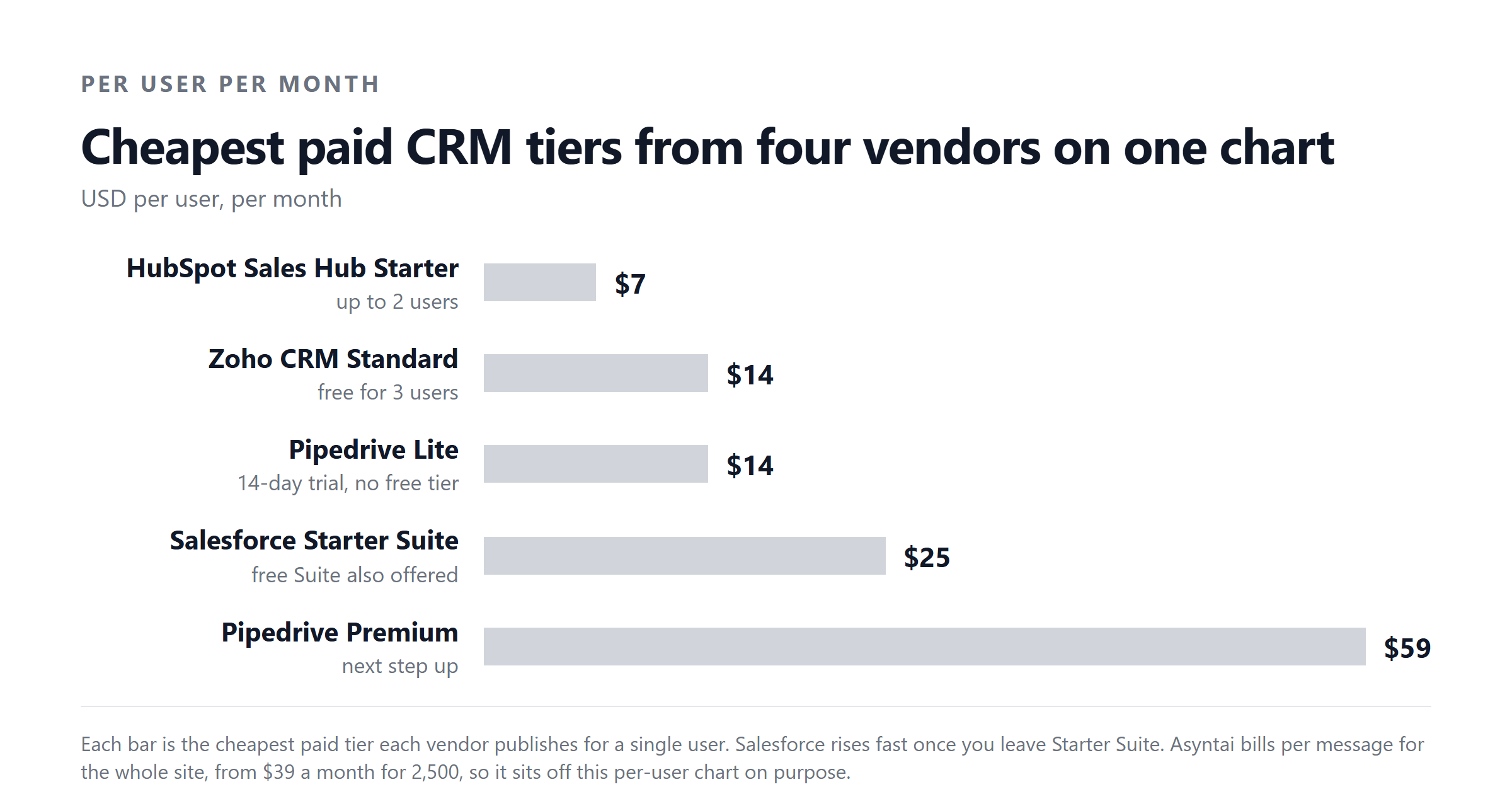
Free tiers, compared
Three of the four publish a free edition. Pipedrive does not, but offers a 14-day trial. Here is what each free edition actually gives an ecommerce store:
| Vendor | Free users | What you can do with it | What you cannot do |
|---|---|---|---|
| Zoho CRM | 3 | Lead and contact management, pipeline view, basic reports, mobile app | Workflow rules, email integration, custom modules, AI features |
| HubSpot Sales Hub | 2 | Contact and deal records, email tracking on up to 200 contacts a month | Sequences, automation, custom objects, document tracking |
| Salesforce Sales Cloud | 2 | Lead, account, contact and opportunity records, mobile app, basic reports | Forecasting, sales engagement, custom fields beyond a small allowance |
| Asyntai | Unlimited | AI chat answers product, sizing, shipping and return questions on your site, 100 messages a month | More than 100 messages a month, which at five messages a conversation is about 20 conversations, so the Free plan is a test rather than a tier to run on |
We make Asyntai, so read that row as a disclosure. The CRM free tiers are real working software and a sensible starting point if your team is two or three people. The Salesforce free tier, called Free Suite, gives you the same record types the paid tiers do, but is throttled on users, contacts and storage.
HubSpot's free tier is the most generous on email and the most limited on automation. Zoho's free tier is the most generous on users and is the only one that allows three seats. Salesforce's free tier is the most restricted by contact count and is worth it only if your store is small and you intend to upgrade.
Five people, one year, on the cheapest sensible tier
The cheapest published tier is rarely the right one for an ecommerce team of five. Free tiers cap at 3 users, so most stores need at least the first paid tier. Here is what each vendor costs for five users on the lowest tier that has the basics an ecommerce store needs: pipeline, email integration, and automation.
Zoho Professional at $1,380 a year for five users is the cheapest sensible option in this set. Pipedrive Growth at $2,340 a year is the cheapest with built-in lead capture and proposals. Salesforce Pro Suite at $6,000 a year is the cheapest that has forecasting and quote management. HubSpot Professional at $6,900 a year is the cheapest with sequences and document tracking, and is the only one that publishes a separate one-time onboarding fee of $1,500.
Those figures are per-vendor licence only. They do not include add-ons. HubSpot charges $0.01 per extra credit on annual billing and credits are consumed by sales emails, calls and other actions. Pipedrive's LeadBooster add-on is priced separately. Zoho's local taxes are charged on top of the published price. None of those are in the published per-user figure.
Where Asyntai fits
A CRM and a help desk are the systems of record. Asyntai is the layer that sits in front of both and handles the questions that come from your store visitors before they become a ticket.
An ecommerce store gets the same dozen questions all day. Where is my order. What is your returns policy. Do you ship to my country. Is this in stock. What size am I. None of those need a human. They all need a current answer drawn from your site. Asyntai answers those, in plain language, on every page, in any language the customer types in.
When a question needs a person, Asyntai routes it to your team. When the question is order status, Asyntai talks to your store platform and answers it without a ticket. When the question is a return, Asyntai starts the return flow and hands the customer to your team only if the situation is unusual.
The published self-serve plans are Free at 100 messages, Starter at $39 for 2,500 messages, Standard at $139 for 15,000 messages, and Pro at $449 for 50,000 messages. Enterprise is a signed order form with a negotiated message allowance, and is the right answer once a store is past the self-serve bands.
How Asyntai's per-message price compares to a CRM's per-user price
The maths looks odd at the top of the page because the meters are different. CRMs charge per user. Asyntai charges per message for the whole site. To compare them fairly you have to state two things: how many conversations your store generates, and how many messages an average conversation runs to, because the second number is what the allowance is measured in.
Those two numbers are not the same metric, and the comparison is rough. A human agent does things Asyntai cannot, including handling returns, speaking to angry customers, and resolving edge cases. The point is that when the volume of repeat questions is high, a per-message layer is cheaper than the next seat.
What each CRM does well for ecommerce
No CRM in this list is built only for ecommerce. Each has commerce integrations, but they vary in depth.
Zoho CRM integrates with Shopify, WooCommerce, Zoho Inventory and Zoho Books. The free edition for three users is the reason small stores start here. Zoho's own help desk, Zoho Desk, is included at lower tiers and uses the same contact record, which is a real advantage when you want support and sales history on one screen.
Pipedrive has a Shopify integration, an active campaign integration, and a wider Zapier layer for everything else. It is built around the deal, not the contact. For an ecommerce store that treats repeat orders as deals, that is a fit. For a store that treats them as line items on a contact, it is not.
HubSpot Sales Hub has the deepest marketing layer in this set. Its commerce integrations are reasonable but not exceptional. The strength is the marketing automation, the form builder, and the contact activity timeline. Stores with a content-driven acquisition model fit here.
Salesforce Sales Cloud has the deepest app ecosystem of any CRM, and a Shopify Plus app maintained by Shopify itself. The Commerce Cloud product is separate, and is a different conversation. Stores that already run Salesforce for B2B sales typically extend the same instance to B2C rather than introduce a second CRM.
What each help desk does well, and why it matters here
An ecommerce CRM works best when paired with a help desk that shares the contact record. Three of the four vendors above also publish a ticketing system on a similar price ladder, which is worth knowing if you are buying both.- Zoho Desk is included for free with Zoho CRM Standard and above for a small number of agents. The same contact record is shared, which is rare in this market.
- HubSpot Service Hub sits on the same free tier as Sales Hub. Two users get a ticketing system with shared contacts. The paid Service Hub tiers mirror Sales Hub pricing and add a required onboarding fee at the same levels.
- Salesforce Service Cloud is a separate product with a published ladder of its own. Pricing is per agent per month, with different tier names than Sales Cloud. The contact record is shared.
- Pipedrive does not publish a help desk. Stores that pick Pipedrive typically use Zendesk, Gorgias or Freshdesk alongside, and rely on Zapier to keep the contact record in step.
The reason this matters: the master record decision in section one is harder to make if your help desk and your CRM are from different vendors and do not share the contact. Two-way sync works until it does not, and when it does not you get duplicate contacts and tickets pointing at the wrong person.
How to pick
A short way to choose, if you have read this far and want a recommendation rather than another paragraph of context.
Pick Zoho Professional at $23 per user per month, billed annually, if your team is small, your volume is steady, and you want a shared contact record between your CRM and your help desk without paying for both.
Pick Pipedrive Growth at $39 per seat per month, billed annually, if your store treats repeat orders as opportunities and you want a deal-centric pipeline view with a lighter per-seat price.
Pick HubSpot Professional at $90 per seat per month, billed annually, plus the $1,500 onboarding, if marketing automation is the reason you are buying a CRM and your contact acquisition is form-driven.
Pick Salesforce Pro Suite at $100 per user per month, billed annually, if you already run Salesforce for another part of the company and you want one contact record across B2B and B2C.
Add Asyntai Standard at $139 a month on top of whichever CRM you pick, to handle the order status, sizing and shipping questions on your store without generating a ticket.
Asyntai answers product, sizing, shipping and return questions on your store in any language, day and night. It installs with a script tag or a Squarespace Code Injection block, reads your site for current answers, and routes anything unusual to your team. The Free plan covers 100 messages a month. The Starter plan covers 2,500 messages for $39 a month. See the plan that fits your store.
Zoho CRM: Zoho's own pricing page, checked 4 September 2026.
Pipedrive: Pipedrive's own pricing page, checked 4 September 2026.
HubSpot Sales Hub: HubSpot's own pricing page, checked 4 September 2026.
Salesforce Sales Cloud: Salesforce's own pricing page, checked 4 September 2026.
Asyntai plans: asyntai.com pricing, checked 4 September 2026.