Ticketing software for small business — where the AI answers first and your inbox stays quiet
Most small business tickets are questions your website already answers. Asyntai puts an AI chatbot in front of your inbox that resolves 60-80% of those questions instantly, so only the genuinely difficult ones ever become tickets.
See how it handles your customers' questions
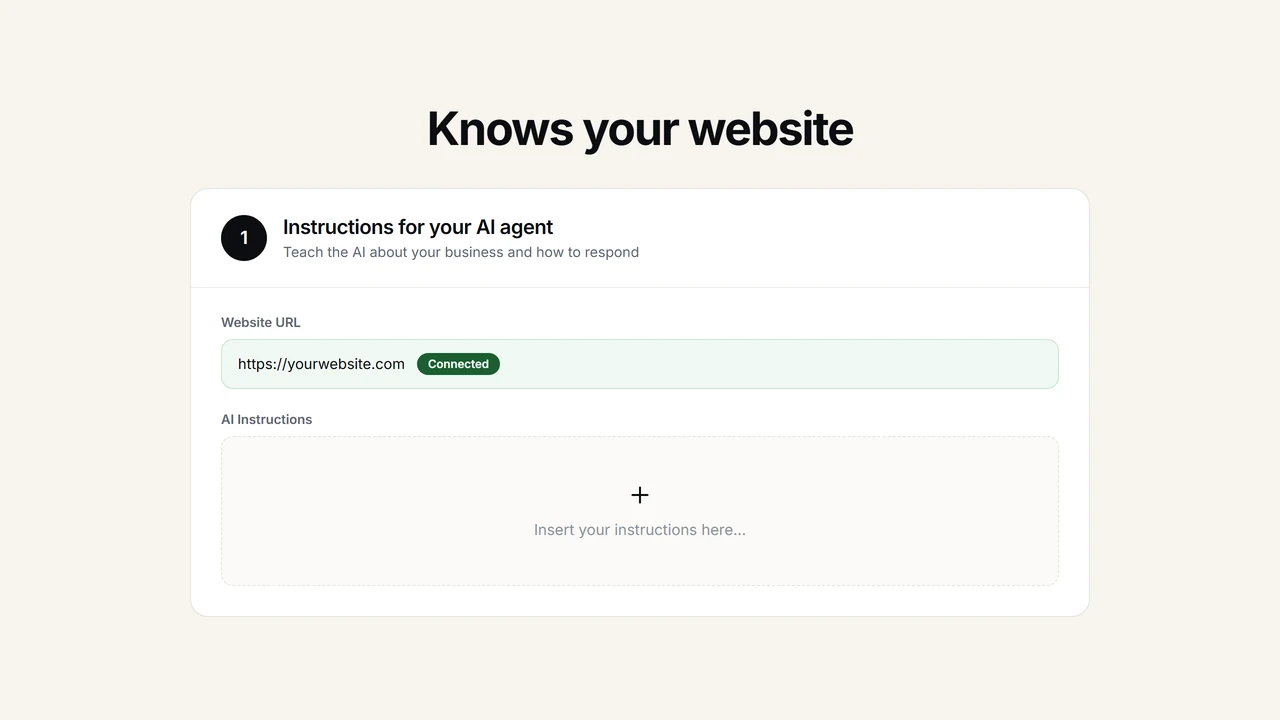
Paste your website URL and watch the AI build a support chatbot from your existing content
Your website already has the answers — the AI just delivers them before a ticket gets filed
Small businesses run lean. You don't have a tier-one support team sorting through "where's my order" and "what's your return policy" all day. But those questions still come in, and every one that turns into a ticket costs you time you could spend growing the business. Asyntai crawls up to 50 pages of your website — your FAQ, product pages, shipping info, policies — and builds a knowledge base the chatbot uses to answer visitor questions the moment they ask. The questions that would have sat in your inbox for hours get answered in seconds, without you lifting a finger.
- Learns from what you already wroteYour FAQ page, return policy, product descriptions, and help articles become the chatbot's working knowledge. No manual training needed — paste your URL and the AI reads it all.
- Answers instantly, around the clockVisitors get accurate replies at 2 AM on a Sunday — the same quality answer they'd get from you during business hours, pulled directly from your own content.
- Catches the questions that eat your morningsShipping times, pricing clarifications, product availability, store hours, sizing info — the repetitive questions that stack up overnight get handled before you open your laptop.
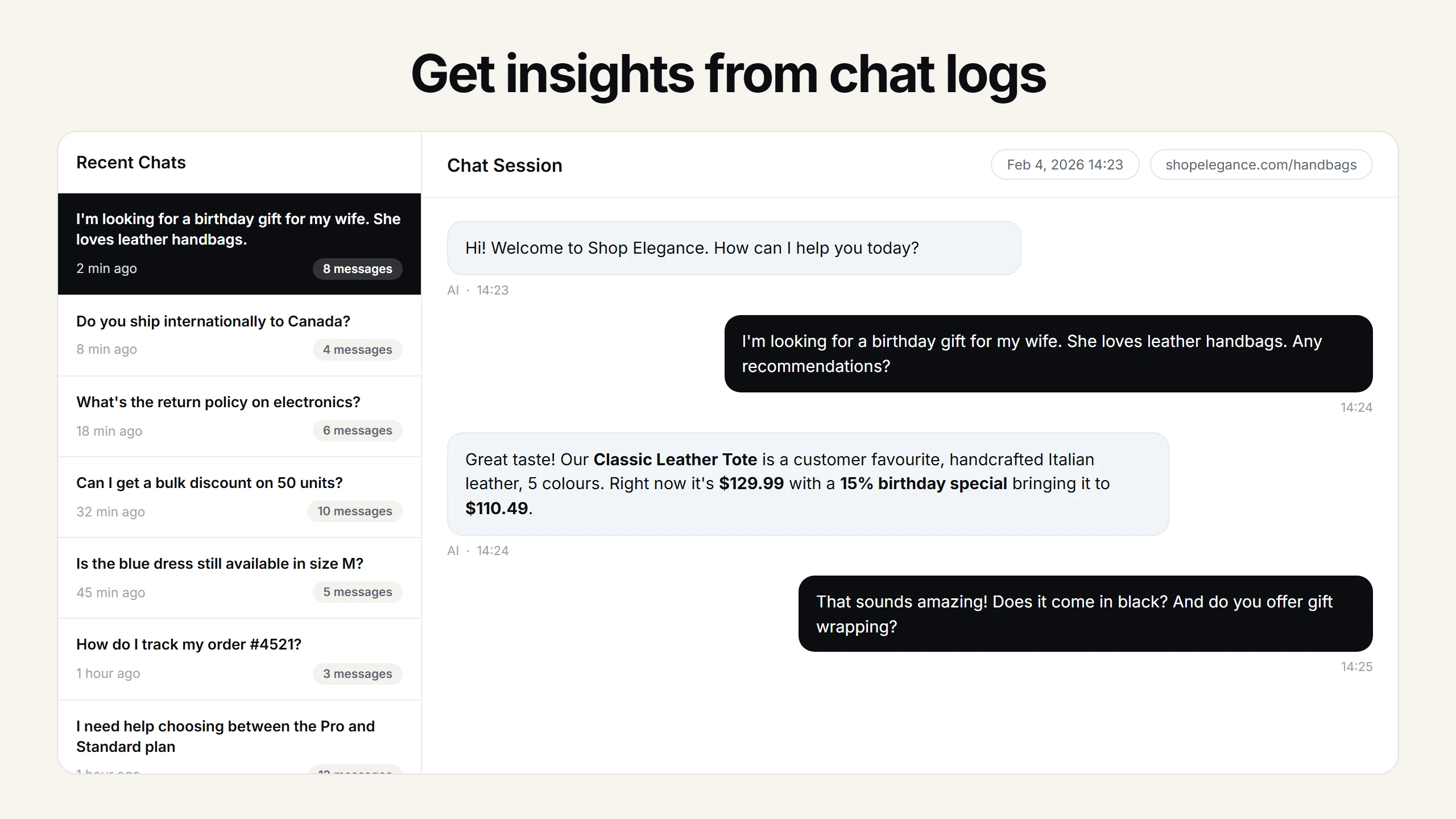
Hard questions reach your inbox with the conversation already attached
Not every question has an answer on your website. A customer with a damaged shipment, a bulk order request, or a product complaint needs a human. The chatbot recognizes when it's out of its depth and collects the visitor's email plus the full conversation, then sends it straight to your inbox. You pick up where the AI left off — no re-asking, no lost context. On Standard ($139/month) and Pro ($449/month) plans, Custom Tools let the chatbot pull live data from your own systems — order status, account details, inventory — so it can resolve even more questions before they reach you.
- Full conversation forwardedEvery escalation includes the visitor's email and the complete chat transcript, so you never start a support interaction blind.
- No second tool to checkEscalations arrive as email notifications — route them to your existing inbox, Gmail, Outlook, or any shared mailbox. No new dashboard to monitor.
- Custom escalation rulesWrite plain-English instructions like "always escalate refund requests" or "offer a human handoff for orders over $200." The AI follows your boundaries.
- 36 languages, one knowledge baseYour content stays in English. The chatbot auto-detects each visitor's language and responds in kind — Spanish, French, Japanese, Arabic — from the same source material.
- Live data with Custom ToolsOn Standard and Pro plans, connect the chatbot to your backend so it can look up order status, check inventory, or verify account details without human involvement.
Set up your small business ticketing in one afternoon
No IT department needed. No integrations to configure. Paste one line of code into your site header and the chatbot starts working immediately.
- Create a free account and paste your website URL
- The AI scans up to 50 pages and builds a knowledge base from your content
- Copy the one-line embed snippet into your site header
- The chatbot goes live — answering visitor questions in 36 languages
<script src="https://asyntai.com/widget.js"
data-id="your-site-id" async>
</script>
</head>
# Resolving customer questions before they hit your inbox.
Ticketing software for small business — FAQs
Common questions from small business owners evaluating AI-powered ticketing solutions.
Is this a full ticketing system or something that works alongside one?
Asyntai is a pre-ticket layer, not a full ticketing system. It sits in front of whatever you use now — Gmail, Outlook, a shared inbox, or a proper helpdesk tool — and resolves the questions it can answer from your content. The ones it can't resolve get escalated to your existing inbox with full context. For most small businesses, this means 60-80% fewer messages to deal with manually.
How does the AI know what to say?
When you sign up, you give Asyntai your website URL. The AI crawls up to 50 pages — your FAQ, product pages, policies, help articles — and uses that content to answer visitor questions. It answers using your own content, not generic responses. You can also upload additional documents or write custom instructions to fine-tune what it says and how it escalates.
What happens when the chatbot can't answer a question?
It collects the visitor's email address and sends you the full conversation via email notification. You pick up the thread with complete context — you know what the visitor asked, what the chatbot already tried, and what they still need. No information gets lost in the handoff.
Do I need technical skills to set this up?
No. If you can paste a line of code into your website header — the same way you'd add Google Analytics — you can install Asyntai. Most website builders (WordPress, Wix, Squarespace, Shopify) have a dedicated spot for header scripts. The whole setup takes under 30 minutes.
What does it cost?
Free: $0/month, 1 site, 50 messages. Starter: $39/month, 2 sites, 800 messages. Standard: $139/month, 3 sites, 15,000 messages. Pro: $449/month, 20 sites, 50,000 messages. Most small businesses start on Free to test it, then move to Starter once they see the ticket reduction.
Can it handle questions in other languages?
Yes — 36 languages. The chatbot detects each visitor's language from their first message and responds in that language, even if your website content is only in English. A Spanish-speaking visitor gets Spanish answers synthesized from your English FAQ.
Will it give wrong answers to my customers?
The chatbot answers using your own content — it doesn't make things up from general knowledge. If a question isn't covered by your website or uploaded documents, it says it doesn't know and offers to connect the visitor with you. You can also write explicit instructions like "never quote prices for custom work" to keep it within safe boundaries.
Why small businesses need a pre-ticket layer, not another ticketing dashboard
Running a small business means wearing every hat at once, and customer support is the hat that never comes off. An email comes in at 7 AM asking about return shipping labels. By 9, three more have arrived — one about product sizing, one about a delayed shipment, and one asking a question answered on the first line of your FAQ page. Each ticket takes five minutes: read, look up the answer, type a reply, hit send. By the time you've cleared the morning queue, an hour has evaporated — an hour you needed for inventory, marketing, or actually building your product. The problem isn't that the questions are hard. The problem is that they exist as tickets at all.
Traditional ticketing software doesn't solve this for small businesses; it just organizes the overwhelm. You get a dashboard, a queue, tags, priorities, SLA timers — all the apparatus of a support operation designed for a team that has dedicated agents. A three-person company doesn't need SLA timers. It needs the repetitive questions to stop arriving. That's a fundamentally different problem, and it requires a different kind of tool: one that intercepts questions before they become tickets and answers them directly from the information you've already published.
Asyntai approaches small business support from that angle. Instead of building another inbox for you to check, it puts an AI chatbot on your website that reads your existing content — your FAQ page, product descriptions, shipping policy, return instructions, store hours, sizing guides — and uses that content to answer visitor questions the instant they're asked. The visitor gets an immediate, accurate response pulled from your own words. You never see the interaction unless the chatbot can't handle it, in which case it escalates with the visitor's email and the full conversation attached. Your inbox stays reserved for the questions that actually need your attention.
The economics of this matter specifically for small businesses because your time has no fungible substitute. A mid-market company can hire another support agent when ticket volume grows. You can't — or if you can, the cost of that hire doesn't justify the volume of tickets they'd handle. What you need is leverage: a way to handle 200 customer questions a month while only personally responding to 40 of them. If the AI resolves the other 160 — the ones about shipping times, the ones about return windows, the ones about product specs that are already on the product page — you've effectively added a support team member who works every hour of every day and costs a fraction of a part-time hire.
Setup is intentionally minimal because small businesses can't afford a multi-week implementation project. You sign up, give Asyntai your website URL, and the AI crawls up to 50 pages of your site — pulling in FAQ content, product information, policy pages, and any other text it can reach. Within minutes, the chatbot has a working knowledge base built entirely from your existing content. You paste one line of JavaScript into your site header (the same place you'd put a Google Analytics tag), and the chatbot appears on every page. From there, visitors interact with the AI instead of reaching for your contact form.
The knowledge base isn't static. As you update your website — new products, revised policies, adjusted shipping windows — the chatbot picks up the changes on its next crawl. You can also upload documents the chatbot should reference but that aren't on your public site: internal handling procedures, product care guides, wholesale pricing sheets, anything a customer might ask about. Custom instructions let you define boundaries in plain English: "never offer discounts without asking me first," "always suggest the customer emails me for warranty claims over $100," "don't answer questions about competitor products." The chatbot follows these rules alongside its knowledge base, so it stays within the guardrails you set.
Language coverage is where a small business chatbot earns its keep internationally. If you sell to customers in multiple countries — even passively through an online store — you've likely fielded questions in Spanish, French, Portuguese, German, or other languages you don't speak fluently. Writing back in those languages takes time and risks miscommunication. The chatbot supports 36 languages with automatic detection. A French visitor's question gets a French answer, synthesized from your English content. A Japanese visitor gets Japanese. You don't need to translate your FAQ or maintain multilingual support docs — the AI handles the language layer.
Escalation design is what separates a useful chatbot from a frustrating one. A chatbot that refuses to admit it doesn't know something will damage customer trust faster than no chatbot at all. Asyntai's escalation works simply: when the chatbot encounters a question it can't confidently answer from your content, it tells the visitor it'll connect them with you, collects their email, and sends you the full conversation. You receive an email notification with everything — what the visitor asked, what the chatbot tried, and where the conversation ended. You reply to the visitor directly. No new tool to learn, no dashboard to check, no second login.
On Standard and Pro plans, Custom Tools extend the chatbot's reach into your actual business systems. Instead of just answering from static content, the chatbot can call your endpoints to check order status, look up account details, or verify inventory. A visitor asking "where's my order" gets a real-time tracking update instead of a generic "check your email for tracking info." This moves the deflection rate even higher because a large share of support tickets at small ecommerce businesses are order-status inquiries that don't need human involvement — they just need access to the data.
The pricing structure maps to small business scale. Free tier: 100 messages per month, one site — enough to test the chatbot on a low-traffic site and see what it deflects. Starter at $39 per month: 2,500 messages, two sites — covers most small businesses running one or two storefronts. Standard at $139 per month: 15,000 messages, three sites, plus Custom Tools for live data lookups. Pro at $449 per month: 50,000 messages, twenty sites — typically used by agencies or businesses with multiple brands. For a small business spending even a few hours a week on repetitive support, the cost of Starter or Standard pays for itself in recovered time within the first month.
The small businesses that get the most from this approach share a pattern: they have a decent website with real content, they receive a meaningful volume of questions that are already answered somewhere on that site, and the person handling support is also the person handling everything else. Ecommerce stores, SaaS startups, professional services firms, local businesses with online booking, educational platforms, subscription box companies — anywhere the support volume is real but the team is small. The chatbot doesn't replace customer service. It replaces the part of customer service that was never a good use of your time to begin with, and gives that time back to you.