White label SaaS for agencies — rebrand a complete AI chatbot and sell it as your own
Add a fully managed AI chatbot to your agency's service lineup. One dashboard, every client branded individually, margin you control entirely.
Preview the SaaS your clients will use
Drop any client URL below. The AI reads their site and assembles a working chatbot in seconds — this is the product you rebrand and deliver
One subscription gives your agency a full AI chatbot platform to resell
Most white label SaaS products force agencies into complicated per-seat licensing or revenue share arrangements. Asyntai does neither. You subscribe to a plan — Pro at $449/month is the most popular for agencies — and everything within that subscription is yours to package however you want. The AI chatbot answers visitor questions using each client's own website content, supports 36 languages with automatic detection, and installs on any platform in one line of code. Your agency name, logo, and colors appear everywhere the client sees. To the outside world, this is your product. For Standard plan users who want white-label activation, email [email protected] for manual setup.
- Every client gets their own branded chatbotEach website you add to your account is a separate chatbot with its own knowledge base, widget design, and branding configuration. A law firm gets one look. A bakery gets another. Both live under your agency's umbrella and appear as your product to each respective client.
- Centralized management, zero per-client overheadAdd content, adjust AI behavior, review conversations, and export leads — all from one dashboard. You do not need separate logins, separate tools, or separate billing relationships with the platform. Your agency manages everything from a single account.
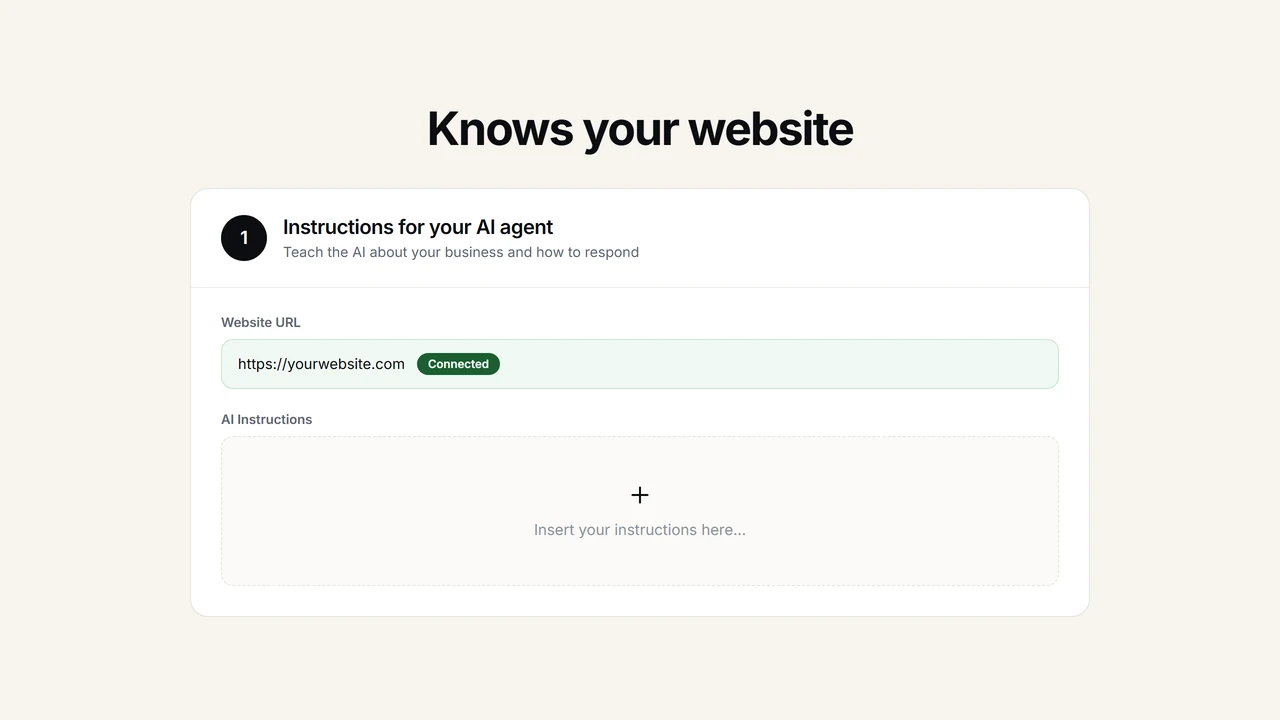
- No development team requiredThe chatbot builds its knowledge base by reading each client's website. The widget is configured through a visual editor. Installation is a single JavaScript snippet. Your agency can deploy a new client chatbot in 20 minutes without writing a line of code or involving a developer.
Fixed subscription, variable revenue — the margin widens with every client
The appeal of white label SaaS for agencies is the leverage it creates. You pay a flat fee and resell the product at your chosen price point, pocketing the difference. With the Pro plan at $449/month covering 20 sites and 50,000 messages, the economics favor agencies from the first few clients onward. When you outgrow 20 sites, the Custom Pro plan extends your capacity without changing the model.
- 3 clients at $250 each: $301/month marginEven a modest start with three agency clients turns a profit. You collect $750/month against $449 in cost. The chatbot practically runs itself — no ongoing development, no servers to manage, no support tickets to field about uptime.
- 8 clients at $250 each: $1,551/month marginEight clients is a realistic target within two to three months. Revenue reaches $2,000/month, margin hits $1,551, and you still have twelve open slots. The work per client stays minimal because the AI handles the heavy lifting.
- 20 clients at $250 each: $4,551/month marginAt full capacity you generate $5,000/month in revenue on a $449 cost base. That is $54,612 in annual margin from a service that requires less than 30 minutes of maintenance per client per month.
- Shared message pool absorbs uneven usageYour 50,000 monthly messages are shared across all clients. Quiet clients offset busy ones. A local accounting firm might use 150 messages while a busy restaurant uses 1,800 — the aggregate stays well within your allocation for most agency portfolios.
- Custom Pro for agencies scaling past 20 sitesWhen your agency outgrows the standard Pro allocation, the Custom Pro plan raises both site and message caps. Same white-label branding, same centralized dashboard — just more room to grow.
Deploy a client chatbot in under 20 minutes
No APIs, no staging environments, no QA cycles. Your agency adds a client site, brands the widget, and goes live with one snippet.
- Subscribe to the Pro plan at asyntai.com/pricing — $449/month covers 20 client sites, 50,000 messages, and full white-label branding removal.
- Add your client's domain in the dashboard. The AI reads the site immediately and builds a knowledge base from their existing pages, products, and content.
- Open the widget editor and apply your agency's branding — name, logo, colors, welcome message. Each client chatbot can have a unique look while still sitting under your single account.
- Copy the embed snippet and paste it into your client's website. The chatbot appears instantly, answering visitor questions using the client's own content, under your brand.
<!-- Your brand on every surface. Your invoice, your margin. -->
<script src="https://asyntai.com/widget.js"
data-id="client-site-id" async>
</script>
# One snippet. Fully branded. Managed from your dashboard.
# Your agency's SaaS product — deployed in minutes.
How reselling works
From signing up to billing your first client — four simple steps.
Choose a plan
Subscribe to a plan that fits how many client websites you need. Pro is the most popular for resellers — white-label plus up to 20 websites.
View plans →Add a client website
Each website you add under your account is one client's chatbot. Add up to the number your plan allows.
Go to your dashboard →Set up the chatbot
Add the client's content, customize the widget to their brand, and install it on their site. You can also give the client read-only access to their chat logs, analytics and leads on your own website.
Setup guide →Resell at your price
Charge your client whatever you like. You own the relationship and bill them directly — the margin is yours, every month.
Reseller Resources
Everything you need to get started, answer client questions, and see the dashboard in action
Reseller Guide
Step-by-step walkthrough: white-label branding, the embeddable client dashboard, and how to get your first client live.
Read the guideReseller FAQ
Pricing, margins, billing, white-label details, platform compatibility, and everything else partners ask before starting.
View FAQClient Dashboard Demo
See the embeddable white-label dashboard with sample data — conversations, analytics, and leads under your brand.
See the demoWhite label SaaS for agencies — FAQs
Common questions agencies ask before adding AI chatbot SaaS to their service lineup.
What exactly do I get when I subscribe as an agency?
You get a complete AI chatbot platform that you rebrand as your own. The Pro plan at $449/month includes white-label branding removal, capacity for 20 client websites, and 50,000 messages shared across all of them. Each client site gets its own chatbot with an independent knowledge base, widget design, and analytics. You manage everything from one dashboard and bill clients at whatever rate you choose. There is no revenue share, no per-client fee, and no sales quota.
How is this different from building our own chatbot SaaS?
Building your own AI chatbot platform from scratch involves natural language processing infrastructure, hosting, a widget framework, analytics pipelines, multi-tenant architecture, ongoing model updates, and a dedicated engineering team. That is typically a six-figure annual investment before you serve your first client. With Asyntai's white-label SaaS, the entire platform already exists — you subscribe, apply your branding, and start deploying. Your clients see your product. You skip years of development and start generating revenue immediately.
Can each client chatbot look completely different?
Yes. Every client site under your account has independent widget settings — colors, logo, header text, welcome message, position on the page, and response behavior. A spa client can have a soft, pastel-themed widget while a tech startup gets a minimal dark design. They all run under your single subscription and share nothing visible with each other. The only common element is your agency branding, which appears in place of the original platform branding.
Do my clients know this is a white-labeled product?
Not from anything they can see. On the Pro plan, the "Powered by Asyntai" badge is removed from the chat widget entirely. Your agency's name and logo replace it. The embeddable client dashboard — where clients view their conversations, analytics, and leads — also carries your branding. Visitors interacting with the chatbot and clients reviewing their data both see a product that appears to be built by your agency.
What platforms does the chatbot work on?
Virtually all of them. The chatbot installs via a single line of JavaScript that works on any website. There are also dedicated plugins for WordPress, Shopify, Magento, WooCommerce, Wix, Squarespace, Webflow, Joomla, Drupal, and over 30 other platforms. This means your agency can serve clients on different website builders without any compatibility concerns. The installation method is the same regardless of the platform.
How does the AI know what to say for each client?
When you add a client's website, the AI reads all the pages and builds a knowledge base from that content. It answers visitor questions using the client's own information — products, services, pricing, policies, and anything else published on their site. You can also upload supplementary documents like PDFs or product catalogs. The AI does not guess or invent answers. It retrieves the relevant content and uses it to respond accurately in any of 36 supported languages.
Can we start on a smaller plan and scale up?
Absolutely. The Starter plan at $39/month supports 2 sites and 800 messages — enough to demo the product and onboard your first agency client. The Standard plan at $139/month supports 3 sites and 15,000 messages. White-label branding removal is included automatically on Pro, but Standard plan users can email [email protected] for manual activation. Many agencies start on Standard, validate the business model with 2-3 clients, and then upgrade to Pro when they need the capacity.
What happens when we outgrow 20 sites?
The Custom Pro plan extends both site and message limits for agencies that have outgrown the standard Pro allocation. You keep the same white-label branding, the same centralized dashboard, and the same billing model — just with higher capacity tailored to your volume. Contact [email protected] to discuss your requirements.
Is there an affiliate option if some prospects want to self-manage?
Yes. Asyntai's affiliate program pays 20% recurring commission for up to 12 months on each referral. If a prospect does not need your agency's managed service and prefers to run their chatbot independently, you can refer them through your affiliate link instead of white-labeling for them. A referral who subscribes to the Pro plan generates $89.80/month in passive commission. Many agencies run both models side by side — white-label for managed clients and affiliate referrals for self-serve prospects.
Why agencies are adding white label SaaS to their service stack — and how the model works
Agencies have always been in the business of assembling solutions from specialized tools and presenting them as cohesive services. A web design agency does not build its own CMS — it uses WordPress, Webflow, or Shopify and wraps its expertise around the platform. A social media agency does not build a scheduling tool — it licenses one and focuses on strategy. White label SaaS follows the same logic but removes the last remaining seam: the client never sees the underlying tool at all. When an agency deploys a white-labeled AI chatbot, the client experiences a branded product that appears to be built, hosted, and maintained by the agency. The technical platform is invisible. What the client perceives is their agency delivering another valuable service.
The specific appeal of AI chatbot SaaS for agencies lies in the combination of recurring revenue and minimal delivery effort. Most agency services — web design, SEO campaigns, paid media management — involve significant labor per client per month. The margin on those services is capped by the hours available. A white-labeled AI chatbot, by contrast, takes roughly twenty minutes to deploy for a new client and requires very little ongoing work. The AI builds its knowledge base by reading the client's website content, so there is no manual data entry. The chatbot answers visitor questions around the clock, so there is no staffing requirement. The analytics dashboard gives the client visibility into usage and lead capture, so there are fewer reporting calls. The agency bills monthly for a service that largely runs itself, creating a revenue stream with a fundamentally different margin profile than traditional agency work.
Multi-client management is where the SaaS model proves its value over piecemeal tools. Every client your agency serves has a separate website, separate branding, and separate visitor demographics. A single Asyntai subscription handles this naturally — each website you add becomes an independent chatbot with its own knowledge base, widget appearance, and conversation history. You configure one client's chatbot to match their minimalist SaaS branding while another gets the warm aesthetic of a family-run restaurant. The dashboard lets you switch between clients instantly, review any conversation, and export leads. There is no juggling separate logins, no confusion about which account you are in, and no risk of pushing one client's settings onto another.
The economics work because the cost structure is flat while the revenue is linear. The Pro plan costs $449/month and supports up to 20 client websites. Whether you have three clients or eighteen, your platform cost does not change. If you price the chatbot service at $200 per client per month — a conservative figure for a product that captures leads and answers visitor questions around the clock — five clients generate $1,000 in revenue against $449 in cost, producing $551 in monthly margin. Ten clients double the revenue to $2,000 with the same $449 cost, yielding $1,551 in margin. At full capacity with twenty clients at $200, revenue reaches $4,000 and margin hits $3,551. Agencies that bundle the chatbot with existing services or position it as a premium add-on regularly charge $300 to $400 per client, pushing those margins even higher.
Deploying a new client chatbot involves four steps that any account manager can handle without developer support. First, you add the client's domain in your dashboard. The AI immediately begins crawling the website and building a knowledge base from the pages it finds — service descriptions, product listings, FAQs, about pages, pricing, and anything else published on the site. Second, you configure the widget's appearance: your agency's logo, the client's brand colors, a welcome message tailored to their visitors. Third, you copy the embed snippet — a single line of JavaScript — and paste it into the client's website. The chatbot goes live immediately. Fourth, you share the white-labeled client dashboard URL with the client so they can review their conversations, view analytics, and export leads. The entire process takes fifteen to twenty minutes, and most of that time is spent choosing brand colors and writing the welcome message.
What separates white label SaaS from a simple referral or affiliate arrangement is ownership. When you refer a client to a SaaS product, the client signs up with that company, pays them directly, and builds a relationship with their support team. You collect a referral fee and fade into the background. With white-label SaaS, the dynamic is reversed — you are the vendor. The client pays you, interacts with your brand, and attributes the service to your agency. Their chatbot shows your name. Their analytics dashboard displays your logo. If they have a question, they contact you. This ownership compounds over time. As the chatbot accumulates conversation data and the AI's responses become more refined based on the client's specific content, the switching cost grows. The client is not locked in by a contract — they are locked in by value that has been personalized to their business over months of operation.
Language support makes the white label SaaS model viable for agencies operating across borders or serving multilingual markets. The AI chatbot supports 36 languages and detects the visitor's preferred language automatically. An agency based in Germany can serve clients in Austria, Switzerland, and France from the same account, with each chatbot responding in the appropriate language. An agency in Canada can handle English and French clients without any additional configuration. A US-based agency serving Hispanic communities can deploy chatbots that respond in Spanish when visitors browse in Spanish and in English when they browse in English. None of this requires the agency to hire multilingual staff or configure language settings — it happens automatically based on the visitor's browser language.
Custom Tools, available on Standard and Pro plans, open up a premium tier for agencies that want to offer more than conversational AI. Custom Tools allow the chatbot to call a client's own API endpoints during a conversation, enabling real actions rather than just informational responses. For an ecommerce client, the chatbot can check order status and initiate a return. For a healthcare clinic, it can look up appointment availability. For a property management company, it can pull up lease details for a specific tenant. Each client's tools are configured independently within their chatbot's settings, and the setup requires no coding — you point the tool at an endpoint, define the parameters, and describe when the AI should use it. Agencies that offer Custom Tools integration alongside basic chatbot deployment can justify a significant price premium, often charging $150 to $200 more per month for what amounts to an afternoon of configuration work.
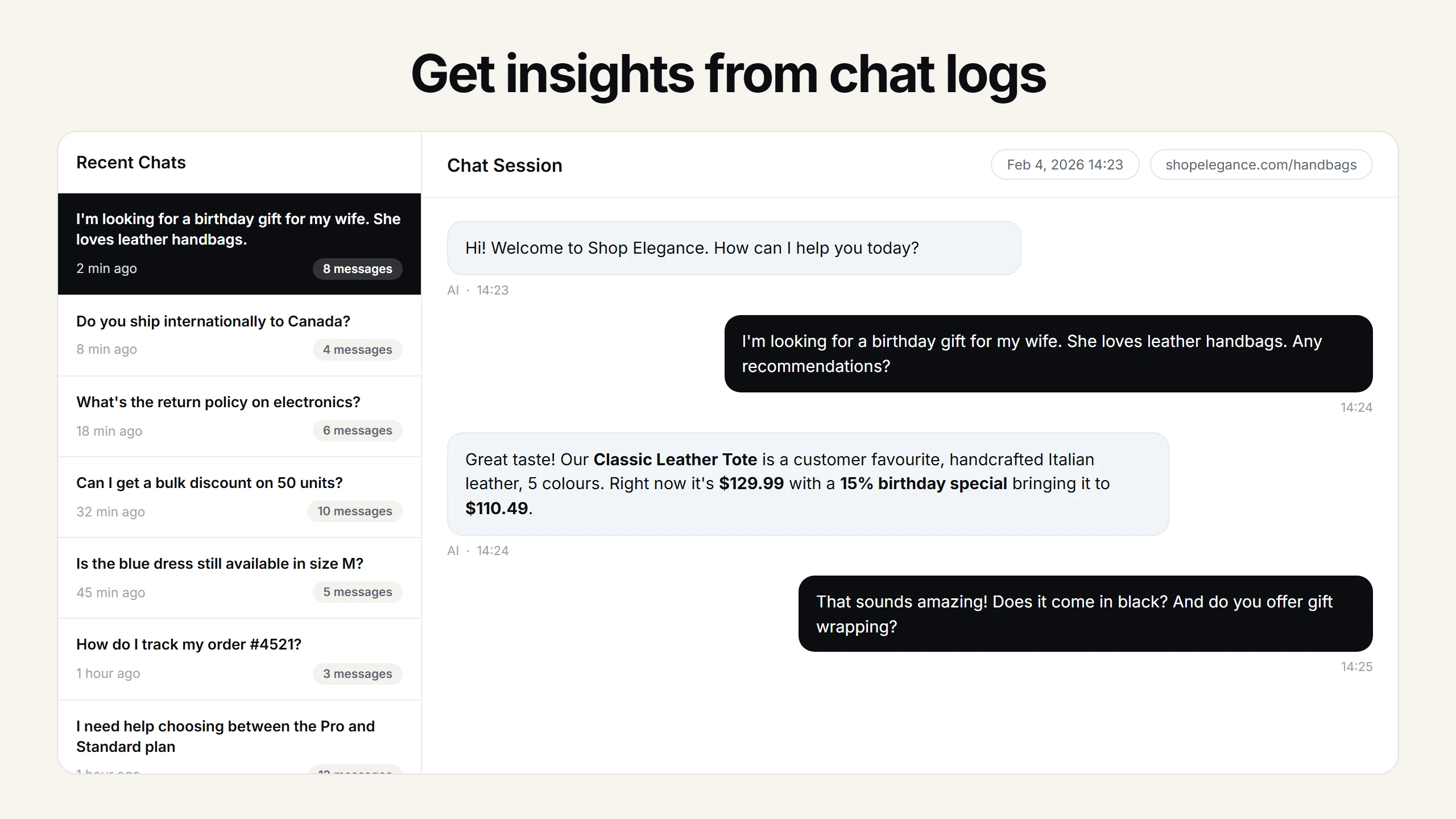
Client reporting is a perpetual pain point for agencies, and the white-labeled dashboard addresses it with minimal effort. Each client you deploy gets access to an embeddable dashboard with three tabs: Conversations (full chat transcripts with timestamps and visitor details), Analytics (message volumes, conversation trends, peak hours), and Leads (captured visitor information with one-click CSV export). You embed this dashboard on your own agency website using a JavaScript snippet, and it displays your logo, colors, and branding throughout. Clients log in to your domain, review their data, and export reports — all within an interface that looks like a native part of your agency's platform. For agencies that bill by the hour, reducing the time spent manually compiling chat reports directly improves the margin on the chatbot service.
Vertical specialization amplifies the SaaS model's returns because it compresses deployment time and justifies higher prices. An agency that positions itself as the provider of AI chat solutions for dental practices, for example, develops reusable templates for AI instructions (how to describe common procedures, how to handle insurance questions, what to say about emergencies), standard widget configurations that match medical-practice aesthetics, and a sales pitch refined through dozens of similar conversations. Each new dental client takes ten minutes instead of twenty because the template is proven. The agency can charge more because it is selling industry expertise, not a generic tool. The same approach works for real estate agencies, law firms, fitness studios, restaurants, and any other sector with common visitor questions and consistent website structures.
The competitive dynamics in the agency market increasingly favor those that offer AI capabilities alongside traditional services. Clients are actively looking for AI solutions, and the agency that bundles an AI chatbot into a website redesign package or a digital marketing retainer wins the contract over the agency that offers the same traditional deliverables without AI. White label SaaS eliminates the barrier to adding this capability. You do not need an AI engineer. You do not need machine learning expertise. You do not need to understand natural language processing. You need a subscription and twenty minutes per client. The AI handles the complex work — understanding visitor questions, retrieving relevant content from the knowledge base, and formulating accurate responses in the visitor's language.
Retention metrics in the white label SaaS model tend to outperform other agency services for a structural reason: the product becomes more valuable over time. In the first week, the chatbot answers questions based on the client's existing website content. Over the following months, the agency or client uploads supplementary documents, refines the AI instructions based on real conversations, and identifies gaps in the knowledge base that need filling. Three months in, the chatbot has been tuned to the client's specific business — handling niche questions accurately, responding in the tone the business prefers, and capturing leads with the right qualifying questions. A new chatbot from scratch would take months to reach the same level of refinement. This creates a natural retention moat that reduces churn without requiring contracts or penalties.
Agencies concerned about platform compatibility can set that worry aside early. The embed method — a single line of asynchronous JavaScript — works on every website builder in the market. WordPress has an official plugin. Shopify has an App Store listing. Wix, Squarespace, Webflow, Magento, WooCommerce, Joomla, Drupal, OpenCart, and over 30 other platforms all support the standard embed. This means your agency never has to turn away a client because of their tech stack. Whether a client is running a custom-built site, a hosted ecommerce platform, or a simple landing page builder, the chatbot installs identically and performs identically.
The path from evaluating white label SaaS to generating revenue from it is measured in hours, not weeks. You subscribe, brand the platform, deploy your first client chatbot, and start billing. There is no onboarding queue, no implementation consultant, and no integration project. The Starter plan at $39/month lets you test the platform with two sites and 800 messages before committing to the Pro plan. Some agencies start by deploying the chatbot on their own website first — experiencing the product from the client's perspective — and then pitch it to existing clients once they have seen it perform. The fastest agencies go from subscription to first client invoice within a single business day.
Ready to add white label SaaS to your agency? Start with the Pro plan and deploy your first branded chatbot today — or email [email protected] with any questions about the platform.