White label marketing software that turns website visitors into leads through AI chat
Give your clients an AI chatbot that engages every visitor, captures contact details, and surfaces products — all under your brand. You set the price and keep the margin.
Watch the marketing chatbot convert a visitor in real time
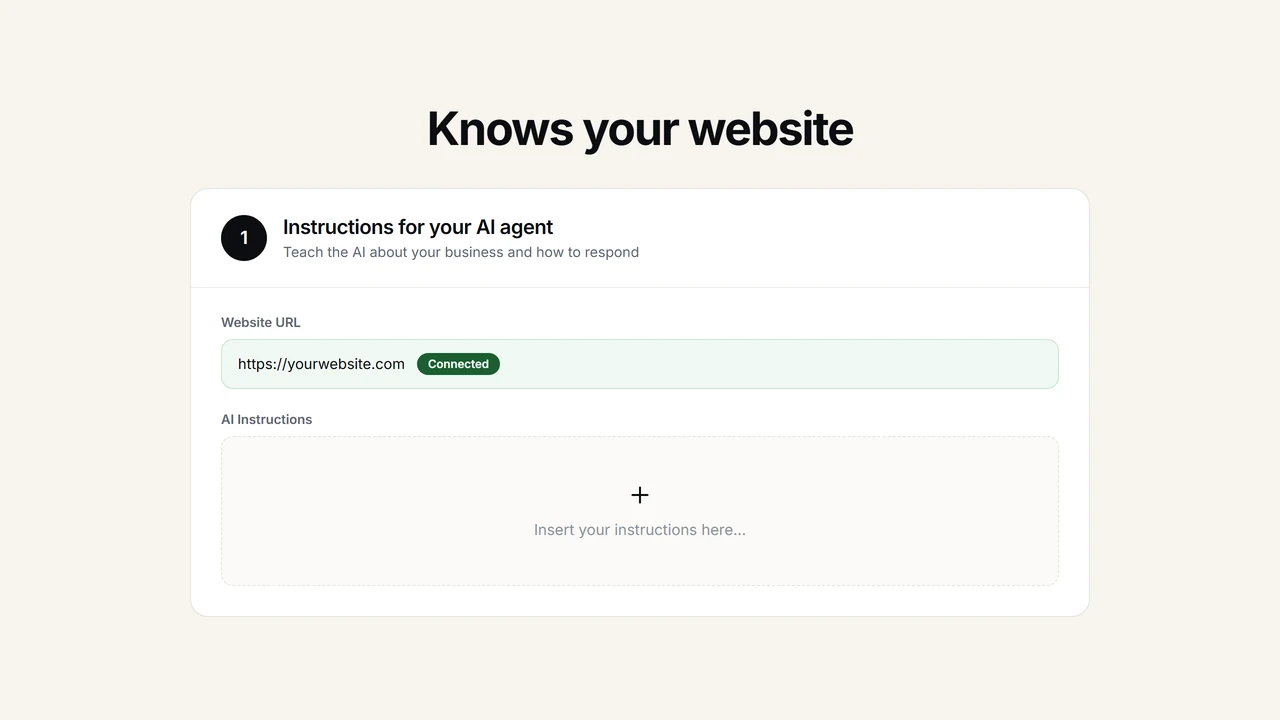
Enter a client website URL below. The AI reads every page, builds a knowledge base, and starts answering product questions, capturing leads, and guiding visitors toward a purchase — in seconds.
Every conversation is a chance to capture a lead — the AI never misses one
Most website visitors leave without filling out a contact form. An AI chatbot changes that equation by starting a conversation, answering questions using the client's own content, and naturally collecting contact details when the visitor shows intent. The captured leads appear in the client dashboard — exportable as CSV for any CRM — and the analytics tab shows you which pages drive the most conversations, so your clients can optimize their marketing. On the Pro plan at $449/month, you manage up to 20 client sites with full white-label branding and 50,000 messages. Standard plan resellers who want white-label activation can email [email protected] for manual setup.
- Built-in lead capture with CSV exportThe chatbot collects visitor names, emails, and phone numbers during natural conversation — no pop-ups, no static forms. Captured leads appear in the Leads tab of the white-labeled client dashboard, where your client can review details and export everything as a CSV file for their CRM or email marketing platform.
- Dynamic Product Cards for ecommerce clientsConnect a Real-Time Data Feed to your ecommerce client's product catalog and the chatbot surfaces Dynamic Product Cards inside the chat — showing product images, names, prices, descriptions, and direct links to the product page. When a visitor asks about products, the AI searches the live catalog and presents visual cards that drive clicks and purchases.
- Conversation analytics that show marketing ROIThe Analytics tab in the client dashboard tracks message volume, response quality, and engagement trends. Your clients see exactly how many conversations happened, which topics visitors ask about most, and how the chatbot is performing over time. This data helps marketing teams refine messaging, identify content gaps, and prove the chatbot's value in monthly reports.
From visitor engagement to product discovery — a marketing engine your clients pay for monthly
The Pro plan at $449/month covers 20 client sites and 50,000 messages. At $200 per client per month, ten clients generate $2,000 in revenue against $449 in cost — a margin that grows as you fill more slots. Each site operates independently with its own knowledge base, branding, and lead data. Agencies scaling past 20 clients can move to a Custom Pro plan with expanded limits.
- Visitor engagement that outperforms static formsA chatbot invites conversation from the moment a page loads. Visitors who would never fill out a contact form will ask a chatbot a question — and that question is the opening of a lead capture flow. The AI answers accurately using the client's own content, builds trust, and collects contact information when the moment is right.
- Product discovery that drives revenue for ecommerce clientsFor online stores, the chatbot acts as a personal shopping assistant. A visitor asks for running shoes under $120, and the AI searches the live product feed, presents matching Dynamic Product Cards with images and prices, and links directly to the product pages. The product data updates in real time — price changes and stock levels reflect immediately.
- 36 languages with auto-detection for global campaignsThe AI supports 36 languages and detects the visitor's language automatically. A French visitor gets responses in French. A Japanese visitor gets responses in Japanese. For agencies with international clients or clients who serve multilingual markets, the chatbot handles every language from a single setup — no separate configurations per language.
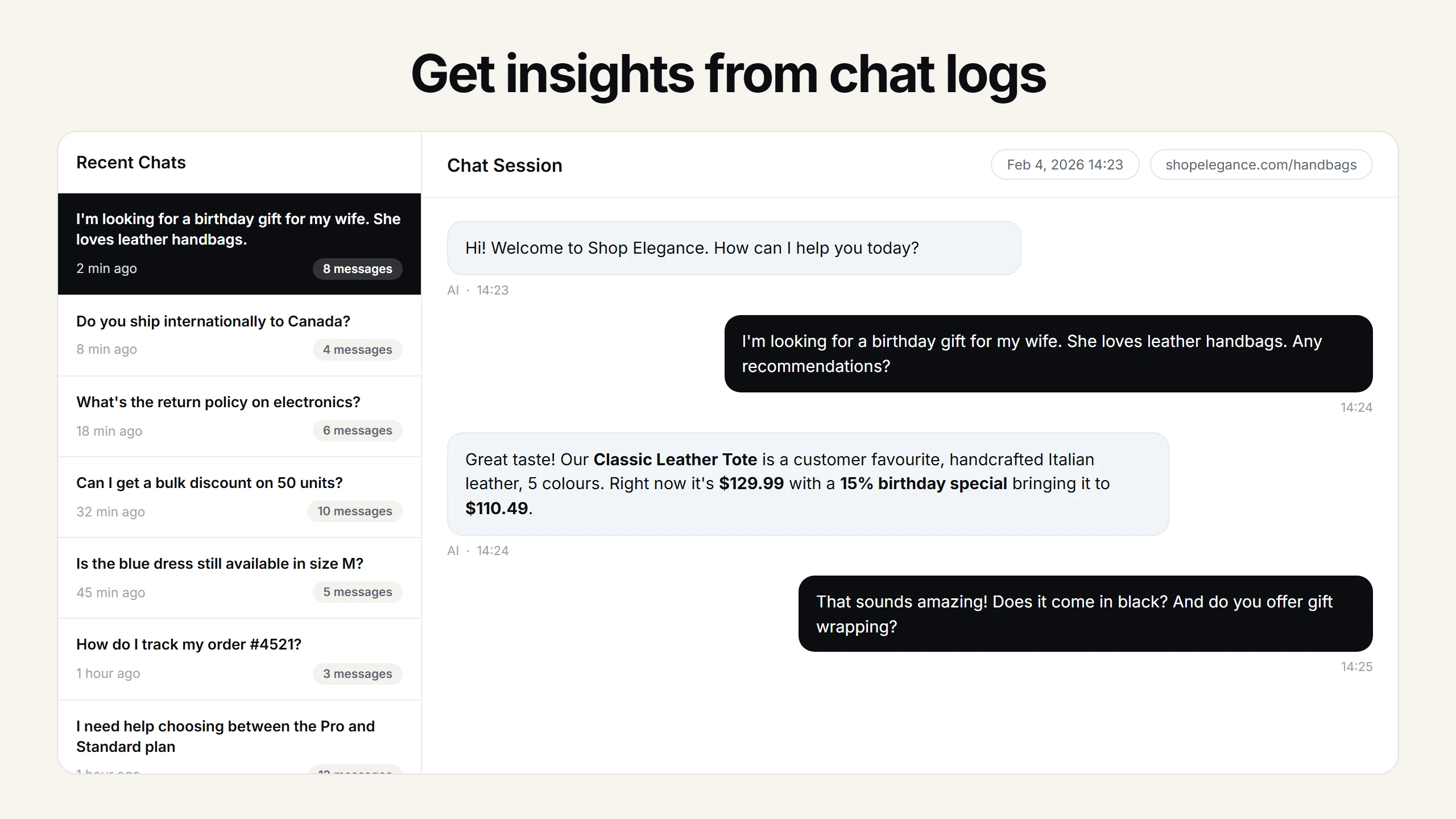
- White-labeled client dashboard for reportingEach client accesses a dashboard with three tabs — Conversations, Analytics, and Leads — embedded on your website via a JS snippet and branded with your logo, name, and colors. Clients see their marketing data under your brand. They review chat transcripts, track engagement trends, export leads, and never encounter a third-party name.
- Custom Tools turn the chatbot into a conversion machineOn Standard and Pro plans, Custom Tools let the AI call your client's own API endpoints during a conversation. A real estate client's chatbot can check listing availability. A SaaS client's bot can look up pricing tiers and start a trial. An insurance client's bot can generate a preliminary quote. The chatbot moves visitors from interest to action without leaving the chat window.
Deploy a lead-generating AI chatbot on your client's site
No developers. No marketing automation certifications. From signup to a branded, lead-capturing chatbot on your client's website — twenty minutes and four steps.
- Subscribe to the Pro plan at asyntai.com/pricing — you get white-label branding, 20 sites, and 50,000 messages per month to power your clients' marketing chatbots.
- Add your client's website in the dashboard, then set your agency name, logo, and brand colors on the widget so visitors see your brand — not ours.
- Let the AI crawl your client's site to build a knowledge base from their pages, products, and FAQs. Upload any additional content — brochures, catalogs, pricing sheets — to expand what the chatbot can answer.
- Copy the embed script into your client's site. The chatbot starts engaging visitors, answering questions, capturing leads, and surfacing products immediately.
<!-- Captures leads, answers questions, surfaces products -->
<script src="https://asyntai.com/widget.js"
data-id="client-site-id" async>
</script>
# Every visitor conversation is a lead opportunity.
# Your brand on the widget. Your margin on every deal.
How reselling works
From signing up to billing your first client — four simple steps.
Choose a plan
Subscribe to a plan that fits how many client websites you need. Pro is the most popular for resellers — white-label plus up to 20 websites.
View plans →Add a client website
Each website you add under your account is one client's chatbot. Add up to the number your plan allows.
Go to your dashboard →Set up the chatbot
Add the client's content, customize the widget to their brand, and install it on their site. You can also give the client read-only access to their chat logs, analytics and leads on your own website.
Setup guide →Resell at your price
Charge your client whatever you like. You own the relationship and bill them directly — the margin is yours, every month.
Reseller Resources
Everything you need to get started, answer client questions, and see the dashboard in action
Reseller Guide
Step-by-step walkthrough: white-label branding, the embeddable client dashboard, and how to get your first client live.
Read the guideReseller FAQ
Pricing, margins, billing, white-label details, platform compatibility, and everything else partners ask before starting.
View FAQClient Dashboard Demo
See the embeddable white-label dashboard with sample data — conversations, analytics, and leads under your brand.
See the demoWhite label marketing software — FAQs
Common questions from marketing agencies, digital consultants, and web professionals evaluating AI chat as a white-label marketing tool.
How does the chatbot capture leads?
The AI engages visitors in natural conversation — answering questions about the client's products, services, or policies using their own website content. When the visitor shows buying intent or asks for a quote, consultation, or callback, the chatbot collects their name, email, and phone number within the chat flow. There are no static pop-up forms. The captured contact details appear in the Leads tab of the white-labeled client dashboard, where your client can review them and export the full list as a CSV file for import into their CRM or email marketing platform.
What marketing data can my clients see in the dashboard?
Each client accesses a white-labeled dashboard with three tabs. The Conversations tab shows full chat transcripts with visitor details — useful for understanding what visitors are asking and how the AI is responding. The Analytics tab tracks message volume, engagement trends, and response quality over time. The Leads tab collects every captured contact with name, email, and phone number, plus CSV export. You embed this dashboard on your own website via a JS snippet, branded with your logo and colors. Clients see their data under your brand name.
Can the chatbot show products inside the chat window?
Yes, through Dynamic Product Cards. You connect a Real-Time Data Feed — a URL that returns the client's product catalog in JSON or CSV format — and the AI searches the catalog when visitors ask about products. The chatbot responds with visual product cards showing the product image, name, price, a short description, and a direct link to the product page. The data feed updates in real time, so price changes and stock adjustments reflect immediately. Standard plan clients get up to 200,000 characters of data feed capacity. Pro clients get up to 10,000,000 characters — enough for catalogs with thousands of products.
Does the chatbot help with conversions beyond lead capture?
Absolutely. The chatbot serves as a real-time sales assistant that guides visitors through decision-making. For ecommerce clients, it surfaces relevant products, answers comparison questions, and links directly to purchase pages. For service businesses, it explains pricing, qualifies the visitor's needs, and suggests the right service tier. With Custom Tools on Standard and Pro plans, the bot can call the client's own API endpoints to perform live actions — checking appointment availability, looking up pricing, generating quotes — which keeps visitors engaged and moving toward conversion rather than bouncing to search for answers elsewhere.
How much does it cost and what are the margins?
The Pro plan at $449/month is the most popular for resellers. It includes complete white-label branding removal, up to 20 client sites, and 50,000 messages per month. At 20 clients, your cost is approximately $22 per client. Charge your clients $150 to $300 per month for an AI marketing chatbot and you keep the difference — no revenue share, no commission split. The Standard plan at $139/month supports 3 sites and 15,000 messages if you are starting smaller. Agencies that outgrow 20 clients can move to a Custom Pro plan with higher limits.
Does the chatbot work for clients in different industries?
Yes. The AI builds its knowledge base from each client's own website content, so it adapts to any industry automatically. A real estate client's chatbot answers questions about listings and open houses. A fitness studio's chatbot covers class schedules and membership options. An accounting firm's chatbot explains tax preparation services and deadlines. Each client's site operates independently under your account with its own knowledge base, widget branding, and lead capture data. You manage dentists and ecommerce stores and consultants from the same dashboard without any cross-contamination.
Can I use this for international clients or multilingual markets?
Yes. The AI supports 36 languages and auto-detects the visitor's language. If your client serves a bilingual market — English and Spanish in the US, French and English in Canada, German and French in Switzerland — the chatbot handles both languages from a single setup. A visitor types in Spanish and gets a response in Spanish. Another types in English and gets English. No separate configurations. No language-specific instances. For agencies with international client rosters, one white-labeled chatbot per client covers all language markets that client serves.
How does the chatbot compare to traditional marketing tools like forms and pop-ups?
Contact forms rely on the visitor being motivated enough to fill in their details proactively. Pop-ups interrupt the browsing experience and often get dismissed. An AI chatbot works differently — it starts a conversation, answers the visitor's specific question using the client's content, and captures contact information as a natural part of that exchange. The visitor gets value (an answer) before they provide their details, which changes the psychology entirely. A visitor who would never fill out a generic "Contact us" form will happily share their email after the chatbot has just answered three specific questions about their exact situation.
How do I position this to my marketing clients?
Position it as an AI-powered lead generation and visitor engagement tool. The pitch is simple: "Your website gets traffic, but most visitors leave without taking action. This chatbot starts a conversation with every visitor, answers their questions instantly using your own content, captures their contact info, and works 24/7." Show a live demo on their actual site — when the AI accurately answers questions from their real content, the value is immediately obvious. Clients in ecommerce see product cards. Service businesses see lead capture. Everyone sees a chatbot that knows their business and never sleeps. You charge monthly, they see leads flowing in, and the retention is natural.
Why AI chat is the marketing tool agencies should be reselling right now
Marketing agencies have spent years adding services to their retainers — SEO audits, social media calendars, email sequences, paid ad management. Each one demands expertise, ongoing labor, and constant optimization. AI chat flips that model. You deploy a chatbot on a client's website once, it engages every visitor who arrives, and it captures leads and answers questions around the clock without anyone on your team lifting a finger after setup. The recurring revenue stacks up because the chatbot delivers visible value — leads in the dashboard, questions answered, visitors engaged — and the operational cost on your side is negligible. One Pro subscription at $449/month covers up to 20 client sites with 50,000 messages. That is not a tool cost. That is the wholesale price of a service line that can generate thousands in monthly recurring revenue.
The reason chat converts better than forms comes down to reciprocity. A contact form asks a visitor to hand over personal information in exchange for nothing — fill in your name, email, phone, and "someone will get back to you." The visitor has no idea if anyone will actually respond, how long it will take, or whether the business can even help with their specific question. An AI chatbot reverses that exchange. The visitor asks a question and gets an immediate, accurate answer drawn from the client's own website content. They ask a follow-up and get another answer. They ask about pricing, availability, or compatibility and get specific details. By the time the chatbot asks for their email or phone number, the visitor has already received value. They have seen that this business is responsive and knowledgeable. Sharing contact information feels like the natural next step in a conversation, not a gamble on a faceless form submission.
For ecommerce clients, the marketing value goes beyond lead capture. Dynamic Product Cards transform the chatbot into a personal shopping assistant that lives on every page. A visitor browsing a clothing store asks about waterproof jackets under $200, and the AI searches the live product feed, presents matching products with images, prices, and direct links to the product pages. The visitor clicks through and buys. The product data updates in real time through the Real-Time Data Feed, so price changes, new arrivals, and stock-outs reflect instantly. Standard plan clients get up to 200,000 characters of data feed capacity. Pro clients get up to 10,000,000 characters, which handles catalogs with thousands of products. For an agency selling marketing services to ecommerce brands, this feature alone justifies the chatbot's monthly fee — it drives product discovery and purchase intent directly from within the chat conversation.
The white-label aspect matters because marketing agencies sell outcomes under their own brand, not under someone else's. On the Pro plan, all Asyntai branding is removed completely. The chat widget displays your agency name, your logo, and your brand colors. The client-facing dashboard — where your client reviews conversations, checks analytics, and exports leads — is embeddable on your own website via a JS snippet and carries your branding throughout. Your client sees a marketing tool that appears to be part of your agency's product suite. They log in to your website, review their chatbot's performance data under your brand name, download their leads, and never encounter a third-party name. The experience is seamless: your brand on the surface, our infrastructure underneath.
Selling AI chat as a marketing service is genuinely easier than selling most agency offerings because the demo sells itself. You enter a prospect's website URL, the AI crawls their content, and within minutes you can show them a chatbot that answers real questions from their real website. "Here is a visitor asking about your return policy — the chatbot answered correctly using the text from your FAQ page. Here is someone asking about your most popular product — the chatbot pulled the right description and price." The prospect does not need to imagine what the chatbot would do. They see it happening on their own site, with their own content, answering their own customers' questions. The close rate on demos like this is substantially higher than pitching an abstract "we will improve your marketing" proposal, because the value is tangible and immediate.
The analytics layer gives both you and your clients something that contact forms cannot provide: visibility into what visitors are actually asking about. The Analytics tab in the client dashboard tracks conversation volume, trending topics, response quality, and engagement patterns over time. For marketing teams, this data is gold. If dozens of visitors are asking about a product feature that is buried three clicks deep on the website, the client knows they need to surface it. If visitors consistently ask about pricing but the website buries pricing on a hidden page, the client sees the gap. If there is a spike in questions about a seasonal promotion, the marketing team sees proof that the campaign is driving interest. The chatbot becomes a real-time window into customer intent — something no contact form submission can match — and that intelligence makes the service stickier over time.
Multi-language capability opens up a segment of the market that most marketing agencies cannot serve efficiently. The AI supports 36 languages and auto-detects what language the visitor is typing in. A Miami real estate agency's chatbot handles English and Spanish visitors from the same installation. A Swiss hospitality client's chatbot responds in German, French, Italian, and English without any language-specific configuration. For agencies with clients in multilingual markets — or for agencies that serve international clients — the chatbot eliminates the need for separate lead capture forms, separate FAQ pages, or separate chat support teams per language. One deployment, 36 languages, and every visitor gets answers in their own language. Pitch that to a client who has been paying for multilingual support or losing leads because their site only works in English.
Custom Tools on Standard and Pro plans extend the chatbot from a marketing engagement layer into a conversion tool that takes action. For a real estate client, the AI can call an endpoint to check listing availability and schedule a viewing. For a SaaS client, the bot can look up the visitor's account status and offer an upgrade. For a financial services client, the bot can generate a preliminary insurance quote based on the visitor's responses. These are not hypothetical scenarios — Custom Tools are configurable per client, pointing to their own API endpoints, with each tool's behavior defined through natural language instructions. The chatbot does not just capture the lead and hand it off. It moves the visitor from interest to commitment within the same conversation, which shortens the sales cycle and increases the conversion rate. For an agency, this elevates the chatbot from a nice-to-have add-on to a critical part of the client's conversion infrastructure.
The per-client economics scale in your favor as you fill seats. A Pro subscription at $449/month supports 20 sites and 50,000 messages. Start with five marketing clients at $200 per month each — that is $1,000 in revenue against $449 in cost, leaving $551 in margin. Add five more clients and revenue doubles to $2,000 while cost stays at $449, pushing margin to $1,551. At fifteen clients, revenue is $3,000 with $2,551 in margin. At twenty, revenue hits $4,000 and margin reaches $3,551. The subscription cost is fixed regardless of how many client slots you fill, so every new client is nearly pure margin. And unlike project-based work that ends, every client is a monthly recurring charge. Your MRR builds month over month as your client roster grows.
The message pool — 50,000 per month on Pro — is shared across all your client sites, which works in your favor for a portfolio of marketing clients. A local accounting firm might generate 200-400 chatbot conversations per month. A boutique hotel might see 500-800. A mid-size ecommerce store might use 1,000-2,000. The quiet clients effectively subsidize the busier ones. If you have a healthy mix of low-traffic and moderate-traffic sites, 50,000 messages accommodates 15-20 clients comfortably. For agencies with high-traffic ecommerce clients pushing the message ceiling, the Custom Pro plan scales both site and message limits upward. But most marketing agencies discover that 50,000 messages is generous for a typical client portfolio.
Installation on any client platform takes minutes because the embed is a single line of JavaScript. WordPress clients get an official plugin that handles the setup automatically. Shopify clients can install via the Shopify App Store listing. Clients on Wix, Squarespace, Webflow, Magento, BigCommerce, or any other platform paste the script into a custom code block or site header. The widget loads asynchronously — it does not slow down the client's page or interfere with their existing marketing tools, analytics scripts, or conversion pixels. For an agency managing clients across a dozen different website platforms, this universality means you never need to learn a platform-specific integration process. One script, every platform, every client.
Client retention for a marketing chatbot service is built into the product's behavior. Over the first few months, the knowledge base gets refined: additional documents are uploaded, AI instructions are tuned to match the client's voice, edge cases are addressed with supplementary content. The chatbot becomes increasingly accurate, increasingly personalized to the client's business, and increasingly valuable. A client who has spent three months building up their chatbot's knowledge base — and who sees 50 leads per month flowing from it — is not going to cancel and start over with a competitor. The chatbot compounds in value over time, which creates natural retention without lock-in contracts. You charge monthly because the chatbot delivers monthly. The client stays because the results are visible in their dashboard every time they log in.
Agencies that get the most traction with white-label marketing chatbots specialize by vertical rather than selling a generic "AI chatbot" to anyone who will listen. A real estate marketing agency offers an AI assistant that answers listing questions, captures buyer contact info, and schedules viewings. A restaurant marketing agency provides a chatbot that shows the menu, takes reservation inquiries, and captures event catering leads. A B2B services agency deploys bots that qualify leads based on company size, budget, and timeline — the data feeds into a proposal workflow before a human ever picks up the phone. The underlying technology is identical for all of them, but the packaging, the AI instructions, and the marketing materials are tailored to each niche. Vertical specialization lets you charge premium prices because you are not selling a tool — you are selling a marketing solution that speaks the client's industry language from day one.
The affiliate program adds a second revenue stream alongside white-label reselling. When you refer a business to Asyntai directly — using a tracking link from your affiliate dashboard — you earn a 20% recurring commission on their subscription for up to 12 months per referral. A referral who signs up for a Pro plan earns you $89.80 per month, every month, with no setup work or ongoing support. Some marketing agencies use both models: white-label chatbots for their managed clients (where they want full branding control and higher margins) and affiliate links for prospects they advise but do not manage (businesses they meet at conferences, readers of their blog content, members of their community). The two revenue streams complement each other and both compound over time.
Questions about white-label marketing chatbots? Reach out at [email protected] — we respond within 24 hours.