White label marketing automation that agencies resell as their own product
Deploy AI chatbots across client sites that capture leads, engage visitors, and deflect FAQs — all branded under your agency. Your clients see your platform, never the one behind it.
See white label marketing automation on any website
Paste a client URL below. The AI reads their site and builds a working chatbot in seconds — capturing leads, answering questions, and engaging visitors under whatever brand you choose
Marketing automation your clients think you built from scratch
White label marketing automation means deploying a sophisticated AI chatbot across every client website — and having it appear as if your agency designed it. The chatbot reads each client's website content and uses it to answer visitor questions, capture contact details through natural conversation, and engage prospects at any hour of the day. Your agency logo sits in the widget. Your agency name appears in the dashboard your clients log into. There is no "Powered by" badge, no third-party branding, and no visible link back to the underlying platform. The entire experience is wrapped in your identity, which means your clients perceive it as proprietary technology you bring to the table. One Pro plan at $449/month covers up to 20 client sites with full white-label branding and 50,000 pooled messages — the automation runs under your name, at a fixed cost that does not grow with your client count.
- Your brand on every surface the client touchesThe chatbot widget carries your agency name, logo, and color scheme. The client dashboard — embeddable directly on your website — displays Conversations, Analytics, and Leads tabs, all branded to your agency. When your client exports a CSV of leads or reviews a conversation transcript, they see your platform identity throughout. There is nothing to reveal that the technology comes from somewhere else.
- Automated lead capture that runs without your involvementThe AI engages website visitors in natural conversation, answers their questions using the client's own content, and collects name, email, and inquiry details when buying intent surfaces. Every captured lead appears in the dashboard with a full transcript attached. Your client sees leads flowing in through what appears to be your proprietary system — and you never had to manually qualify or route a single one.
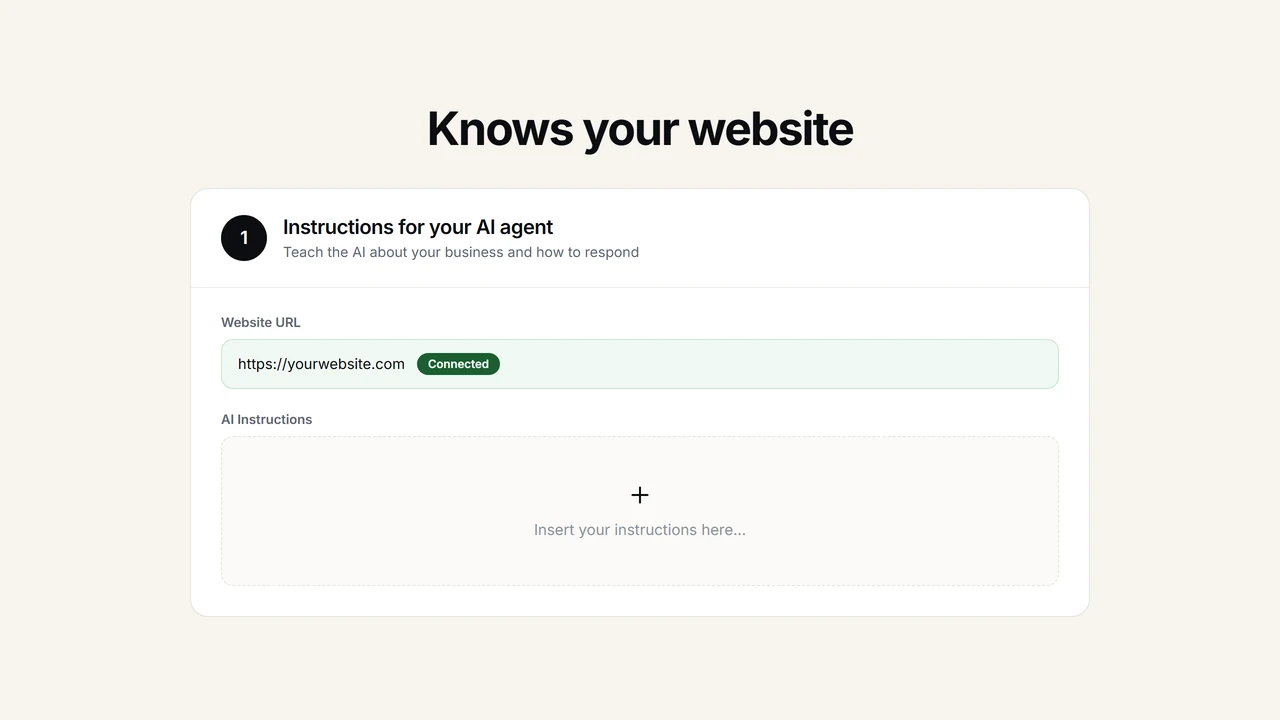
- One setup, continuous automation across all client sitesEach client chatbot operates independently with its own knowledge base, branding, and conversation history. Adding a new client takes about twenty minutes: add the domain, let the AI read the site, configure the widget, and paste the embed script. The chatbot goes live immediately and continues running without maintenance — even when the client updates their website content, the knowledge base refreshes automatically.
20 white-labeled client sites from a single agency account
The operational advantage of white label marketing automation is that scale does not expose the underlying infrastructure. Whether you manage three clients or eighteen, every chatbot carries your brand, every dashboard shows your logo, and every client interaction reinforces the perception that your agency built this capability. The Pro plan at $449/month gives you 20 client sites, 50,000 pooled messages, and complete branding control. Agencies growing beyond 20 sites can move to a Custom Pro plan with expanded limits — same white-label experience, higher capacity.
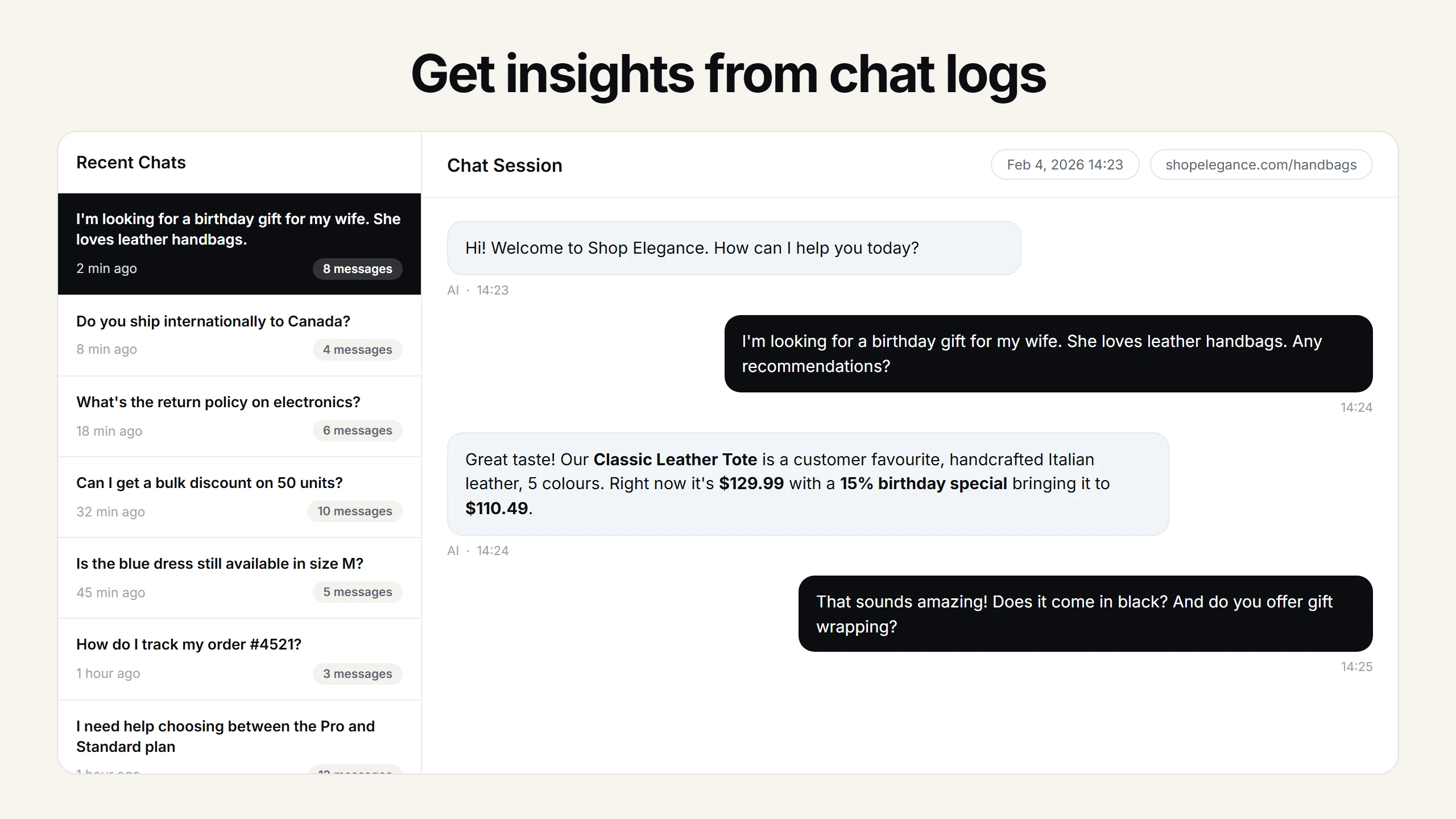
- Embeddable client dashboard under your domainEach client gets access to a white-labeled dashboard that you embed on your own website. They log in at your URL, see your branding, and review three tabs: Conversations (full chat transcripts), Analytics (message volume, engagement trends), and Leads (captured contacts with CSV export). Your client interacts with your platform — the underlying technology is invisible to them.
- Complete branding removal on ProThe Pro plan removes all third-party branding from the chat widget automatically. Your agency name replaces it. Your logo appears in the widget header. Your brand colors define the visual identity. On the Standard plan at $139/month, white-label branding is available by request — email [email protected] to activate it. Either way, the end result is a chatbot that looks and feels like it was built in-house.
- Pooled messages across your entire portfolioThe 50,000 monthly messages on Pro are shared across all your client sites. A quiet accounting firm using 60 conversations per month balances against a busy restaurant generating 800. The pooling model eliminates per-client usage anxiety and means you rarely need to think about allocations — the pool absorbs natural usage variation across your portfolio.
- Custom Tools extend automation beyond conversationAvailable on Standard and Pro plans, Custom Tools connect the AI to your client's own API endpoints. A hotel's chatbot checks room availability. A clinic's bot looks up appointment slots. An ecommerce client's bot retrieves order status. These integrations transform the chatbot from a marketing engagement tool into an operational automation layer — and your client sees it as part of your platform's capabilities, not an external integration.
- 36 languages without per-language configurationThe AI detects each visitor's language automatically and responds in kind. A Spanish-speaking visitor on an English-language site receives Spanish responses generated from the English content. For agencies with multilingual or international clients, this means a single chatbot deployment handles every language — no separate instances, no translation management, and no additional cost.
Launch your first white-labeled chatbot in 20 minutes
No coding, no rule-building, no language-by-language setup. Add the client site, brand the widget to your agency, and paste one line of code.
- Subscribe to the Pro plan at asyntai.com/pricing — $449/month covers 20 client sites, full white-label branding, and 50,000 messages.
- Add your client's domain in the dashboard. The AI automatically crawls up to 50 pages of their website and builds a knowledge base from their content — no manual data entry or document uploading required.
- Brand the widget with your agency name, logo, and colors. Set AI instructions to match the client's tone — for example, always suggest booking a consultation, or redirect billing questions to a specific number.
- Copy the one-line embed script and add it to the client's site. The chatbot goes live immediately — engaging visitors, capturing leads, and answering questions under your agency brand around the clock.
<!-- Captures leads, engages visitors, never shows who built it -->
<script src="https://asyntai.com/widget.js"
data-id="client-site-id" async>
</script>
# One line. Full white-label. Your brand on every surface.
# The chatbot runs the marketing — your client sees only you.
How reselling works
From signing up to billing your first client — four simple steps.
Choose a plan
Subscribe to a plan that fits how many client websites you need. Pro is the most popular for resellers — white-label plus up to 20 websites.
View plans →Add a client website
Each website you add under your account is one client's chatbot. Add up to the number your plan allows.
Go to your dashboard →Set up the chatbot
Add the client's content, customize the widget to their brand, and install it on their site. You can also give the client read-only access to their chat logs, analytics and leads on your own website.
Setup guide →Resell at your price
Charge your client whatever you like. You own the relationship and bill them directly — the margin is yours, every month.
Reseller Resources
Everything you need to get started, answer client questions, and see the dashboard in action
Reseller Guide
Step-by-step walkthrough: white-label branding, the embeddable client dashboard, and how to get your first client live.
Read the guideReseller FAQ
Pricing, margins, billing, white-label details, platform compatibility, and everything else partners ask before starting.
View FAQClient Dashboard Demo
See the embeddable white-label dashboard with sample data — conversations, analytics, and leads under your brand.
See the demoWhite label marketing automation for agencies — FAQs
Common questions about reselling AI chatbot automation under your agency brand.
What exactly does "white label" mean in this context?
White label means every visible element of the chatbot and its management dashboard carries your agency's branding instead of ours. The chat widget on your client's website shows your agency name, your logo, and your colors. The "Powered by" badge is removed entirely. The client dashboard — where your client reviews conversations, analytics, and leads — is embeddable on your own website under your domain. Your client interacts with what appears to be your proprietary marketing automation tool. There is no visible trace of the underlying platform anywhere in the experience.
Which plans include white-label branding?
The Pro plan at $449/month includes automatic white-label branding — all third-party branding is removed as soon as you subscribe. The Standard plan at $139/month supports white-label branding by request; email [email protected] to activate it. Both plans include the embeddable client dashboard. The key difference beyond branding is capacity: Standard supports 3 client sites with 15,000 messages, while Pro supports 20 sites with 50,000 messages. Most agencies reselling to multiple clients start on Pro for the higher capacity and automatic branding removal.
How does the embeddable client dashboard work?
The client dashboard is a standalone interface that you embed on your own website using an iframe or direct link. Each client gets their own login credentials and sees only their data: Conversations (full chat transcripts with visitor details), Analytics (message volume, engagement trends over time), and Leads (captured contacts with name, email, inquiry reason, and full conversation context — exportable as CSV). The dashboard displays your agency branding throughout. You control what each client can access, and all data is isolated between clients. Your clients manage their chatbot performance from what they perceive as your platform.
How does the chatbot capture leads through marketing automation?
The AI engages visitors in natural conversation instead of presenting static forms. When a visitor asks a question that signals buying interest — pricing inquiries, service comparisons, availability checks — the chatbot answers their question first, then asks for their name and email so someone can follow up with details. This conversational approach captures visitors who would never fill out a "Contact Us" form, because they willingly share contact information after receiving a helpful answer. All leads appear in the dashboard with full conversation transcripts, and your client can export them as CSV for import into any CRM system.
Can each client's chatbot have different branding and behavior?
Yes. Every client site you add gets its own completely independent configuration: its own knowledge base (built automatically from their website content), its own widget appearance (matching the client's website design within your agency's outer branding), its own AI instructions (controlling tone, specific handling rules, and fallback behavior), and its own conversation history. A veterinary clinic's chatbot never crosses wires with a roofing company's. You configure each one independently, and the AI uses only that client's content to generate responses.
What happens when I grow past 20 client sites?
Agencies exceeding 20 sites can move to a Custom Pro plan with expanded site limits and higher message allocations. The transition is seamless — your existing client configurations, conversation histories, and branding settings carry over. Custom Pro plans are priced based on your specific needs, and white-label branding remains fully included. Many agencies start on the standard Pro plan, fill it to 15-20 clients, and then upgrade to Custom Pro as they continue scaling.
Do I need technical skills to set up the chatbots?
No. The entire setup process is point-and-click. You add a client's domain, the AI crawls up to 50 pages of their website and builds a knowledge base automatically — no manual data entry, no document formatting, no rule-writing. You customize the widget appearance through a visual editor, set optional AI instructions in plain language, and copy a one-line embed script to paste on the client's site. The script works on any website that supports custom code: WordPress, Shopify, Wix, Squarespace, Webflow, and over 30 other platforms. Most agencies complete their first client setup in under 20 minutes.
How much can I charge clients for the automated chatbot?
You set your own prices — there are no restrictions or guidelines on what you charge. Agencies typically charge between $150 and $400 per month per client for an AI chatbot that handles visitor engagement, lead capture, and after-hours support. At $200 per client with 15 clients on the Pro plan ($449/month), you collect $3,000 in revenue against $449 in cost — $2,551 in monthly gross margin. Some agencies bundle the chatbot into broader marketing retainers, while others sell it as a standalone product. Either way, the margin structure is favorable because your delivery cost is fixed regardless of how many clients you serve.
Is there an affiliate option instead of white-label reselling?
Yes. The affiliate program is designed for agencies that encounter clients who prefer to manage the chatbot themselves. Instead of white-labeling and billing the client directly, you refer them through a tracking link and earn a 20% recurring commission on their subscription for up to 12 months. A referral who subscribes to Pro generates $89.80/month in affiliate income with no ongoing work on your part. Many agencies use both models: white-label reselling for clients who want a managed service, and affiliate referrals for clients who prefer self-serve. The two approaches complement each other and let you monetize every type of prospect.
Why white-label changes the economics of selling marketing automation
The difference between reselling a branded tool and reselling white-label marketing automation is not cosmetic — it is structural. When a client can see the name of the vendor behind the chatbot on their website, they can look up that vendor, compare pricing, and wonder why they are paying you instead of subscribing directly. That question, even when unspoken, erodes the perceived value of your agency's involvement. White-label branding eliminates the question entirely. The client sees your agency name in the widget, your logo in the dashboard, and your domain in the URL where they review their conversations and leads. The technology appears to be yours. The conversation about value shifts from "why am I paying a middleman" to "my agency built me a marketing tool that captures leads while I sleep." That reframing is worth more than any feature specification.
Brand perception compounds over time in ways that agencies underestimate at the moment of purchase. On day one, white-label branding simply means removing a "Powered by" badge. But by month three, the client has logged into your branded dashboard dozens of times. They have exported lead CSVs from what they believe is your platform. They have shown the chatbot to a colleague and said "our marketing agency set this up for us." Each of these interactions reinforces the association between your agency and the automation capability. By month six, the chatbot is not something your agency provides — it is something your agency is. The technology becomes part of your brand identity in the client's mind, and that perception is extremely difficult for a competitor to dislodge. You are no longer one of several agencies the client could work with; you are the agency that built their marketing automation system.
The mechanics of white-label marketing automation are simpler than the concept suggests. You subscribe to a plan, add a client's website domain, and the AI crawls their pages and builds a knowledge base from the content it finds — service descriptions, product details, pricing pages, FAQs, blog posts. There are no rules to write, no decision trees to map, and no question-and-answer pairs to manually define. The AI reads the content and uses it to answer visitor questions accurately, in whatever language the visitor speaks. You brand the widget to your agency, paste a single script tag on the client's site, and the chatbot goes live. The entire setup for a new client takes about twenty minutes. What makes this marketing automation, rather than just a chatbot, is what happens next: the AI captures leads through conversation, engages visitors after hours, deflects repetitive questions, and collects contact information from prospects who would never fill out a static form. These are the marketing tasks that agencies typically perform manually or not at all.
Pricing white-label marketing automation is where the margin advantage becomes concrete. Your cost is fixed: $449/month for the Pro plan, which covers up to 20 client sites. Your revenue is variable and entirely under your control. Most agencies charge between $150 and $400 per month per client for an AI chatbot that captures leads and handles visitor engagement. At $250 per client across twelve clients, you collect $3,000/month in revenue against $449 in platform cost — $2,551 in gross margin, or an 85% margin rate. Adding client thirteen does not increase your cost by a dollar, but adds another $250 in revenue. The margin improves with every client you onboard, and the work required to deliver the service does not scale with the client count. Compare that to any hourly or project-based service your agency currently sells, and the leverage is immediately visible.
The embeddable client dashboard is what transforms white-label marketing automation from a widget into a platform experience. When you embed the dashboard on your own website, each client logs in under your domain and reviews their chatbot's performance: Conversations tab with full transcripts, Analytics tab with engagement metrics and trends, and Leads tab with every contact captured through conversation — names, emails, inquiry reasons, and full conversation context. The dashboard displays your logo, your colors, and your agency name throughout. For the client, this is not a chatbot they were given access to; it is a marketing intelligence platform they pay your agency to operate. The dashboard is what makes the monthly fee feel justified even in quiet months, because the client can see the work happening — conversations handled, visitors engaged, leads collected — without you needing to send a report or schedule a review call.
Client retention on white-label marketing automation is structurally higher than on most agency services. The chatbot accumulates configuration over time — AI instructions tuned to the client's specific tone, supplementary documents uploaded to cover niche topics, response patterns refined from real conversation data. This accumulated intelligence makes the chatbot more accurate and more valuable month after month. It also creates a genuine switching cost. A client who has spent four months refining their chatbot's behavior is not going to walk away and start over, because the refinement represents real effort and measurable improvement. Add the brand perception layer — the client thinks of this as your platform — and you have a service with stronger retention dynamics than any campaign-based or project-based offering. Churn drops below 5% monthly for most agencies running white-label chatbot automation, compared to industry averages of 10-15% for standard marketing retainers.
Vertical specialization amplifies the white-label advantage in a way that horizontal agencies miss. When you build chatbots for ten dental practices, you develop an instruction template that handles the questions dental visitors always ask: insurance acceptance, emergency appointment availability, cosmetic procedure pricing, new patient intake process. Your eleventh dental deployment takes ten minutes instead of twenty, because the template is already dialed in. More importantly, you can position the chatbot as a "dental front desk automation" rather than a generic chatbot — which commands premium pricing and builds referral networks within the vertical. The technology is identical for every client; the specialization lives in your configuration and positioning. But the client perceives proprietary dental expertise, which justifies $300-400/month rather than $150.
The 36-language capability matters more for white-label marketing automation than for standalone chatbots, because agency clients increasingly serve multilingual audiences. A real estate agency in Miami needs Spanish and English. A tourism company in Montreal needs French and English. An ecommerce brand shipping internationally needs a dozen languages. With white-label automation, you deploy one chatbot per client and it handles every language automatically — no separate instances, no translation management, no additional configuration. The AI detects the visitor's language and responds in kind, generating answers from the client's content regardless of what language the content is in. For the client, this looks like your platform has built-in multilingual intelligence. For you, it required zero extra work.
Custom Tools on Standard and Pro plans extend white-label marketing automation into operational territory. Without Custom Tools, the chatbot answers questions and captures leads. With Custom Tools, the chatbot takes actions: checking order status against a client's ecommerce system, looking up appointment availability from a scheduling API, retrieving account details from a CRM. These integrations make the chatbot feel like a fully integrated part of the client's business, not just a marketing layer. For agencies, Custom Tools create a natural upsell tier. Basic chatbot automation at one price; advanced automation with system integrations at a premium. The setup is straightforward — you define the API endpoint, what parameters to send, and when the tool should be triggered — and the perceived value to the client is substantial because the automation now replaces human tasks.
Platform compatibility ensures that white-label marketing automation works regardless of what website builder your clients use. The chatbot installs via a single JavaScript tag that works on any site supporting custom scripts. WordPress has an official plugin for even simpler installation. Shopify has an App Store listing. Wix, Squarespace, Webflow, Magento, WooCommerce, Joomla, Drupal, and over 30 other platforms support the embed natively. For agencies, this eliminates the qualification step of checking whether a prospect's site is compatible before pitching. Every client in your pipeline can run the chatbot, which means every client is a potential white-label deployment. You never have to turn someone away because of their tech stack.
The affiliate program complements white-label reselling for agencies that encounter two distinct types of clients. Some clients want a managed service — they want you to handle everything and just see the results. These are your white-label clients, and they pay your monthly fee for the convenience of never touching the technology. Other clients want control — they prefer to log in, adjust settings, review data, and manage things themselves. These are your affiliate referrals. You send them a tracking link, they subscribe directly, and you earn a 20% recurring commission on their subscription for up to 12 months. A Pro referral generates $89.80/month in passive income. Running both channels means you monetize every type of prospect: high-touch clients through white-label margins, low-touch clients through affiliate commissions.
Measuring performance for white-label clients is built into the dashboard, which means your monthly review conversations are backed by hard data rather than subjective impressions. You can show each client exactly how many conversations the chatbot handled, how many leads it captured, what percentage of visitor questions were answered without human intervention, and how engagement trends have moved over time. These are tangible metrics tied to the client's own website visitors. When a dental practice sees 45 leads captured last month through the chatbot — each with a full conversation transcript showing what the visitor asked and how the bot responded — the value of the $250 monthly fee is self-evident. You do not need to defend the price; the dashboard defends it for you.
The operational reality of running white-label marketing automation across a portfolio of clients is lighter than any comparable service offering. New client setup takes twenty minutes. Ongoing maintenance is close to zero because the AI updates its knowledge base automatically when website content changes. Client communication centers on periodic performance reviews and occasional AI instruction adjustments. There are no creative revisions, no campaign builds, no reporting deadlines. The automation runs continuously, the leads flow into your branded dashboard, the clients pay monthly, and you spend your time growing the business rather than servicing it. For agencies looking to build high-margin recurring revenue that scales without proportionally expanding their team, white-label marketing automation delivers exactly that.
Ready to sell marketing automation under your own brand? Start with the Pro plan and launch your first white-labeled client chatbot in under 20 minutes — or email [email protected] with questions about scaling.