White label for agencies: rebrand an AI chatbot and sell it as your own product
Strip every trace of the original brand. Replace it with yours. Your clients see your name on the chatbot, your logo in their dashboard, and your invoice in their inbox.
See the chatbot your clients will think you built
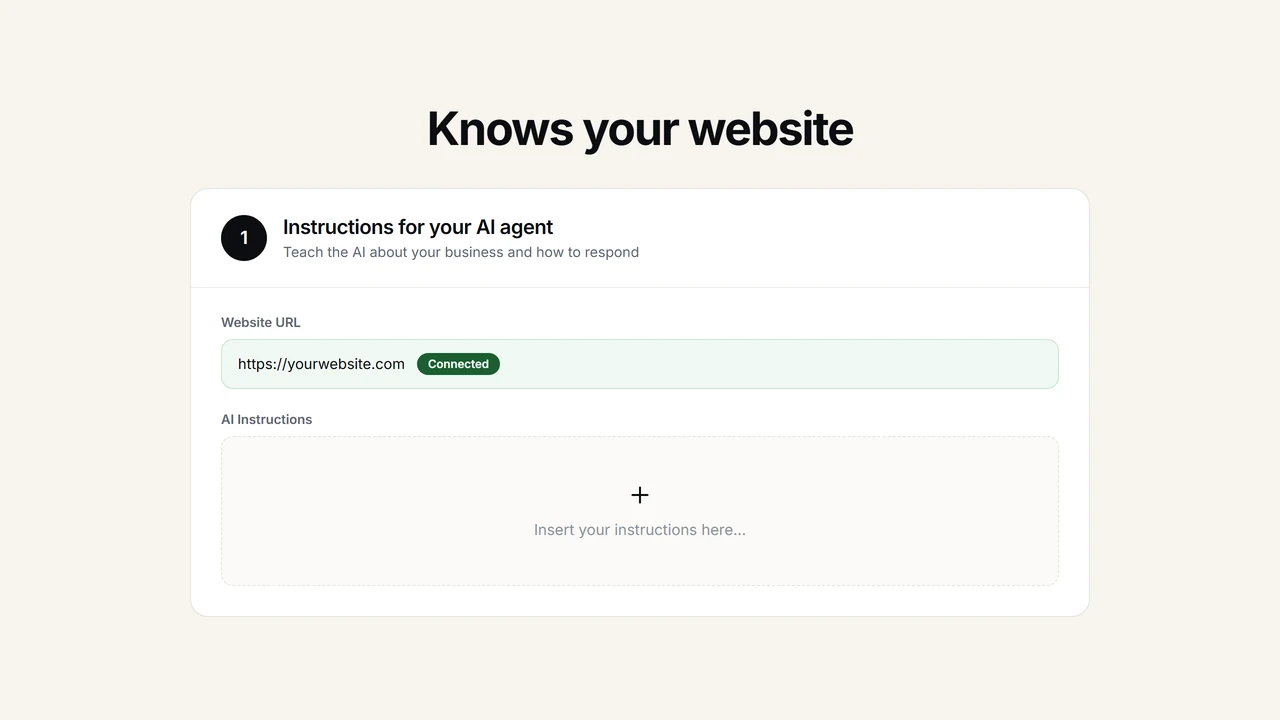
Enter any website URL. The AI reads the content and creates a working chatbot in seconds — the same product you will white-label and deploy under your agency brand.
Your brand on every surface — the client never sees anyone else
White-labeling is the difference between being a vendor who recommends tools and being a provider who delivers a proprietary product. When your agency name appears on the chat widget, on the client dashboard, and in every interaction a visitor has with the chatbot, the client perceives the AI as something you built and operate. That perception justifies premium pricing, deepens the relationship, and makes switching to another provider feel like abandoning your technology — not just canceling a subscription. On the Pro plan at $449/month, all original branding is automatically removed and replaced with yours across 20 client websites and 50,000 shared messages. Standard plan users at $139/month for 3 sites can request manual white-label activation by emailing [email protected]. In either case, your agency name, logo, and colors are the only things a client or their website visitors ever see.
- Complete brand replacement, not a logo swapWhite-label on Pro removes every original identifier from the widget header, chat interface, and client-facing dashboard. Your agency name appears in the greeting, in the powered-by line, and throughout the dashboard navigation. A visitor clicking the chat bubble sees your brand. A client reviewing their conversation logs sees your brand. There is no asterisk, no fine print, and no residual mark from the underlying platform.
- Clients perceive proprietary technologyWhen a client tells their board "our agency deployed an AI assistant on the website," they are talking about your product. They are not talking about a third-party tool you recommended. That distinction matters because proprietary products command higher fees, create deeper trust, and make the agency indispensable. The client is not buying a chatbot — they are buying your AI capability.
- A branded dashboard that lives on your websiteEach client gets a white-labeled dashboard you can embed directly on your agency site — password-protected and domain-restricted. Conversations, analytics, and leads all appear under your brand. The client logs into your website to see their data, not someone else's platform. Over time, their conversation history and captured leads accumulate there, raising the switching cost with every month.
Every touchpoint carries your name — from the first chat bubble to the monthly report
White-label is not a single setting you toggle. It is a comprehensive brand replacement across every surface a client or visitor touches. Here is exactly what changes when you activate white-label on Pro — or request it on Standard. Agencies scaling beyond 20 sites move to the Custom Pro plan for higher capacity with full white-label intact.
- Chat widget: your name, your logo, your colorsThe widget that appears on a client's website displays your agency name in the header, your logo in the avatar, and your brand colors throughout the interface. Visitors interact with what appears to be your agency's AI product. There is no "powered by" attribution, no external links, and no indication that the technology originates anywhere other than your agency.
- Client dashboard: your portal, your domainThe embeddable dashboard that shows Conversations, Analytics, and Leads tabs uses your branding throughout. You embed it on your own website, secure it with passwords, and restrict access by domain. Your client opens a browser, navigates to your website, and reviews their chatbot data — entirely within your ecosystem. They never leave your site, and they never see another brand.
- Widget customization: match any client's visual identityBeyond your agency branding, each client's widget is individually configurable. Set the widget colors to match their website, choose the position (bottom-right or bottom-left), customize the welcome greeting, and adjust the avatar. A law firm gets a conservative blue theme. A children's toy store gets a playful green. The white-label branding (your agency name) remains consistent while the visual treatment adapts to each client.
- Zero branding leakage in notifications and exportsLead capture emails, CSV exports, and conversation transcripts carry no original platform branding. When a client exports their leads or reviews a transcript, the data is clean — associated with the domain and the chatbot, not with any underlying provider. Your agency controls the narrative from end to end.
- 36 languages — all white-labeledThe AI detects visitor language automatically and responds in kind. Whether a visitor writes in Japanese, Spanish, or Arabic, the white-labeled widget handles it natively. Your agency brand appears consistently regardless of language, and you never need separate configurations for multilingual clients.
White-label a client chatbot and go live in 20 minutes
No development work required. Subscribe, brand the widget, add a client site, and paste one script tag. The white-label branding applies automatically on Pro.
- Subscribe to the Pro plan at asyntai.com/pricing ($449/month, 20 sites, automatic white-label). Standard ($139/month, 3 sites) also supports white-label — email [email protected] to activate.
- Open your dashboard and set your agency branding — upload your logo, enter your agency name, and choose your brand colors. This applies across all client widgets and dashboards.
- Add your first client's domain. The AI reads up to 50 pages of their website content and builds a knowledge base automatically. Upload supplementary documents — PDFs, product catalogs, internal guides — to fill any gaps.
- Copy the embed script and install it on the client's site. Works on WordPress, Shopify, Wix, Squarespace, and 30+ other platforms. The chatbot appears immediately with your agency branding.
<!-- Your brand. Your pricing. Your client relationship. -->
<script src="https://asyntai.com/widget.js"
data-id="client-site-id" async>
</script>
# One script tag. Works everywhere.
# Your agency delivers AI. The client sees your brand.
How reselling works
From signing up to billing your first client — four simple steps.
Choose a plan
Subscribe to a plan that fits how many client websites you need. Pro is the most popular for resellers — white-label plus up to 20 websites.
View plans →Add a client website
Each website you add under your account is one client's chatbot. Add up to the number your plan allows.
Go to your dashboard →Set up the chatbot
Add the client's content, customize the widget to their brand, and install it on their site. You can also give the client read-only access to their chat logs, analytics and leads on your own website.
Setup guide →Resell at your price
Charge your client whatever you like. You own the relationship and bill them directly — the margin is yours, every month.
Reseller Resources
Everything you need to get started, answer client questions, and see the dashboard in action
Reseller Guide
Step-by-step walkthrough: white-label branding, the embeddable client dashboard, and how to get your first client live.
Read the guideReseller FAQ
Pricing, margins, billing, white-label details, platform compatibility, and everything else partners ask before starting.
View FAQClient Dashboard Demo
See the embeddable white-label dashboard with sample data — conversations, analytics, and leads under your brand.
See the demoWhite label for agencies — FAQs
Common questions about white-labeling an AI chatbot and selling it under your agency's brand.
What exactly gets white-labeled?
Everything the client and their website visitors see. The chat widget header displays your agency name instead of the original brand. Your logo appears as the avatar. Your brand colors are used throughout the interface. The client dashboard — where clients view Conversations, Analytics, and Leads — shows your branding in the navigation and headers. There is no "powered by" text, no external links, and no residual branding from the underlying platform. If a visitor inspects the widget or a client examines their dashboard, they find your agency brand and nothing else.
Which plans include white-label branding?
White-label is automatic on the Pro plan ($449/month, 20 sites, 50,000 messages). On the Standard plan ($139/month, 3 sites, 15,000 messages), white-label can be activated manually — email [email protected] to request activation. The Starter plan ($39/month, 2 sites, 800 messages) and free tier do not include white-label. Most agencies reselling chatbots choose Pro because it combines white-label with sufficient capacity to run a profitable book of clients.
Can my clients tell who the underlying provider is?
No. White-label on Pro removes every identifying marker. The widget source code loads from a generic script URL. The client dashboard is embedded on your website, so the browser address bar shows your domain. There are no outbound links, branding watermarks, or meta tags that reveal the underlying technology. Your clients interact with what appears to be your agency's proprietary AI product. Many reselling agencies have operated for months without a single client discovering the underlying provider.
How does the embeddable client dashboard work?
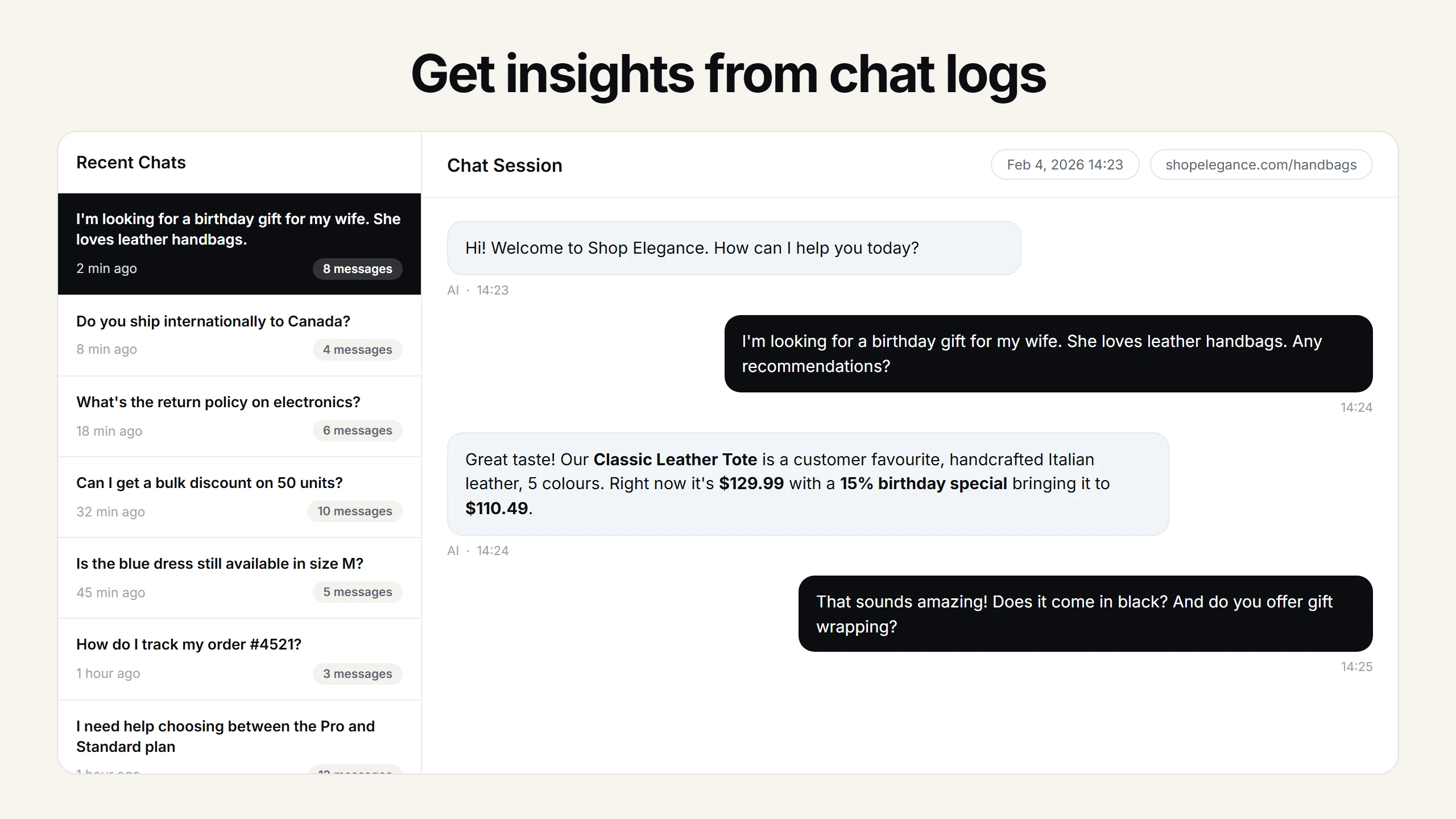
Each client gets a white-labeled dashboard with three tabs: Conversations (full chat transcripts with timestamps), Analytics (message volume, peak hours, usage trends), and Leads (captured visitor contact information with CSV export). You embed this dashboard on your own agency website using an iframe. It is password-protected and can be restricted by domain, so only the intended client can access their data. The dashboard carries your agency branding — your name, your colors — and the client never leaves your website to view their chatbot data.
Can I customize each client's widget differently while keeping my agency brand?
Yes. Your agency branding (name, logo) stays consistent across all client widgets, but each widget can be individually styled to match the client's website. You can set different colors, widget positions (bottom-right or bottom-left), welcome greetings, and avatars per client. A financial advisory firm gets a navy theme with a formal greeting. A yoga studio gets a warm palette with a casual tone. The white-label branding layer — your agency identity — sits on top of these per-client customizations.
What if I need more than 20 client sites?
The Custom Pro plan extends your capacity beyond 20 sites and 50,000 messages with full white-label branding intact. It is designed for agencies that have validated the reseller model and are scaling their client roster. Contact [email protected] to discuss your requirements and get a plan tailored to your volume.
How quickly can I go from signup to deploying a white-labeled chatbot?
About 20 minutes. Subscribe to Pro, set your agency branding in the dashboard (logo, name, colors), add a client's domain, and paste the one-line embed script on their website. The AI reads the client's website content automatically and builds a knowledge base — no manual data entry required. The chatbot goes live immediately with your agency branding. You can set up additional clients in 10-15 minutes each because your agency branding is already configured.
Does white-label apply to all 36 supported languages?
Yes. The AI detects visitor language automatically and responds accordingly. Your agency branding — name, logo, colors — appears consistently regardless of which language the visitor uses. Whether a visitor chats in English, Japanese, Arabic, or any of the other 36 supported languages, the white-label experience is identical. There is no additional configuration needed for multilingual white-label support.
Can I combine white-label reselling with the affiliate program?
Yes — many agencies use both models. For clients you manage directly, white-label reselling gives you full control and higher margins: you set the price, own the billing relationship, and the client sees your brand. For clients who prefer self-service and do not need your ongoing management, refer them through your affiliate link and earn a 20% recurring commission on their subscription for up to 12 months. The two models serve different client profiles and maximize your revenue across your entire pipeline.
White label for agencies: why the brand on the chatbot matters more than the chatbot itself
There is a thought experiment that clarifies the entire white-label proposition. Imagine two agencies pitch the same prospect. Agency A opens a laptop and shows a chatbot on the prospect's website with a third-party logo in the corner and someone else's name in the header. Agency B shows the same chatbot — identical technology, identical answers — but with their own agency logo, their own name in the header, and their own colors throughout the interface. Agency A is demonstrating a product they found. Agency B is demonstrating a product they appear to have built. The prospect does not know the difference, and that is the point. The technology behind the chatbot is invisible. The brand on the chatbot is the product. White-labeling does not change what the chatbot does. It changes who gets the credit.
Most agencies already understand branding as a concept — it is, after all, what many of them sell to their clients. But they rarely apply the same logic to their own service delivery tools. An agency that sends clients to a third-party dashboard, or deploys a widget with someone else's name on it, is advertising someone else's product every time the client logs in or a visitor chats. Every impression is a reminder that the agency did not build this. Every help article linked to an external domain is a breadcrumb trail leading the client away from the agency's ecosystem. Over months, these micro-exposures erode the client's perception of the agency as the source of value. White-labeling reverses this dynamic entirely. The client sees one brand — yours — and attributes the chatbot's performance to your agency's capability.
The mechanics of white-label branding on the Pro plan are comprehensive by design. Your agency name replaces the original in the widget header. Your logo appears as the chatbot avatar. Your chosen color palette is applied to buttons, borders, and accent elements throughout the chat interface. The client dashboard — the portal where clients view conversation transcripts, review analytics, and export captured leads — displays your agency branding in the navigation bar, page headers, and footer. When you embed that dashboard on your own agency website using the provided iframe, the client accesses their chatbot data without ever leaving your domain. The browser URL bar shows your website. The page design matches your site. The branding is yours. There is nothing to trace back.
What makes this meaningful for revenue — not just aesthetics — is the price differential it supports. An agency that deploys a chatbot with visible third-party branding is effectively installing a commodity on the client's site. The client can see what the product is, look it up, and potentially buy it directly for less than the agency charges. That transparency puts downward pressure on pricing and invites comparison shopping. A white-labeled chatbot, by contrast, is opaque. The client cannot comparison-shop because they do not know what the underlying product is. They evaluate the chatbot on its performance and on their trust in the agency, not on the retail price of a SaaS subscription. This is why white-label resellers routinely charge $250 to $400 per client per month for a product that costs them roughly $22 per client slot on Pro. The margin is not gouging — it reflects the value of integration, support, branding, and the perception that this is the agency's own technology.
The client dashboard is where white-labeling becomes a retention mechanism, not just a branding exercise. Each client accumulates data in their dashboard from the first day the chatbot goes live: conversation transcripts showing every visitor interaction, analytics charts revealing peak engagement hours and message trends, and a growing database of captured leads with names, email addresses, and phone numbers. After three months, that dashboard contains business intelligence the client relies on. After six months, it contains a lead database they cannot replicate elsewhere. After a year, switching chatbot providers means abandoning a year of conversation history, lead data, and performance trends — all hosted on the agency's website, under the agency's brand. The dashboard does not just display data. It accumulates switching costs month after month.
Agencies that resell without white-label operate in a fundamentally different competitive position. Their clients know the product. Their clients can price-compare. Their clients can bypass the agency and buy direct. The agency's value proposition shrinks to "we set it up for you," which is a one-time service, not an ongoing relationship. White-label agencies, by contrast, own the relationship from the brand layer down. The client cannot bypass them because the client does not know there is anything to bypass. The agency's value proposition is "we built this AI product and we run it for you," which is a recurring relationship that the client has no reason to question. This structural advantage compounds over time as the client's dependence on the dashboard, the lead data, and the conversational AI grows deeper.
Setting up white-label branding takes about five minutes within the dashboard. Upload your agency logo, enter your agency name, select your primary and accent colors. These settings propagate automatically to every widget deployed under your account and to every client dashboard. When you add a new client site, the white-label branding is already in place — you configure the client's individual widget colors and greeting, but your agency identity is baked in from the start. On the Pro plan at $449/month, this happens automatically. On the Standard plan at $139/month, email [email protected] to request activation. Once activated, the experience is identical.
The financial model of white-label reselling favors agencies that fill their capacity. The Pro plan covers 20 client websites and 50,000 shared messages for $449/month. Your cost per client slot is approximately $22.45 if you fill all 20. At five clients charging $250 each, you collect $1,250/month against $449 in cost — $801/month in margin, roughly $9,600 annually. At twelve clients at $300 each, revenue reaches $3,600/month with $3,151 in margin — over $37,800 annually. At full capacity with 20 clients averaging $275 each, you are collecting $5,500/month against $449 — more than $60,000 in annual margin from a service that requires minimal ongoing effort after the initial deployment. Agencies that exceed 20 clients move to the Custom Pro plan for expanded capacity.
Vertical specialization amplifies the white-label advantage. A generic agency offering "AI chatbot" competes on price. An agency offering "AI front desk for veterinary clinics" competes on expertise. When you specialize, your white-labeled chatbot stops being a generic widget and becomes a vertical solution — complete with pre-configured greetings, industry-specific AI instructions, and a setup process you can complete in ten minutes because you have already solved the configuration for that industry. A dental practice sees "AI Patient Assistant by [YourAgency]" and perceives a purpose-built product for dental offices. The white-label branding makes this believable because nothing contradicts it. The combination of vertical positioning and white-label branding is the strongest version of this model.
Custom Tools — available on Standard and Pro plans — expand what the white-labeled chatbot can do beyond answering questions. Without Custom Tools, the chatbot responds using the client's website content: product details, FAQs, policies, hours. With Custom Tools, you configure the chatbot to call the client's own API endpoints during a conversation. An HVAC company's chatbot checks appointment slots and books a service call. A subscription box company's chatbot looks up a customer's next delivery date. A property management firm's chatbot retrieves maintenance request status. These integrations are invisible to the visitor — the chatbot simply answers the question. But for the agency, they create a premium tier: basic white-label chatbot at $200/month, chatbot with Custom Tools integration at $400/month. The stickiness increases because the integrations are specific to each client's systems and would need to be rebuilt elsewhere.
Platform compatibility eliminates one of the most common objections in agency sales conversations. The chatbot installs via a single JavaScript tag that works on any website regardless of the underlying platform. Official plugins exist for WordPress and Shopify. The embed script is compatible with Wix, Squarespace, Webflow, Magento, WooCommerce, Joomla, Drupal, OpenCart, and over 30 other platforms. An agency with clients on seven different website builders deploys the white-labeled chatbot the same way on all of them. You never have to qualify a prospect based on their tech stack, and you never have to say "sorry, we do not support that platform." If the client has a website, the chatbot runs on it — with your agency branding intact.
The affiliate program creates a complementary revenue stream alongside white-label reselling. Some prospects want a chatbot but do not want ongoing agency management — they prefer to handle it themselves. Rather than losing those prospects entirely, refer them through your affiliate link and earn a 20% recurring commission on their subscription for up to 12 months. A Pro plan referral generates $89.80/month. A Standard plan referral generates $27.80/month. The affiliate model is hands-off passive income; the white-label reseller model is high-margin active income. Using both ensures you monetize every prospect who shows interest in AI chatbots, regardless of their management preference.
The agencies that delay white-labeling often do so because they underestimate how much the brand on the widget affects client perception and retention. They think the chatbot's functionality is what the client is paying for. In reality, the client is paying for the experience of having an AI product that their agency deployed and manages — and that experience is defined almost entirely by whose name is on it. A chatbot answering questions accurately is table stakes. A chatbot that appears to be the agency's proprietary technology, delivered through the agency's own portal, with data accumulating under the agency's brand — that is a service worth $300/month and a relationship worth protecting. White-label is not a feature. It is the business model.
Ready to white-label an AI chatbot under your agency brand? Start with the Pro plan for automatic white-label across 20 client sites — or email [email protected] if you need a custom configuration.