White label AI assistant — always on, always accurate, always your brand
Deploy an AI assistant that answers using each client's own content. Rebrand it completely, manage 20 clients from one account, and keep the full margin.
See the AI assistant working on any website
Paste a URL below — the AI reads the site and starts answering questions from its content within minutes
Every answer comes from the client's own content — nothing invented
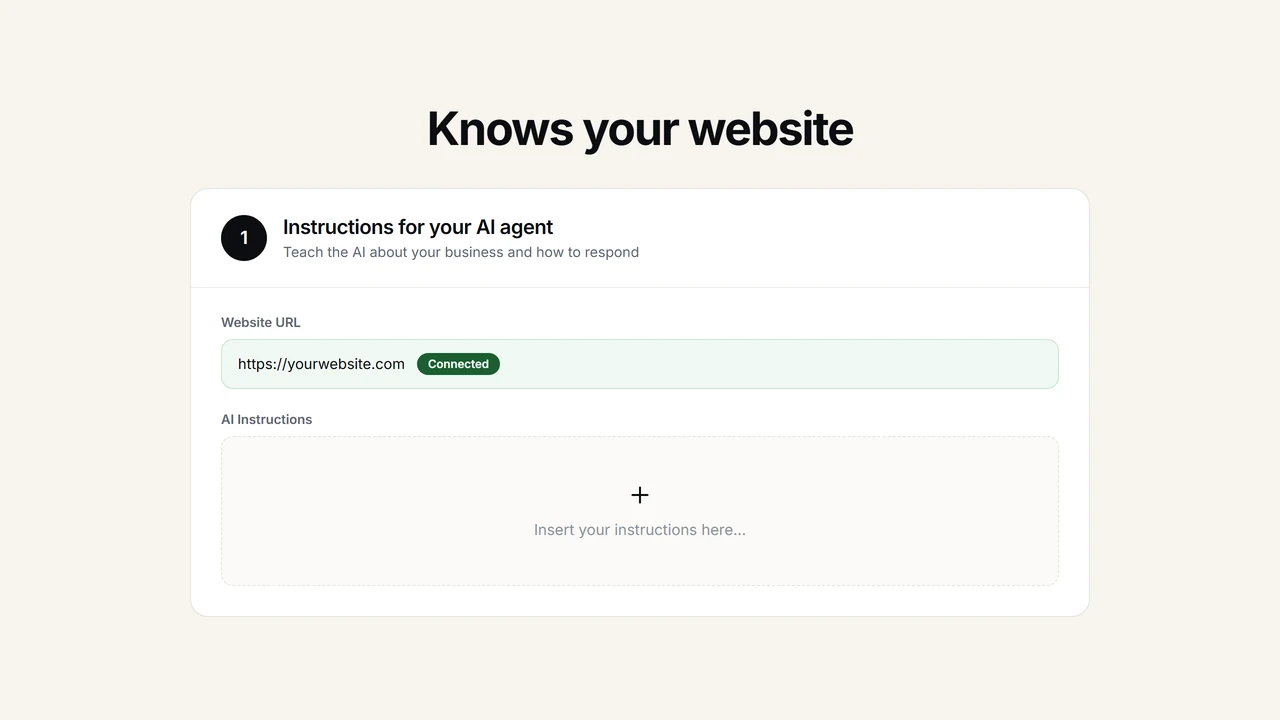
The AI assistant reads your client's website — every page, every blog post, every FAQ, every product description — and builds a knowledge base from that content. When a visitor asks a question, the assistant searches this knowledge base and constructs a response using the actual information it found. It does not generate plausible-sounding fiction or pull answers from the general internet. A visitor asking about return policies gets the exact return policy from the site. A visitor asking about a specific service gets the description as it appears on the services page. You can also upload additional documents — PDFs, internal guides, product catalogs — and the AI incorporates those alongside the crawled content. The result is an assistant that knows the business as well as a tenured employee.
- Automatic knowledge base from website contentThe AI crawls the client's site and indexes every page. Blog posts, service descriptions, pricing tables, FAQs, team bios — all of it becomes searchable knowledge the assistant draws from when answering questions.
- Upload documents to fill gapsIf the client has information that is not on their website — internal policies, product specs, training manuals — upload them as PDFs or text files. The AI incorporates them seamlessly into its knowledge base alongside the crawled pages.
- Grounded answers, not hallucinated onesThe assistant only responds with information it can trace back to the knowledge base. If the answer is not in the content, the AI says so instead of fabricating something. Accuracy is not optional when the assistant represents your client's business.
One subscription, twenty clients, margins that make the service worth offering
The Pro plan costs $449/month and covers up to 20 client sites with 50,000 messages. That puts your per-client cost around $22. Bill each client $150 to $300 per month for an always-on AI assistant — the margin is entirely yours. No revenue share, no commission split, no minimum commitment. White-label branding removes all Asyntai references: your name in the header, your logo in the widget, your colors throughout. Each client also gets access to a branded dashboard — embeddable on your website via JS snippet — with three tabs: Conversations, Analytics, and Leads with CSV export. Agencies scaling past 20 sites can move to a Custom Pro plan for higher limits.
- $449/month for 20 sites and 50,000 messagesAt full capacity, your cost per client is approximately $22/month. Charge $200 per client and your gross margin is $3,551/month. The numbers improve with every client you add because the subscription cost is fixed.
- Full white-label on Pro — zero trace of AsyntaiThe "Powered by" badge disappears. Your agency name, logo, and brand colors replace ours on the chat widget and the client dashboard. End users and clients see your brand exclusively.
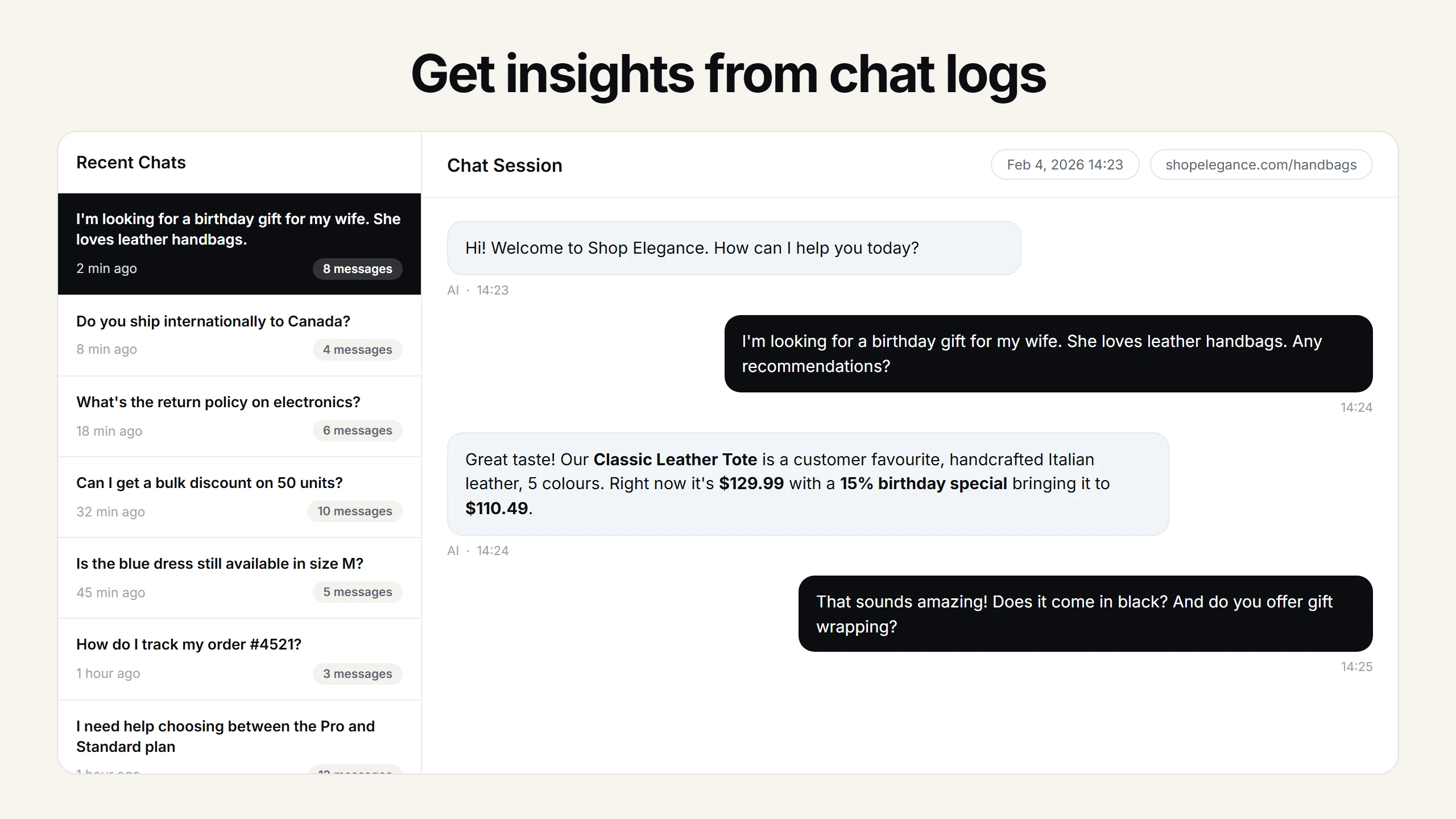
- Client dashboard with Conversations, Analytics, and LeadsGive each client a branded portal where they review chat transcripts, track usage metrics, and export captured contact details as CSV. Embed it on your own website. Password-protected, domain-restricted, fully white-labeled.
- Custom Tools for clients who need the assistant to take actionOn Standard and Pro plans, configure the AI to call your client's API endpoints — checking appointment slots, looking up order status, retrieving account details. The assistant does not just answer; it acts.
Get a white-labeled AI assistant live on a client site
Twenty minutes, no code, no API integration. The assistant reads the client's content, you set your branding, and the embed script handles the rest.
- Sign up for the Pro plan — white-label branding, 20 sites, 50,000 messages per month.
- Add your client's website URL. The AI crawls the site automatically and builds a knowledge base from all available content.
- Configure widget branding: your agency name, your logo, your colors, your welcome message. Upload any extra documents the client provides.
- Copy the one-line embed script and paste it into the client's site. The AI assistant goes live instantly under your brand.
<!-- Always on, always accurate -->
<script src="https://asyntai.com/widget.js"
data-id="client-site-id" async>
</script>
# Your brand on every surface.
# The assistant knows the client's business inside out.
How reselling works
From signing up to billing your first client — four simple steps.
Choose a plan
Subscribe to a plan that fits how many client websites you need. Pro is the most popular for resellers — white-label plus up to 20 websites.
View plans →Add a client website
Each website you add under your account is one client's chatbot. Add up to the number your plan allows.
Go to your dashboard →Set up the chatbot
Add the client's content, customize the widget to their brand, and install it on their site. You can also give the client read-only access to their chat logs, analytics and leads on your own website.
Setup guide →Resell at your price
Charge your client whatever you like. You own the relationship and bill them directly — the margin is yours, every month.
Reseller Resources
Everything you need to get started, answer client questions, and see the dashboard in action
Reseller Guide
Step-by-step walkthrough: white-label branding, the embeddable client dashboard, and how to get your first client live.
Read the guideReseller FAQ
Pricing, margins, billing, white-label details, platform compatibility, and everything else partners ask before starting.
View FAQClient Dashboard Demo
See the embeddable white-label dashboard with sample data — conversations, analytics, and leads under your brand.
See the demoWhite label AI assistant — FAQs
Answers to the questions agencies ask before deploying a rebranded AI assistant for their clients.
What makes this an "assistant" rather than a chatbot?
The distinction is depth. A typical chatbot matches keywords or follows scripted paths. The AI assistant reads the client's entire website, understands the content contextually, and constructs answers in natural language. It handles vague questions, multi-part inquiries, follow-ups that reference earlier messages, and phrasing it has never seen before. On Standard and Pro plans, Custom Tools also let the assistant perform actions — checking availability, looking up orders, retrieving account details — making it a functional helper rather than a static Q&A interface.
How does the AI learn about each client's business?
When you add a client's domain, the AI crawls their website automatically — reading pages, blog posts, product listings, FAQ sections, and any other published content. This content becomes the knowledge base that the assistant draws from when answering questions. You can supplement the crawl with uploaded documents: PDFs, spreadsheets, internal guides, product catalogs. The assistant searches this combined knowledge base for every question and responds using the actual content it found. It does not search the internet or make up information.
Does the assistant stay current when the client updates their website?
Yes. The AI re-crawls the client's website periodically and picks up new pages, updated content, and removed information. When a client publishes a new blog post, adds a product, or updates their pricing page, the assistant's knowledge base reflects those changes after the next crawl. You do not need to manually update anything. For time-sensitive content changes that need to take effect immediately, you can trigger a manual re-crawl from the dashboard.
What does the white-label branding cover?
On the Pro plan, every reference to Asyntai is removed. The "Powered by Asyntai" badge disappears from the chat widget. Your agency name replaces ours in the header. Your logo appears in the widget. Your brand colors are used throughout the interface. The embeddable client dashboard — with Conversations, Analytics, and Leads tabs — also carries your branding: your logo, your name, your primary color. Your clients interact with a dashboard that looks like part of your platform, not a third-party tool.
How many client sites can I manage?
The Pro plan supports up to 20 sites on a single subscription, each with its own knowledge base, widget configuration, AI instructions, and conversation history. All 20 sites share a pool of 50,000 messages per month. If you grow beyond 20 clients or need more messages, the Custom Pro plan extends both limits. The Standard plan at $139/month supports 3 sites and 15,000 messages for agencies starting smaller — email [email protected] to request white-label activation on Standard.
What languages does the AI assistant support?
The assistant supports 36 languages with automatic detection. There is no language configuration or selector — the AI detects the visitor's language on each message and responds in the same language. A single deployment handles visitors in English, Spanish, Japanese, German, Arabic, and any of the other supported languages without separate instances or configurations. The knowledge base content can be in any language; the AI manages the mapping between the question and the relevant content.
Can the AI assistant capture leads?
Yes. You can configure the assistant to collect visitor information — name, email, phone number, company — during the conversation. Captured leads appear in the Leads tab of the client dashboard, where the client (or you) can view them and export as CSV. Lead capture can happen naturally within the conversation flow, prompted by the AI when appropriate, or triggered by specific visitor actions. Each client's leads are stored separately and accessible only through their dashboard.
What website platforms does the embed work on?
The AI assistant embeds via a single line of JavaScript that works on any website supporting custom HTML. WordPress, Shopify, Wix, Squarespace, Webflow, Magento, Joomla, Drupal, custom-built sites — all supported. There are also dedicated plugins for 30+ platforms that simplify installation further. The widget loads asynchronously and does not interfere with the client's existing site, theme, or page builder. One embed method covers your entire client roster regardless of what platforms they use.
Is there an affiliate option if I do not want to manage clients?
Yes. The affiliate program lets you refer customers to Asyntai using a tracking link and earn 20% recurring commission on their subscription for up to 12 months per referral. A Pro plan referral earns you $89.80 per month with no setup work or client management. Some agencies combine both models: white-label for managed clients, affiliate links for casual referrals. You can apply for the affiliate program from the affiliate dashboard.
What an always-on AI assistant means for agencies that sell website services
Most website visitors leave without talking to anyone. They arrive, browse a few pages, and leave — often with unanswered questions that would have converted them into customers, patients, clients, or subscribers if someone had been there to help. A contact form does not solve this because nobody fills one out when they just have a quick question. A live chat widget does not solve this because it requires a human sitting at a desk, and most small businesses cannot staff that around the clock. An AI assistant solves it because it is always on, always responsive, and always drawing answers from the client's own content. It does not take breaks, does not call in sick, and does not go home at 5 PM. A visitor at two in the morning gets the same quality answer as a visitor at two in the afternoon. For agencies offering website services, adding a white-labeled AI assistant creates a new monthly revenue line that requires almost no ongoing work.
The "always-on" characteristic matters more than most agencies initially realize. Examine any client's analytics and you will find a long tail of visits happening outside business hours. Evening browsers, weekend researchers, visitors in different time zones — they all arrive when nobody is available. These are not idle browsers. Many of them have specific questions: "Do you offer emergency plumbing on weekends?" "Can I book a trial class for Saturday?" "What is the turnaround time for alterations?" Without an answer, they leave and try the next result on Google. The AI assistant catches these visitors. It reads the question, searches the knowledge base for the relevant page or document, and delivers an accurate answer in seconds. The visitor stays. The competitor down the search results page does not even get the click.
What makes the white-label model particularly attractive for agencies is the ratio of setup effort to recurring revenue. Deploying the AI assistant for a new client takes approximately twenty minutes. You add their domain, the AI crawls their site, you set your branding on the widget, and you paste the embed script on their site. That is the work. From that point forward, the assistant runs autonomously. It updates its knowledge when the client's website content changes. It answers questions without intervention. It captures leads and stores them in the dashboard. The client pays you $150, $200, or $300 per month — whatever you decide to charge — and your ongoing involvement is minimal. Compare that to any other service an agency sells: SEO audits, social media management, paid ad campaigns — all of which require continuous labor. The AI assistant is closer to passive income than any other service in a typical agency's catalog.
The Pro plan at $449 per month supports up to 20 client sites with 50,000 messages. The economics at scale are compelling. With ten clients paying $200 each, you generate $2,000 in revenue against $449 in cost — $1,551 in monthly margin. At twenty clients, revenue climbs to $4,000 with the same $449 cost, leaving $3,551 in margin. If you position the AI assistant as a premium service and charge $300 per client, twenty clients produce $6,000 in revenue and $5,551 in margin. These figures assume you fill all twenty slots, but the model is profitable from client number one: a single client paying $200 per month already covers nearly half the subscription cost, and client number three puts you solidly in the black.
Each of the twenty sites on a Pro subscription operates in complete isolation. The knowledge base for a dental clinic has no connection to the knowledge base for an accounting firm. The AI instructions governing the spa's assistant — tone, response style, topics to avoid — are entirely separate from the instructions for the auto repair shop's assistant. Conversation histories, analytics data, lead capture records, and widget configurations are all siloed per client. This isolation is not just a technical detail; it is the foundation that makes multi-client reselling trustworthy. You can assure each client that their data stays within their environment, that no information leaks between businesses, and that their assistant operates independently of every other client on your account.
The embeddable client dashboard transforms the service from an invisible background process into something clients can see and interact with. Each client accesses a white-labeled dashboard with three tabs: Conversations, where they read full chat transcripts and see visitor details; Analytics, where they track message volume, response patterns, and usage over time; and Leads, where they view captured contact information and export it as CSV for their CRM or mailing list. You embed this dashboard on your own website using a JS snippet. It displays your logo, your brand name, and your colors. The client bookmarks it, checks it weekly, and watches the AI assistant working on their behalf. This visibility is critical for retention — clients who can see the assistant handling real conversations and capturing real leads understand the value they are paying for.
Language support expands the addressable market without adding complexity. The AI assistant supports 36 languages and auto-detects the visitor's language on every single message. A visitor typing in Portuguese receives a Portuguese response. A visitor switching from French to English mid-conversation gets a seamless transition. There is no language selector, no separate configuration per language, and no need for translated knowledge bases. A single deployment on a single client site handles visitors in any of the 36 supported languages. For agencies serving clients with multilingual audiences — tourism businesses, international ecommerce, professional services in diverse markets — this eliminates the need for separate chat solutions per language and makes one assistant genuinely global.
Custom Tools, available on Standard and Pro plans, turn the AI assistant from a knowledge resource into an active participant in the client's business workflow. You configure the AI to call external API endpoints during the conversation. A property management client's assistant can check apartment availability and start an application. A fitness studio's assistant can look up class schedules and reserve a spot. A B2B software client's assistant can pull license details and check support ticket status. Each client's Custom Tools are configured independently — the property management APIs have no connection to the fitness studio's booking system. The visitor experiences a seamless interaction: they ask a question, the assistant recognizes it needs live data, calls the endpoint, and returns the result without breaking the conversational flow.
The knowledge base architecture is designed for accuracy over cleverness. When the AI assistant receives a question, it does not guess or generate a plausible-sounding response from general knowledge. It searches the specific content that has been crawled from the client's website and uploaded as supplementary documents. If the answer exists in the knowledge base, the assistant constructs a response from that content. If the answer does not exist, the assistant says so — clearly, without fabricating information. For businesses where incorrect answers carry real consequences — healthcare providers, financial advisors, legal practices, ecommerce stores with specific return policies — this grounded approach is not a nice-to-have. It is the only acceptable standard. The assistant is honest about what it knows and honest about what it does not.
The installation story covers every platform an agency's clients might use. The embed is a single line of JavaScript that works on any website capable of running a script tag. WordPress sites can use the official plugin for one-click installation. Shopify stores can install through the App Store. Clients on Wix, Squarespace, Webflow, Magento, Joomla, Drupal, OpenCart, PrestaShop, and dozens of other platforms paste the script into a custom code block or their site header. The widget loads asynchronously, meaning it does not slow down the client's pages or conflict with their existing theme or plugins. One line of code. That is the technical barrier for your clients, regardless of platform.
Pricing the service is where agencies can be creative. Some charge a flat monthly fee — $150, $200, $300 — for the AI assistant as a standalone product. Others bundle it into a broader website management or digital marketing package, adding $100 to $200 on top of their existing monthly retainer. Some offer tiered pricing based on the client's website traffic or industry vertical. A dental practice AI assistant with appointment-related Custom Tools might command a higher price than a basic informational assistant for a local bakery. The flexibility is yours because there is no minimum price requirement, no revenue share, and no commission. You bill the client directly for whatever amount the market supports, and the entire difference between what you charge and your per-client cost ($22 at full Pro capacity) is your margin.
Client retention rates for AI assistant services tend to be high for a structural reason: the assistant gets better over time. In the first week, the knowledge base reflects whatever was on the client's website at the time of the initial crawl. Over the following months, the client adds blog posts, updates service descriptions, publishes case studies, uploads internal documents. The knowledge base grows. You or the client refine the AI instructions — adjusting tone, adding guidance for specific topics, tuning how the assistant handles edge cases. The assistant becomes more knowledgeable, more aligned with the client's brand voice, and more effective at converting visitors. This accumulated refinement is a natural switching cost. A client who has spent four months building up their assistant's knowledge and behavior would lose all of that progress by switching to a competitor and starting over.
The affiliate program offers a complementary path for agencies that encounter businesses outside their managed service scope. Rather than white-labeling and billing the client directly, you refer them to Asyntai with a tracking link and earn 20% recurring commission on their subscription. A Pro plan referral generates $89.80 per month in passive income — no setup, no support, no billing. Some agencies use a combined strategy: white-label assistants for clients they manage actively, affiliate referrals for businesses they advise informally or audiences that follow their content. The two revenue streams run independently and compound over time.
The market timing is relevant. Businesses across every industry are looking for AI solutions, but most lack the technical expertise to evaluate, deploy, and maintain an AI assistant on their own. They need a provider — someone who understands the technology, sets it up correctly, and presents it as a polished, branded service. Agencies that position themselves as that provider, with a white-labeled AI assistant that looks and functions like a proprietary product, capture demand that already exists in the market. The assistant answers the client's visitors around the clock, captures leads, and demonstrates measurable value in the dashboard. Once a client sees their AI assistant handling real conversations and generating real leads, they do not cancel. They are locked in — not by a contract, but by results.
Questions about deploying AI assistants for your clients? Contact [email protected] or get the Pro plan to start today.