White-label AI agent that takes actions, not just answers questions
Resell an AI agent that checks orders, books appointments, and processes requests in real time — all under your brand, with zero code on your end.
See the AI agent handle a real conversation
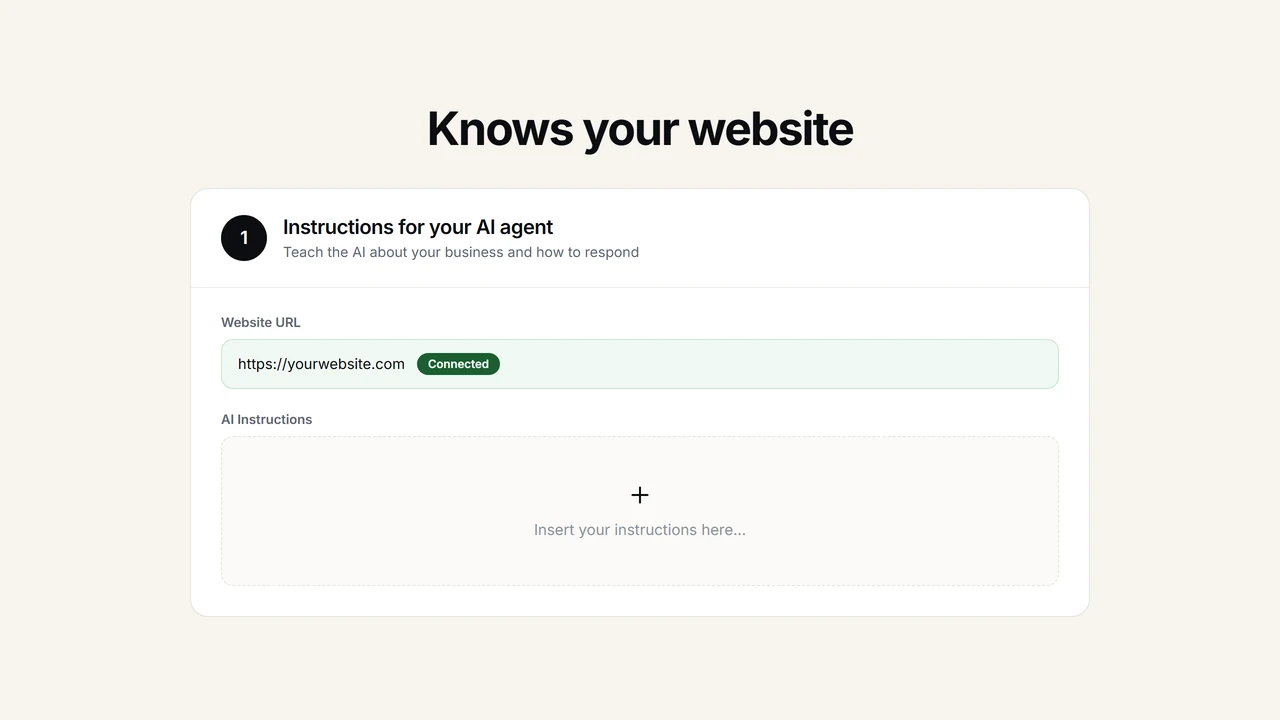
Enter any website URL. The AI builds a knowledge base from the content and starts answering visitor questions — then imagine it also calling your client's APIs to take real actions
Custom Tools turn answers into actions — order lookups, bookings, refunds, and more
Most chatbots stop at answering questions. The white-label AI agent keeps going. With Custom Tools (available on Standard and Pro plans), the AI calls your client's own API endpoints during a conversation to perform real actions. A customer asks "Where is my order?" and the agent calls the order tracking API, retrieves the shipment status, and delivers the answer — all within the chat, in seconds. A visitor asks to book an appointment, and the agent checks the scheduling system for available slots and confirms the booking. A customer requests a return, and the agent initiates the process through the returns API. Each client's Custom Tools are configured independently. The ecommerce bot checks orders. The dental bot books appointments. The SaaS bot resets passwords. Same platform, different capabilities, all under your brand.
- Order tracking and shipment statusThe AI agent calls the client's order management API, retrieves the current status — processing, shipped, out for delivery, delivered — and shares tracking details with the customer. No need for the customer to dig through confirmation emails or navigate to a tracking page. The answer arrives in the conversation within seconds.
- Appointment booking and availability checksConnect the AI to a scheduling API and the agent can check available time slots, confirm bookings, and even send confirmation details — all inside the chat. Dental practices, salons, consulting firms, and any appointment-based business benefit from instant scheduling without phone calls or form submissions.
- Returns, refunds, and account actionsThe agent can initiate return requests, check refund status, update account details, reset passwords, and perform other account-level actions by calling the client's backend systems. Each action is configured as a Custom Tool with defined parameters, so the AI knows exactly what information to collect from the customer before making the API call.
Your brand on every surface — the agent, the dashboard, and the client portal
The Pro plan at $449 per month removes all Asyntai branding. The chat widget carries your agency name, logo, and colors. The client dashboard — embeddable on your website via a JS snippet — shows your brand to your clients when they review conversations, analytics, and leads. Twenty client sites per account, each fully isolated with its own knowledge base, Custom Tools configuration, and conversation history. Your clients see an AI agent built by you. The upstream platform is invisible. For agencies scaling beyond 20 sites, the Custom Pro plan extends limits based on your volume.
- Complete branding removal on ProThe "Powered by Asyntai" badge disappears entirely. Your agency name appears in the chat header. Your logo loads in the widget. Your color scheme defines the visual identity. A visitor interacting with the AI agent sees your product — nothing else.
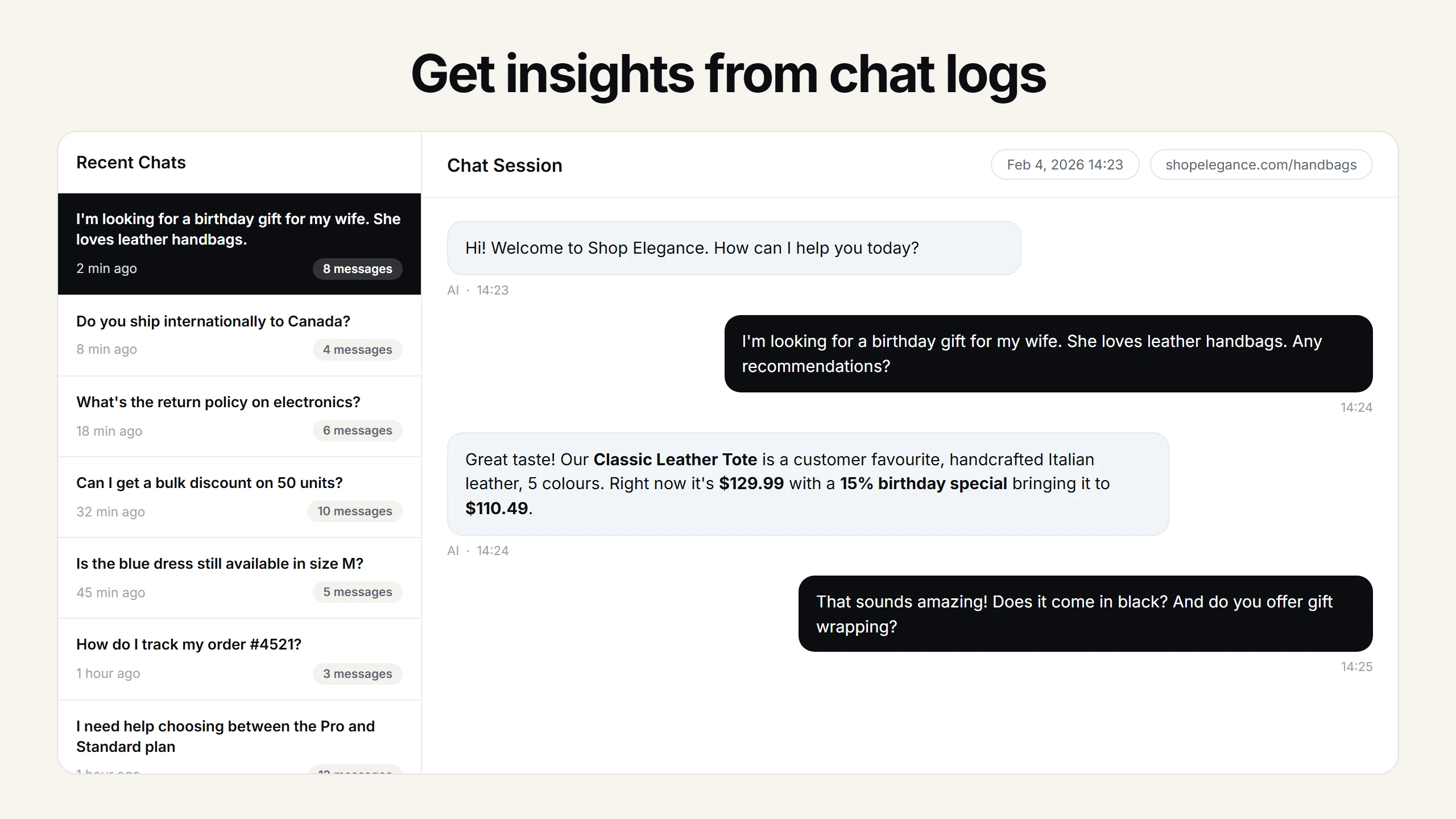
- Embeddable client dashboard with three tabsConversations: full chat transcripts including Custom Tool actions taken. Analytics: message volume, tool usage, response quality. Leads: captured contact information with CSV export. Embed it on your website with a JS snippet. Your logo, your brand name, your colors. Password protection and domain restrictions per client token.
- Independent configuration per client siteEach of your 20 sites has its own knowledge base, its own Custom Tools, its own widget branding, and its own AI behavior instructions. The ecommerce client's agent looks up orders. The medical client's agent checks appointment slots. No cross-contamination, no shared data, no risk of one client's tools firing for another's visitors.
- Per-client economics that scaleAt $449/month for 20 sites, your per-client cost is roughly $22. Charge $200 to $400 per month for an AI agent with real action capabilities — a substantial premium over simple chatbots — and the margin compounds with every client you add.
Deploy a white-labeled AI agent for your first client
No backend development. No API gateway setup. Configure Custom Tools in the dashboard, paste the embed script, and the AI agent is live — taking actions under your brand.
- Subscribe to the Pro plan at asyntai.com/pricing — white-label branding, 20 sites, 50,000 messages, and Custom Tools included.
- Add your client's website and let the AI crawl their content to build a knowledge base. Upload any additional documents the agent should reference.
- Configure Custom Tools: add the client's API endpoints (order lookup, appointment booking, etc.) with the parameters the AI should collect from visitors before calling each endpoint.
- Paste the embed script into the client's site. The AI agent is live — answering questions from the knowledge base and taking actions via Custom Tools, all under your brand.
<!-- Answers questions AND takes actions -->
<script src="https://asyntai.com/widget.js"
data-id="client-site-id" async>
</script>
# Your brand. Real actions. Not just answers.
# Order lookups, bookings, returns — all in the chat.
How reselling works
From signing up to billing your first client — four simple steps.
Choose a plan
Subscribe to a plan that fits how many client websites you need. Pro is the most popular for resellers — white-label plus up to 20 websites.
View plans →Add a client website
Each website you add under your account is one client's chatbot. Add up to the number your plan allows.
Go to your dashboard →Set up the chatbot
Add the client's content, customize the widget to their brand, and install it on their site. You can also give the client read-only access to their chat logs, analytics and leads on your own website.
Setup guide →Resell at your price
Charge your client whatever you like. You own the relationship and bill them directly — the margin is yours, every month.
Reseller Resources
Everything you need to get started, answer client questions, and see the dashboard in action
Reseller Guide
Step-by-step walkthrough: white-label branding, the embeddable client dashboard, and how to get your first client live.
Read the guideReseller FAQ
Pricing, margins, billing, white-label details, platform compatibility, and everything else partners ask before starting.
View FAQClient Dashboard Demo
See the embeddable white-label dashboard with sample data — conversations, analytics, and leads under your brand.
See the demoWhite-label AI agent — FAQs
Common questions from agencies evaluating an AI agent they can rebrand and resell to clients.
What makes this an "agent" and not just a chatbot?
A chatbot answers questions. An agent takes actions. With Custom Tools (available on Standard and Pro plans), the AI can call your client's own API endpoints during a conversation to perform real tasks: looking up an order, checking appointment availability, initiating a return, resetting a password, or checking account status. The AI decides when to use a tool based on what the visitor asks, collects the required information conversationally, calls the endpoint, and delivers the result — all within the chat. It is the difference between "Here is our returns policy" and "I have initiated your return for order #4821. You will receive a confirmation email shortly."
Do I need to build the APIs that Custom Tools call?
You do not build them — your client provides them, or they already exist. Most businesses with order systems, booking platforms, or CRMs already have APIs or webhook endpoints. You configure Custom Tools in the dashboard by specifying the endpoint URL, the HTTP method, the parameters the AI should collect from the visitor, and a description of what the tool does. The AI handles the rest: it recognizes when a visitor's request matches a tool, asks for the required parameters naturally in conversation, makes the API call, and presents the result. If a client does not have APIs, the AI agent still works as a powerful Q&A assistant using their website content — Custom Tools are an optional layer on top.
Can different clients have different Custom Tools?
Yes, each client site has its own independent Custom Tools configuration. An ecommerce client's agent can have tools for order lookup, return initiation, and inventory check. A dental practice client's agent can have tools for appointment availability and booking confirmation. A SaaS client's agent can have tools for account status, password reset, and subscription management. The tools are configured per site, and no client's tools are visible to or usable by another client's visitors. Twenty sites, twenty different tool sets, all from one account.
Is the white labeling fully invisible to end users?
On the Pro plan ($449/month), yes. All Asyntai branding is removed, including the "Powered by Asyntai" badge. The chat widget shows your agency name, your logo, and your brand colors. The client-facing dashboard — where clients view conversations (including Custom Tool actions), analytics, and leads — is embeddable on your website and carries your branding. Visitors interact with an AI agent that appears to be your product. Your clients manage it through a dashboard that appears to be your platform.
How many clients can I run on one account?
The Pro plan supports 20 sites with 50,000 messages per month. Each site is a fully independent AI agent with its own knowledge base, Custom Tools, widget branding, and conversation history. If you need more than 20 sites or higher message volume, the Custom Pro plan extends both limits based on your agency's requirements.
What happens if a Custom Tool API call fails?
The AI handles failures gracefully. If an API endpoint is unreachable or returns an error, the agent tells the visitor that it was unable to complete the action and suggests an alternative — such as contacting support directly or trying again later. It does not crash, show an error code, or expose technical details. You can also configure fallback instructions for each tool, so the AI knows exactly what to say when a specific tool is unavailable. The visitor experience remains smooth even when the backend has issues.
Does the agent still answer regular questions, or only use tools?
Both. The AI agent answers questions using the client's website content (the knowledge base) and uses Custom Tools when a visitor's request requires an action. A visitor who asks "What is your return policy?" gets an answer from the knowledge base. A visitor who asks "I want to return my order #3847" triggers the return initiation tool. The AI decides which approach to use based on the visitor's intent. Most conversations involve a mix of Q&A and tool use — the agent handles both seamlessly within the same chat.
Can I charge more for AI agent services than for a basic chatbot?
Absolutely, and you should. An AI agent that takes real actions — checking orders, booking appointments, processing returns — delivers measurably more value than a Q&A chatbot. It reduces support ticket volume, shortens resolution times, and handles tasks that would otherwise require human staff. Agencies typically charge $250 to $500 per month for AI agent services with Custom Tools, compared to $150 to $250 for basic chatbot services. Your cost remains $449/month for up to 20 sites regardless, so the higher pricing goes directly to your margin.
Does the AI agent work in multiple languages?
Yes. The AI supports 36 languages with automatic detection. A visitor types in Spanish, the agent responds in Spanish — including when using Custom Tools. The tool results are presented in the visitor's language regardless of what language the API returns data in. This means a single AI agent on an ecommerce site can handle order lookups in English, French, German, Japanese, or any of the 36 supported languages without separate configurations per language.
Why the shift from chatbot to AI agent changes the reselling equation entirely
There is a ceiling on what you can charge for a chatbot that only answers questions. Clients see it as a fancy FAQ page, a convenience rather than a necessity, and they price it accordingly in their heads — maybe $100, maybe $150 a month. Useful, but not transformative. The moment the AI starts taking actions — looking up orders, booking appointments, processing returns, checking account balances — the perceived value shifts from "nice-to-have" to "this replaces a support agent." That shift is the difference between a $150/month chatbot service and a $400/month AI agent service. For agencies building a reselling business, the distinction between chatbot and agent is not semantic. It is the difference between modest margins and margins that justify building a team around.
Custom Tools are the mechanism that makes this possible. Available on Standard ($139/month) and Pro ($449/month) plans, Custom Tools let you configure the AI to call your client's own API endpoints during a live conversation. You specify the endpoint URL, the HTTP method, the parameters the AI needs to collect from the visitor, and a plain-language description of what the tool does. The AI handles everything else: it recognizes when a visitor's question or request matches a configured tool, asks for the required information naturally ("Could you share your order number so I can look that up for you?"), makes the API call, and presents the result in conversational language. The visitor never sees a loading screen, a redirect, or a form. They ask a question and get an answer — or ask for an action and see it completed — all within the same chat window.
The use cases span every industry your agency serves. For ecommerce clients, the AI agent checks order status, retrieves tracking numbers, initiates returns, and looks up product availability. A customer who would have submitted a support ticket or waited on hold gets their answer in fifteen seconds. For appointment-based businesses — dental practices, salons, consulting firms, fitness studios — the agent checks the scheduling system for open slots and confirms bookings inside the conversation. For SaaS clients, the agent looks up account details, checks subscription status, resets passwords, and triggers support workflows. Each of these actions currently requires a human to handle a support request, an email, or a phone call. The AI agent collapses that process into a single conversational exchange.
The architecture keeps everything isolated between clients, which is critical when you are managing Custom Tools that connect to live business systems. Each of your 20 sites on the Pro plan operates independently: separate knowledge base, separate Custom Tools configuration, separate conversation history, separate analytics. The ecommerce client's order lookup tool has no connection to the dental practice's appointment booking tool. API credentials, endpoint URLs, and parameter definitions are stored per site. When you onboard a new client, you configure their tools from scratch — no risk of inheriting another client's endpoints or exposing one client's data to another's visitors. The isolation is not just logical; it is structural. Twenty sealed environments under one account.
The pricing leverage for agencies is substantial. A basic chatbot service — one that answers questions using the client's website content — commands $150 to $250 per month. That is the market rate for a Q&A widget, and pushing above it is difficult because the client can always point to free or low-cost chatbot alternatives. An AI agent with Custom Tools is a different product entirely. When you demonstrate that the agent can check a customer's order status in real time, book an appointment without human intervention, or process a return request end-to-end — those are tasks that currently require staff time. A single support agent costs $3,000 to $5,000 per month in salary. An AI agent that handles 40% of those interactions for $300 to $500 per month is a straightforward cost-reduction pitch. You are no longer competing with free chatbots. You are competing with hiring.
Setting up Custom Tools for a client does not require you to build APIs or write backend code. The client's existing systems almost always have the necessary endpoints. Shopify stores have order APIs. Booking platforms like Calendly, Acuity, and SimplyBook have scheduling APIs. CRMs like HubSpot, Salesforce, and Zoho have contact and deal APIs. Payment processors have transaction lookup APIs. Your role as the agency is to identify which actions the client wants the AI to perform, locate the relevant API endpoints in their existing tools, and configure them as Custom Tools in the dashboard. The configuration is done through a form interface — endpoint URL, method, parameters, description — not through code. A typical client setup with three or four Custom Tools takes thirty to forty-five minutes, most of which is spent understanding the client's workflow rather than configuring the platform.
The knowledge base and Custom Tools work together, not in isolation. When a visitor asks "What is your return policy?", the AI searches the knowledge base (built from the client's website content) and delivers the policy. When that same visitor then says "OK, I want to return my order #7291," the AI switches from knowledge base lookup to Custom Tool execution — calling the returns API with the order number, checking eligibility, and initiating the process. The transition is seamless from the visitor's perspective. They asked a question, got an answer, made a decision, and the AI acted on it — all within a single conversation. This combination of knowledge and action is what makes the AI an agent rather than a chatbot. It understands context and it does things.
White labeling the AI agent means your clients never know about the upstream platform. On the Pro plan, the "Powered by Asyntai" badge is removed. Your agency name appears in the chat header. Your logo loads in the widget. Your brand colors define the visual identity. The client-facing dashboard — where your clients review conversation transcripts (including which Custom Tools the AI used and what results were returned), view analytics, and export leads — is embeddable on your website via a JS snippet and carries your logo and brand name. When a client logs in to check how many orders the AI agent looked up this week or how many appointments it booked, they see your dashboard, your brand, your product. The technology is invisible. The value is visible.
Language support extends to Custom Tool interactions, not just Q&A. The AI supports 36 languages with automatic detection. When a Spanish-speaking visitor asks about their order status, the AI collects the order number in Spanish, calls the tracking API, receives the response (typically in English from the backend), and presents the tracking information to the visitor in Spanish. The language layer wraps around the entire interaction — knowledge base answers, tool parameter collection, and tool result presentation. For agencies serving clients with international customer bases, this means a single AI agent handles visitors in any supported language without per-language configuration or separate tool setups.
The competitive moat for agencies offering AI agent services is deeper than for basic chatbot services. Once you configure Custom Tools for a client — connecting their order system, their booking platform, their CRM — and the AI agent starts handling real customer interactions, switching costs rise significantly. The client would need to reconfigure all of their tool integrations with a new provider, retrain the AI on their content, and accept downtime during the transition. More importantly, the AI agent accumulates interaction data that informs how well it handles edge cases: unusual order statuses, booking conflicts, return eligibility questions. This learned behavior compounds over time. A client who has been running an AI agent for six months has a more capable agent than one who just started. That capability gap is a retention mechanism that basic chatbots do not have.
The operational model for managing AI agent clients is lean because most of the ongoing work is handled by the platform. The knowledge base updates automatically when the client's website content changes. Custom Tools do not require maintenance unless the client changes their API endpoints. Conversation monitoring, analytics, and lead management happen in the dashboard. When a client wants to add a new Custom Tool — say, they launch a loyalty program and want the agent to check point balances — it is a fifteen-minute configuration task. You are not building integrations from scratch each time. You are adding a tool definition: endpoint, parameters, description. The AI figures out when and how to use it.
Agencies scaling beyond 20 sites or 50,000 messages per month move to the Custom Pro plan, which provides higher limits tailored to volume. The affiliate program offers a lighter-touch alternative: refer businesses to Asyntai with a tracking link and earn 20% recurring commission on their subscription without managing the setup, Custom Tools, or ongoing service. Some agencies blend both — white-label AI agents for their premium managed clients, affiliate referrals for businesses that want self-service. The two models serve different segments of your pipeline without conflicting.
The market timing is noteworthy. Businesses are actively looking for AI solutions that go beyond answering questions. They have seen basic chatbots and found them limited. They want AI that does things — checks orders, books appointments, resolves issues. Agencies that can deliver an AI agent under their own brand, configured with Custom Tools specific to each client's business, occupy a position that is difficult for competitors to replicate quickly. The combination of white-label branding, multi-tenant architecture, per-client Custom Tools, and 36-language support is not something a freelancer can stitch together from open-source components over a weekend. It is a productized service with real infrastructure behind it, available for $449 per month, ready to resell on day one.
Questions about Custom Tools, white-label AI agents, or reselling? Contact [email protected] or start with the Pro plan today.