Software for marketing agencies that turns every client website into a lead machine
Deploy an AI chatbot across all your client sites in minutes. It captures leads, answers visitor questions using their content, and runs under your agency brand around the clock.
Build a chatbot for any client site in seconds
Drop a client URL below and watch the AI read their pages and create a working chatbot. This is the same experience you will deliver to every client — branded as yours
One subscription powers every client site — the margin stacks, the overhead does not
Marketing agencies live and die by recurring revenue, and software that scales without scaling headcount is the difference between a growing agency and a stagnant one. The Pro plan at $449/month covers up to 20 client websites and 50,000 messages. Every chatbot you deploy runs under your brand, answers questions using that client's own website content, and captures leads while you sleep. You do not hire for this. You do not outsource it. The software does the work, and the margin goes straight to your bottom line. Agencies needing white-label on fewer sites can start with Standard at $139/month and email [email protected] for manual white-label setup.
- Flat cost, stacking revenueYour subscription cost stays locked at $449 whether you serve one client or twenty. Each new client you add is almost pure margin — no additional license fee, no per-seat pricing, no metered surcharges. The math bends further in your favor with every deployment.
- Your agency name on every surfaceThe Pro plan strips all original branding. Your logo, your colors, your agency name appear in the chat widget and the client dashboard. Visitors interact with what looks and feels like your proprietary technology. Clients see your brand when they review their leads and analytics.
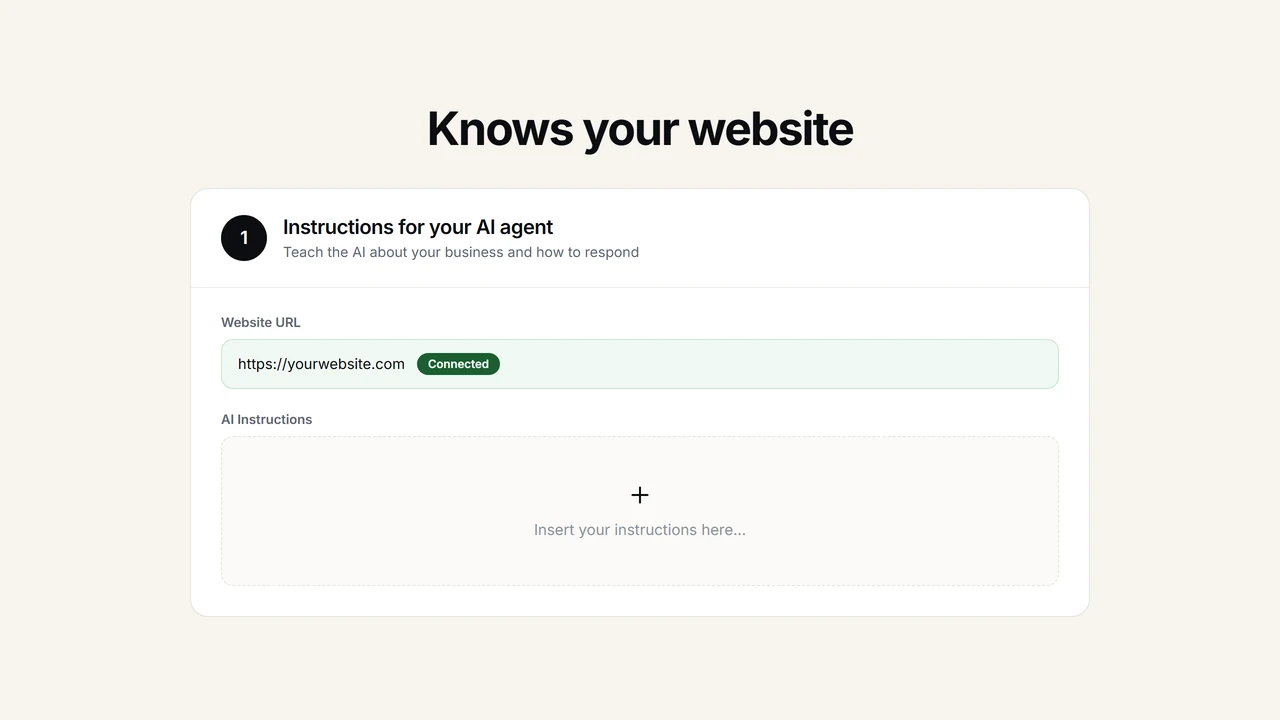
- No developers, no designers, no project managersSetting up a client chatbot is a configuration task, not a development project. Add the URL, adjust colors, paste one line of JavaScript. Twenty minutes, start to finish. You do not need to scope it, sprint-plan it, or assign it to a team. One person in your agency can run the entire chatbot service line.
Add $1,500 to $5,000 in monthly margin without adding a single employee
Agency profitability hinges on the ratio between what you charge and what it costs to deliver. Most services — SEO, paid media, content — require skilled labor that scales linearly with client count. Software-powered services break that pattern. The Pro plan costs $449/month for 20 sites. Your delivery cost per client is configuration time, not ongoing labor. That gap between a flat subscription and per-client billing is where the margin lives, and it widens every time you onboard someone new. Agencies growing past 20 clients can move to the Custom Pro plan for higher site and message limits.
- 3 clients at $250: you are already profitableThree clients paying $250 each bring in $750 against a $449 cost. That is $301 in margin from the third month of the service line — and you have 17 open slots to fill. Many agencies start here, deploying to existing retainer clients who already trust them.
- 8 clients at $250: $1,551/month marginAt eight clients your monthly revenue hits $2,000 while costs remain at $449. The margin crosses $1,500 per month — $18,000 annually — from a service that takes less than three hours per month to manage across all clients combined.
- 15 clients at $300: $4,051/month marginFifteen clients at $300 generates $4,500 in monthly revenue against the same fixed $449. The margin exceeds $4,000 per month. At this point the chatbot service line is likely the highest-margin offering in your agency portfolio.
- Messages pool across all sitesThe 50,000 monthly messages are shared, not per-site. A low-traffic accounting firm might use 150 messages while a busy restaurant uses 1,800. The aggregate stays well within the pool for most agency portfolios, and the Custom Pro plan extends the allocation if your volume grows beyond it.
Deploy your first client chatbot before your next standup
No staging environment. No QA cycle. No client approval flow. You add the site, brand the widget, and paste the code.
- Subscribe to the Pro plan at asyntai.com/pricing — $449/month for white-label branding, 20 client sites, and 50,000 shared messages.
- Add your client's domain in the dashboard. Set the widget to your agency's name, logo, and brand colors. Every client sees your identity, never ours.
- The AI reads the client's website automatically and builds a knowledge base from their existing content. Upload supplementary materials — pricing PDFs, product catalogs — if the website does not cover everything.
- Copy the one-line embed script, install it on the client's site, and the chatbot goes live. It answers visitor questions using the client's content, captures leads, and runs under your agency brand continuously.
<!-- Your brand. Your client's content. Always on. -->
<script src="https://asyntai.com/widget.js"
data-id="client-website-id" async>
</script>
# One embed. Leads captured. Questions answered.
# Your agency's newest — and easiest — revenue line.
How reselling works
From signing up to billing your first client — four simple steps.
Choose a plan
Subscribe to a plan that fits how many client websites you need. Pro is the most popular for resellers — white-label plus up to 20 websites.
View plans →Add a client website
Each website you add under your account is one client's chatbot. Add up to the number your plan allows.
Go to your dashboard →Set up the chatbot
Add the client's content, customize the widget to their brand, and install it on their site. You can also give the client read-only access to their chat logs, analytics and leads on your own website.
Setup guide →Resell at your price
Charge your client whatever you like. You own the relationship and bill them directly — the margin is yours, every month.
Reseller Resources
Everything you need to get started, answer client questions, and see the dashboard in action
Reseller Guide
Step-by-step walkthrough: white-label branding, the embeddable client dashboard, and how to get your first client live.
Read the guideReseller FAQ
Pricing, margins, billing, white-label details, platform compatibility, and everything else partners ask before starting.
View FAQClient Dashboard Demo
See the embeddable white-label dashboard with sample data — conversations, analytics, and leads under your brand.
See the demoSoftware for marketing agencies — FAQs
Common questions about using Asyntai as agency software for chatbot delivery and reselling.
Why should a marketing agency add AI chatbot software to its stack?
Because it creates recurring revenue that does not require labor to deliver. Most agency services — SEO, paid media, content creation — scale with headcount. A chatbot service scales with configuration. You set it up once per client, and the software runs continuously: answering visitor questions, capturing leads, and generating engagement data. The ongoing effort is near zero, but the monthly billing continues. It is the highest-margin line item most agencies will ever add to their offerings.
How does this work as software I resell rather than just use internally?
You subscribe to a plan and manage client chatbots from your account. Each client's chatbot is configured independently — separate knowledge base, separate branding, separate analytics. On the Pro plan ($449/month, 20 sites), all original branding is removed and replaced with yours. You invoice clients at whatever price you choose. Asyntai has no visibility into or claim on what you charge. You are the vendor, not a referral partner.
Can I start with a few clients before committing to the full Pro plan?
Yes. The Starter plan at $39/month supports 2 sites with 800 messages — enough to demo the product and onboard your first client or two. The Standard plan at $139/month covers 3 sites with 15,000 messages and includes Custom Tools for deeper integrations. White-label branding removal is automatic on Pro, but Standard users can email [email protected] for manual activation. Many agencies validate the model on Standard and then upgrade to Pro when they have the demand to fill more slots.
What platforms does the chatbot work on?
The chatbot installs via a single line of JavaScript that works on any website. There are also native plugins for over 30 platforms including WordPress, Shopify, WooCommerce, Magento, Wix, Squarespace, Webflow, Joomla, Drupal, and more. Your client roster can include businesses on completely different platforms — the deployment process is the same for all of them. You never have to turn away a client because of their CMS.
Do my clients get access to their own data?
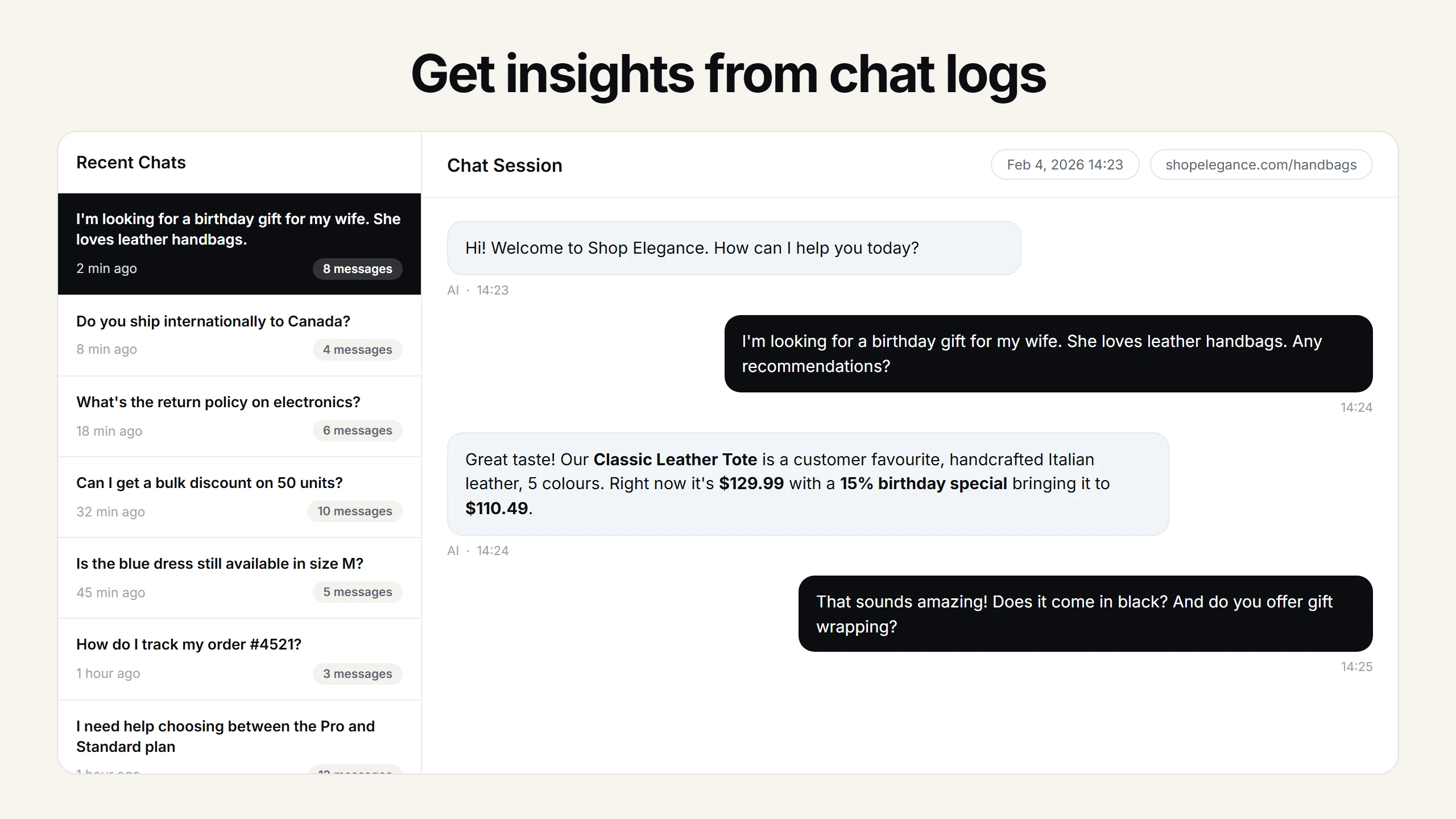
Yes. Each client can access a white-labeled dashboard with three tabs: Conversations (full chat transcripts), Analytics (message volume and trends), and Leads (captured visitor contact info with CSV export). You embed this dashboard on your own website using a JS snippet. It displays your agency's logo, name, and colors — the client sees it as part of your platform. You can set password protection and restrict access by domain.
Does the chatbot handle multiple languages for international clients?
Yes. The AI supports 36 languages and detects the visitor's language automatically. A French bakery's visitors get French responses. A Brazilian ecommerce store's visitors get Portuguese. The knowledge base content can be in any language — the AI handles matching. This means one agency account can serve clients across countries and languages without any per-language configuration or additional cost.
How much time does it take to manage client chatbots ongoing?
Very little. After the initial 20-minute setup, the AI updates its knowledge base automatically as the client's website content changes. Most agencies spend less than 10 minutes per client per month on chatbot management. The time goes to reviewing captured leads, making occasional tweaks to AI instructions if a client requests a tone adjustment, or uploading a new PDF when a client launches a product. There is no content creation, no design work, and no code to maintain.
What is the difference between using this and hiring a live chat team?
A live chat team requires recruiting, training, scheduling, and managing agents — and coverage gaps are inevitable. The AI chatbot runs continuously without shifts, sick days, or training ramp-up. It answers questions using the client's own website content and captures leads 24/7, including nights and weekends. For agencies, the distinction is even sharper: you cannot scale a live chat service across 10+ clients without proportional staffing costs. The software scales to 20 clients on a single flat-rate subscription.
What happens when I outgrow 20 client sites?
The Custom Pro plan extends your capacity beyond 20 sites and 50,000 messages. It is built for agencies that have proven the model and need higher limits. Email [email protected] to discuss your volume and get a plan tailored to your agency's scale.
Why software — not services — is how agencies build a chatbot revenue line
Marketing agencies have been trained to think in terms of services. A client needs SEO, you assign a strategist. They need paid media, you assign a campaign manager. They need content, you assign a writer. Every new client adds headcount pressure, and every new service line requires hiring or contracting someone with a specific skill set. The chatbot opportunity is different in a fundamental way: the delivery mechanism is software, not labor. You configure it once, the software runs continuously, and your ongoing involvement is measured in minutes per month rather than hours per week. This distinction is not cosmetic. It reshapes the unit economics of an entire service offering and makes it possible for a five-person agency to deliver chatbot services at the same scale as a fifty-person one.
Consider what happens when you add a traditional service to your agency. You scope the project, estimate hours, assign team members, build deliverables, run revisions, and then manage the ongoing relationship. Each client engagement occupies a meaningful portion of your team's bandwidth. Software-based delivery inverts that model. The work to set up a client chatbot is a fixed, predictable effort — about twenty minutes of configuration. There is no scoping because the scope is always the same: add the website, brand the widget, paste the code. There are no revisions because the AI builds the knowledge base from the client's own content automatically. There is no ongoing labor because the software handles responses, lead capture, and knowledge updates without human intervention. You bill monthly, and the delivery happens on its own.
The financial structure matters more than most agencies initially realize. A traditional service retainer might generate $2,000 per month per client but consume 20-30 hours of team time. A chatbot subscription can generate $200 to $400 per client per month and consume about 15 minutes of setup time with near-zero ongoing effort. On a per-dollar basis, the chatbot revenue is almost entirely margin. The Pro plan at $449/month covers up to 20 client sites. If you charge ten clients $250 each, you collect $2,500 against $449 in cost — $2,051 in margin — and the labor required to maintain those ten deployments is roughly two hours per month across all of them combined.
Every agency faces the question of which software becomes essential to its stack and which is a nice-to-have that gathers dust. The tools that earn their place share a trait: they let existing staff do more without working longer. A project management tool does not eliminate project management, but it lets one PM handle twelve clients instead of six. A reporting platform does not write strategy, but it lets analysts produce client reports in an afternoon instead of a week. Chatbot software follows the same pattern. It does not replace your strategists or account managers — it gives them a new deliverable to sell without expanding their workload. The agency that discovers this tends to lead with it in pitches, because the demo is immediate and the value is visible.
Positioning is where most agencies leave money on the table, and the chatbot is unusually flexible in how you frame it. To a local business, it is an always-on receptionist that answers phone-call-level questions on the website. To an ecommerce brand, it is a shopping assistant that helps visitors find the right product and captures contact information for remarketing. To a professional services firm, it is a lead qualifier that gathers details before routing prospects to the sales team. To a hospitality client, it is a concierge that handles reservation questions, menu inquiries, and directions at two in the morning. You are selling the same software in every case. The configuration changes — different website content, different branding, sometimes different AI instructions — but the underlying platform is identical. Your agency's knowledge of each vertical is the differentiator, not the technology.
The white-label component removes the last barrier to presenting the chatbot as your own product. On the Pro plan, every trace of original branding is stripped. The chat widget carries your agency name, your logo, and your color palette. The embeddable client dashboard — where clients review their Conversations, Analytics, and Leads — shows your branding on every screen. A client who logs into their dashboard on your website sees what looks like a proprietary analytics platform built by your team. The illusion is seamless because there is no attribution to break it. You are not a reseller in the client's eyes. You are the maker of the product they use every day.
Agencies that specialize by vertical accelerate faster because the setup process becomes templated. After deploying chatbots for three dental practices, you know the common AI instruction patterns: handle insurance questions with a gentle redirect to the front desk, answer cosmetic procedure pricing from the FAQ page, and capture appointment requests with name, phone number, and preferred time. Your fourth dental client takes eight minutes instead of twenty because you have refined the blueprint. This templating effect compounds. By the time you have served a dozen clients in one vertical, you can articulate their pain points in a sales call before they mention them. Your pitch shifts from "here is a chatbot" to "here is the exact solution your competitors are already using." That shift moves conversations from price comparison to value recognition.
Lead capture is the single feature that sells the chatbot to marketing-minded clients. Most business websites let visitors browse, read, and leave without any interaction. The chatbot intervenes at the moment of curiosity — when a visitor has a question about pricing, availability, compatibility, or process. During that conversation, the chatbot can prompt for a name and email address before providing detailed information. Those captured leads appear in the client dashboard with full conversation context, exportable as CSV. For a marketing agency, framing the chatbot as a lead generation tool rather than a support tool changes the buying dynamic. Clients who resist paying for "a chatbot" will pay for "a tool that captures 30-50 qualified leads per month that you are currently losing."
Custom Tools — available on Standard and Pro plans — open the door to premium pricing tiers within your chatbot offering. With Custom Tools, the AI chatbot can call the client's own API endpoints during a conversation: checking order status, looking up appointment availability, verifying account details, or initiating return requests. This capability transforms the chatbot from an information-retrieval tool into an action-taking assistant. For agencies, the pricing structure writes itself: base chatbot at $200/month, chatbot with Custom Tools integration at $350 to $500/month. The integration effort is minimal — you define an endpoint URL and the parameters the AI should collect — but the perceived value to the client is enormous because their bot moves from answering questions to resolving them.
Retention is a quiet advantage that reveals itself over months. When a chatbot has been running on a client's site for three months, the AI instructions have been refined, the knowledge base reflects their latest content, and the lead capture flow is dialed in. That accumulated configuration is a switching cost the client can feel. Starting over with a different provider means rebuilding the knowledge base, re-testing responses, and losing the behavioral tuning that makes the current chatbot accurate. Monthly churn rates drop as deployment tenure increases, which means your revenue becomes more predictable the longer you operate the service line. Predictable recurring revenue is what agency owners dream about — it is what separates agencies that get acquired from agencies that get stuck.
Language support broadens your addressable market without adding complexity. The AI handles 36 languages with automatic detection, so a visitor who types in Spanish gets a Spanish response without any manual configuration. For agencies serving multicultural markets — a salon in Miami, a law firm in Montreal, a restaurant in Berlin — this is table stakes. For agencies looking to expand into international client acquisition, it removes the language barrier entirely. You can serve clients in Latin America, Europe, and Asia from a single account, and the chatbot handles the linguistic heavy lifting in every case.
The operational workflow for a ten-client chatbot practice is strikingly simple compared to other agency services. Monday morning: check the dashboard for any flagged conversations or unusual patterns across client sites. This takes about fifteen minutes. Mid-week: review new leads captured for each client and include highlights in your regular client report or send the CSV export directly. This takes ten minutes per client if you include it in an existing report, or zero minutes if the client pulls their own data from the dashboard. End of month: bill your clients, reconcile against your single Asyntai subscription, and note any clients approaching message limits. The entire management overhead for ten active clients is three to four hours per month — less time than a single SEO client typically requires.
Scaling beyond twenty clients is a milestone, not a ceiling. The Custom Pro plan extends both site capacity and message allocation for agencies that have validated the model. Some agencies also layer in the affiliate program alongside their reseller practice: clients who want to self-manage get referred through an affiliate link that earns 20% recurring commission on their subscription for up to 12 months. A referred client who subscribes to the Pro plan generates $89.80 per month in passive income. The two models — reselling for managed clients, affiliates for self-serve ones — coexist naturally and maximize revenue across different client profiles.
The agency that adds chatbot software to its stack does not just add a product — it adds a different kind of revenue. Revenue that does not require timesheets. Revenue that does not depend on a specific employee's availability. Revenue that grows when you add clients but costs nothing more to deliver. Most agencies spend years looking for this kind of leverage and find it in consulting, productized services, or SaaS development. The chatbot path gets you there without writing code, hiring engineers, or building infrastructure. The software already exists. Your job is to brand it, sell it, and collect the margin.
Ready to add chatbot software to your agency's stack? Start with the Pro plan and deploy your first client today — or email [email protected] if you have questions about fit or volume.