How to sell AI: the fastest path from zero to recurring revenue
You do not need a machine learning degree or a development team. White-label an AI chatbot, deploy it to local businesses in minutes, and bill them monthly.
See what you would be selling — live demo
Enter any business website below. The AI reads the site, builds a knowledge base, and starts answering visitor questions. This is exactly what your clients get under your brand.
AI chatbots are the simplest AI product to sell — here is why
Most people who search for how to sell AI picture themselves building a machine learning model or hiring a data science team. That is one path — expensive, slow, and technically demanding. There is a far simpler one: white-label an AI chatbot that already works, put your brand on it, and sell it to businesses that need it. Every company with a website has visitors who leave with unanswered questions. An AI chatbot that answers using the business's own content solves that problem in a way that is visible, measurable, and easy for a non-technical business owner to understand. You do not need to explain neural networks or transformer architectures. You show them a chatbot answering real questions from their own website, and the value sells itself. The Pro plan at $449/month gives you up to 20 client sites with full white-label branding and 50,000 messages — your subscription is the only cost, and you keep every dollar of margin above it.
- No technical skills required — the AI does the hard partThe AI reads your client's website, builds its own knowledge base from the content it finds, and starts answering questions accurately. You do not write code, configure APIs, or manage servers. The entire setup happens through a visual dashboard. If you can fill in a form and paste a script tag, you have all the technical ability this business requires.
- Recurring revenue from day one — not project-based billingUnlike web design or consulting where you deliver a project and chase the next one, an AI chatbot generates monthly recurring revenue. Your client pays you every month because the chatbot works for them every day. At $150-$300 per client per month, three to five clients already cover your $449 subscription and produce consistent profit.
- The product demonstrates itself in real timeSelling AI to a business owner who has never used AI is hard when the product is abstract. A chatbot is concrete — you pull up their website in the demo, the AI answers a question using their own content, and the owner immediately understands what it does. The live demo closes deals faster than any slide deck.
Where to find businesses that will pay you monthly for an AI chatbot
The addressable market for AI chatbots is every business with a website and visitors who have questions — which is nearly every business. But when you are starting, focus beats breadth. The easiest first clients are businesses you already interact with: your dentist, your accountant, the restaurant where you eat lunch, the gym where you work out, the auto shop that fixes your car. These are people who know and trust you, which removes the biggest barrier in any sale. Walk in with a demo running on their actual website — show the dentist's chatbot answering a question about teeth whitening prices pulled from their own site — and you skip the abstract pitch entirely. Once you have two or three live clients generating results, referrals and case studies do the prospecting for you. The business compounds because every happy client is a reference for the next one.
- Start with businesses in your personal networkYour barber, your chiropractor, the boutique down the street — anyone whose website you visit is a prospect. You already have rapport, which makes the first conversation natural. Offer to show them what their chatbot would look like with a live demo on their site. No cost to you, no commitment from them until they see it working.
- Target service businesses with high-value visitorsDental offices, law firms, real estate agencies, financial advisors, and clinics get website visitors who are actively looking to spend money. A chatbot that captures those visitors after hours or answers qualifying questions during business hours is worth $200-$400 per month to these businesses — they spend more than that on a single missed lead.
- Leverage the 30+ platform plugins to simplify installationWhen your prospect says they use WordPress, Shopify, Wix, Squarespace, or any of the other platforms Asyntai supports, you can tell them installation is a one-click plugin — not a technical project. This removes the objection that adding a chatbot to their site is complicated or risky. Plugins exist for over 30 platforms.
- Bundle with services you already offerIf you already do web design, SEO, social media management, or marketing, adding an AI chatbot to your package increases your monthly recurring revenue per client without increasing your workload significantly. The chatbot becomes another line item on the invoice you are already sending — $150-$300 more per month per client.
- Use the affiliate model for prospects you do not want to manageNot every business you encounter is worth managing as a white-label client. For those, use the affiliate program — share a tracking link and earn 20% recurring commission on whatever plan they subscribe to. A Pro plan referral earns you $89.80 every month. You can run both models simultaneously: white-label for managed clients, affiliate for referrals.
Go from zero to your first AI sale in under an hour
You do not need a business plan, a pitch deck, or a technical co-founder. Here is the step-by-step path from signing up to invoicing your first client.
- Subscribe to the Pro plan at asyntai.com/pricing — $449/month gets you 20 client sites, 50,000 messages, and full white-label branding with your name, logo, and colors on every widget.
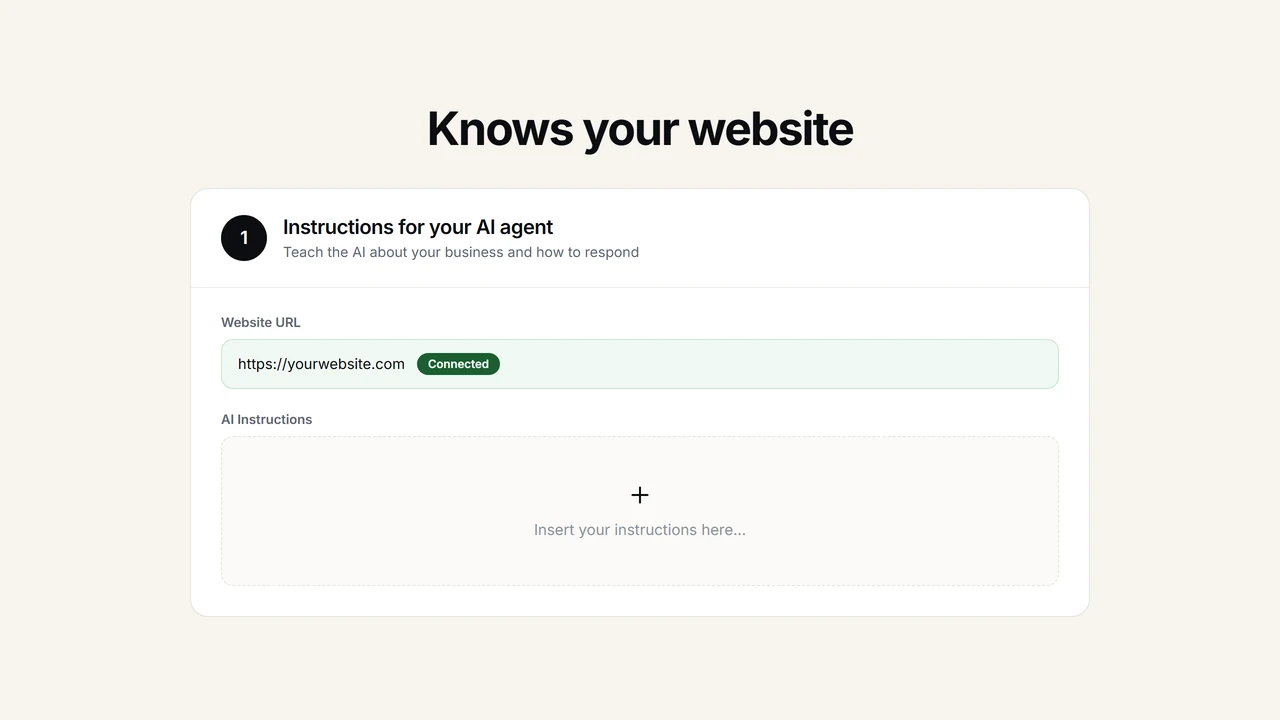
- Add your first client's website domain. The AI crawls their pages automatically — services, products, FAQs, about pages — and builds a knowledge base from the content it finds. Upload any additional documents the client has.
- Customize the chat widget with your brand identity (or the client's brand if they prefer). Set the header name, logo, and primary color. The "Powered by" badge is removed on Pro.
- Copy the one-line JavaScript embed, paste it into the client's site, and the chatbot goes live — answering visitor questions around the clock, under your brand.
<!-- The client sees your name. Their visitors see your name. -->
<script src="https://asyntai.com/widget.js"
data-id="client-site-id" async>
</script>
# One script tag. White-labeled. Live.
# Invoice the client. Keep the margin.
How reselling works
From signing up to billing your first client — four simple steps.
Choose a plan
Subscribe to a plan that fits how many client websites you need. Pro is the most popular for resellers — white-label plus up to 20 websites.
View plans →Add a client website
Each website you add under your account is one client's chatbot. Add up to the number your plan allows.
Go to your dashboard →Set up the chatbot
Add the client's content, customize the widget to their brand, and install it on their site. You can also give the client read-only access to their chat logs, analytics and leads on your own website.
Setup guide →Resell at your price
Charge your client whatever you like. You own the relationship and bill them directly — the margin is yours, every month.
Reseller Resources
Everything you need to get started, answer client questions, and see the dashboard in action
Reseller Guide
Step-by-step walkthrough: white-label branding, the embeddable client dashboard, and how to get your first client live.
Read the guideReseller FAQ
Pricing, margins, billing, white-label details, platform compatibility, and everything else partners ask before starting.
View FAQClient Dashboard Demo
See the embeddable white-label dashboard with sample data — conversations, analytics, and leads under your brand.
See the demoHow to sell AI — common questions
Practical answers for anyone exploring how to sell AI chatbots to businesses without a technical background.
Do I need to understand artificial intelligence or machine learning to sell AI?
No. You do not need to know how the AI works under the hood — just what it does for the business. The chatbot reads the client's website content and answers visitor questions using that information. You can explain it to a client in one sentence: "It answers your visitors' questions using the information already on your website, 24 hours a day." That is the entire pitch. The technical complexity is handled by the platform.
How do I find my first client?
Start with businesses you personally interact with — your dentist, your accountant, your hairstylist, a local restaurant. Pull up their website in the demo tool on this page, show them the chatbot answering a real question from their own site, and ask if they would like it running 24/7. The demo does the selling. Most resellers land their first client within their personal network because the trust already exists.
How much should I charge per client?
Most resellers charge between $99 and $399 per client per month, depending on the industry and how much value the chatbot delivers. Service businesses with high-value customers (law firms, dental offices, financial advisors) typically accept $200-$400 because a single converted lead is worth more than several months of chatbot fees. Smaller local businesses like restaurants and salons are more comfortable at $99-$149. Your Pro subscription is $449/month regardless of pricing — the margin is whatever you set it to be.
What happens when the chatbot does not know the answer to a question?
The AI only answers using the content from the client's website and any documents you upload. When a question falls outside that knowledge base, the chatbot acknowledges that it does not have the information and offers to connect the visitor with the business directly — via email, phone, or a lead capture form. It does not make up answers. This is a feature, not a limitation, and clients appreciate the honesty.
Can I test with one or two clients before committing to the Pro plan?
Yes. The Starter plan at $39/month supports 2 websites and 800 messages — ideal for testing with a couple of clients before scaling. The Standard plan at $139/month supports 3 sites and 15,000 messages. When you are ready to go full white-label and grow beyond 3 clients, upgrade to Pro. Your existing client configurations carry over — nothing needs to be rebuilt.
How do I handle client support if something goes wrong with the chatbot?
The most common client request is adjusting what the chatbot says about a specific topic — which you handle by updating the AI instructions or uploading a new document to the knowledge base. Both take less than five minutes. The chatbot itself runs on Asyntai's infrastructure, so uptime, performance, and AI model updates are handled by the platform. If you encounter an issue you cannot resolve, reach out to [email protected] — the team responds within 24 hours.
Do I need to create a company or register a business to start selling AI?
You can start as a freelancer or sole proprietor — there is no legal structure requirement from the platform side. Many resellers begin selling to their first few clients as an individual and formalize the business structure after revenue justifies it. The white-label branding uses whatever name and logo you provide, whether that is a registered company name or your personal brand.
What if I do not want to manage clients — can I just refer them?
Yes. The affiliate program pays a 20% recurring commission on every customer you refer using a tracking link. You share the link, they sign up and manage their own chatbot, and you earn commission every month for up to 12 months. A Pro plan referral earns you $89.80 per month for up to 12 months. Many people run both models: white-label reselling for clients they want to manage, and affiliate referrals for everyone else.
How is this different from building my own AI chatbot product?
Building a comparable product from scratch requires a conversational AI engine, web crawler, document parser, vector database, multi-tenant architecture, chat widget, analytics dashboard, lead capture system, and multilingual support across 36 languages — plus the engineering team to build and maintain all of it. That is hundreds of thousands of dollars in development before your first client. White-labeling gives you a finished, working product under your brand for $449/month. You spend your time selling and onboarding clients instead of debugging infrastructure.
The complete guide to selling AI as a business — no technical background required
Everyone hears that AI is the biggest business opportunity in a generation, but most people do not know where to start. The landscape is overwhelming: large language models, computer vision, natural language processing, generative AI, autonomous agents, retrieval-augmented generation, fine-tuning pipelines, GPU clusters. The jargon alone is enough to make someone with a business background feel locked out. Here is the reality that cuts through the noise — you do not need to understand any of that to sell AI. You need to understand a problem that businesses have and an AI product that solves it. The problem is simple: businesses lose customers because website visitors leave with unanswered questions. The product is an AI chatbot that answers those questions using the business's own content, around the clock, in 36 languages. That is the entire value proposition, and it is one you can explain to any business owner in thirty seconds.
The reason AI chatbots are the easiest entry point into selling AI is that the product demonstrates itself. Compare it to selling an AI-powered analytics tool — you would need to explain data pipelines, show dashboards, discuss statistical models, and convince the buyer that insights will materialize over time. With a chatbot, the demo is immediate and visceral. You pull up the prospect's website, the AI reads their content, and within minutes a chatbot is answering real questions about their business. The prospect watches a visitor ask about pricing, hours, services, or product specifications — and the AI responds accurately using information from their own pages. There is no gap between the promise and the proof. The prospect does not need to imagine what the AI will do. They see it happening, on their site, with their content, in real time. That immediacy is why AI chatbots convert faster than almost any other AI product you could sell.
White-labeling is the mechanism that turns someone else's product into your product. When you white-label an AI chatbot, you replace the platform's name, logo, and branding with your own. On the Pro plan, the "Powered by" badge disappears. Your name appears in the chat widget header. Your logo loads when the widget opens. Your colors define the visual identity. The embeddable client dashboard — where your clients review conversations, analytics, and leads — carries your branding too. Your clients interact with your brand throughout the entire experience, from the widget on their website to the dashboard where they manage it. They have no reason to know or care what platform runs behind the scenes. You are the provider. You handle setup, you send the invoice, you own the relationship. The white-label model is not new — web hosting companies, email marketing platforms, and CRM providers have used it for decades. What is new is that you can now white-label an AI product.
The economics of selling AI chatbots through white-labeling deserve a detailed walkthrough because the numbers are what make this business viable. The Pro plan costs $449 per month. It includes up to 20 client websites, 50,000 total messages, and complete white-label branding. There is no per-client fee, no revenue share, and no commission flowing back to the platform. Your revenue is whatever you charge your clients, multiplied by the number of clients you have. Your cost is $449. The gap is gross profit. At $149 per client per month — a conservative price for an AI chatbot — three clients generate $447 in revenue, nearly covering the subscription. Client four puts you in the black. At $199 per client, you break even between two and three clients. At $249, two clients cover it. At $299, you are profitable before client two finishes their first month. The math gets more attractive as you scale: ten clients at $199 each generate $1,990 against $449 in cost — a 77% gross margin. Twenty clients at $199 each generate $3,980, leaving $3,531 in monthly gross profit. Visit asyntai.com/pricing to see all plan options.
Pricing your AI chatbot service is one of the first decisions you will face, and the right price depends on who you are selling to. Think about it from the client's perspective: what is the value of a chatbot that answers visitor questions 24/7, captures leads while the office is closed, and handles repetitive inquiries that would otherwise go to the front desk? For a dental office that loses one patient per month because a visitor could not get their insurance question answered after hours, that one patient is worth $2,000-$5,000 in annual revenue. A chatbot at $299/month is a rounding error compared to that recovery. For a local restaurant where the chatbot primarily handles reservation questions and menu inquiries, the value is lower — $99-$149 per month feels right. Price according to the value you deliver, not the cost of the subscription. The subscription is your cost basis. The price is a function of what the chatbot is worth to the client's business.
Finding clients is not about cold calling or mass outreach — at least not at the beginning. The most effective first move is to start with businesses where you already have a relationship. You walk into your dentist's office, your accountant's lobby, or your barber shop with a phone showing a chatbot running on their website. You did not ask permission to crawl their site — you just used the free demo tool. The conversation goes: "I have been working with AI chatbots and I set one up on your website just to show you what it looks like. It is answering questions from visitors using the content already on your site. Would something like this be useful to you?" That is the pitch. The demo on their own site makes it concrete. If they say yes, you set it up in twenty minutes, send them an invoice, and you have your first recurring client. The second and third clients come more easily because you can now reference the first one.
The technical setup is where people expect complexity and find simplicity instead. For each client, you add their website domain in the dashboard. The AI automatically crawls every page — services, pricing, FAQs, about pages, blog posts, product listings — and builds a knowledge base from what it finds. You do not write training data, label examples, or configure machine learning parameters. The AI handles all of that autonomously. If the client has additional materials — product PDFs, policy documents, a menu as a downloadable file — you upload those and the AI incorporates them into its responses alongside the crawled content. You customize the widget colors, set your brand name and logo in the header, and copy a one-line JavaScript embed. Paste it into the client's site — or use one of the 30+ platform plugins for WordPress, Shopify, Wix, Squarespace, and others — and the chatbot goes live. Twenty minutes, start to finish. No staging environment, no code review, no deployment pipeline.
One of the strongest angles when selling AI chatbots to businesses is the after-hours argument. Most small businesses operate 8 to 10 hours per day, but their websites receive visitors around the clock. A potential customer browsing a dentist's website at 9 PM with a question about Invisalign pricing does not want to wait until morning. Without a chatbot, they leave the site and may never return — or worse, they visit a competitor's site that does answer their question immediately. With an AI chatbot, that 9 PM visitor gets an accurate answer pulled directly from the dentist's website, and the chatbot can capture their email or phone number as a lead. The business owner arrives the next morning to find a qualified lead in their dashboard, generated while they were sleeping. This pitch resonates with every business owner who has ever worried about missing after-hours inquiries, and that is nearly all of them.
Custom Tools elevate the chatbot from a question-answering widget to an AI assistant that takes actions. Available on Standard ($139/month) and Pro plans, Custom Tools let the AI call external API endpoints during a conversation — checking order status, looking up appointment availability, verifying account information, initiating return requests, or fetching live inventory data. For your clients, this transforms the chatbot from a helpful FAQ bot into a functional team member. An ecommerce client's chatbot can tell a customer exactly where their package is. A clinic's chatbot can check whether Tuesday at 2 PM is available and collect intake information on the spot. When you sell a chatbot with Custom Tools capabilities, you are not just selling answers — you are selling automation. That distinction supports higher monthly pricing and creates deeper client dependency on the service you provide.
Language support expands who you can sell to and who your clients can serve. The AI supports 36 languages and auto-detects the visitor's language, responding naturally in whatever language the question arrives in. A Spanish-speaking visitor gets Spanish answers. A Mandarin-speaking visitor gets Mandarin. The knowledge base content does not need to be translated — the AI handles the language conversion from whatever source material is available. For you as a reseller, this means you can serve businesses in non-English markets, businesses with multilingual customer bases, and businesses targeting international audiences — all without additional setup or cost. A single chatbot on a single client's site handles all 36 languages automatically. If you operate in a multilingual market — South Florida, Los Angeles, Toronto, the EU — this feature alone can be the reason a client chooses your service over a competitor's English-only solution.
Scaling from a handful of clients to a full roster is where the business model really shines. Your cost stays flat at $449/month regardless of whether you have 2 clients or 20. Each new client adds revenue with zero additional platform cost. The work per client is minimal after setup — the AI updates its knowledge base automatically as the client's website content changes, conversation logs are available for review in the dashboard, and the most common ongoing task is an occasional tweak to AI instructions when a client wants to adjust tone or add a specific response guideline. Most resellers managing 10-20 clients spend under two hours per week on maintenance. That is roughly six minutes per client per week in exchange for $150-$300 per month per client in revenue. When you outgrow the 20-site limit on the Pro plan, the Custom Pro plan extends your capacity with higher site and message limits.
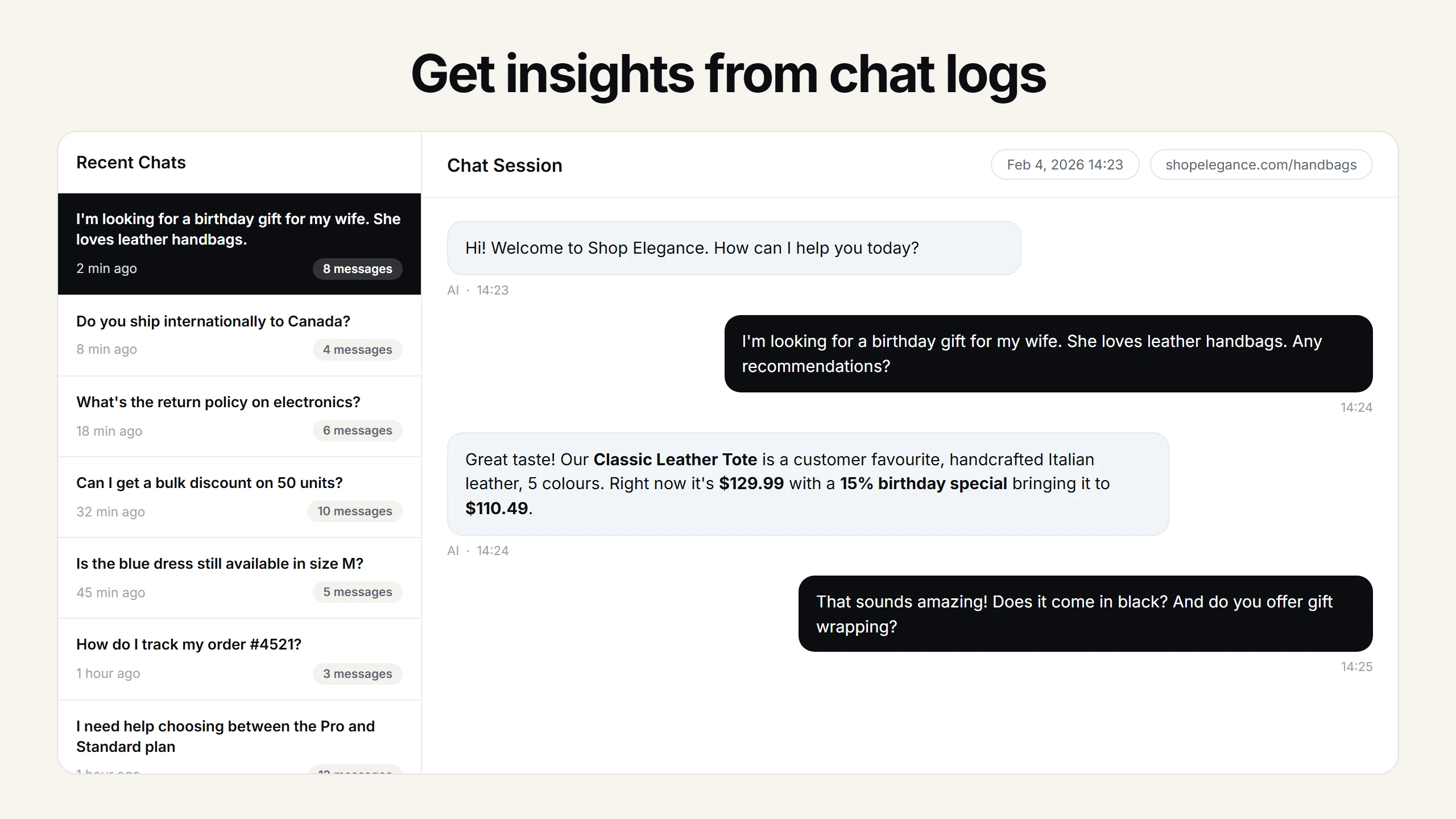
The embeddable client dashboard is a feature that deepens client relationships and reduces support requests. Each client gets access to a white-labeled dashboard with three tabs: Conversations (full chat transcripts with visitor messages and AI responses), Analytics (volume, engagement, and resolution metrics), and Leads (captured contact information with CSV export). You embed this dashboard on your own website using a JS snippet. It carries your logo, your brand name, and your primary color. Password protection and domain restrictions keep each client's data private. When a client wants to see how their chatbot is performing, they log into a dashboard on your website — reinforcing your brand as the provider. They can export leads, review conversations, and track performance without ever contacting you. This self-service access reduces the number of "how is my chatbot doing?" emails you receive and gives clients a tangible reason to stay month after month.
The comparison with building your own AI product is worth spelling out because it illustrates why white-labeling is the rational choice for someone learning how to sell AI. Building a chatbot platform from scratch requires: a large language model integration (or your own model), a web crawling and content ingestion pipeline, a document parser that handles PDFs, Word files, and other formats, a vector database for semantic search, a real-time chat widget with desktop and mobile responsiveness, multi-tenant architecture so each client's data is isolated, an analytics dashboard, lead capture with export functionality, support for 36 languages with auto-detection, installation plugins for 30+ web platforms, and the infrastructure to host, scale, and maintain all of it. A small engineering team building this would cost $30,000-$50,000 per month in salaries alone. That is before hosting, model API costs, security audits, and bug fixes. White-labeling gives you everything above for $449/month. The engineering risk is zero. The opportunity cost of building instead of selling is enormous.
Retention in this business model is structurally favorable. Once a chatbot is live on a client's website, it starts accumulating value that makes switching costly. Conversation histories build up. The knowledge base gets refined with uploaded documents, adjusted AI instructions, and tuned response guidelines. Lead capture data flows into the client's workflow. After three months, the chatbot is woven into how the business handles visitor inquiries. Replacing it means abandoning all that accumulated configuration, retraining a new system, and disrupting a process that works. Clients rarely leave a working chatbot — they renew month after month because the cost of switching exceeds the cost of staying. For you as the seller, this means your monthly recurring revenue becomes more stable over time, not less. The revenue you build in month three is very likely to still be there in month twelve.
If you have been wondering how to sell AI without being a technologist, the answer is straightforward: find a working AI product that solves a clear business problem, white-label it under your brand, and sell it to businesses that need it. AI chatbots are that product. The problem they solve — unanswered visitor questions, lost leads, no after-hours support — is universal. The setup is twenty minutes per client. The economics are transparent: $449/month for up to 20 clients, you set the price, and the gap is your margin. No coding, no ML expertise, no infrastructure management. If you have questions about getting started, pricing for your market, or the Custom Pro plan for larger operations, reach out at [email protected] — the team responds within 24 hours.