Chatbot for marketing agencies: capture leads on every client site around the clock
Deploy AI chatbots across your clients' websites to engage visitors, capture contact details, and increase conversions — all branded under your agency name.
See how the chatbot captures leads on any client site
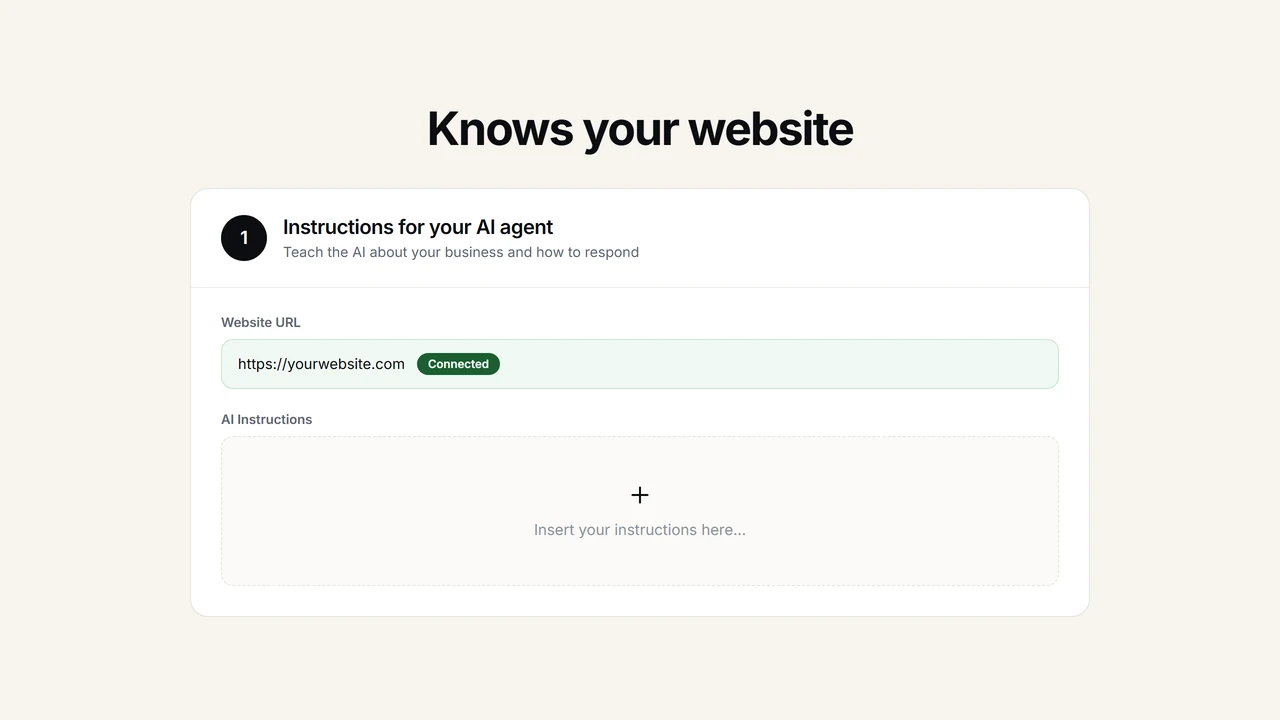
Paste a client URL below. The AI reads their website and builds a working chatbot in seconds — the same one that will capture visitor leads 24/7 under your brand.
Every visitor who leaves without converting is a lead your client paid for and lost
Marketing agencies spend thousands driving traffic to client websites — paid search, social campaigns, content marketing — and then watch a significant share of those visitors leave without taking action. They had a question. Nobody answered it. The visit ended. An AI chatbot intercepts those visitors the moment they hesitate, answers their questions using the client's own website content, and captures their name, email, and phone number before they bounce. For a marketing agency, this is not an add-on service — it is the missing piece that makes every other campaign more effective. The Pro plan at $449/month covers up to 20 client websites with full white-label branding, so the chatbot appears as your agency's own product. The Standard plan at $139/month handles 3 sites with 15,000 messages. Agencies wanting white-label on Standard can email [email protected] to request manual activation.
- Turn traffic into contacts, not just pageviewsYour agency drives the traffic. The chatbot converts it. When a visitor lands on a client's site at 11 PM and asks about pricing, the AI answers their question and captures their contact details in one smooth conversation. That lead goes straight into the client's dashboard — a name, email, and phone number that did not exist before the chatbot was there. The client sees tangible proof that your agency delivers results beyond clicks and impressions.
- Add a service line with no delivery overheadUnlike campaign management or content production, a chatbot deployment takes 20 minutes per client. There is no creative review cycle, no A/B testing queue, no monthly reporting deck. You set up the chatbot, install it with one line of code, and it runs. Monthly billing starts immediately, and the client sees captured leads from day one. It is the fastest service to deploy and the easiest to maintain in your entire portfolio.
- Make your campaigns measurably more effectiveWhen you can show a client that the chatbot captured 47 leads this month from traffic your campaigns drove, the conversation about marketing ROI shifts in your favor. The chatbot does not replace your other services — it amplifies them. PPC visitors who would have bounced become leads. SEO traffic converts at a higher rate. Every marketing channel you manage benefits because the chatbot catches the visitors that would otherwise slip through.
One subscription, 20 client sites — every captured lead increases your agency's ROI story
The math works because you are adding a revenue-generating service on top of campaigns you already manage. The Pro plan at $449/month gives you 20 sites and 50,000 shared messages. Every chatbot deployed on a client site captures leads, answers questions, and makes your marketing campaigns more effective — all under your brand. Agencies growing past 20 clients move to a Custom Pro plan with higher limits.
- 5 clients at $200 each: $551/month marginFive clients from your existing roster paying $200/month for chatbot-driven lead capture generates $1,000/month against a $449 cost. That is $551 in margin — and every lead the chatbot captures reinforces why clients keep paying for your other services too. You are not just earning chatbot revenue; you are strengthening the entire client relationship.
- 12 clients at $275 each: $2,851/month marginAt twelve clients, chatbot revenue reaches $3,300/month with $2,851 in margin. That is over $34,000 annually in recurring revenue from a service that takes an afternoon to roll out across all twelve sites. The chatbot runs while your team focuses on campaigns, creative, and strategy.
- 20 clients at $300 each: $5,551/month marginA full Pro plan at capacity yields $6,000/month in revenue and over $5,500 in margin. At this scale, the chatbot service generates more annual profit than many retainer contracts — and requires a fraction of the labor. Agencies filling 20 slots typically move to the Custom Pro plan to keep scaling.
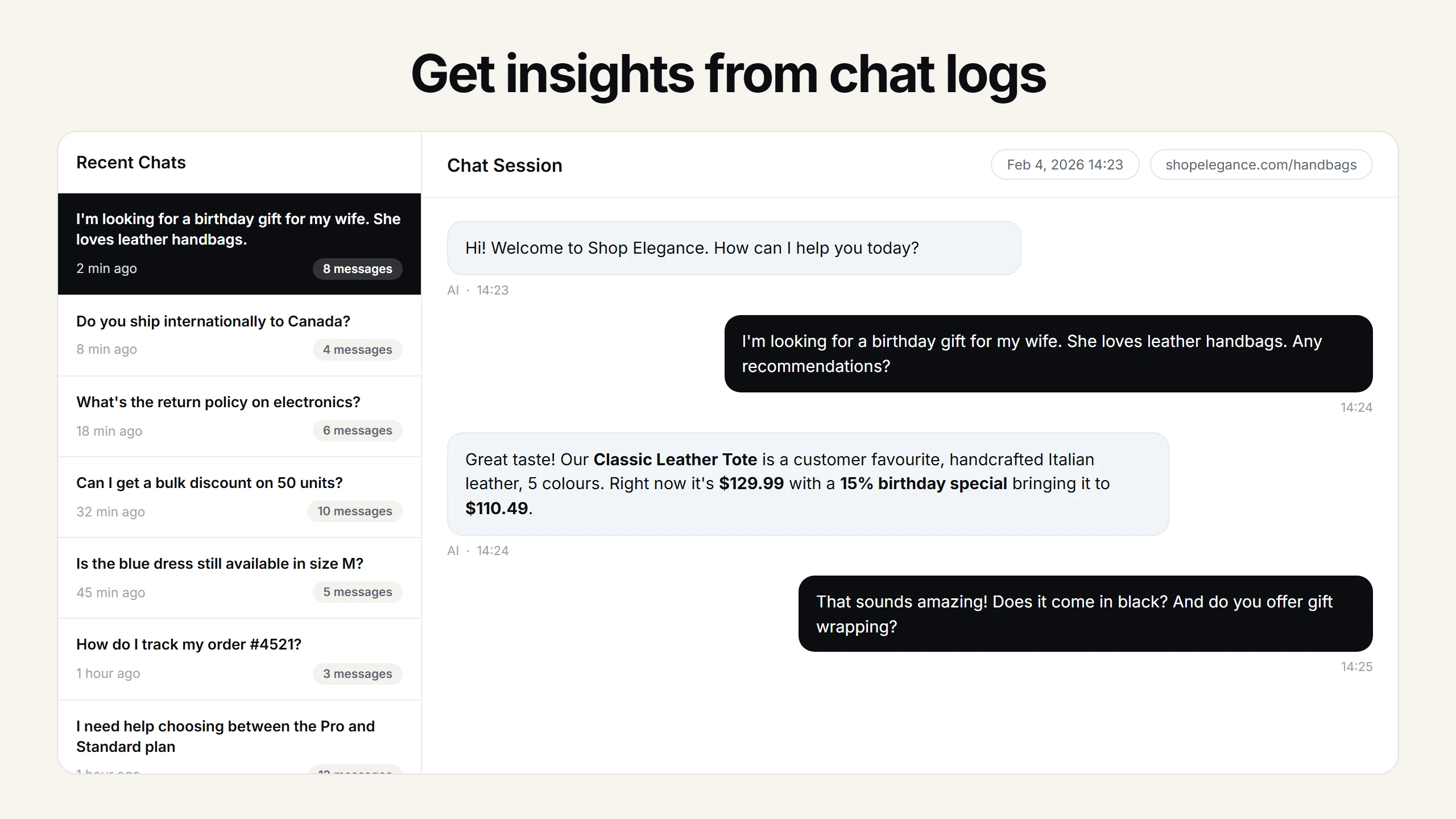
- Leads captured with name, email, and phoneThe chatbot does not just answer questions — it collects visitor contact information during the conversation. Each captured lead appears in the client's white-labeled dashboard with a full transcript showing what the visitor asked and what the AI answered. Clients can export leads as CSV and import them into their CRM. For marketing agencies, captured leads are the most concrete metric you can report.
- 36 languages, zero extra configurationServe clients in any market. The AI detects the visitor's language and responds accordingly — English, Spanish, French, German, Japanese, Arabic, and 30 others. A marketing agency running campaigns for a multilingual clientele gets automatic language support on every deployment without per-language pricing or setup.
Deploy a lead-capturing chatbot on any client site in 20 minutes
No APIs, no code, no ML knowledge. Sign up, add the client site, brand the widget, and paste one script tag. Leads start flowing immediately.
- Choose your plan at asyntai.com/pricing — Pro ($449/month) gives you white-label branding and 20 sites. Standard ($139/month) covers 3 sites. Starter ($39/month) handles 2 sites for testing.
- Add a client's domain in the dashboard. The AI reads their website content — up to 50 pages — and builds a knowledge base automatically. Upload additional documents like product catalogs, pricing sheets, or FAQs to fill gaps.
- Customize the widget to your agency brand — your name, your logo, your colors. On Pro, all original branding is completely removed. Configure the lead capture form to collect name, email, and phone number from visitors.
- Copy the embed script and install it on the client's site. Works on WordPress, Shopify, Wix, Squarespace, Magento, and 30+ other platforms. The chatbot goes live and starts capturing leads immediately.
<!-- Your brand. Your pricing. Your client relationship. -->
<script src="https://asyntai.com/widget.js"
data-id="client-site-id" async>
</script>
# One script tag. Works everywhere.
# Your agency delivers AI. The client sees your brand.
How reselling works
From signing up to billing your first client — four simple steps.
Choose a plan
Subscribe to a plan that fits how many client websites you need. Pro is the most popular for resellers — white-label plus up to 20 websites.
View plans →Add a client website
Each website you add under your account is one client's chatbot. Add up to the number your plan allows.
Go to your dashboard →Set up the chatbot
Add the client's content, customize the widget to their brand, and install it on their site. You can also give the client read-only access to their chat logs, analytics and leads on your own website.
Setup guide →Resell at your price
Charge your client whatever you like. You own the relationship and bill them directly — the margin is yours, every month.
Reseller Resources
Everything you need to get started, answer client questions, and see the dashboard in action
Reseller Guide
Step-by-step walkthrough: white-label branding, the embeddable client dashboard, and how to get your first client live.
Read the guideReseller FAQ
Pricing, margins, billing, white-label details, platform compatibility, and everything else partners ask before starting.
View FAQClient Dashboard Demo
See the embeddable white-label dashboard with sample data — conversations, analytics, and leads under your brand.
See the demoChatbot for marketing agencies — FAQs
Common questions from marketing agencies evaluating AI chatbots for lead capture and client retention.
How does the chatbot capture leads from website visitors?
The chatbot engages visitors in natural conversation — answering their questions about the client's products, services, pricing, or hours — and collects their name, email, and phone number during the interaction. Unlike static contact forms that interrupt the visitor's experience, the chatbot gathers information as part of a helpful exchange. Captured leads appear in the client dashboard with a full conversation transcript, so you know exactly what the visitor was interested in. Leads can be exported as CSV for import into any CRM or email marketing platform.
Can I show clients how many leads the chatbot captured?
Yes. Each client gets access to a white-labeled dashboard with three tabs: Conversations (full chat transcripts), Analytics (message volume, peak hours, usage trends), and Leads (captured contact information with export). The dashboard is embeddable on your agency's own website, so clients log in through your site and see your branding. Monthly lead counts give you a concrete deliverable to include in your reporting — "the chatbot captured 52 leads this month" is a line item clients understand and value.
Does the chatbot work alongside our existing marketing campaigns?
It amplifies them. Visitors arriving from PPC campaigns, organic search, social ads, or email campaigns encounter the chatbot on the client's site. Instead of browsing passively and leaving, they ask questions and get immediate answers. The chatbot captures their contact details before they bounce. For marketing agencies, this means every traffic source you manage converts at a higher rate. The chatbot does not compete with your campaigns — it catches the visitors those campaigns bring in but would otherwise lose.
How does the AI know how to answer questions about each client's business?
When you add a client's domain, the AI reads their website content — up to 50 pages — and builds a knowledge base from it. Product pages, service descriptions, pricing, FAQs, business hours, team bios — all of it becomes source material for the chatbot's responses. You can add supplementary documents like PDF catalogs or internal guides to fill gaps. The AI uses this content to answer visitor questions accurately. It does not make up information — if the answer is not in the knowledge base, the chatbot says so and offers to connect the visitor with a human.
What should I charge my marketing clients for the chatbot?
Most marketing agencies charge between $150 and $400 per client per month. The pricing depends on the vertical, the volume of leads captured, and whether you bundle the chatbot with your other services. Some agencies include it as part of a marketing retainer; others price it as a standalone line item. On the Pro plan, your per-client cost — if you fill all 20 slots — is roughly $22/month. You own the billing relationship completely. Asyntai has no visibility into what you charge and takes no revenue share.
Can the chatbot do more than answer questions and capture leads?
On Standard and Pro plans, Custom Tools let the chatbot call a client's own API endpoints during a conversation. A restaurant client's bot can check reservation availability. A service company's bot can pull up appointment slots. An ecommerce client's bot can look up order status or initiate returns. These integrations create a natural upsell path — basic chatbot at one price, chatbot with live integrations at a premium. Each integration is configured independently per client.
How does white-label branding work for marketing agencies?
On the Pro plan, all original branding is removed from the chat widget and the client dashboard. Your agency name, logo, and colors appear on every surface. Visitors interacting with the chatbot see your brand. Clients viewing their dashboard see your brand. There is no way for anyone to trace the product back to the underlying platform. Your clients perceive the chatbot as something your agency built and operates. Standard plan users can request manual white-label activation by emailing [email protected].
What if a client only wants the chatbot without our ongoing management?
You have two options. Continue managing it under your reseller account and billing them monthly — you keep the margin and maintain the client relationship. Or, if they want full self-service, refer them through your affiliate link. You earn a 20% recurring commission on their subscription for up to 12 months. A Pro plan referral pays $89.80/month in passive income. Many marketing agencies use both models: managed reselling for retainer clients and affiliate referrals for clients who prefer independence.
Can I test the chatbot before rolling it out to clients?
Yes. The free tier gives you 1 site and 50 messages per month — enough to demo the chatbot to prospects on a real client URL. The Starter plan at $39/month gives you 2 sites and 800 messages, which is enough to pilot with one or two clients. Upgrading or downgrading is instant, and there are no contracts or early termination fees on any plan. Most marketing agencies start on Starter to prove the concept, then move to Pro once they see lead capture results.
Chatbot for marketing agencies: the lead capture layer your campaigns are missing
There is a leak in every marketing funnel, and every agency knows where it is. The leak sits between the moment a visitor lands on a client's website and the moment they leave without doing anything. They arrived because the campaign worked — the ad was targeted correctly, the keyword matched, the social post caught their attention. But once on the site, something stalled. Maybe they needed a quick answer about pricing. Maybe they wanted to confirm the business served their area. Maybe they were comparing options and needed one reason to stay. Whatever the question was, nobody answered it, and the visitor clicked away. That click represents wasted ad spend, wasted SEO effort, and a lead the client will never get back. A chatbot sits at exactly that point of leakage and stops it.
The idea that marketing agencies should offer chatbots is not new. What is new is that deploying one no longer requires engineering resources, months of development, or any understanding of machine learning. The barrier used to be prohibitively high — you would need to build something, maintain it, handle updates, troubleshoot failures. Most agencies looked at the effort involved and decided it was not worth the distraction from their core work. That calculation has changed. Today, an agency can add a client's domain, wait roughly sixty seconds while the AI reads the website content, adjust colors and branding, and paste a single line of JavaScript on the site. The chatbot is live, answering visitor questions in the client's own words, capturing names and email addresses, and operating every hour of every day. The entire process takes twenty minutes, and there is no development team required.
What makes this particularly relevant for marketing agencies — as opposed to agencies focused purely on design or development — is the relationship between traffic and conversion. A marketing agency's job is to drive qualified visitors to a client's website. The metric that matters most is not impressions or click-through rate or even traffic volume. It is what happens after the visitor arrives. Every visitor who leaves without converting is a failure of the page to complete the job the campaign started. An AI chatbot bridges that gap by engaging the visitor at the moment of hesitation and providing the information they need to take the next step. This is not a replacement for better landing pages or stronger CTAs. It is an additional conversion layer that works in parallel with everything the agency already does.
Lead capture through a chatbot produces a qualitatively different kind of lead than a form submission. When someone fills out a contact form, you get a name and an email address with no context. When someone engages with a chatbot, you get a full conversation transcript showing exactly what they asked, what mattered to them, and where they were in their decision process. A dentist's front desk receives not just "John Smith, [email protected]" but a transcript showing that John asked about teeth whitening costs, whether the practice accepted his insurance, and how soon he could get an appointment. The client's follow-up call is informed and specific rather than cold. This contextual richness increases conversion from lead to customer, which in turn increases the perceived value of the agency's service.
The economic structure of offering chatbots as a marketing agency service is worth understanding in detail because it differs fundamentally from how most agency services generate revenue. Campaign management, content creation, SEO — these are labor-intensive services that scale linearly. More clients means more hours, more staff, more overhead. A chatbot deployment is a fixed-cost product. The Pro plan at $449/month supports 20 client websites and 50,000 shared messages. The cost does not increase with the second client, or the fifth, or the twentieth. At ten clients charging $250/month each, the agency collects $2,500 against $449 in cost — over $24,000 in annual margin from a service that required no ongoing labor after the initial 20-minute setup. This margin compounds because the revenue is recurring. Clients do not cancel a service that visibly captures leads for them month after month.
The white-label dimension transforms this from a referral arrangement into a genuine agency product. On the Pro plan, every trace of the underlying platform disappears from the widget and the client-facing dashboard. The agency's name sits in the header. The agency's logo appears in the chat interface. The client's visitors see the agency's brand when they interact with the chatbot, and the client sees the agency's brand when they log into their dashboard to review leads and transcripts. The perception — and it matters enormously — is that the agency built this technology. That perception supports premium pricing. A generic chatbot with someone else's logo is a commodity worth $50/month. An AI assistant that carries your agency's identity and captures leads under your brand is worth $300/month or more, because it feels proprietary.
The client dashboard is not just a reporting tool — it is a retention mechanism that strengthens over time. Each client receives a white-labeled dashboard, embeddable on the agency's own website, with Conversations, Analytics, and Leads tabs. Conversations show full transcripts of every visitor interaction. Analytics display message volume, peak hours, and engagement trends. Leads present captured contact information with CSV export. As months pass, the dashboard accumulates data: hundreds of conversations, dozens of leads, behavioral patterns that inform marketing strategy. A client considering switching agencies or canceling the chatbot service is not just losing a widget — they are walking away from months of accumulated lead data and conversation history. The switching cost grows with every month of use, which is why chatbot churn rates are dramatically lower than project-based service churn.
Vertical positioning multiplies the value a marketing agency can extract from chatbots. The underlying technology is identical regardless of the client's industry, but how an agency packages and presents it determines the price point. "AI chatbot for your website" is a generic offering that invites price shopping. "AI lead capture assistant for real estate agents" or "AI intake specialist for personal injury law firms" is a specialized solution that commands a premium. When a marketing agency focuses on a vertical, they learn the common visitor questions, develop optimized AI instructions for that industry, and reduce setup time from twenty minutes to ten. Their pitch decks feature industry-specific case studies. Their clients trust the agency's expertise because the chatbot feels purpose-built for their business — even though the underlying configuration takes minutes.
Custom Tools — available on Standard ($139/month) and Pro ($449/month) plans — represent the premium tier of chatbot services that marketing agencies can offer. Without Custom Tools, the chatbot answers questions using the client's website content and captures leads. With Custom Tools, the chatbot connects to the client's own systems during live conversations. A hotel client's chatbot checks room availability and starts a booking. A fitness studio's chatbot pulls up class schedules and reserves spots. A home services company's chatbot looks up appointment openings and confirms the visit. Each Custom Tool integration is configured per client, and each one deepens the chatbot's value to the point where removing it would mean losing genuine business functionality. For agencies, this creates a natural two-tier offering: basic lead capture at $200/month and integrated lead capture with live actions at $350/month.
Platform compatibility disappears as a concern the moment the agency deploys its second or third chatbot. The widget installs via a single line of asynchronous JavaScript that does not interfere with existing site functionality. WordPress and Shopify have official plugins. Wix, Squarespace, Webflow, Magento, WooCommerce, Joomla, Drupal, and over 30 other platforms all support the embed script natively. A marketing agency whose client roster spans five different website builders installs the chatbot the same way on all of them. There is no "sorry, it does not work on your platform" conversation, because the technology works on any platform that supports a script tag.
Language support is a quiet differentiator for marketing agencies serving diverse markets. The AI supports 36 languages with automatic detection. A chatbot deployed on a bilingual business's website responds in whichever language the visitor uses — no configuration, no per-language pricing, no separate knowledge bases. A marketing agency running campaigns in both English and Spanish markets can serve both with a single deployment. An agency with international clients gains multilingual capability without adjusting their pricing or workflow. The knowledge base content can be in any language, and the AI handles the language matching automatically.
The relationship between chatbot lead capture and existing marketing services is complementary, not competitive. An agency running Google Ads for a client drives visitors to the client's website. Some percentage of those visitors convert through the existing page elements — forms, calls, purchases. The chatbot catches the visitors who do not convert through those elements but who have questions that, once answered, move them to action. The chatbot does not cannibalize other conversion channels; it creates a new one that operates alongside them. This is why adding chatbot services increases an agency's reported ROI for every other service in the stack. When the monthly report shows 200 leads from paid search and 45 additional leads from the chatbot, the client sees a marketing partner delivering comprehensive results.
The affiliate program provides a passive income layer for prospects who fall outside the managed service model. When a marketing agency encounters a business that wants a chatbot but does not want ongoing agency involvement, the affiliate link generates income without management overhead. A 20% recurring commission on the referred client's subscription for up to 12 months produces passive revenue — $89.80/month for a Pro plan referral, $27.80/month for Standard. The two models, managed reselling and affiliate referral, complement each other and allow the agency to monetize every lead category rather than discarding those who do not fit the primary service tier.
Timing matters in a way that agencies do not always appreciate until the opportunity has narrowed. Every month that passes without offering chatbot lead capture is a month where some percentage of clients will encounter the technology through another channel — a competitor's pitch, a direct-to-business ad, a recommendation from another business owner. Once a client has a chatbot from another source, the agency has lost the chance to be the one providing it. The agency that moves now captures the first-mover advantage within its client roster. The switching costs — accumulated lead data, integrated dashboards, trained visitor expectations — compound monthly. Six months from now, the agency that deployed chatbots today will have clients with half a year of captured leads and conversation insights. Displacing that is nearly impossible.
Ready to add lead-capturing chatbots to your marketing services? Start with the Pro plan and deploy your first client chatbot today — or email [email protected] if you have questions about scaling.