AI search for Magento that navigates your entire catalog like a product expert
Magento's Elasticsearch handles keywords. It does not handle "I need a drill bit set for concrete, 10mm or larger, compatible with my SDS-Plus chuck." Asyntai's AI search understands that request, searches your live product catalog via the Magento REST API, and returns matching items as Dynamic Product Cards — visual cards with images, prices, and buy buttons — right inside the chat widget. Configurable products, bundle products, grouped products, multi-store views, B2B tiered pricing. One AI that understands them all.
See how AI search handles your Magento catalog
Enter your Magento or Adobe Commerce store URL and watch the AI find products from your catalog using natural language
Understands complex catalogs — configurable products, attributes, categories, B2B pricing tiers
Magento catalogs are structurally complex in ways that keyword search cannot navigate. Configurable products with dozens of attribute combinations. Bundle products where the visitor needs to assemble components. Grouped products that relate items conceptually but not through a parent SKU. Category trees six levels deep. Attribute sets that differ between product types. Elasticsearch indexes this data and matches keywords against it — but when a visitor asks "stainless steel hex bolts, M8, packs of 100 or more," keyword matching returns noise because the intent spans attributes, categories, and quantity tiers simultaneously. Asyntai's AI search reads that query as a structured product need, searches your catalog through the Real-Time Data Feed connected to your Magento REST API, and returns matching products as Dynamic Product Cards with images, prices, descriptions, and direct buy buttons.
- Conversational queries across product typesVisitors describe what they need in plain language — "industrial casters rated for 500kg, swivel with brake," "a replacement filter for the AX-200 series compressor," "copper pipe fittings, 22mm, pack of 50." The AI interprets the full request — product type, specifications, quantities, compatibility — and searches your Magento catalog for the best matches, not just keyword overlaps.
- Dynamic Product Cards with full detailMatching products appear as rich visual cards inside the chat — product image, name, price, short description, and a direct link to the product page. Multiple results display as a swipeable carousel. For configurable products, the AI can show the base product and mention available options (sizes, colors, materials) so the visitor knows what to expect before clicking through.
- Real-Time Data Feed from your Magento REST APIThe AI searches your live catalog through a Real-Time Data Feed connected to Magento's /rest/V1/products endpoint. Price changes, stock updates, and new products reflect automatically. The feed supports up to 25,000 products on the Data Feed Max plan — enough for even large Magento catalogs with full product descriptions, attributes, and image URLs.
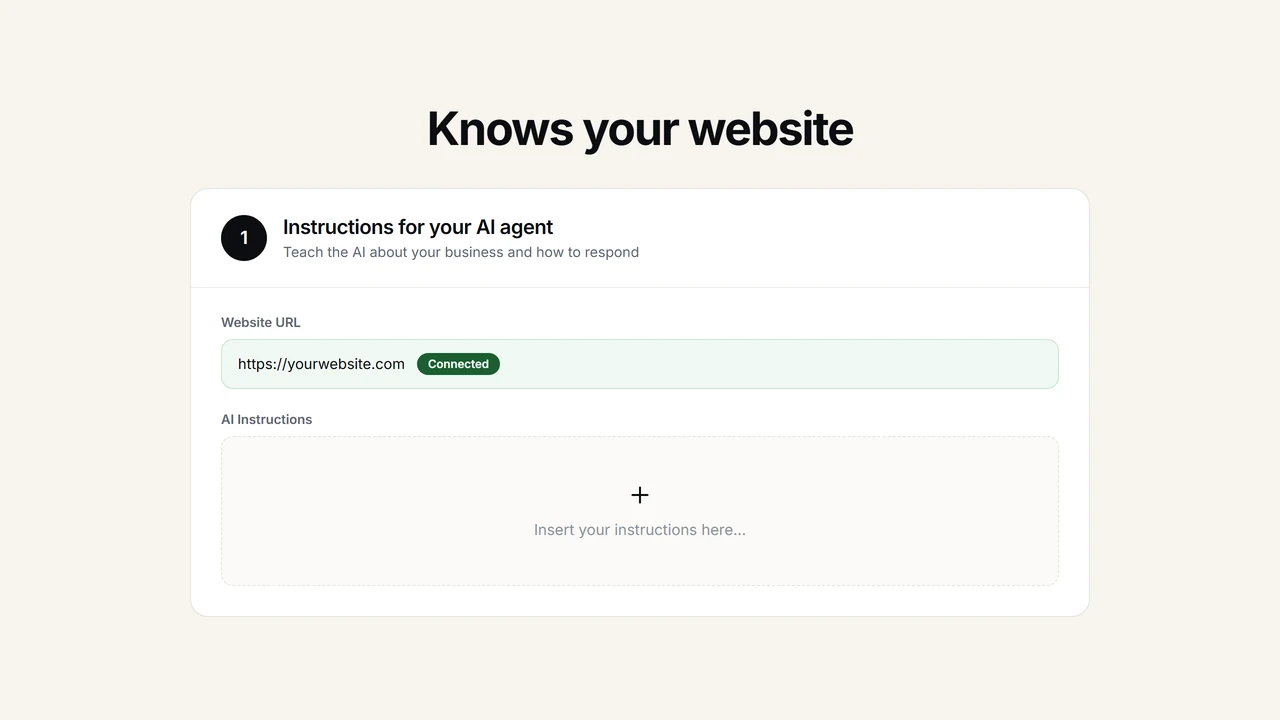
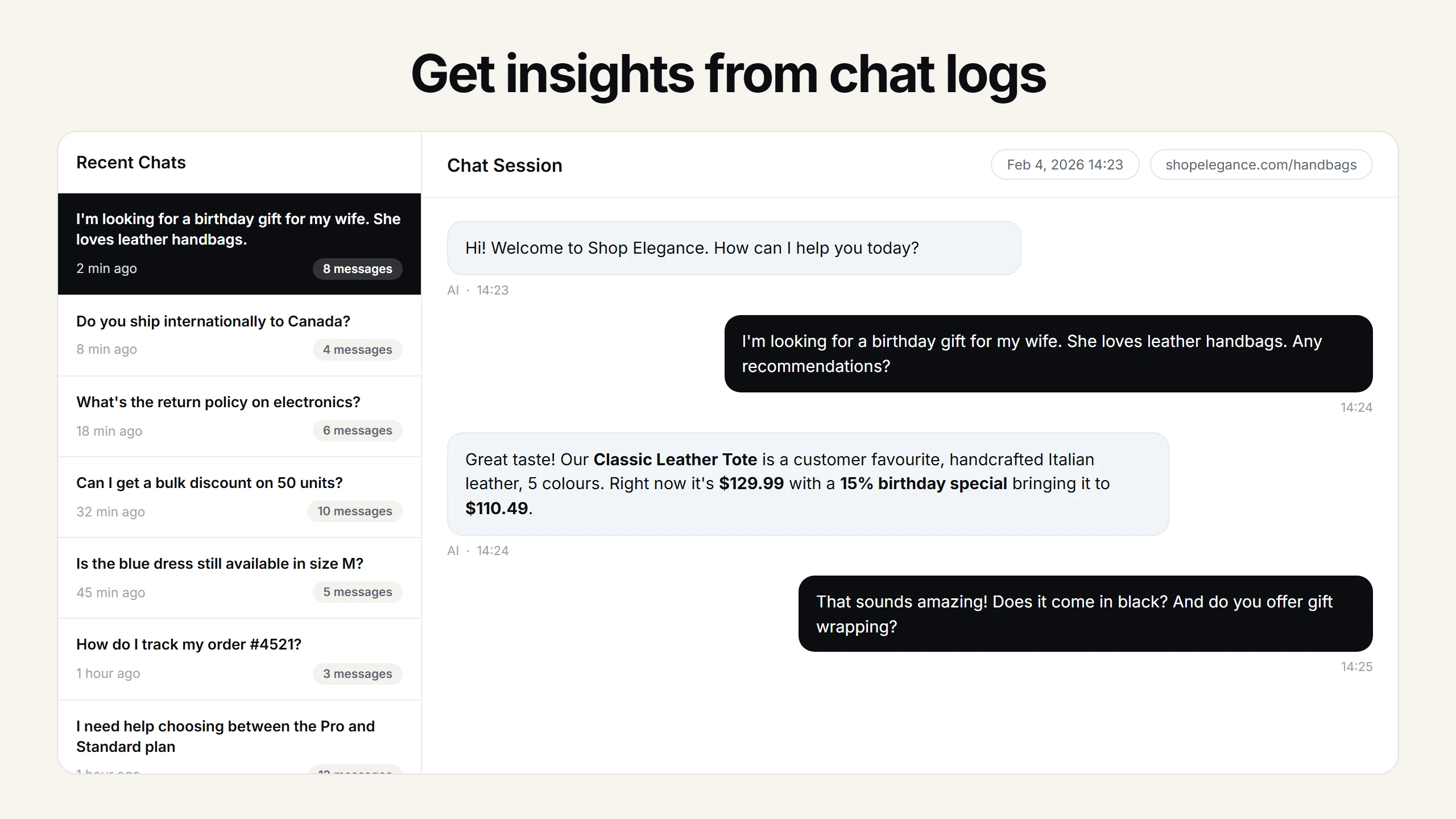
Live from your Magento API — Real-Time Data Feed, Custom Tools, and multi-store support
AI search accuracy depends entirely on data freshness. A visitor who sees a price on a product card and clicks through to a different price on the product page loses trust instantly. Asyntai's Real-Time Data Feed solves this by pulling directly from your Magento REST API — prices, stock levels, and product attributes are always current. The AI also crawls your Magento storefront pages, CMS blocks, and category pages, so it can answer questions that live outside the product catalog — shipping policies, return procedures, installation guides. Integration is a single JavaScript snippet added to your Magento theme, compatible with Luma, Hyva, and any custom theme.
- Magento REST API as your data sourcePoint the Real-Time Data Feed at your Magento /rest/V1/products endpoint or a custom JSON export. The AI indexes your full catalog including configurable product options, bundle components, and custom attributes. Price updates and stock changes reflect immediately. New products appear within 24 hours. Standard plan supports up to 200,000 characters; Real-Time Data Feed Max handles up to 10,000,000 characters — roughly 25,000 products with complete data.
- Custom Tools for order and inventory actionsBeyond product search, the AI can call your Magento REST API endpoints directly through Custom Tools. Order status lookups, real-time inventory checks by SKU and warehouse, return initiation, shipping estimates — each tool you connect extends what the AI can do inside the conversation. A visitor goes from "do you have this in stock?" to a live inventory answer without leaving the chat.
- JS snippet, any Magento themeAdd the Asyntai widget to your Magento store with a single JavaScript snippet in your theme's head or via a CMS block. It works with Luma, Hyva, Porto, and any custom Magento 2 theme. No Magento extension to install, no Composer dependency, no module conflicts. The widget loads asynchronously and never interferes with your storefront performance or Varnish cache.
Add AI search to your Magento store in under an hour
No Magento extension required. Add a JavaScript snippet to your theme, connect your product data feed, and enable Dynamic Product Cards. Your visitors get intelligent product search without a storefront redesign or module installation.
- Sign up at Asyntai and copy your widget embed code from your dashboard.
- Add the JavaScript snippet to your Magento theme's head section — paste it into default_head_blocks.xml or add it via a CMS static block.
- Connect a Real-Time Data Feed by pointing Asyntai at your Magento REST API endpoint (/rest/V1/products) or a JSON product export URL.
- Enable Dynamic Product Cards in your widget settings — the AI will render matching products as visual cards with images, prices, and buy buttons.
<!-- Add to default_head_blocks.xml or CMS block -->
<script src="https://asyntai.com/widget.js"
data-id="your-site-id" async>
</script>
# One snippet. Your entire Magento catalog, searchable by AI.
AI search for Magento — FAQs
Common questions from Magento merchants, Adobe Commerce operators, and agencies evaluating AI-powered search for complex catalogs.
How is this different from Magento's built-in Elasticsearch search?
Magento's Elasticsearch (or OpenSearch on Adobe Commerce Cloud) indexes your catalog and matches keywords against product attributes. It handles exact and fuzzy keyword matching well. What it cannot do is understand conversational intent. When a visitor types "I need pipe fittings compatible with 22mm copper, sold in bulk packs," Elasticsearch tries to match those words against indexed fields — and usually returns a messy mix of results because the query spans product type, compatibility specs, material, size, and packaging simultaneously. Asyntai's AI search reads the full request as a structured product need, reasons about which products match across all those dimensions, and returns them as visual product cards with images, prices, and buy buttons. The visitor gets curated results, not a keyword-ranked list.
Does it handle Magento configurable products?
Yes. Configurable products — where a parent product has child variants differing by size, color, material, or other attributes — are one of Magento's most powerful features and one of the hardest for keyword search to navigate. The AI understands configurable products as a single product with options. When the Real-Time Data Feed includes attribute data, the AI can respond to queries like "do you have the safety helmet in yellow?" by finding the configurable parent, confirming the yellow variant exists, and showing a product card with the correct image and price. It handles simple configurables, products with multiple configurable attributes, and even swatch-based selections.
What about Adobe Commerce (Magento Enterprise) and B2B features?
Asyntai works with both Magento Open Source and Adobe Commerce. For B2B stores with shared catalogs, tiered pricing, and company accounts, the AI searches the product data you expose through the Real-Time Data Feed. If your feed includes tiered pricing (e.g., quantity breaks at 10, 50, 100 units), the AI can reference those tiers in its responses. If you serve different catalogs to different customer groups, you can configure the data feed to reflect the appropriate catalog. Custom Tools can also call your B2B-specific API endpoints for quote requests, requisition list management, or company credit checks.
How many products can it handle? Our catalog has 15,000+ SKUs.
The Real-Time Data Feed on the Standard plan supports up to 200,000 characters of product data — suitable for catalogs of a few hundred products with full descriptions. For larger Magento catalogs, Real-Time Data Feed Max extends that to 10,000,000 characters, which handles roughly 25,000 products with complete descriptions, attributes, prices, and image URLs. The AI also crawls your Magento storefront product pages with no hard SKU limit on crawled content. Between the data feed and crawled pages, catalogs with 15,000 or even 25,000 SKUs are well within range. The AI doesn't degrade as the catalog grows — it reasons about relevance, not keyword frequency.
Will it affect my Varnish cache or storefront performance?
No. The Asyntai widget loads asynchronously via a standalone JavaScript snippet — it does not interfere with your Magento page rendering, Varnish full-page cache, or Fastly CDN. The widget's resources are served from Asyntai's CDN, not from your Magento server. The Real-Time Data Feed is fetched by Asyntai's indexer, not by visitor requests, so it adds no load to your storefront. Your PageSpeed scores, TTFB, and cache hit rates remain unaffected.
Does it support Magento multi-store views?
Yes. If you run multiple store views — different languages, different catalogs, or different brands on the same Magento installation — you can deploy separate Asyntai widgets per store view, each with its own data feed and configuration. Each widget searches only the catalog relevant to that store view. For multi-language setups, the AI supports 36 languages — a visitor on your German store view can ask questions in German and get responses in German, even if the underlying product data feed is in English.
Do I need to install a Magento extension or Composer package?
No. Asyntai integrates via a single JavaScript snippet — no Magento extension, no Composer dependency, no module to maintain across Magento upgrades. You add the snippet to your theme's default_head_blocks.xml layout file or paste it into a CMS static block. This means no conflicts with other extensions, no setup:upgrade commands, no di.xml overrides. The widget is completely decoupled from your Magento backend.
What plan do I need for AI search on Magento?
The AI chat widget works on all plans — including Free — with knowledge base answers from your crawled Magento content. Real-Time Data Feed and Dynamic Product Cards require the Standard plan ($139/month) or Pro plan ($449/month). Standard includes up to 15,000 messages/month and 200,000 characters of data feed. Pro includes 50,000 messages/month and access to Real-Time Data Feed Max (10,000,000 characters) — recommended for Magento stores with large catalogs. Custom Tools for order lookups, inventory checks, and other API integrations are also Standard+.
Why Magento search struggles with complex catalogs — and how conversational AI solves it
Magento is built for complexity. Configurable products with dozens of attribute combinations. Bundle products where the buyer assembles components into a custom kit. Grouped products that collect related items under one listing. Category trees that run six or seven levels deep. Attribute sets that differ between product types — a drill press has torque and chuck size, a safety helmet has impact rating and material, a hydraulic hose has pressure rating and inner diameter. This structural richness is what makes Magento the platform of choice for merchants with large, technical, or B2B catalogs. It is also what makes Magento's native search profoundly inadequate for the way real buyers actually look for products.
Magento's search engine — Elasticsearch on Open Source, OpenSearch or Live Search on Adobe Commerce — indexes product attributes and matches keywords against them. It supports boosting, synonyms, and faceted filtering. For a visitor who knows the product name or SKU, it works well. For a visitor who types "I need a drill bit set for concrete, 10mm or larger," it does not. That query contains a product type (drill bit set), a material compatibility (concrete), a dimensional constraint (10mm minimum), and an implicit attribute (masonry-rated). Elasticsearch sees individual words. It might return drill bits, concrete saws, 10mm wrenches, and unrelated items that happen to contain the word "larger." The visitor gets noise. They refine. They get different noise. They leave.
The problem is not that Magento's search is poorly implemented. The problem is that keyword-matching engines — even sophisticated ones with synonym dictionaries and attribute weighting — operate on a fundamentally different level than human intent. When a procurement manager types "316 stainless steel hex cap screws, M10 x 40, DIN 933, minimum quantity 200," they are describing a specific product with material grade, thread spec, length, standard, and quantity requirement. Keyword search matches some of those terms against some product fields. Conversational AI search reads the entire query as a product specification and searches for items that satisfy all the criteria simultaneously. The difference is not incremental. It is categorical.
Asyntai's AI search for Magento replaces keyword matching with conversational product discovery. Instead of a search results page with ten blue links, visitors interact with an AI-powered chat widget that understands natural language, searches the live product catalog through a Real-Time Data Feed connected to the Magento REST API, and displays matching products as Dynamic Product Cards — visual cards with product images, prices, descriptions, and buy buttons, rendered directly inside the chat conversation. The visitor describes what they need. The AI finds it. The products appear. No search refinement loops. No scrolling through irrelevant results. No back-button cycling between the search page and product detail pages.
The Real-Time Data Feed is the backbone of this system. Magento's REST API (/rest/V1/products) exposes the full catalog with all attributes, pricing, stock status, images, and category assignments. Asyntai indexes this feed and uses it as the AI's primary product knowledge source. When a visitor asks "do you have safety glasses with anti-fog coating, ANSI Z87.1 rated?", the AI searches the indexed feed for products whose attributes match — not just products containing the words "safety glasses" and "anti-fog." It understands that ANSI Z87.1 is a safety certification, anti-fog is a lens coating attribute, and the visitor wants products that have both. If the feed includes those as structured attributes, the match is precise. If they appear only in product descriptions, the AI still reasons about them contextually. Either way, the result is dramatically better than keyword matching.
Configurable products deserve special attention because they are one of Magento's most used and most search-hostile product types. A configurable product in Magento is a parent SKU with child variants — the same T-shirt in five colors and four sizes, the same cable in three lengths and two gauges, the same fastener in metric and imperial thread pitches. Keyword search indexes the parent and sometimes the children, but it cannot reason about variant availability. When a visitor asks "do you carry the PX-400 safety harness in size XL?", keyword search matches "PX-400" and "safety harness" but does not check whether the XL variant exists or is in stock. The AI, working from the data feed that includes variant information, can answer that question directly — "Yes, the PX-400 is available in XL. We have 12 in stock. Here it is:" followed by a product card. That answer saves the visitor a click-through, a page load, a size selector dropdown, and a potential out-of-stock disappointment.
Bundle products present a different challenge. In Magento, a bundle product lets the buyer select components — choose a motor, a mounting bracket, and a control panel to assemble a custom fan unit. Keyword search cannot guide a visitor through this selection. It can only match the parent product name against the query. The AI, with context about the bundle's components from the data feed, can walk the visitor through the selection conversationally. "I need a ventilation fan for a 200 square meter warehouse." The AI identifies the relevant bundle product, explains the component options, and shows a product card for the configured bundle. The visitor doesn't need to understand Magento's bundle product structure. They describe their need and the AI translates it into the right product configuration.
B2B catalogs add another layer of complexity. Magento's Adobe Commerce edition supports shared catalogs, customer group pricing, tiered pricing with quantity breaks, and company accounts with purchasing roles. A procurement officer searching for "500 units of M6 hex nuts, grade 8" is not just looking for a product — they are looking for a product at their negotiated price tier, possibly from a restricted catalog visible only to their customer group. While the AI searches the data feed you provide, you control what goes into that feed. For B2B stores, the feed can reflect the appropriate pricing tier, catalog scope, or product selection. Custom Tools extend this further — the AI can call your Magento B2B API endpoints to check company credit limits, create quote requests, or add items to a requisition list, all within the chat conversation.
The economic case for conversational AI search is strongest on Magento because the gap between visitor intent and keyword capability is widest. On a simple catalog with 200 products, keyword search might be adequate — the visitor can browse categories and find what they need. On a Magento catalog with 10,000 SKUs, configurable products with dozens of variants, and attribute-dense technical products, the visitor who does not know the exact product name or SKU is functionally lost. They rely on category browsing, which works only if your category structure matches their mental model of the product taxonomy. If they think in terms of "material" but your categories are organized by "application," they navigate to the wrong branch and never find the product. AI search bypasses the taxonomy entirely. The visitor describes what they need, and the AI finds it regardless of where it sits in the category tree.
Dynamic Product Cards transform the chat from a text-only Q&A into a visual product browsing experience. Each card displays the product image, name, price, a short description, and a "View Product" button linking to the Magento product page. Multiple matching products appear as a horizontal carousel the visitor can swipe through. For Magento merchants accustomed to investing heavily in product photography and visual merchandising on category pages, the product card format carries that investment into the chat channel. A visitor who asks about drill bit sets sees the actual product images, not just text descriptions. The visual presentation drives click-throughs and conversions in ways that text-only chat responses never can.
The data feed keeps everything current. Unlike search indexes that rebuild on a schedule, the Real-Time Data Feed is read on each relevant query. When you change a price in Magento Admin — whether through a catalog price rule, a scheduled update, or a manual edit — the next visitor who asks about that product sees the updated price on the product card. Out-of-stock items stop appearing in search results. New products added to the feed are indexed within 24 hours. For Magento stores that run frequent promotions, flash sales, or time-limited pricing, this immediacy is critical. The visitor sees the price that will be on the product page when they click through. No bait-and-switch. No "price shown was incorrect" disclaimers.
Custom Tools extend the AI beyond product search into transactional actions. Magento's REST API is one of the most comprehensive ecommerce APIs available, with endpoints for order management, inventory, shipping, customer data, and more. Each API endpoint you connect as a Custom Tool gives the AI a new capability. Check real-time inventory by SKU and warehouse location. Look up an order by order number and return its status, tracking number, and shipping carrier. Calculate shipping costs for the visitor's postal code. Initiate a return or exchange. Check whether a coupon code applies to specific products. The AI handles the API call, interprets the response, and presents the answer conversationally. The visitor never sees the API. They just get answers.
Multi-store views are a core Magento capability, and Asyntai supports them natively. If you operate separate store views for different languages, brands, or regions — a common pattern on Magento — you deploy a separate Asyntai widget on each view, each with its own data feed and widget configuration. The German store view gets a widget that searches the German product catalog and responds in German. The B2B store view gets a widget that searches the wholesale catalog with tiered pricing. The AI supports 36 languages, so a visitor on your French store view asks in French and gets product cards with prices in euros, even if the backend data feed is in English. The language layer and the product data layer operate independently.
Performance is a legitimate concern for Magento merchants, who typically invest significant effort in page speed, Varnish full-page caching, and CDN configuration. The Asyntai widget has zero impact on any of these. It loads asynchronously via a standalone JavaScript snippet served from Asyntai's CDN — not from your Magento server. It does not modify the DOM during initial page render, does not block the critical rendering path, and does not generate any server-side requests during page load. The Real-Time Data Feed is fetched by Asyntai's indexer on a schedule, not by visitor requests. Your Varnish cache hit rate, PageSpeed score, Core Web Vitals, and server load remain completely unaffected.
Installation requires no Magento extension, no Composer package, and no setup:upgrade command. You add a single script tag to your theme's layout XML file (default_head_blocks.xml) or paste it into a CMS static block from the Magento Admin panel. There are no module dependencies, no di.xml preferences to configure, no plugin interceptors, and no event observers. This means zero risk of conflicts with other extensions, zero maintenance burden during Magento upgrades, and zero chance of a module compatibility issue bringing down your storefront. The widget is completely decoupled from your Magento backend — it runs in the visitor's browser, communicates with Asyntai's servers, and interacts with your Magento store only through the data feed and any Custom Tools you configure.
The Magento ecosystem has seen several search solutions come and go — Algolia, Klevu, Searchspring, Adobe's own Live Search. These are sophisticated search-as-a-service tools that improve faceting, ranking, and visual merchandising on the search results page. They are better keyword search. What they are not is conversational product discovery. They still require the visitor to formulate a keyword query, scan a grid of results, and click through to product pages. They improve the accuracy of keyword matching but do not change the paradigm. Asyntai changes the paradigm. Instead of "search box to results page to product page," it is "describe what you need to see it in the chat." For merchants with complex, attribute-dense catalogs where visitors struggle to translate their needs into search keywords, that paradigm shift is where the conversion gains live.
The merchants who see the most impact from AI search on Magento share a pattern: they sell products that buyers describe in terms of specifications, use cases, or compatibility rather than product names. Industrial supply ("drill bit for concrete, SDS-Plus, 10mm"). Electrical components ("3-phase motor, 2.2kW, IP55, flange mount"). Fasteners ("M8 hex bolt, stainless A2, 50mm, DIN 931"). Safety equipment ("fall arrest harness, EN 361, with lanyard attachment points"). Auto parts ("brake pads for 2019 Ford Transit, front axle"). In every case, the visitor knows exactly what they need but cannot map their specification language to your catalog's product names and category structure. Keyword search forces them to guess your vocabulary or navigate your taxonomy. Conversational AI search meets them with their vocabulary — their specifications, their use cases, their compatibility requirements — and translates that into the products you sell. That translation is the entire value proposition. And on Magento, where catalogs are built for exactly this kind of structural complexity, the value is enormous.