An AI product you can actually sell — white-label it, deploy it, bill for it
Not a course. Not a prompt pack. A working AI chatbot you rebrand and sell to businesses as your own product — they pay you monthly, you keep the margin.
See the AI product your clients will get
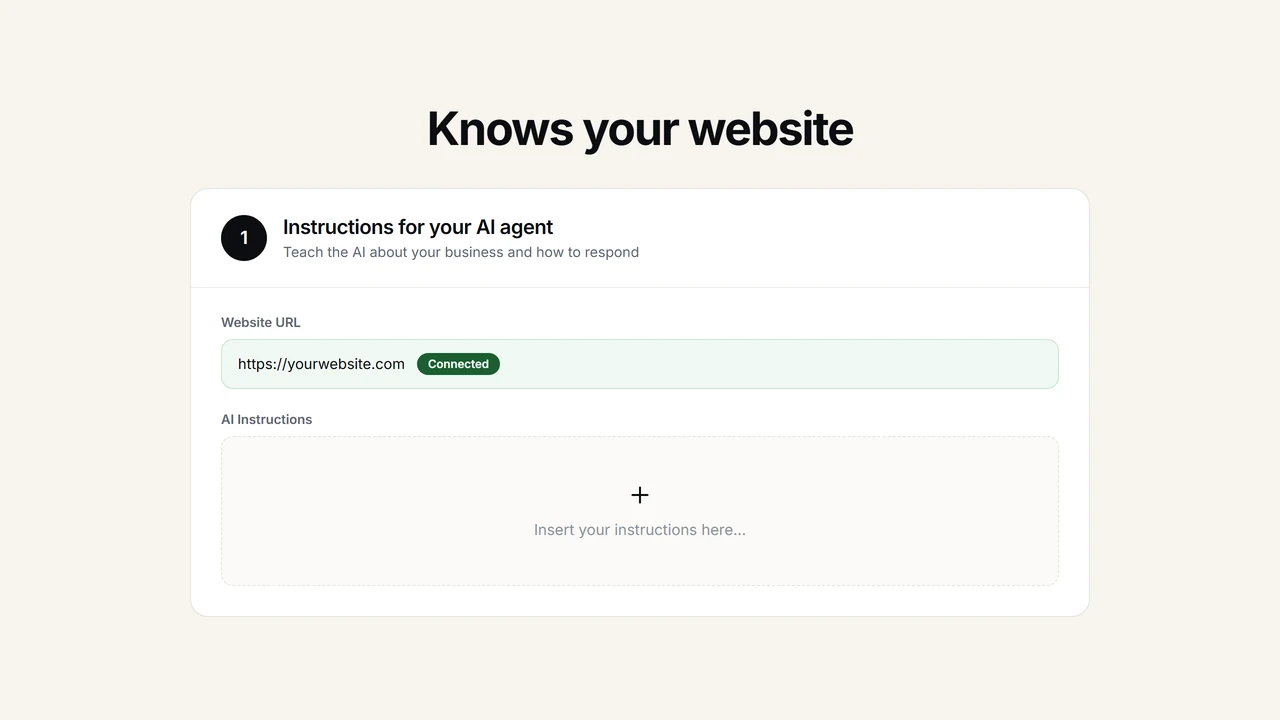
Enter any website URL and watch the AI read the site, build a knowledge base, and start answering visitor questions — all within minutes. This is the product you will sell under your brand.
Businesses already need this — you just have to show up
Every business with a website loses visitors who leave because their question went unanswered. The visitor wanted to know if the dentist takes their insurance, whether the plumber serves their zip code, or if the product ships internationally — and nobody was there to answer at 11 PM on a Tuesday. That is the problem this AI product solves. It reads the business's own website content — services, products, FAQs, policies, hours — and answers visitor questions instantly, around the clock, in 36 languages. You are not selling a novelty. You are selling something that directly addresses a gap every business owner already feels: missed inquiries, lost leads, and an inbox full of repetitive questions that someone has to answer manually. When you demo this to a business owner using their own website and the AI starts answering their actual visitor questions correctly, the sale becomes obvious. They see the value immediately because the problem is already costing them.
- Solves a problem businesses already recognizeYou are not pitching an abstract technology. Every business owner knows they lose visitors who leave without reaching out. An AI chatbot that answers questions using the business's own content is a solution they can understand in one sentence and see working in one demo.
- The demo sells itself — use their own websiteEnter the prospect's URL, let the AI crawl their content, and show them a chatbot answering their visitors' real questions. No slides. No hypotheticals. A live product running on their own site, answering questions about their own services. That demo converts because it is concrete and immediate.
- Recurring revenue from day oneThis is not a one-time project you invoice and forget. You charge clients monthly — $150, $200, $300 per month — for a service that runs continuously. The subscription model means your revenue compounds as you add clients, not resets to zero each quarter.
Your brand, your price, your client relationship
Selling this AI product does not require a sales team, a marketing budget, or a technical background. The product is already built. The white-label branding means your name appears on the widget, not ours. And the demo — entering a prospect's URL and showing them an AI chatbot answering questions from their own website — is the most effective sales tool you could ask for. You identify businesses that would benefit, run the demo, name your price, and deploy. The Pro plan at $449/month supports up to 20 client websites with 50,000 messages and full white-label branding. If you charge $200 per client per month, three clients cover your cost and every additional client is margin. You bill them directly through whatever payment method you prefer — Stripe, PayPal, bank transfer. There is no revenue share. No per-client fee back to the platform. The gap between your $449 subscription and what your clients pay you is yours.
- White-label removes all platform brandingOn the Pro plan, the "Powered by" badge disappears entirely. Your name is in the header, your logo loads in the widget, your colors define the look. When visitors interact with the chatbot on your client's site, they see your brand. The embeddable client dashboard carries your branding too — Conversations, Analytics, and Leads tabs under your name.
- Set your own price — keep the full marginThere is no suggested retail price. You determine what to charge based on your market, the client's size, and the value you deliver. The platform charges you a flat subscription. Whatever you collect above that is gross profit with no commission, no revenue share, and no per-transaction fee.
- Start with Starter or Standard, scale to ProYou do not have to begin at the Pro tier. The Starter plan at $39/month supports 2 sites with 800 messages — enough to test with a couple of clients. The Standard plan at $139/month covers 3 sites with 15,000 messages. When your client roster grows, upgrade to Pro for 20 sites and white-label branding. Existing setups carry over.
- Works on every website platformWordPress, Shopify, Wix, Squarespace, Webflow, Magento, Joomla, Drupal, and over 30 more — the chatbot installs with a single line of JavaScript or a dedicated plugin. Your client's tech stack is never a blocker.
- Custom Pro plan when you outgrow 20 clientsTwenty clients is a milestone, not a ceiling. The Custom Pro plan extends your site count and message limits so the business model scales beyond the initial Pro cap.
Go from sign-up to your first paying client in under an hour
No development team. No infrastructure. No weeks of integration. Here is how you get your first AI product deployed and invoiced.
- Subscribe to a plan at asyntai.com/pricing — Pro at $449/month is the reseller favorite (20 sites, white-label, 50,000 messages), but you can start smaller with Starter ($39/month, 2 sites) or Standard ($139/month, 3 sites).
- Add your first client's website in the dashboard. Configure the chat widget with your brand — your name, logo, and colors — so the chatbot appears as your product when visitors see it.
- The AI automatically reads your client's website and builds a knowledge base from their pages, services, products, and FAQs. Upload any additional documents the client provides — the AI incorporates those as well.
- Copy the one-line embed script, paste it into the client's website, and the chatbot goes live instantly — answering visitor questions using the client's own content, under your brand, 24/7 in 36 languages.
<!-- The client sees your name. Their visitors see your name. -->
<script src="https://asyntai.com/widget.js"
data-id="client-site-id" async>
</script>
# One script tag. White-labeled. Live.
# Send the invoice and keep the margin.
How reselling works
From signing up to billing your first client — four simple steps.
Choose a plan
Subscribe to a plan that fits how many client websites you need. Pro is the most popular for resellers — white-label plus up to 20 websites.
View plans →Add a client website
Each website you add under your account is one client's chatbot. Add up to the number your plan allows.
Go to your dashboard →Set up the chatbot
Add the client's content, customize the widget to their brand, and install it on their site. You can also give the client read-only access to their chat logs, analytics and leads on your own website.
Setup guide →Resell at your price
Charge your client whatever you like. You own the relationship and bill them directly — the margin is yours, every month.
Reseller Resources
Everything you need to get started, answer client questions, and see the dashboard in action
Reseller Guide
Step-by-step walkthrough: white-label branding, the embeddable client dashboard, and how to get your first client live.
Read the guideReseller FAQ
Pricing, margins, billing, white-label details, platform compatibility, and everything else partners ask before starting.
View FAQClient Dashboard Demo
See the embeddable white-label dashboard with sample data — conversations, analytics, and leads under your brand.
See the demoAI product to sell — common questions
Answers to the most frequent questions from people evaluating this AI chatbot as an AI product they can sell to clients.
Is this an actual product I can sell, or is it a toolkit I have to build from?
It is a finished, working product. The AI chatbot is fully built — it crawls websites, builds knowledge bases, answers visitor questions in 36 languages, captures leads, and provides analytics. You do not write code, train models, or assemble components. You subscribe, add a client's website, configure branding, and deploy. The product works out of the box.
Do my clients know I am reselling someone else's product?
Not on the Pro plan. All platform branding is removed — the "Powered by" badge disappears from the widget. Your name, logo, and colors appear instead. The embeddable client dashboard also carries your branding. Your clients and their visitors see your brand only. Standard plan users who want white-label branding can email [email protected] for manual activation.
How much can I charge clients for this AI product?
Whatever you want. There is no suggested retail price and no restrictions on your pricing. Most resellers charge between $150 and $400 per client per month, depending on the value delivered and the client's size. Your only cost is the flat subscription — Pro at $449/month covers 20 clients. The difference between your subscription and what you collect from clients is your gross profit.
How does the AI know what to say for each client?
The AI reads each client's website — every page, product listing, FAQ, blog post, service description — and builds a knowledge base from that content. It answers visitor questions using the information it found on the client's site. You can also upload additional documents like PDFs, product guides, or policy sheets. The AI references all of this content when responding, so answers are specific and accurate to each business.
What if a client's website changes — do I have to update the chatbot manually?
No. The AI automatically updates its knowledge base as the client's website content changes. New blog posts, updated product pages, revised pricing — the chatbot picks up changes without manual intervention. You only need to act if the client provides entirely new supplemental documents that are not on their website.
Can the chatbot do more than answer questions?
Yes. On Standard and Pro plans, Custom Tools let the AI call external API endpoints during a conversation — performing real actions, not just chatting. For an ecommerce client, the chatbot can check order status and initiate returns. For a clinic, it can look up appointment availability. For a restaurant, it can check reservations. These capabilities let you sell the product as an AI assistant that does things, which supports higher pricing.
Do I need technical skills to sell and deploy this product?
No. Deploying the chatbot on a client's site means pasting one line of JavaScript or installing a plugin (available for 30+ platforms including WordPress, Shopify, Wix, Squarespace, and more). Configuring the branding, colors, and knowledge base is done through a visual dashboard — no coding required. If you can copy-paste and fill out a form, you can deploy this product.
What happens when I get more than 20 clients?
The Pro plan supports up to 20 sites. When you grow beyond 20 clients, you move to a Custom Pro plan with higher site and message limits configured for your volume. There is no interruption — you reach out, limits are increased, and you continue adding clients.
Can I combine reselling with the affiliate program?
Yes, and many people do. White-label reselling is for clients you manage directly — you deploy the product, handle their setup, and collect monthly payments at your price. The affiliate program pays 20% recurring commission on customers you refer via a tracking link — they manage their own setup and deal directly with the platform. You can resell to hands-on clients and refer hands-off ones. The two models do not conflict.
Why an AI chatbot is the best AI product you can sell today
The market is saturated with things that claim to be AI products you can sell. Prompt packs. ChatGPT wrappers. Online courses that teach you to "leverage AI." Template bundles. None of these are products in the way a business owner understands the word. A product is something tangible that solves a specific problem and that the buyer pays for repeatedly because it keeps delivering value. An AI chatbot that sits on a business's website, answers visitor questions using the business's own content, captures leads, and works in 36 languages — that is a product. It runs around the clock. The business owner can see it working. Their visitors interact with it daily. It replaces the need for someone to answer the same repetitive questions over and over again. When you offer this to a local dentist, a real estate agency, or an online retailer, they understand what it does within thirty seconds. There is no education required, no "AI literacy" prerequisite. They see a chat bubble on their site that answers their visitors' questions correctly, and they want it.
The distinction between a product and a project matters enormously for anyone trying to build recurring revenue. A project has a start date and an end date. You build a website for a client, you invoice them, and you move on to the next project. An AI chatbot sold as a monthly service does not end. The client pays you $150, $200, or $300 every month because the chatbot keeps working every month. It answers questions today, next week, next year. The knowledge base updates automatically as the client's website content changes. There is no deliverable to hand off and no "project complete" moment that terminates the revenue. This is why the subscription model matters for sellers. Every client you add increases your monthly recurring revenue permanently (or at least until they cancel, which is rare when the chatbot is well-configured and visibly useful). After a year of adding one client per month, you have twelve monthly payments arriving, not twelve completed projects behind you.
Selling AI products is different from selling other technology services because the demonstration is the pitch. When you sell website design, you show a portfolio. When you sell SEO, you show case studies. When you sell an AI chatbot, you enter the prospect's URL, wait a few minutes, and show them a chatbot answering their visitors' actual questions using their own content. The prospect sees their own business name, their own services, their own pricing being communicated by an AI that just read their website. That moment — when the chatbot answers a question about the prospect's own business correctly — is when the sale happens. No slide deck competes with a live demo running on the prospect's own content. This is the advantage of selling a product that works immediately without customization: the demo is not hypothetical, it is real.
The financial model for reselling this AI product is worth examining at each plan tier because different entry points suit different stages. The Starter plan at $39/month gives you 2 client sites and 800 messages. If you charge $100 per client, two clients generate $200 against $39 in cost — a healthy 80% margin, though the scale is small. The Standard plan at $139/month gives you 3 sites and 15,000 messages. Three clients at $150 each produce $450 in revenue versus $139 in cost. The Pro plan at $449/month is where the model truly scales: 20 sites, 50,000 messages, and full white-label branding. Twenty clients at $200 each generate $4,000 in monthly revenue against $449 in cost. That is $3,551 in monthly gross margin — over $42,000 annually — from a single subscription. The per-client cost drops as you add more sites: $449 for one client, $225 for two, $45 for ten, roughly $22 for the full twenty. The subscription is flat. Every new client improves the margin without increasing your expense.
White-label branding is what separates this from simply recommending a product and collecting a referral fee. Without white-labeling, you are an affiliate — you point people to someone else's product and earn a commission. With white-labeling, you are the product. Your name appears in the chat widget header. Your logo loads in the corner. Your color scheme defines the visual identity. The "Powered by" badge disappears on the Pro plan. When your client's website visitors interact with the chatbot, they see your brand. When the client logs into the embeddable dashboard you provide — three tabs: Conversations, Analytics, Leads with CSV export — they see your brand. You are not reselling someone else's product in the way that feels like a middleman arrangement. You are delivering your own AI product, backed by infrastructure you do not have to build or maintain.
The question of what happens after you sell the product — ongoing maintenance, client support, troubleshooting — is where this model breaks from traditional service businesses. In a services model, every client consumes your time proportionally. More clients means more hours. With an AI chatbot product, the ongoing work per client is close to zero. The AI updates its knowledge base automatically as the client's website changes. Conversation logs are available in the dashboard. Analytics track themselves. The only recurring tasks are occasional: uploading a new document the client provides, adjusting the AI's response instructions for tone or specificity, or reviewing conversation logs to ensure quality. Most resellers managing a full roster of clients spend under two hours per week on maintenance — a few minutes per client. That ratio of revenue-to-time is what makes this a scalable business rather than a time-for-money trade.
Custom Tools add a dimension that lets you sell this AI product at a premium tier. Available on Standard and Pro plans, Custom Tools allow the chatbot to call external API endpoints during a conversation. Instead of just answering questions, the chatbot can perform actions. For a property management client, the chatbot can check if a specific unit is available and pull the current rent. For an online store, it can look up order status by order number and provide tracking information. For a medical clinic, it can check appointment availability for a requested date and specialty. When you sell these capabilities, you are no longer offering a Q&A widget — you are offering an AI assistant that does things. That distinction supports $300 to $500 monthly pricing because the value is operational, not informational. The client is not just getting answers for their visitors; they are getting work done by an AI.
Language support makes this AI product viable in markets that most English-only solutions cannot reach. The chatbot supports 36 languages with automatic detection — a visitor who types in Portuguese gets a Portuguese response, a visitor who types in Japanese gets Japanese, regardless of what language the client's website content is written in. For resellers operating in multilingual regions — South Florida, Montreal, the EU, Southeast Asia — this is a significant differentiator. A single chatbot deployment handles every language a visitor might use, with no additional configuration, no separate language versions, and no extra cost. If your client base includes businesses that serve diverse populations, the 36-language capability turns a potential objection ("but our customers speak different languages") into a selling point.
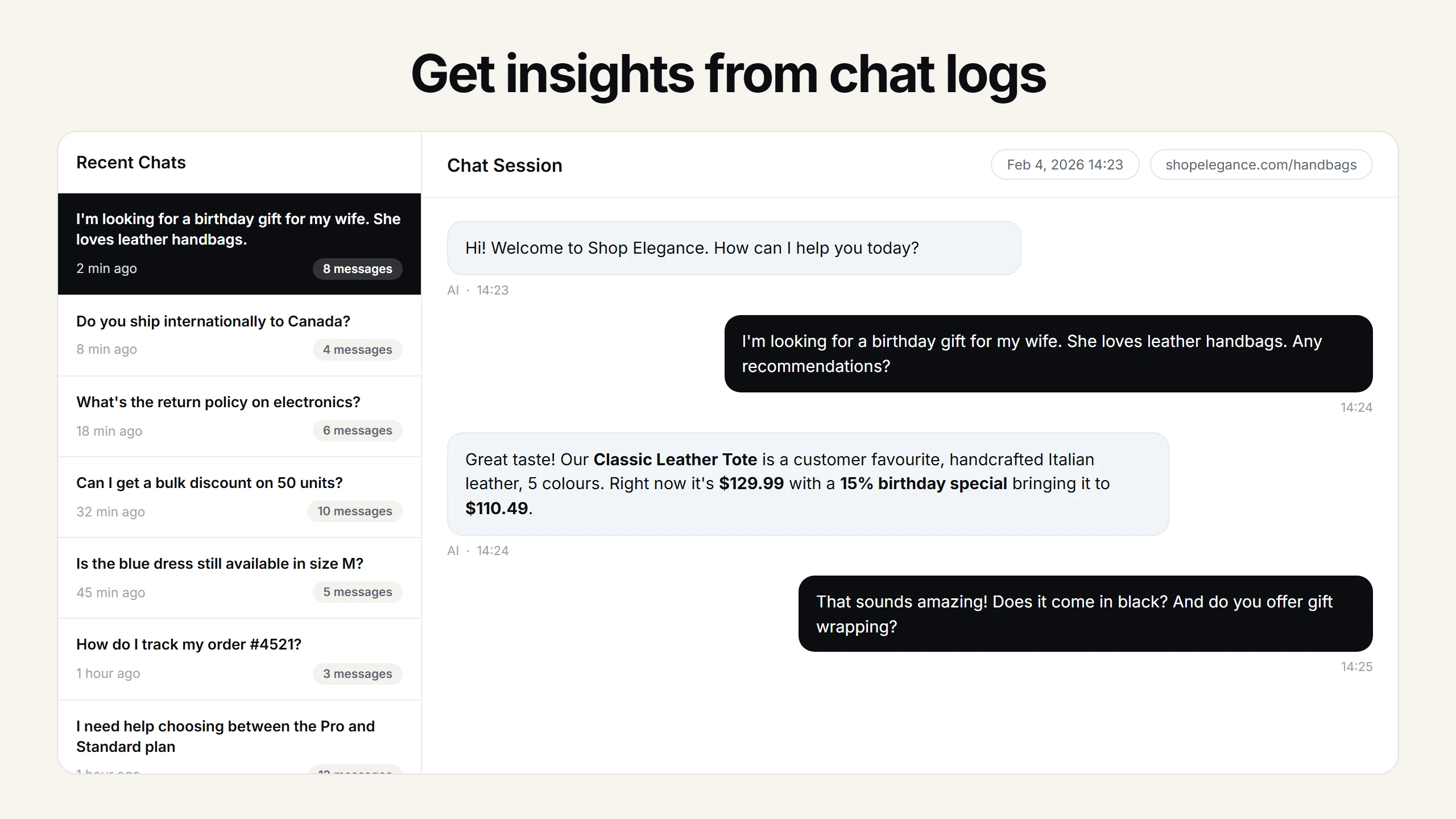
The client dashboard you provide to your customers is an underappreciated part of the sales process. When a business owner subscribes to your AI chatbot service, they want to see what it is doing. The embeddable dashboard gives them exactly that: a Conversations tab showing every chat interaction, an Analytics tab showing usage patterns and trends, and a Leads tab with captured contact information and CSV export. You embed this dashboard on your own website using a JS snippet, and it displays under your branding — your logo, your company name, your primary color. Password protection and domain restrictions keep each client's data separate. The dashboard is not just a reporting tool; it is a retention tool. When a client logs in and sees hundreds of conversations their chatbot handled, leads it captured, and analytics showing visitor engagement, they see ongoing value. That visibility is what keeps them paying month after month.
Platform compatibility removes a common objection before it arises. When you pitch an AI chatbot to a business, the first technical question is usually "does it work with my website?" The answer is always yes. The chatbot installs via a single line of JavaScript that works on every website platform. There are also dedicated plugins for over 30 platforms — WordPress, Shopify, Wix, Squarespace, Webflow, Magento, Joomla, Drupal, OpenCart, BigCommerce, and more. A reseller with a mixed portfolio of clients — a WordPress dental practice, a Shopify ecommerce store, a Squarespace photography studio, a custom-built real estate site — uses the same product and the same deployment process for every one of them. You never have to tell a prospect "sorry, it does not work with your platform." It works with all of them.
The difference between selling an AI product and building one from scratch is measured in years and hundreds of thousands of dollars. To build a comparable AI chatbot platform, you would need: a conversational AI engine, a web crawler that reads and indexes website content, a document parser for PDFs and other file formats, a vector embedding and retrieval system, a chat widget with desktop and mobile support, multi-tenant architecture for client isolation, a real-time analytics dashboard, lead capture and export, multilingual support across 36 languages with auto-detection, and the infrastructure to host, scale, and maintain all of it. The engineering cost alone would exceed multiple years of Pro plan subscriptions before you had a minimum viable product. And that is before the ongoing costs of model updates, bug fixes, uptime monitoring, and the thousand edge cases that surface when real businesses rely on the system every day. White-labeling an existing product skips all of that. You inherit a mature, working system and spend your time on the activity that actually generates revenue: selling.
The affiliate program offers an alternative path for AI products you encounter but do not want to manage. The affiliate model pays 20% recurring commission on every customer referred through your tracking link. If someone you refer subscribes to the Pro plan at $449/month, you earn $89.80 every month for up to 12 months — without handling their setup, their support, or their billing. Some sellers use both models: white-label reselling for clients they manage personally (higher margin, full control) and affiliate referrals for businesses they do not want to support ongoing (passive income, zero maintenance). The two approaches are complementary, not competing. You can resell to clients in your city and refer clients from other regions. You can resell to industries you know well and refer businesses in industries you do not.
If you are evaluating AI products to sell, the decision ultimately comes down to three questions. First, is the product something businesses will pay for monthly? An AI chatbot that answers visitor questions, captures leads, and works around the clock — yes, businesses pay for that. Second, can you demonstrate it quickly and convincingly? Enter a URL, show the chatbot answering real questions from the prospect's own site — the demo takes minutes, not days. Third, does the financial model work at your scale? The Pro plan at $449/month covering 20 clients means break-even at two to three clients, and $3,500+ in monthly margin at capacity. Whether you start with the Starter plan at $39/month to test with two clients or go directly to Pro, the path from product to revenue is measured in days, not months. For questions about reselling, pricing, or your specific use case, reach out at [email protected] or visit the pricing page to get started.