AI marketing tools for agencies — the one your clients can actually see working
White-label an AI chatbot as your agency's own product, deploy it across client websites, and turn a single subscription into a new monthly revenue stream. Live in under 30 minutes.
See the AI marketing tool in action on any website
Paste a client URL below. The AI reads their site content and produces a working chatbot in seconds — this is the exact product you will resell under your agency brand.
Your clients want AI results — not another strategy deck
Marketing agencies live and die by measurable outcomes. Click-through rates, conversion percentages, cost per acquisition — these are the currencies your clients understand. An AI chatbot is the rare marketing tool that delivers a visible result the same day it is deployed: a widget on the client's website that greets visitors, answers their questions using the site's own content, and captures contact information around the clock. No other AI marketing tool produces something your client can interact with this quickly. The Pro plan at $449/month supports up to 20 client websites with complete white-label branding — your agency name, your logo, your colors on every widget and dashboard. Agencies starting with a smaller roster can use the Standard plan at $139/month for 3 sites and request manual white-label activation via [email protected].
- A deliverable your clients can touch and testMost AI marketing tools generate reports or optimize campaigns behind the scenes. A chatbot sits on the client's homepage where they can watch it work. They ask it a question, it responds with accurate information pulled from their website. That five-second interaction builds more trust than a 40-page analytics report ever will.
- Monthly billing that does not require monthly laborCampaign management requires constant creative work, media buying needs daily optimization, and SEO demands months of content production. A chatbot deployment takes a single afternoon. After setup, the AI maintains itself — re-reading the client's site content as it changes. Your agency collects a monthly fee for a service that runs on autopilot.
- A wedge into accounts you could not win beforeSome prospects do not need a full marketing retainer. They need one specific thing that works. Offering an AI chatbot as a standalone product opens conversations with businesses that would never hire you for a $5,000/month retainer but will happily pay $250/month for a chatbot that captures leads while they sleep.
Fixed cost, variable revenue — the economics tilt in your favor with every client
AI marketing tools for agencies usually mean software subscriptions that scale per seat or per campaign. This model is different. You pay one flat subscription and resell across multiple clients at whatever price point your market supports. The Pro plan at $449/month includes 20 websites and 50,000 pooled messages. Your cost does not change whether you serve four clients or eighteen. Agencies that exceed 20 sites can move to a Custom Pro plan built for higher volume.
- 4 clients at $200 each: $351/month marginFour clients — pulled from your existing book of business — generate $800/month in revenue against the $449 subscription. After the subscription is paid, you are profitable with 16 open slots remaining. Each one is nearly pure upside.
- 10 clients at $275 each: $2,301/month marginAt ten clients, revenue reaches $2,750/month and your annual margin crosses $27,000. You are halfway through your capacity and the chatbot line already outearns what many agencies make from their third or fourth largest client.
- 18 clients at $300 each: $4,951/month marginNear-full capacity at a premium price yields $5,400/month in revenue and close to $60,000 in annual margin. This is a standalone business inside your agency — built on a service that takes less time to deliver each month than a single client status call.
- 50,000 messages shared across all clientsThe pooled message model absorbs the natural variation in client traffic. A boutique law firm might use 150 messages per month while a busy restaurant's chatbot handles 3,000. The pool flexes without per-site overage charges. For higher volumes, the Custom Pro plan scales with your needs.
- 36 languages included on every planServe clients in multilingual markets without bolt-on translation costs. The AI detects visitor language automatically and responds in kind — English, Spanish, Mandarin, Arabic, Portuguese, and 31 others. A marketing agency with clients across regions gains instant multilingual capability.
From signup to live AI chatbot on a client site — here is what it takes
No API keys, no developer hours, no machine learning background. Pick a plan, add the client, brand the widget, and embed one script.
- Select your plan at asyntai.com/pricing — Pro ($449/month) includes white-label branding and 20 client sites. Standard ($139/month) covers 3 sites. Starter ($39/month) supports 2 sites for testing.
- Add a client's domain in your dashboard. Customize the chat widget with your agency branding — your name, your colors, your logo. On Pro, all original platform branding is automatically removed.
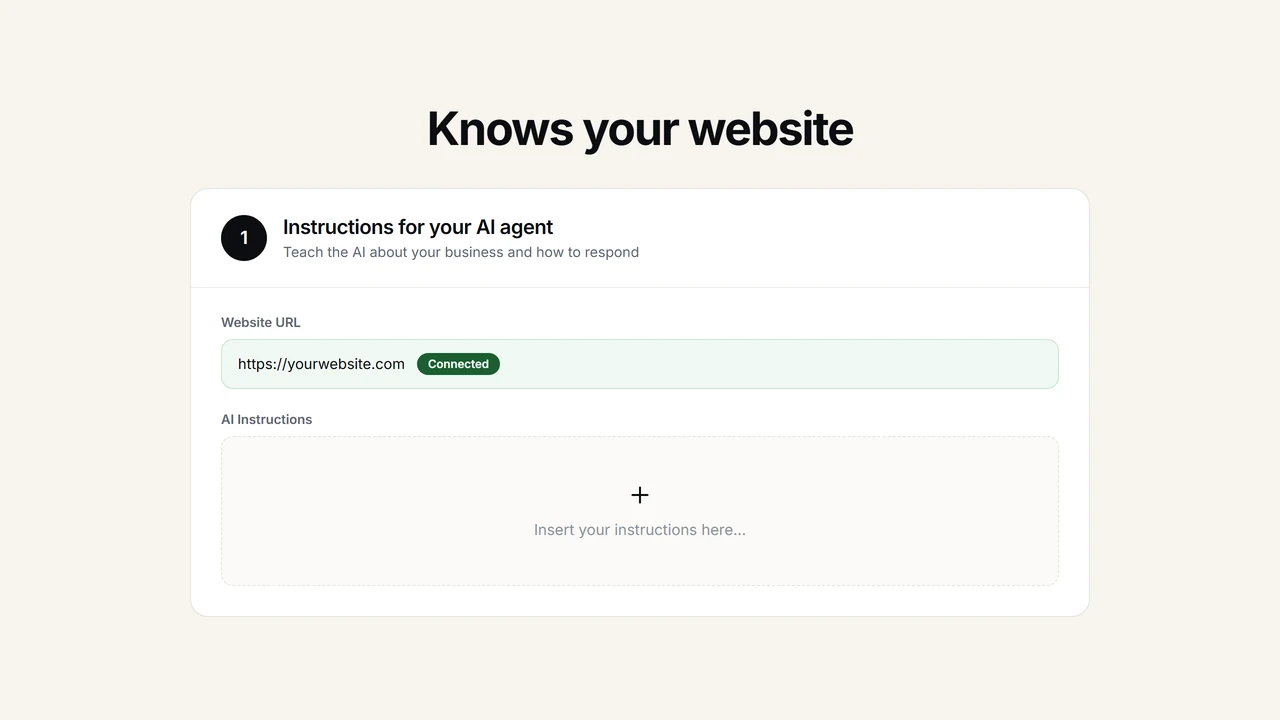
- The AI reads the client's website — up to 50 pages — and builds a knowledge base from their content. Upload supplementary files like pricing sheets, product catalogs, or internal guides to fill in anything the website does not cover.
- Copy the embed script and paste it onto the client's website. Compatible with WordPress, Shopify, Wix, Squarespace, Webflow, and 30+ other platforms. The chatbot appears immediately.
<!-- Your brand. Your margin. Your client. -->
<script src="https://asyntai.com/widget.js"
data-id="client-site-id" async>
</script>
# One line of code. Every platform.
# Your agency delivers AI marketing — the client sees your brand.
How reselling works
Four steps from signup to billing your first client for AI marketing services.
Choose a plan
Pick the plan that matches your client count. Pro is the most popular for resellers — full white-label branding and room for up to 20 client websites.
View plans →Add a client website
Each website you add becomes a separate chatbot with its own knowledge base and branding. Add as many as your plan allows.
Go to your dashboard →Set up the chatbot
Load the client's content, style the widget to match their site, and install it with a single embed script. Optionally give clients read-only access to their conversations, analytics, and leads through a white-labeled dashboard.
Setup guide →Resell at your price
Bill the client whatever your market supports. You control the pricing, the relationship, and the margin — every month.
Reseller Resources
Guides, answers, and a live demo to help you get started and close your first client
Reseller Guide
End-to-end walkthrough covering white-label setup, the embeddable client dashboard, and deploying your first chatbot.
Read the guideReseller FAQ
Answers to the most common questions about margins, billing, white-label branding, platform support, and scaling.
View FAQClient Dashboard Demo
Preview the white-label dashboard your clients will use — conversations, analytics, and lead exports, all under your agency brand.
See the demoAI marketing tools for agencies — FAQs
Questions marketing agencies ask before adding AI chatbot reselling to their service lineup.
How does an AI chatbot fit into a marketing agency's service stack?
It sits alongside your existing services — SEO, paid media, content marketing, web design — as a standalone recurring revenue line. You deploy it on a client's website to engage visitors, answer questions using that site's own content, and capture leads 24/7. Unlike campaign work that requires ongoing creative output, the chatbot runs autonomously after a one-time setup. Most agencies position it as a conversion optimization tool: the chatbot keeps visitors on the site longer, answers purchase-blocking questions, and feeds qualified leads directly into the client's pipeline.
Do I need technical skills or AI expertise to resell this?
No. The entire setup is point-and-click. You enter a client's website URL, the AI reads their content automatically, you adjust the widget appearance to match their branding, and you paste a one-line embed script on their site. There are no prompts to write, no models to configure, and no infrastructure to manage. If your team can install a tracking pixel or configure a WordPress plugin, they can deploy this chatbot.
How does the white-label branding work?
On the Pro plan, all original Asyntai branding is stripped from the chat widget and client dashboard automatically. Your agency's name, logo, and color scheme appear everywhere the client or their visitors interact with the product. Visitors chatting with the bot see your brand. Clients reviewing their conversation logs and leads see your brand. On the Standard plan, you can request manual white-label activation by contacting [email protected].
What pricing should I charge my clients?
That is entirely up to you. On the Pro plan, your per-client cost — if you fill all 20 slots — is approximately $22/month. Marketing agencies typically charge between $150 and $400 per client per month depending on the vertical, whether the chatbot is bundled with other services, and how much setup customization is involved. Some agencies add a one-time onboarding fee. Asyntai has no visibility into your pricing and takes no cut of what you bill.
Can the chatbot do more than answer questions from the website?
Yes. On Standard and Pro plans, Custom Tools let the chatbot call a client's own API endpoints during a conversation. A client running an ecommerce store can have the chatbot check order status in real time. A service business can let the chatbot pull appointment availability from their booking system. You define each tool in the dashboard — endpoint URL, parameters, and a description of when the AI should use it. This opens a natural upsell path: basic chatbot at one price, chatbot with live integrations at a premium.
What happens with clients who want to manage things themselves?
You have two options. First, you can set them up under your reseller account and give them access to a white-labeled dashboard where they view conversations, analytics, and leads — all branded as your agency. Second, if a client truly wants full independence, you can refer them through your affiliate link and earn a 20% recurring commission on their subscription for up to 12 months. The reseller path gives you higher margins and ongoing control. The affiliate path gives passive income with no management. Many agencies use both depending on the client.
Is there a way to try it before committing to a paid plan?
The free tier includes 1 website and 50 messages per month — enough to build a chatbot on a client's site and demonstrate it in a pitch meeting. The Starter plan at $39/month gives you 2 sites and 800 messages, which supports running a pilot with one or two real clients. You can upgrade or downgrade at any time — no contracts, no cancellation penalties on any tier.
Which website platforms does the chatbot support?
All of them. The chatbot installs through a single JavaScript snippet that works on any website capable of running a script tag. Official plugins exist for WordPress and Shopify. The embed code also works natively on Wix, Squarespace, Webflow, Magento, WooCommerce, Joomla, Drupal, OpenCart, and over 30 additional platforms. You will never lose a deal because of a platform incompatibility.
What if my agency grows past 20 client sites?
The Custom Pro plan is built for agencies that have outgrown the standard 20-site allocation. It scales your site count and message pool to match your client base. Contact [email protected] to discuss your volume and get a plan configured for your agency's trajectory.
AI marketing tools for agencies: why the chatbot is the one that sticks
Marketing agencies have spent the last two years watching AI tools multiply like browser tabs — content generators, ad copy optimizers, SEO analyzers, predictive analytics platforms, image creators, social media schedulers with "AI-powered" badges. The category has gotten so crowded that "AI marketing tool" as a phrase has almost lost its signal. When a client asks their agency about AI, they are not asking about another SaaS subscription that runs in the background. They want something visible. Something they can point at. Something that did not exist on their website yesterday and does today. An AI chatbot is that thing. It sits on the client's homepage, it talks to their visitors, it captures leads at 3 AM, and it answers questions about the client's products and services using the content already published on their website. Among every AI marketing tool an agency can offer, the chatbot is the only one the client can actually interact with in real time and verify is working.
The reason most AI marketing tools fail to become resellable agency services is that they are invisible to the end client. An AI-powered content optimizer might improve blog post performance by 12%, but the client sees a marginally better report — not a product. An AI ad copy tool might generate 30 headline variations, but the client sees the same Facebook Ads dashboard they always see. The output is better, but the vehicle is the same. Agencies cannot charge a premium for invisible improvements because the client cannot distinguish the AI's contribution from the agency's existing work. A chatbot flips this dynamic entirely. The client opens their website, sees a chat bubble in the corner, clicks it, and watches an AI answer a visitor's question accurately. That interaction — visible, testable, and immediate — is what makes the chatbot sellable as a standalone product rather than an invisible optimization baked into existing deliverables.
For a marketing agency evaluating AI marketing tools to resell, the deployment model matters as much as the technology. Most AI tools require ongoing configuration — someone at the agency has to write prompts, adjust settings, interpret outputs, and fold results into client reports. The labor scales linearly with the number of clients, which erodes margins and turns the AI tool into another service that demands headcount. The chatbot model works differently. Setup is a one-time event: enter the client's URL, the AI reads their website content and builds a knowledge base, customize the widget branding, and paste a script tag. After that, the chatbot operates independently. The AI re-reads the client's site content as it changes — new products, updated hours, revised policies — and adjusts its answers accordingly. The agency's ongoing labor requirement is close to zero, which is how the margin stays high as the client count grows.
The financial structure is what makes this particular AI marketing tool viable as an agency offering rather than just another software expense. A single Pro subscription at $449/month covers up to 20 client websites with 50,000 shared messages and full white-label branding. The agency's cost is fixed. The revenue — whatever the agency charges each client — scales with every deployment. At five clients billing $250/month, the agency collects $1,250 against $449 in cost, yielding $801 in margin. At twelve clients, the same math produces $2,551 in margin. At eighteen clients, it crosses $4,000. Unlike project-based work that requires scoping, execution, and revision for every engagement, the chatbot produces recurring revenue that compounds automatically because the product continues delivering value without additional agency input.
White-label branding is the structural element that transforms this from a referral play into a genuine agency product. Without white-labeling, the agency is reselling someone else's software — the client can find the same product, see the original brand, and cut out the middleman. With white-labeling on the Pro plan, every surface the client touches carries the agency's identity. The chat widget header shows the agency name. The widget avatar shows the agency logo. The client dashboard — where the client reviews conversation transcripts, monitors analytics, and exports leads — displays the agency brand throughout. The client has no reason to believe the product came from anywhere other than their marketing agency. This perception underpins premium pricing. An agency-branded AI assistant is worth $300/month. A recognizable third-party widget with a "powered by" tag is worth $50.
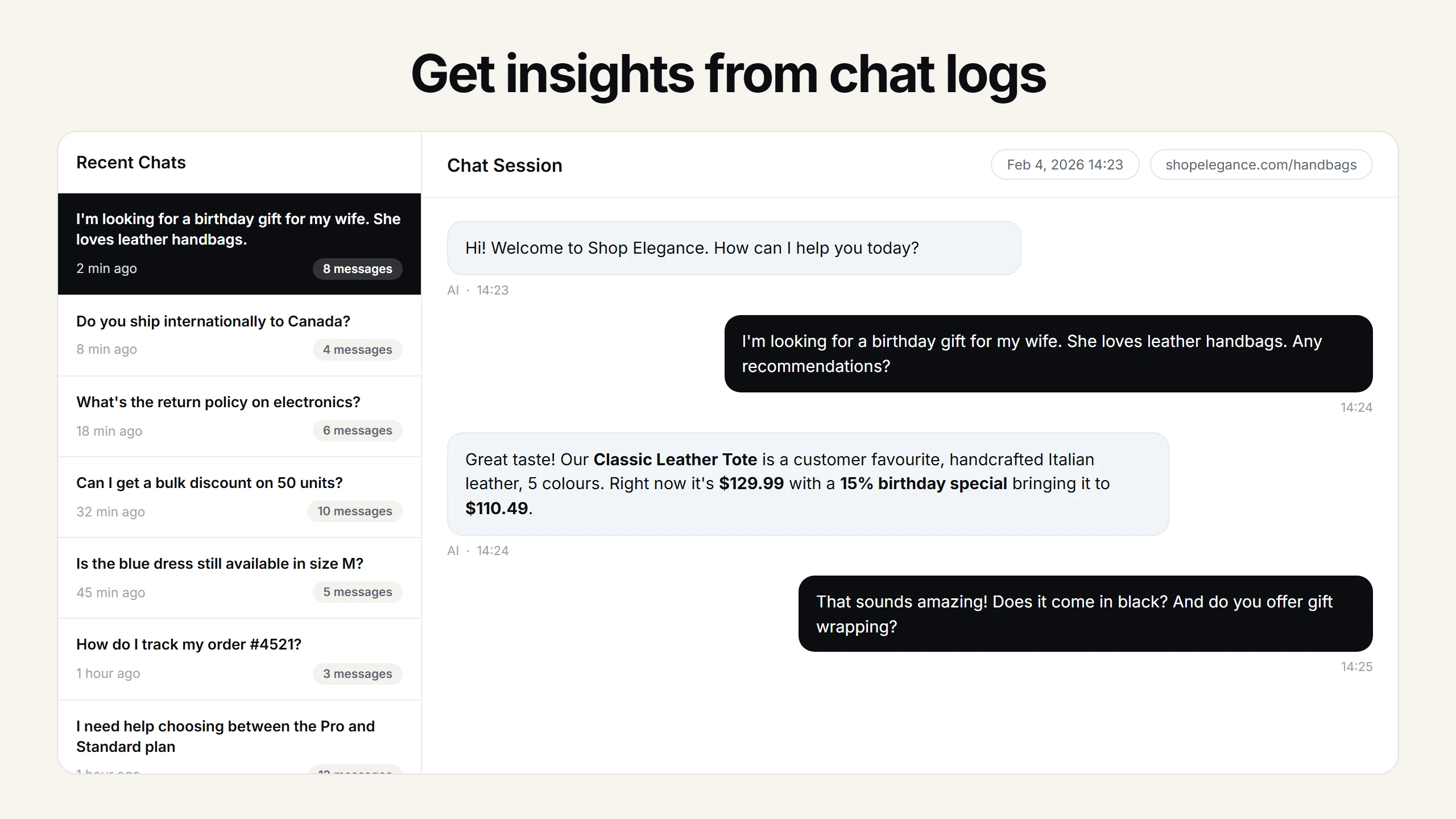
The client dashboard is an underappreciated retention lever in this model. When a marketing agency deploys a chatbot and gives the client access to a branded dashboard, the client begins accumulating data that becomes increasingly valuable over time. Three months of conversation transcripts reveal patterns in what their visitors ask. Six months of lead captures build a contact list they are actively working. A year of analytics data shows seasonal trends, peak engagement hours, and the topics that drive the most interaction. All of this data lives in the agency-branded dashboard. Switching away from the chatbot means losing access to that history. The longer the chatbot runs, the stickier the relationship becomes — not because of a contract, but because of accumulated value the client does not want to abandon.
Agencies that specialize in specific industries unlock a pricing tier that generalist agencies cannot reach. A marketing agency focused on healthcare practices deploys the chatbot on dentist, chiropractor, and dermatology websites, developing template configurations that handle common patient questions — office hours, insurance accepted, procedure details, appointment availability. The next healthcare client takes ten minutes to set up instead of thirty because the template already exists. The agency's pitch stops being "we offer AI chatbots" and becomes "we deploy AI receptionists built specifically for medical practices." That positioning commands $350-$500/month instead of $200, and the close rate increases because the client recognizes the agency understands their industry. The same dynamic applies across verticals — real estate, legal, hospitality, fitness, automotive. The underlying technology is identical; the packaging determines the price.
Custom Tools, available on Standard ($139/month) and Pro plans, expand what the chatbot can do from answering static questions to performing live actions during a conversation. Without Custom Tools, the chatbot pulls answers from the client's website content — pricing, services, policies, FAQs. With Custom Tools, the chatbot calls the client's own API endpoints to fetch real-time data. A retail client's chatbot checks inventory before answering "do you have this in stock?" A SaaS client's chatbot verifies subscription status when a user asks "what plan am I on?" A property management client's chatbot looks up maintenance request status by ticket number. For marketing agencies, Custom Tools create a natural upgrade path within the service offering: basic chatbot at $200/month, chatbot with live integrations at $350/month. The client sees measurably more value, and the agency earns a higher margin on the same subscription.
Language support expands the addressable market for agencies without adding any operational complexity. The AI detects the visitor's language automatically and responds in kind — 36 languages supported. An agency serving restaurant clients in Miami can deploy one chatbot that handles English, Spanish, and Haitian Creole conversations without separate configurations. A European marketing agency serving clients across the EU operates from a single account where French, German, Dutch, and Italian are all handled natively. The knowledge base content can be in any language — the AI reads it and responds to visitors in whatever language they use. This is not a premium feature locked behind an expensive tier. It is included on every plan, which means the agency can sell multilingual capability at a premium without incurring additional cost.
The competitive advantage for agencies that offer AI chatbot reselling goes beyond the revenue itself. When a marketing agency deploys a chatbot on a client's site, the relationship deepens in a way that other services do not replicate. The client sees daily evidence that their agency delivered something functional and valuable. Every captured lead is a reminder that the agency is generating results. Every after-hours conversation is proof that the chatbot is working when no one else is. This ongoing visibility keeps the agency at the top of the client's mind and makes the agency significantly harder to replace. A competitor pitching their web design or SEO services against yours has to contend with the fact that you also put a working AI on the client's website — and the client does not want to lose it.
The affiliate program runs alongside the reseller model for clients that fall outside the managed service model. When a marketing agency encounters a prospect who wants AI chatbot functionality but does not need hands-on management — maybe they have an in-house marketing team, or they are too small for the agency's minimum retainer — the agency can send them through an affiliate link. The agency earns a 20% recurring commission on the prospect's subscription for up to 12 months. A Pro plan referral produces $89.80/month in passive income. A Standard plan referral produces $27.80/month. The reseller model captures high-value managed relationships. The affiliate model captures everyone else. Together, they ensure no prospect interaction goes unmonetized.
Platform compatibility eliminates the most common objection agencies face when introducing a new tool to their client roster. The chatbot installs through a single line of JavaScript that loads asynchronously on any website. WordPress, Shopify, Wix, Squarespace, Webflow, Magento, WooCommerce, Joomla, Drupal, OpenCart, and over 30 additional platforms all support the embed code natively. Official plugins exist for WordPress and Shopify. An agency with clients spread across six different website builders installs the chatbot the same way on every one. There is no integration matrix, no platform-specific workaround, and no client you have to turn away because their site runs on something unsupported.
Marketing agencies contemplating AI marketing tools should consider the difference between tools they use internally and tools they sell externally. An internal AI tool — a content generator, an analytics dashboard, a campaign optimizer — saves the agency time but does not create a new revenue line. The client never sees the tool, never pays for it directly, and never attributes value to it. An external AI tool — a chatbot deployed on the client's website — is a billable product that the client experiences firsthand. The agency's ROI on internal AI tools is measured in saved labor hours. The ROI on a resellable chatbot is measured in new monthly recurring revenue. Both have value, but only one grows the agency's top line.
The timing question is straightforward. Every marketing agency will eventually need to answer the question "what AI do you offer?" with something more convincing than "we use AI in our internal processes." The agencies answering that question today with a live chatbot demo — pulling up the client's own website, showing the AI answer real questions, capturing a lead in real time — are closing deals that will not be available to late movers. Once a client has an AI chatbot deployed by one agency, they are not going to hire a second agency to deploy a different one. The switching cost is not just financial — it is the accumulated conversation data, the leads already captured, and the visitor engagement patterns already tracked in the dashboard. Moving first means owning the relationship.
Ready to add a resellable AI marketing tool to your agency? Start with the Pro plan and deploy your first client chatbot today — or email [email protected] to discuss your agency's specific needs.