An AI digital product you can sell — no inventory, no shipping, just revenue
White-label an AI chatbot, brand it as your own, and sell it to any business with a website. You set the price. You keep the margin. The product delivers itself.
See the AI digital product your clients will get
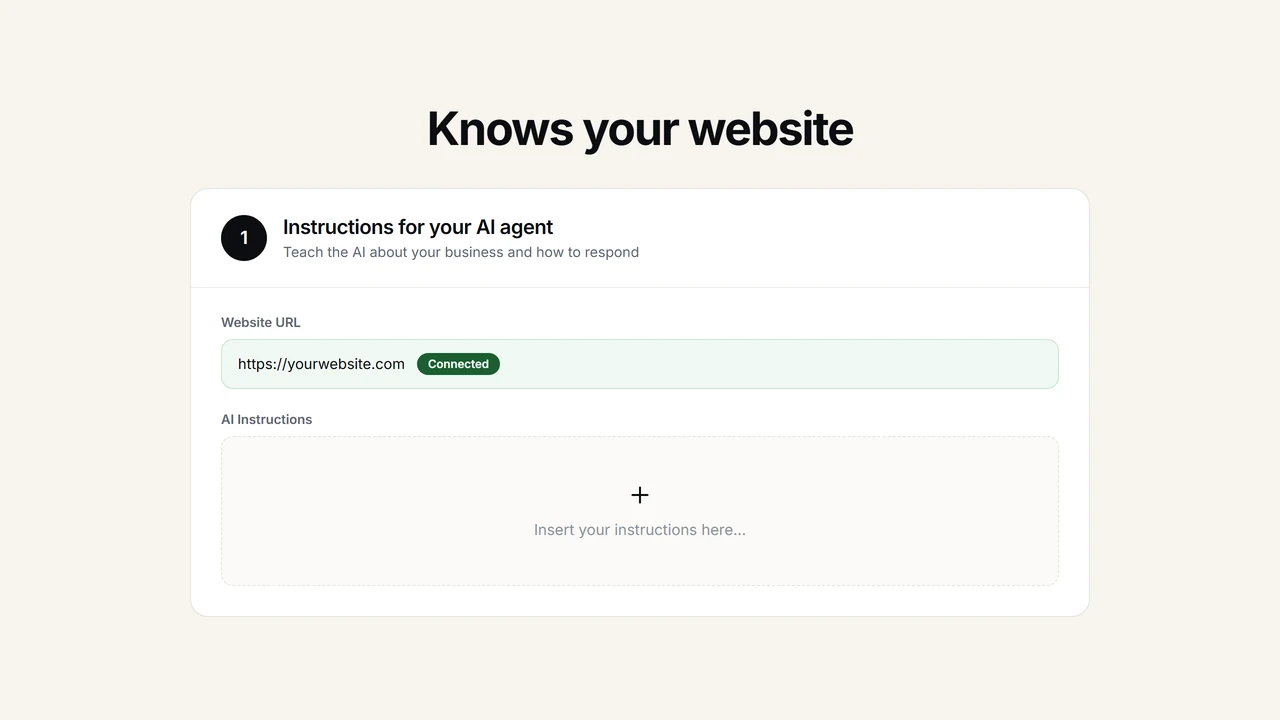
Enter any website URL and watch the AI build a knowledge base from its content. This is exactly what your clients experience — under your brand.
A product that costs you $449 and sells twenty times
Most digital products sell once. This one renews every month. A Pro plan subscription is $449/month and covers up to 20 client websites with 50,000 total messages. Each client you add is another monthly invoice you send — $150, $200, $300, whatever you decide. There is no per-client fee on the platform side. No royalty. No revenue share. The full difference between what you pay and what you collect is margin, and that margin multiplies with every client you onboard. Three clients at $150 each covers your entire subscription. Everything after that is nearly pure profit from a digital product you did not have to build, host, or maintain.
- Zero fulfillment cost — the product delivers itselfPhysical products need warehouses, packaging, and shipping labels. Services need your time. This AI digital product installs with one line of code, builds its own knowledge base by reading the client's website, and answers visitor questions around the clock. You do not ship anything. You do not perform the service. The product runs itself after a twenty-minute setup.
- Recurring revenue, not one-time salesEvery client pays monthly for as long as the chatbot is live on their site. A single sale becomes twelve invoices per year, then twenty-four, then thirty-six. At ten clients paying $200 each, you collect $2,000 every month — $24,000 per year — against a fixed cost of $449/month ($5,388/year). That is $18,612 in annual gross margin from a product you did not code.
- No warehouse, no returns, no support tickets about shippingDigital products eliminate every headache of physical commerce. There are no damaged-in-transit claims, no inventory forecasting, no supplier negotiations. Your entire product catalog is one AI chatbot platform that you configure differently for each client. The supply chain is a subscription page. The delivery mechanism is a script tag.
A 24/7 AI assistant that answers using your client's own content
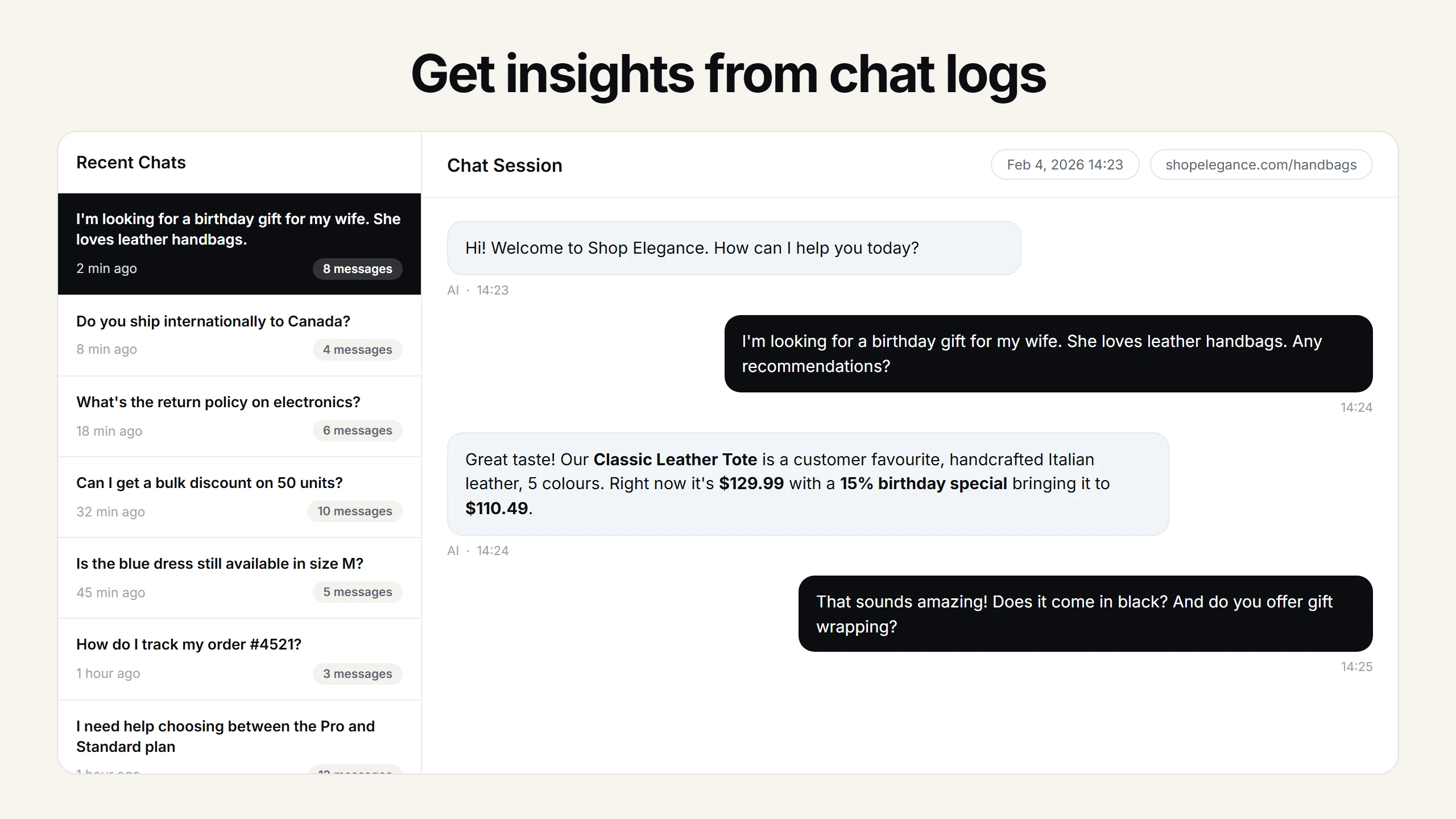
When you sell this AI digital product to a client, here is what they get: an AI chatbot on their website that reads their pages, products, services, and FAQs, then answers visitor questions accurately — in 36 languages, around the clock. The AI does not guess. It pulls answers from the content the business already has published. When the business updates their website, the AI updates its knowledge automatically. Your clients get a tool that converts visitors into leads and reduces support load. You get a monthly payment for delivering it. Custom Tools on Standard and Pro plans let the AI call client API endpoints to perform real actions — check order status, book appointments, look up availability — turning a Q&A widget into a functional assistant. Agencies that outgrow 20 sites move to a Custom Pro plan with expanded limits.
- Knowledge base built automatically from the client's websitePoint the AI at a domain and it crawls every page — services, pricing, hours, team bios, blog posts, product listings. No manual data entry. If the client has PDFs, policy documents, or product sheets, upload those too. The AI absorbs everything and uses it to answer visitor questions with real information from the business.
- Your brand on everything — full white-label on ProThe chatbot widget displays your name, your logo, and your colors. The "Powered by" badge is removed on the Pro plan. Your clients see your brand in the dashboard. Their visitors see your brand in the chat. You are the product company. The technology behind it stays invisible.
- 36 languages with auto-detectionA visitor types in Spanish, the chatbot responds in Spanish. Another types in Japanese, it switches to Japanese. No extra configuration, no translation files, no multilingual setup per client. One chatbot handles 36 languages from whatever content is available on the site.
- Lead capture and conversation analyticsEvery chatbot interaction is logged. The dashboard shows conversation history, analytics on visitor engagement, and a leads section with CSV export. Your clients can see exactly how many visitors the chatbot helped, which questions were asked, and which interactions converted into leads.
- Works on any website platform — 30+ plugins availableWordPress, Shopify, Wix, Squarespace, Webflow, Magento, Joomla, Drupal — the embed script works everywhere. Dedicated plugins for over 30 platforms make installation even easier. Your client's tech stack is never a blocker.
Get your first AI digital product sale live in under an hour
No development background needed. From subscription to a live, branded chatbot on your client's website — here is the entire process.
- Subscribe to the Pro plan at asyntai.com/pricing — $449/month gives you white-label branding, 20 client sites, and 50,000 messages. You can start selling immediately.
- Add your first client's website in the dashboard. Set your agency name, logo, and colors on the widget so the chatbot appears under your brand — not anyone else's.
- The AI crawls the client's website and builds a knowledge base from their content automatically. Upload any additional documents the client provides for a richer knowledge base.
- Copy the one-line embed script, paste it into the client's site, and the branded AI chatbot goes live — answering visitor questions 24/7 using the client's own content, under your brand.
<!-- No inventory. No shipping. Just paste and earn. -->
<script src="https://asyntai.com/widget.js"
data-id="client-site-id" async>
</script>
# One script tag. Branded. Revenue starts now.
# Bill the client at your price. Keep every dollar above $449.
How reselling works
From signing up to billing your first client — four simple steps.
Choose a plan
Subscribe to a plan that fits how many client websites you need. Pro is the most popular for resellers — white-label plus up to 20 websites.
View plans →Add a client website
Each website you add under your account is one client's chatbot. Add up to the number your plan allows.
Go to your dashboard →Set up the chatbot
Add the client's content, customize the widget to their brand, and install it on their site. You can also give the client read-only access to their chat logs, analytics and leads on your own website.
Setup guide →Resell at your price
Charge your client whatever you like. You own the relationship and bill them directly — the margin is yours, every month.
Reseller Resources
Everything you need to get started, answer client questions, and see the dashboard in action
Reseller Guide
Step-by-step walkthrough: white-label branding, the embeddable client dashboard, and how to get your first client live.
Read the guideReseller FAQ
Pricing, margins, billing, white-label details, platform compatibility, and everything else partners ask before starting.
View FAQClient Dashboard Demo
See the embeddable white-label dashboard with sample data — conversations, analytics, and leads under your brand.
See the demoSelling AI digital products — your questions answered
Common questions from entrepreneurs and agencies evaluating this AI chatbot as a digital product to sell.
Do I need to know how to code to sell this AI digital product?
No. The entire process is visual: you add a website, configure colors and branding through a dashboard, and copy a one-line embed script. There is no coding, no API integration, and no technical setup beyond pasting a script tag into your client's site. If you can use a web browser, you can sell this product.
What exactly am I selling to my clients?
You are selling an AI chatbot service that answers questions on their website using their own content. The AI reads their pages, products, and FAQs, then responds to visitor questions accurately — 24 hours a day, in 36 languages. To your client, you are the provider. The technology behind it is invisible. You set your own price, send your own invoices, and keep the margin.
How many clients can I serve on one subscription?
The Pro plan supports up to 20 client websites with 50,000 messages per month for $449. The Standard plan supports 3 sites with 15,000 messages for $139/month. The Starter plan covers 2 sites with 800 messages for $39/month. If you outgrow 20 sites, the Custom Pro plan extends your limits further.
How much should I charge my clients?
That is entirely your decision. Most resellers charge between $99 and $349 per client per month for an AI chatbot service. At $150 per client, three clients cover your $449 Pro subscription. At $250, two clients cover it. Higher pricing is common when you bundle the chatbot with other services like web design, SEO, or marketing. There is no minimum or maximum price — you bill clients directly and keep everything above your subscription cost.
Will my clients know who provides the platform?
No. On the Pro plan, all platform branding is removed — including the "Powered by" badge on the chat widget. The widget shows your name, your logo, and your colors. The embeddable client dashboard carries your branding too. Your clients and their website visitors never see the name of the underlying technology provider.
What happens if a client's website changes?
The AI automatically updates its knowledge base when the client's website content changes. New pages, updated product listings, revised hours, additional blog posts — the AI picks up all of it without manual intervention. You do not need to re-crawl, re-upload, or refresh anything. The chatbot stays current with the business it serves.
Can I try this with one or two clients before committing to Pro?
Yes. Start with the Starter plan at $39/month (2 sites, 800 messages) or the Standard plan at $139/month (3 sites, 15,000 messages) to test with a few clients. When you are ready for white-label branding and more sites, upgrade to Pro. All existing configurations carry over — nothing needs to be rebuilt.
How is this different from other digital products I could sell?
Most digital products — templates, courses, ebooks — sell once. You make one sale and move on. An AI chatbot subscription renews every month. Each client pays you as long as the chatbot is active on their site. Ten clients at $200/month is $24,000 in annual recurring revenue from a product you did not build, do not host, and do not maintain. The recurring nature is what separates this from one-time digital product sales.
Is there a way to earn without managing clients directly?
Yes. The affiliate program pays a 20% recurring commission on every customer you refer through a tracking link. If someone you refer subscribes to the Pro plan at $449/month, you earn $89.80 every month they stay subscribed — without handling their setup, support, or billing. Some people do both: white-label reselling for clients they manage, and affiliate referrals for the ones they do not.
Why an AI chatbot is the best digital product you can sell right now
Digital products were supposed to free you from inventory. Ebooks, courses, templates — they promised passive income without warehouses. And for a while, they delivered. But the market shifted. Every niche is flooded with templates that look identical, courses that teach the same curriculum, and downloadable guides that collect dust on hard drives. The margins are still there, technically, but the attention is not. Buyers have seen it all. What they have not seen — what most small businesses still do not have — is an AI that sits on their website and answers visitor questions using their own content. That is the gap, and it is wide open.
An AI chatbot is not an information product you sell and forget. It is a service that renews every month because it does something visible and measurable every single day. When the chatbot answers a question at 2 AM that would have been lost to a bounce, the business owner notices. When a visitor asks about pricing and the chatbot walks them through the options using the business's actual pricing page, the business owner notices that too. The value is concrete, immediate, and continuous — which is why clients keep paying. Monthly retention is the engine that turns this from a side hustle into a business.
The mechanics are almost absurdly simple compared to building a physical product business. You subscribe to a plan — the Pro plan at $449/month is the most popular for resellers because it includes white-label branding and supports 20 client websites. You add a client's domain to your dashboard, configure the widget with your agency name and colors, and the AI crawls their site automatically. Within hours it can answer questions about their services, products, pricing, hours, and anything else published on their pages. You copy a single line of JavaScript, paste it into the client's site, and the chatbot goes live. The entire process takes twenty minutes. There is no development, no design phase, no quality assurance sprint. The product is ready the moment you subscribe.
Pricing your AI digital product is where the leverage becomes tangible. Since you pay a flat $449 regardless of how many of your 20 client slots you fill, every additional client improves your margin without increasing your cost. At one client charging $200/month, your net is negative $249. At three clients, you collect $600 and net $151. At five, $1,000 against $449 — a 55% gross margin. At ten, $2,000 with a 78% margin. At twenty, $4,000 per month for an 89% gross margin. The product is the same in every scenario. Your effort per client is approximately the same. The only variable is how many people you sell to.
What makes this particular AI digital product defensible is the white-label layer. Anyone can refer someone to a chatbot company. That is an affiliate, and it pays commissions. But when you white-label, you become the brand. Your name is on the widget. Your logo loads in the header. Your colors define the visual identity. The "Powered by" badge disappears on Pro. Your clients think of you as the technology provider — because visually, you are. This is not a referral arrangement. It is a product business where you own the customer relationship, set the pricing, and control the experience. The underlying platform is infrastructure, like a cloud server behind a SaaS product. Nobody asks their SaaS vendor which cloud they run on.
The client base for this product is not a niche — it is nearly every small and mid-sized business with a website. Dental offices need chatbots that answer questions about insurance acceptance, appointment availability, and emergency procedures. Restaurants need chatbots that handle menu inquiries, dietary restrictions, reservation questions, and private event details. Ecommerce stores need chatbots that help visitors find products, understand shipping policies, and check order status. Real estate agencies, law firms, fitness studios, auto repair shops, tutoring centers, veterinary clinics, hotels, spas — every one of these businesses has a website with visitors who leave because their question went unanswered. Your AI digital product solves that problem, and the breadth of the market means you are unlikely to run out of prospects.
One concern that stops people from starting is whether they can handle the technical side. The honest answer is that there is very little technical side to handle. Adding a client website is a form. Configuring the widget is a color picker and a logo upload. Installing the chatbot is copying and pasting one script tag — the same process as adding a Google Analytics snippet or a Facebook pixel. If your client uses WordPress, Shopify, or any of the other 30+ platforms with dedicated plugins, installation is even simpler: install the plugin, paste the site ID, done. You do not need to understand AI, machine learning, or natural language processing. The platform handles all of that. You need to understand your clients' businesses well enough to sell them a chatbot — and that is a sales skill, not a technical one.
Custom Tools raise the ceiling on what you can charge. Available on Standard and Pro plans, Custom Tools let the AI call external API endpoints during a conversation — not just answer questions, but perform actions. For an ecommerce client, the chatbot can look up an order by number and tell the customer where their package is. For a restaurant, it can check table availability for a specific date and party size. For a clinic, it can pull appointment openings and collect patient intake information. When you offer a chatbot that does things — not just talks — you can justify $250 to $400 per client per month. The client is not paying for a widget. They are paying for an employee that works every hour of every day, never calls in sick, and handles dozens of conversations simultaneously.
Language support eliminates geographic barriers from your sales territory. The AI handles 36 languages with automatic detection — a visitor who types in Portuguese gets a Portuguese response; one who types in Korean gets Korean. The content on the client's website does not need to be translated. The AI manages the language layer from whatever content exists. For you as a reseller, this means a single chatbot deployment serves international audiences, multilingual communities, and clients in non-English markets. A dental practice in Miami with Spanish-speaking patients. A hotel in Montreal with French and English visitors. An ecommerce store shipping globally. One product configuration handles all of it, which means you sell one product to a far wider pool of businesses than an English-only chatbot would allow.
The comparison to other digital product models makes the case clearer. Selling online courses requires creating the curriculum, recording videos, building a platform or paying for one, marketing continuously, and dealing with refund requests — and each sale is one-time. Selling templates requires design skills, marketplace competition, race-to-the-bottom pricing, and again, one-time sales. Selling an AI chatbot subscription requires a twenty-minute setup per client and a monthly invoice. No content creation. No design competition. No one-time economics. The effort-to-revenue ratio is different by an order of magnitude, especially past the third or fourth client when your subscription is already covered and every new sale is margin.
The embeddable client dashboard adds a layer of professionalism that deepens your position as a product company. Each client can access a white-labeled dashboard with three tabs — Conversations, Analytics, and Leads with CSV export — embedded on your own website via a JavaScript snippet. It carries your logo, brand name, and primary color. Password protection and domain restrictions keep each client's data private. When your client logs in to review their chatbot's performance, they see your brand wrapping everything. This is not a portal where they log into someone else's platform. It is your dashboard, on your domain, under your name. The distinction matters for perceived value and for retention — clients who see your brand every time they check analytics are less likely to go looking for alternatives.
Scaling from one client to twenty follows a predictable pattern. Your first client is the proof of concept — ideally someone in your existing network whose website you already know. Set up their chatbot, show them the demo with their real content, and let the AI's ability to answer questions from their actual pages do the selling. Once that first client is live, you have a case study, a screenshot, and a testimonial waiting to happen. Clients two through five come from that credibility. By client ten, referrals from your existing roster are doing half the prospecting for you. The reseller guide walks through the full onboarding and sales process.
Retention in a subscription AI product is structurally strong because switching costs accumulate. After month one, the chatbot has conversation history the client can review. After month three, the knowledge base has been refined with uploaded documents, tuned AI instructions, and adjusted response behaviors. After six months, the chatbot is embedded in the business's daily operations — handling visitor inquiries, capturing leads, routing conversations. Replacing it means starting from zero with a new provider, re-uploading content, re-configuring behavior, and losing months of conversation data. Most clients simply do not switch once the chatbot is performing, which means your monthly recurring revenue stabilizes and compounds over time rather than churning.
For agencies that hit the 20-site ceiling, the Custom Pro plan extends both site count and message limits. Reaching 20 clients is a milestone that proves the model works — not a wall that stops growth. The custom plan scales your capacity to match your pipeline, so the business model that worked from one to twenty continues working from twenty to fifty and beyond.
If you have been searching for an AI digital product to sell — something with real margins, recurring revenue, and a market that has barely been tapped — this is the model. No inventory. No shipping. No development team. No support infrastructure beyond a dashboard and a twenty-minute setup process. You subscribe, you brand, you sell, you collect. The product delivers itself every hour of every day on every client's website, in 36 languages, without your involvement. For questions about reselling, pricing structures, or whether this fits your situation, reach out at [email protected] — responses come within 24 hours.