AI automations that let digital marketing agencies capture every lead from the traffic they drive
You already run SEO, PPC, and social campaigns for your clients. Now automate the visitor side — AI chatbots that answer questions, capture leads, and handle support across every client site.
See AI automation working on any client website
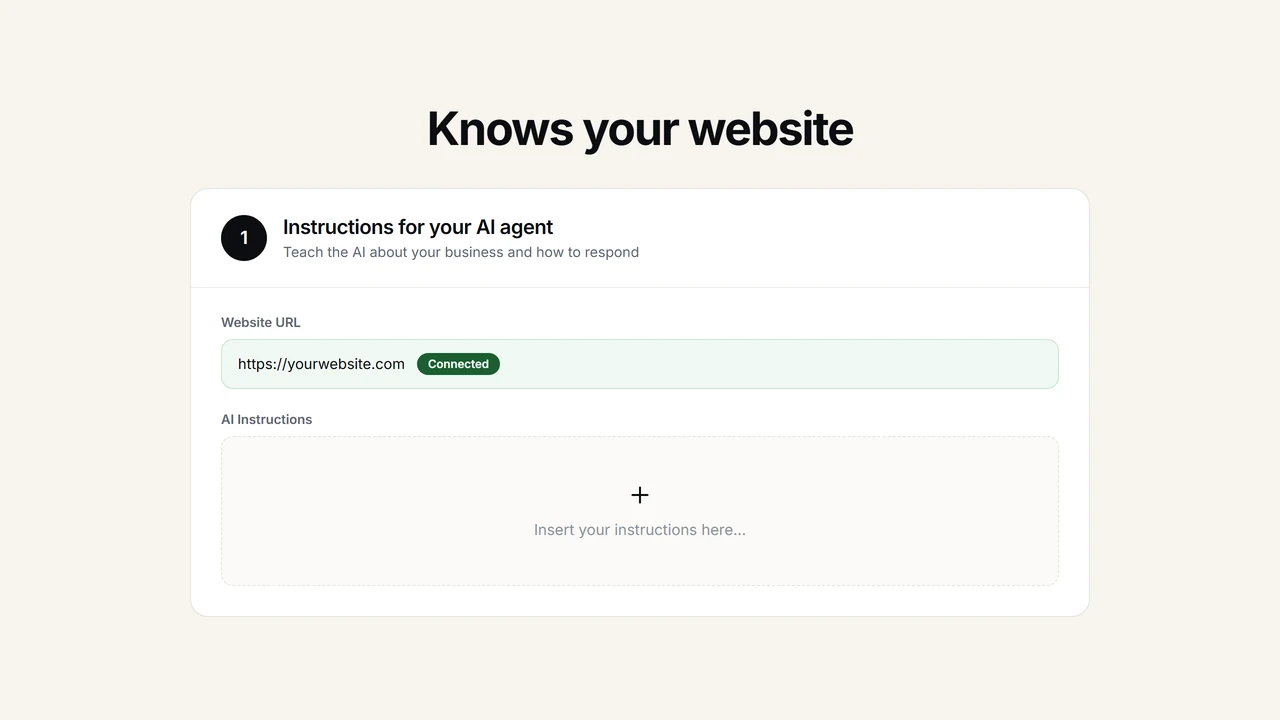
Paste a client URL below. The AI reads their website content and builds a working chatbot in seconds — capturing leads from visitors, answering questions, and deflecting support without a human in the loop
You drive the traffic — now automate what happens when it arrives
Digital marketing agencies spend months building campaigns that bring visitors to client websites. SEO rankings climb, ad clicks convert to page views, social posts generate traffic. But once those visitors land on the site, most of them leave without taking action — because nobody is there to answer their question at 11 PM, the contact form feels like shouting into a void, and the FAQ page does not cover what they actually want to know. AI automations for digital marketing agencies close that gap. A chatbot sits on the client's site, reads their content, and engages every visitor in real-time conversation — answering product questions, capturing contact details, and handling the repetitive support queries that would otherwise go unanswered. Your campaigns bring the visitors; the automation converts them. One subscription on the Pro plan covers up to 20 client sites for $449/month — so the automation scales with your roster without scaling your costs.
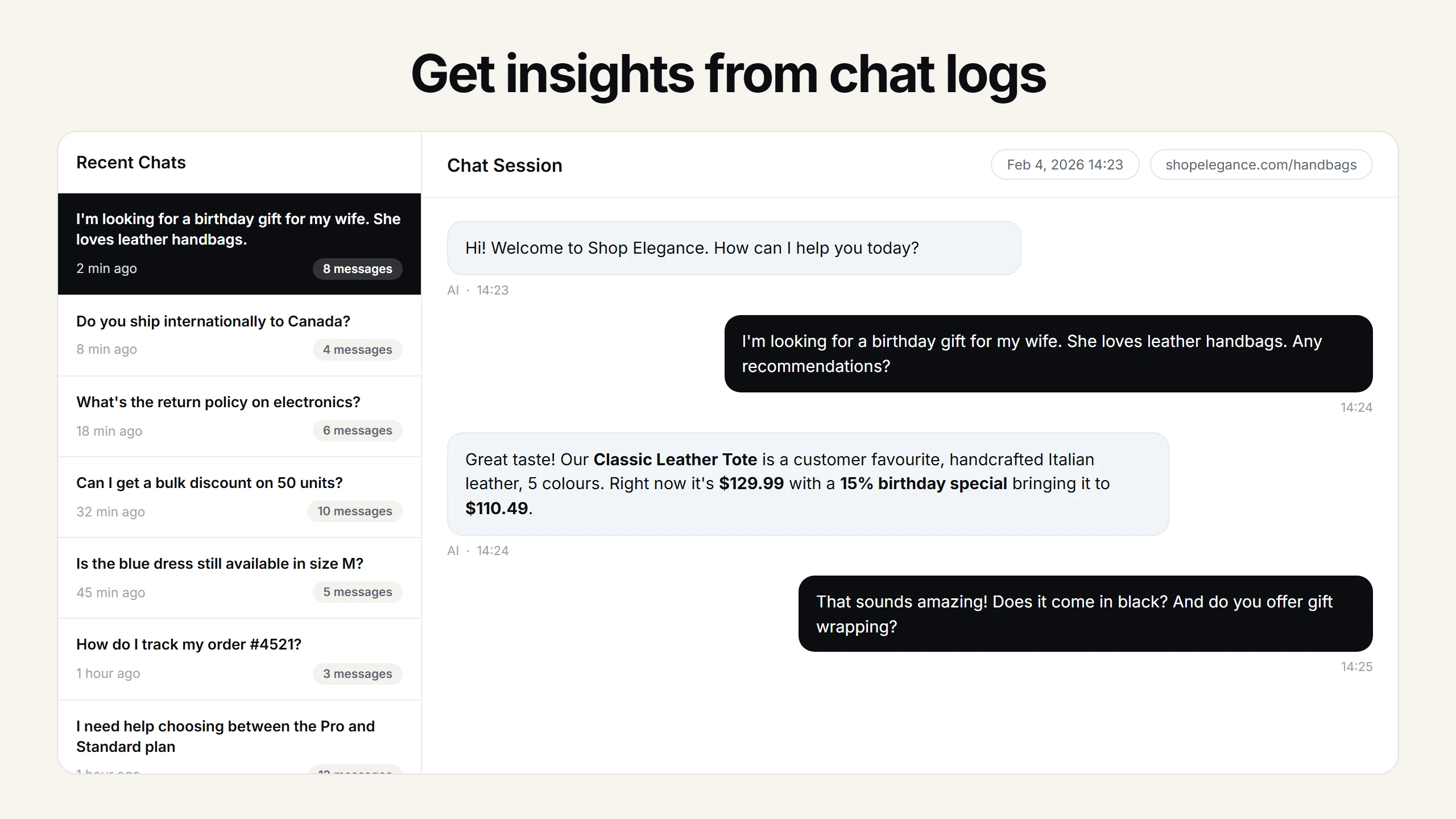
- Turn campaign traffic into captured leads automaticallyEvery PPC click, every organic visit, every social referral reaches a site with an AI chatbot ready to engage. Instead of hoping visitors fill out a static form, the chatbot answers their questions using the client's own website content and naturally collects their name, email, and inquiry details. Leads appear in the dashboard with full conversation transcripts and are exportable as CSV for import into any CRM your client uses.
- Deflect support queries so your team stays focused on growthClient websites generate repetitive questions — hours of operation, return policies, service areas, pricing breakdowns. The AI handles all of these automatically by reading the client's published content and generating accurate responses. Your team stops fielding "Can you ask the client about X?" messages and spends that time on campaign strategy, creative development, and the work that actually grows accounts.
- Deploy across your entire roster from one dashboardEach client chatbot operates independently — separate knowledge base, separate widget branding, separate conversation history. Adding a new client takes about twenty minutes: point the AI at their website, customize the widget, paste one line of code. You do not need a dedicated person managing chatbots. The automation maintains itself when clients update their content, so there is nothing to revisit after the initial setup.
One account, every client covered, margins that compound
Digital marketing agencies evaluate tools on two criteria: does it create results the client can see, and does it scale without eating the margin? The Pro plan at $449/month delivers on both. You manage up to 20 client sites from a single dashboard, each with its own knowledge base and branded chatbot. The 50,000 monthly messages pool across all sites, so a quiet law firm client naturally balances a high-traffic ecommerce client. White-label branding means every widget carries your agency identity, not ours. Agencies growing past 20 sites can move to a Custom Pro plan with expanded limits — same margin structure, just more capacity.
- Every client site is fully isolatedEach website gets its own knowledge base, widget configuration, conversation history, and AI instructions. A plumber's chatbot never mixes with a medical spa's. You configure each deployment independently, and the AI uses only that specific client's content to generate responses. Client data stays separated at every level.
- White-label branding removes the platform entirelyOn the Pro plan, the chatbot displays your agency name, your logo, and your color palette. The "Powered by" badge disappears completely. Each client also gets a white-labeled dashboard — embeddable on your own website — with Conversations, Analytics, and Leads tabs under your brand. Your clients see your platform, not the underlying technology.
- 50,000 messages shared across all sitesThe pooled message model works in your favor because client usage varies. A niche B2B consulting firm might generate 60 conversations per month; a busy restaurant client might generate 800. The pool absorbs these variations naturally — you rarely need to think about individual client limits. Most agency portfolios of 12-20 small business clients sit comfortably within the allocation.
- Custom Tools connect the chatbot to client systemsAvailable on Standard and Pro plans, Custom Tools let the AI call your client's own API endpoints. A fitness studio's chatbot can check class availability. A car dealership's bot can look up whether a specific model is on the lot. An ecommerce client's bot can pull order status by confirmation number. The automation goes beyond answering questions — it performs tasks that normally require a human at a computer.
- 36 languages with zero extra configurationThe AI detects visitor language automatically and responds in kind. A Spanish-speaking visitor on an English-language website gets Spanish answers. For agencies serving clients with multilingual customer bases or international markets, one deployment handles every language without creating separate chatbot instances or translating anything manually.
Deploy AI automation on a client site in 20 minutes
No coding background needed. No decision trees to build. Add the client site, let the AI read their content, brand the widget, and paste one embed line.
- Sign up for the Pro plan at asyntai.com/pricing — $449/month covers 20 client sites, white-label branding, and 50,000 messages.
- Add your client's domain in the dashboard. The AI automatically crawls up to 50 pages and builds a knowledge base from their website content — service pages, product descriptions, FAQs, blog posts — no manual data entry required.
- Brand the widget with your agency name, logo, and colors. Set AI instructions to match the client's tone and any specific rules (like redirecting pricing questions to a sales number or always suggesting a consultation).
- Copy the one-line embed script and paste it on the client's site. The chatbot goes live immediately — answering visitor questions, capturing leads, and running around the clock under your brand.
<!-- Captures leads, answers questions, never takes a day off -->
<script src="https://asyntai.com/widget.js"
data-id="client-site-id" async>
</script>
# One line. Full automation. Your brand on every surface.
# The chatbot handles the visitors — you collect recurring revenue.
How reselling works
From signing up to billing your first client — four simple steps.
Choose a plan
Subscribe to a plan that fits how many client websites you need. Pro is the most popular for resellers — white-label plus up to 20 websites.
View plans →Add a client website
Each website you add under your account is one client's chatbot. Add up to the number your plan allows.
Go to your dashboard →Set up the chatbot
Add the client's content, customize the widget to their brand, and install it on their site. You can also give the client read-only access to their chat logs, analytics and leads on your own website.
Setup guide →Resell at your price
Charge your client whatever you like. You own the relationship and bill them directly — the margin is yours, every month.
Reseller Resources
Everything you need to get started, answer client questions, and see the dashboard in action
Reseller Guide
Step-by-step walkthrough: white-label branding, the embeddable client dashboard, and how to get your first client live.
Read the guideReseller FAQ
Pricing, margins, billing, white-label details, platform compatibility, and everything else partners ask before starting.
View FAQClient Dashboard Demo
See the embeddable white-label dashboard with sample data — conversations, analytics, and leads under your brand.
See the demoAI automations for digital marketing agencies — FAQs
Common questions about adding AI chatbot automation to your agency's service offering.
How does the chatbot know what to say about each client's business?
When you add a client's domain, the AI crawls up to 50 pages of their website — service pages, product listings, FAQs, blog posts, about pages — and builds a knowledge base from that content. It then uses this content to generate accurate answers to visitor questions. There is no manual Q&A writing or decision-tree building involved. If the client publishes a new page or updates their pricing, the knowledge base refreshes automatically. You can also upload supplementary documents (PDFs, internal guides) for topics not covered on the website.
We already run SEO and PPC for clients — how does this fit into our service stack?
SEO and PPC drive visitors to the site. The chatbot handles what happens after they arrive. Instead of relying on a static contact form or hoping someone checks the email inbox, the AI engages visitors in conversation, answers their specific questions from the client's own content, and captures their contact information through natural dialogue. The result is more leads from the same traffic volume you are already generating. You can present this to clients as a conversion optimization layer that sits on top of the campaigns you already manage, with its own monthly fee.
Do we need technical staff to deploy chatbots?
No. The entire process is non-technical. You add the client's domain, the AI builds the knowledge base automatically, you customize the widget appearance in a visual editor, and then paste one line of JavaScript onto the client's site. If the client uses WordPress, there is an official plugin. Shopify has an App Store listing. For all other platforms — Wix, Squarespace, Webflow, and over 30 others — it is a single script tag pasted before the closing body tag. Anyone who can edit a webpage can install it.
How do we make money reselling chatbots?
You subscribe to a plan (Pro at $449/month is the most popular for agencies), deploy chatbots to your client sites under your brand, and charge each client whatever monthly fee you choose. If you charge 15 clients $250/month each, you collect $3,750/month against $449 in platform cost — $3,301 in gross margin. You own the client relationship, you set the price, and you bill them directly. The chatbot runs under your brand with white-label branding on Pro, so the client sees your platform. Agencies growing past 20 sites can move to a Custom Pro plan.
What is the difference between white-label and the affiliate program?
White-label reselling means you deploy the chatbot under your own brand, manage the client relationship, and set your own pricing — the client never sees the underlying platform. The affiliate program is for referrals: you send prospects a tracking link, they sign up and manage their own chatbot, and you earn a 20% recurring commission on their subscription for up to 12 months. Many agencies use both — white-label for clients who want a managed service, affiliate referrals for prospects who prefer self-serve. The two approaches cover different client profiles.
Can we customize the chatbot's behavior for different industries?
Yes. Each client chatbot has its own AI instructions where you define tone, behavior rules, and specific handling logic. For a medical practice, you might instruct the chatbot to always recommend booking a consultation and never provide medical advice. For a restaurant, you might tell it to always mention the reservation link. Once you build a few chatbots in the same vertical, you develop instruction templates that make new setups faster — a dental template, a real estate template, a home services template. The AI reads the client's unique content; the instructions shape how it communicates.
What reporting do clients get access to?
Each client can access a white-labeled dashboard — embeddable on your own website — with three tabs. Conversations shows every chat transcript with timestamps and visitor details. Analytics displays message volume, conversation counts, and engagement trends over time. Leads lists every contact captured through conversation, with full transcripts attached and CSV export. You can use these reports in client review meetings to show the exact number of leads captured, questions answered, and visitors engaged — concrete metrics that justify the monthly fee and make renewals easy.
Can we start with one or two clients before going all-in?
Absolutely. The Starter plan at $39/month supports 2 sites with 800 messages — enough to deploy on two client sites and validate the model. The Standard plan at $139/month supports 3 sites with 15,000 messages and adds Custom Tools for API-connected automation. When you are ready for full white-label branding and higher capacity, upgrade to Pro. There are no contracts, no setup fees, and no upgrade penalties. Plans are month-to-month, and you can scale up as your client roster grows.
Why digital marketing agencies are adding AI chatbot automation to their service stack
Digital marketing agencies have spent the last decade perfecting their ability to drive traffic. They know how to get a client's website to rank for competitive keywords, how to structure ad campaigns that bring qualified visitors, how to build social presences that generate clicks. What most agencies have not solved is what happens after the visitor arrives. The website loads, the visitor scans the page, maybe reads a few paragraphs — and then leaves. The bounce rate holds steady at sixty or seventy percent month after month, and the agency's monthly report shows impressive traffic numbers alongside a conversion rate that barely moves. The missing layer is engagement. Not more content, not faster load times, not a redesigned contact form — but a real-time conversation that meets the visitor at the moment of interest and turns curiosity into a captured lead. That is exactly what AI chatbot automation provides, and it slots into the agency service stack as naturally as analytics reporting does.
The economics of chatbot automation differ from every other service a digital marketing agency sells. SEO requires ongoing content, link building, and technical audits — labor-intensive work that scales linearly with the number of clients. PPC management demands daily monitoring, bid adjustments, and creative rotation. Social media needs a steady pipeline of posts, responses, and community management. Each of these services requires human attention proportional to the number of accounts. An AI chatbot, once deployed, requires virtually none. The setup takes about twenty minutes: add the client's domain, let the AI read their content, customize the widget, paste the embed code. After that, the chatbot runs on its own — answering questions at midnight, capturing leads on weekends, handling the same five visitor questions that would otherwise require someone checking email. Adding the eighth client to your chatbot roster takes the same effort as the second, but your subscription cost has not increased. The Pro plan at $449/month covers up to 20 sites. The margin on every additional client is nearly pure profit.
For agencies that manage paid advertising, the chatbot creates a measurable lift in campaign ROI that clients notice immediately. Consider the typical PPC funnel: the client spends $3,000/month on Google Ads, the ads drive 1,200 clicks, and maybe 30 of those visitors fill out the contact form — a 2.5% conversion rate. The other 1,170 visitors leave without a trace, and the $2,925 spent driving them is wasted. A chatbot on the landing page changes this dynamic. It proactively engages visitors who are reading the page but hesitating, answers the specific question holding them back, and captures their contact information through conversation rather than a form. Agencies running chatbots alongside paid campaigns typically see lead capture increase because the chatbot reaches visitors who would never interact with a static form. When you show a client that their same ad spend is now generating forty-five leads instead of thirty, the value of the chatbot service is self-evident.
Content marketing agencies face a particular version of this problem. They produce blog posts, guides, and resource pages designed to attract organic visitors — and they succeed. The content ranks, the traffic grows, and the analytics dashboard looks healthy. But blog visitors have notoriously low conversion intent. They came for information, not to buy. A chatbot shifts this dynamic by offering to help the visitor with related questions after they finish reading. A visitor who just read a guide on kitchen remodeling costs might have a follow-up question about timelines or financing. The chatbot answers using the contractor client's own content and, when the visitor's questions signal buying intent, collects their contact details. The blog post that used to generate traffic but no leads now generates both — and the agency can point to the chatbot as the reason.
The white-label component transforms this from a tool recommendation into a proprietary service offering. Without white-label, you are telling the client to use a chatbot product and hoping they do not wonder why they need you in the middle. With white-label on the Pro plan, every trace of the underlying platform disappears. The chatbot carries your agency name. The widget shows your logo and colors. The client dashboard — embeddable on your own website — displays Conversations, Analytics, and Leads under your brand. When the client logs in to export their monthly leads, they are using what appears to be your platform. When their customers chat with the widget, they see your brand. The distinction matters because agencies survive on perceived expertise and proprietary value. A white-labeled chatbot service positioned as your in-house AI solution carries fundamentally different value than a third-party tool recommendation.
One aspect of AI chatbot automation that agency owners discover after their first few deployments is how dramatically it reduces client communication overhead. Before the chatbot, a typical week includes emails from clients asking whether someone responded to a website inquiry, whether the contact form is actually sending notifications, and whether they missed any leads over the weekend. The chatbot eliminates these conversations because the answers are in the dashboard. Leads are captured with full transcripts. Visitor questions are answered in real time. After-hours coverage is automatic. Client anxiety about missed opportunities drops because the evidence is visible — they can see every conversation and every lead. This reduction in client management time is not a headline benefit, but for agency owners tracking billable hours and project management overhead, it is material.
Vertical specialization within digital marketing makes chatbot automation even more powerful. An agency that serves dental practices knows that dental website visitors ask the same categories of questions: which insurance plans are accepted, whether the practice handles emergencies, what cosmetic procedures cost, and how to book a new patient appointment. After building two or three dental chatbots, the agency has an instruction template that handles these patterns with precision. New dental client deployments drop from twenty minutes to ten because the template is ready — only the website content and branding change. The agency can market this as a specialized "AI front desk for dental practices" and charge a premium for what is effectively the same technology with industry-specific configuration. The vertical expertise lives in the AI instructions and positioning, not in the underlying platform, but the client perceives a purpose-built solution.
For agencies managing local SEO campaigns, the chatbot adds a layer of engagement that strengthens the local search signals they are already optimizing. When a visitor from Google Maps or a local search query lands on the client's site and has a conversation with the chatbot, that visitor spends more time on the site and interacts with more content — both behavioral signals that search algorithms consider. More importantly, the chatbot captures the lead that local SEO worked to deliver. A homeowner searching for "roof repair near me" who clicks through to a roofing company's website and gets immediate answers about inspection scheduling and insurance claim assistance is far more likely to become a customer than one who lands on the same page and sees a phone number and a contact form. The chatbot is the bridge between the agency's local SEO work and the client's actual revenue.
Pricing chatbot automation as a service requires thinking about value, not cost. The platform cost on Pro is $449/month for up to 20 sites, which works out to roughly $22 per client at full capacity. But the value to each client — 24/7 visitor engagement, automated lead capture, support deflection, multilingual coverage across 36 languages — justifies monthly fees of $200 to $400 depending on the client's traffic volume and industry. Some agencies bundle the chatbot into their existing retainer at a slight markup. Others position it as a separate line item with its own monthly fee. The second approach is stronger because it creates a distinct revenue stream with its own perceived value, making it harder for the client to negotiate it away during contract renewals. Whichever model you choose, the margin structure is fundamentally different from labor-based services because your incremental cost per client is effectively zero.
Custom Tools on Standard and Pro plans open a second tier of automation that agencies can sell at a premium. Beyond answering questions from website content, Custom Tools let the chatbot connect to a client's own systems via API endpoints and perform actions. A medical practice's chatbot can check appointment availability by date and provider. An ecommerce client's bot can pull order status by tracking number. A property management client's bot can look up maintenance request status for tenants. This transforms the chatbot from a conversational FAQ into an operational automation layer — it does not just tell visitors things, it does things for them. For agencies, this creates a natural upsell path: basic chatbot at one price, advanced automation with system integrations at a premium. The setup is straightforward, but the perceived value is substantial because the automation now replaces specific human tasks.
The affiliate program provides an additional revenue channel for agencies that encounter prospects who want a chatbot but do not want managed services. Instead of deploying white-label and billing the client monthly, you share a tracking link. The prospect signs up, manages their own chatbot, and you earn a 20% recurring commission on their subscription for up to 12 months. A single referral to the Pro plan generates $89.80/month in passive income. This works particularly well for agencies doing website redesigns or one-time projects where ongoing management is not part of the engagement — you recommend the chatbot, the client self-serves, and you collect the commission. Running both white-label reselling and affiliate referrals in parallel covers every client profile: those who want full management and those who prefer to handle it themselves.
The operational truth of running chatbot automation across a roster of fifteen to twenty digital marketing clients is that it becomes the lightest service you deliver relative to its revenue contribution. New deployments take twenty minutes. The AI updates its knowledge base automatically when website content changes, so there is no maintenance cycle. Client-facing reviews consist of pulling dashboard metrics — conversations handled, leads captured, engagement trends — and presenting them alongside the campaign performance data you already report on. There are no creative revisions, no A/B test cycles, no content calendars to manage. The chatbot runs, the leads accumulate, the clients see the value, and the monthly fee continues. For a digital marketing agency looking to increase recurring revenue without proportionally increasing its headcount, AI chatbot automation is the highest-leverage addition available.
Ready to add AI automation to your digital marketing agency? Start with the Pro plan and deploy your first client chatbot in under 20 minutes — or email [email protected] with any questions about reselling.