WordPress knowledge base documentation plugin that turns your articles into conversations
Install a plugin that lets AI read every article, guide, and FAQ on your WordPress site — then answer visitor questions in plain language, across 36 languages, without search bars or category trees.
Preview the knowledge base plugin on your WordPress site
Enter your WordPress URL and see how the AI finds answers buried in your documentation
Every page, post, and document becomes searchable by conversation
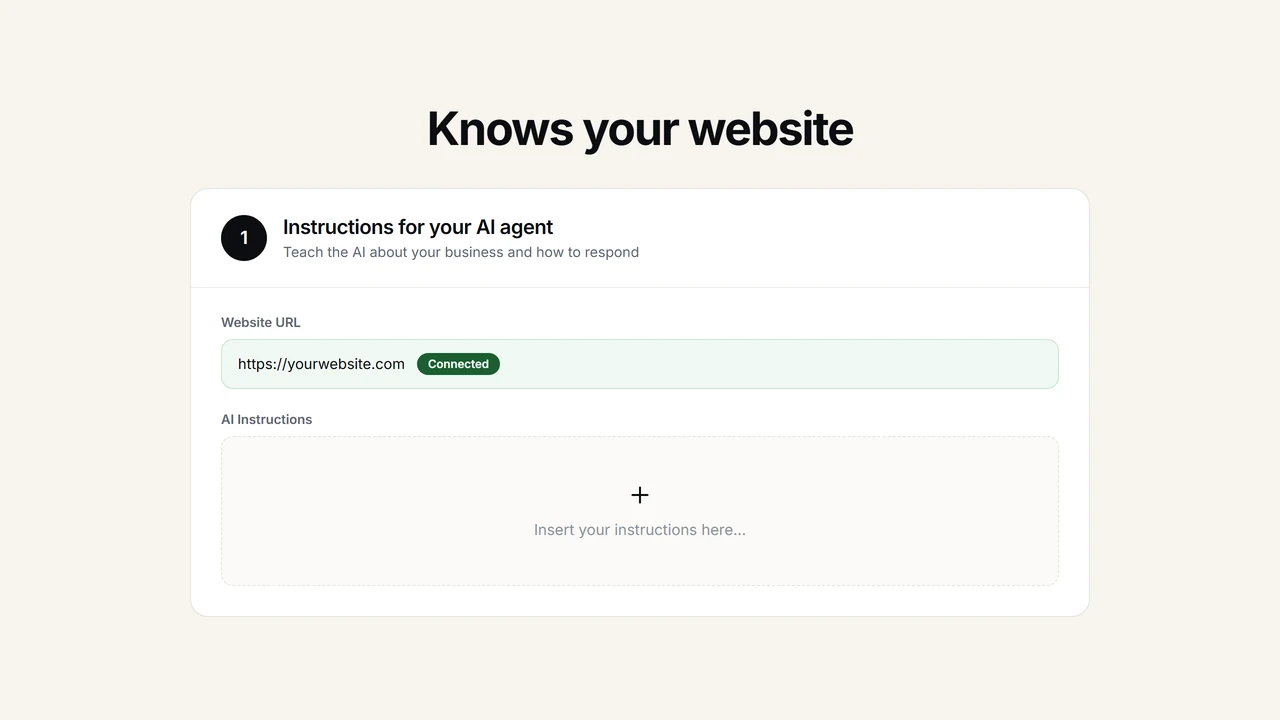
WordPress sites accumulate knowledge in layers — pages, posts, custom post types, PDF attachments, category archives. Traditional knowledge base plugins force visitors to navigate those layers manually, clicking through hierarchies until they stumble onto the right article. Asyntai collapses that entire structure into a single conversational interface. The AI crawls your published content, absorbs the text from each page, and uses it to answer questions directly. Your visitor asks a question; the AI finds the relevant paragraph across any content type and delivers the answer in seconds.
- Crawls your WordPress pages and postsDocumentation pages, knowledge base articles, FAQ posts, WooCommerce product descriptions, custom post types — any published content on your WordPress site is automatically ingested and made searchable.
- Handles uploaded documentsPDFs, internal guides, staff manuals, and partner documentation that lives outside your public pages — upload directly to Asyntai and the AI references it alongside your WordPress content.
- Re-crawl when content changesPublished a new article or revised an old one? Hit re-crawl in the dashboard and the AI updates its knowledge within minutes. No rebuild, no re-indexing queue, no waiting overnight.
Pull live data into answers with Custom Tools
Documentation answers most questions, but some require real-time information — order status, account balances, subscription details. On Standard ($139/month) and Pro ($449/month) plans, Custom Tools let the AI call your own API endpoints mid-conversation to fetch live data and even perform actions like initiating returns or updating account preferences. Your WordPress knowledge base becomes more than a reference library — it becomes an interactive service desk.
- Fetch order and account detailsConnect endpoints that return order status, tracking numbers, or account information. The AI calls them when a visitor asks and weaves the live data into a natural response.
- Perform actions on behalf of visitorsProcess cancellations, update preferences, trigger password resets — any action your API supports, the AI can execute when the conversation warrants it.
- 36-language auto-detectionA German visitor asking about their order in German gets a German response with live data — same endpoint, no separate language configuration required.
- Escalation with full transcriptWhen a question exceeds what documentation and live data can resolve, the AI captures the visitor's email and entire conversation, then routes it to your inbox with complete context.
Add the knowledge base plugin to WordPress in minutes
Asyntai offers an official WordPress plugin that handles the snippet injection automatically — no theme editing required. Alternatively, paste the script directly into your header.php or use any header injection plugin you already have installed.
- Create a free Asyntai account and copy your unique script snippet from the dashboard. Free plan includes 1 site and 50 messages per month at no cost.
- Install the official Asyntai WordPress plugin from your dashboard, or paste the snippet into your theme's
header.phpbefore the closing</head>tag. - Enter your WordPress site URL in the Asyntai dashboard to crawl your documentation, articles, and knowledge base pages. Upload any private PDFs or internal guides separately.
- Write custom AI instructions for tone, escalation rules, and topic boundaries. Upgrade anytime — Starter at $39/month (2 sites, 800 messages), Standard at $139/month (3 sites, 15,000 messages), or Pro at $449/month (20 sites, 50,000 messages).
<script src="https://asyntai.com/widget.js"
data-id="your-site-id" async>
</script>
# Add to header.php or use the official WordPress plugin.
# Works with any theme — Genesis, Astra, GeneratePress, Divi, and custom themes.
WordPress Knowledge Base Documentation Plugin — FAQs
Common questions from WordPress site owners setting up AI-powered documentation.
Does this work with any WordPress theme?
Yes. The Asyntai widget loads as an independent JavaScript overlay, so it works identically on any WordPress theme — Astra, GeneratePress, Divi, Elementor-based themes, OceanWP, Flavor, Flavor theme, Flavor starter, and fully custom themes. It does not depend on theme hooks, template structure, or any specific page builder. Install the official plugin or paste the snippet into header.php and it works everywhere.
Will it conflict with my existing knowledge base plugin?
No. Asyntai does not modify your WordPress database, override post types, or interfere with plugins like BetterDocs, Echo Knowledge Base, or Heroic KB. It operates as a conversational layer on top of whatever documentation structure you already have. Your existing articles, categories, and search remain intact — Asyntai simply adds an AI chat interface that visitors can use as an alternative to browsing manually.
How does the AI access my documentation content?
You provide your WordPress site URL in the Asyntai dashboard, and the system crawls your published pages and posts automatically. It reads the text content from each page — titles, body copy, FAQ sections, product descriptions, knowledge base articles — and uses that content to answer visitor questions. For private or internal documents that are not publicly published, you upload PDFs or paste the text directly.
Can the AI answer questions from WooCommerce product pages?
Yes. If your WordPress site runs WooCommerce, the crawler picks up product descriptions, specifications, shipping details, and policy pages. A visitor asking about a specific product's dimensions, materials, or availability gets an answer drawn directly from that product's published page content.
Does it support multilingual WordPress sites?
The AI auto-detects the visitor's language and responds in that language across 36 supported languages, regardless of what language your articles are written in. If your docs are in English and a French visitor asks a question in French, the AI answers in French using the English source content. This works independently of WPML, Polylang, or TranslatePress — the translation happens at the AI response level.
What happens when the AI cannot find an answer in my documentation?
The AI acknowledges the gap honestly rather than fabricating an answer. It then offers to collect the visitor's email and question so your team can follow up. The full conversation transcript and contact details are delivered to your Asyntai dashboard and forwarded to your inbox if email notifications are configured. Your team picks up with full context of what was already discussed.
How many pages can it crawl from my WordPress site?
The crawler processes up to 50 pages per crawl session. For larger documentation sites, you can prioritize the most important sections and supplement with PDF uploads for content that lives outside the crawl scope. Most WordPress knowledge bases fall well within the 50-page limit when organized by topic rather than individual posts.
Is there an official WordPress plugin or do I edit theme files?
Both options are available. The official Asyntai WordPress plugin installs from your dashboard and injects the snippet automatically — no code editing needed. Alternatively, you can paste the snippet directly into your theme's header.php file or use any third-party header injection plugin you already have installed. The result is identical either way.
What does the WordPress knowledge base plugin cost?
The free tier covers 1 site and 50 messages per month. Starter is $39/month for 2 sites and 800 messages. Standard is $139/month for 3 sites and 15,000 messages, which also unlocks Custom Tools for live data lookups. Pro is $449/month for up to 20 sites and 50,000 messages with automatic white-label branding. The plugin itself is free — pricing is based on conversation volume.
WordPress knowledge base documentation plugin — why articles alone stopped being enough
There is a quiet tragedy playing out on thousands of WordPress documentation sites right now. Someone on the team spent months writing thoughtful knowledge base articles — each one carefully titled, properly categorized, tagged with relevant keywords, formatted with headers and screenshots. The site has a search bar, a sidebar full of categories, maybe even a table of contents plugin for longer articles. And yet, support tickets keep pouring in asking the exact questions those articles already answer. The articles exist. The answers are there. But visitors cannot find them, because the gap between how people think about their problems and how documentation is organized is wider than any search bar can bridge.
Consider how a real visitor approaches a documentation site. They land on a WordPress knowledge base with a problem that is specific, messy, and phrased in their own words — not in the neat category labels the documentation team chose. They type something like "why did my invoice show a different amount than the quote" into the search bar. The search engine matches on "invoice" and returns eight articles, three of which are about generating invoices and none of which address the quote-to-invoice discrepancy that is actually their problem. The visitor clicks the first result, skims for thirty seconds, decides it is not relevant, goes back, tries the second result, gives up, and opens a support ticket. That ticket takes a human agent four minutes to answer by copying the relevant paragraph from the article the visitor never found. Multiply this by fifty tickets a day and you have a documentation system that costs more to maintain than it saves.
Asyntai's WordPress knowledge base plugin attacks this problem at the root. Instead of improving the search bar — an approach that has diminishing returns regardless of how sophisticated the algorithm gets — it replaces the entire discovery paradigm. The AI reads every published article on your WordPress site, absorbs the content, and makes itself available as a chat interface in the corner of every page. When a visitor types that messy, specific question about invoice discrepancies, the AI locates the relevant paragraph across all your documentation, synthesizes an answer in plain language, and delivers it in seconds. The visitor never needs to know which category the article was filed under, what it was titled, or even that it exists as a separate page. The knowledge reaches them through conversation, not navigation.
WordPress is uniquely well-suited to this approach because of how content accumulates on the platform. A typical WordPress documentation site is not a pristine, centrally planned information architecture — it is a living organism. Articles get added over months and years by different team members. Some live as Pages, others as Posts. Some use a dedicated knowledge base plugin with custom post types. Product descriptions sit in WooCommerce. Policies live on standalone pages. An FAQ might be built with an accordion shortcode on one page and repeated in slightly different form on another. This organic sprawl is not a flaw of WordPress — it is a natural consequence of a CMS that makes publishing easy. But it makes traditional search and navigation progressively worse as the content library grows, because no human visitor can hold the entire sitemap in their head. An AI that has read everything, however, treats the entire corpus as a flat, searchable surface regardless of where each piece lives in the WordPress hierarchy.
The official Asyntai WordPress plugin makes installation as simple as activating any other plugin from the WordPress dashboard. No theme file editing, no PHP knowledge, no pasting scripts into header.php unless you prefer that approach. The plugin handles snippet injection automatically and works with every major theme — Astra, GeneratePress, Divi, OceanWP, Flavor theme, and fully custom themes. For site owners who run multiple WordPress properties, each site gets its own independently configured AI with its own crawled content and behavioral instructions, kept completely separate even under a single Asyntai account.
Language coverage deserves specific attention for WordPress documentation sites that serve international visitors. Writing and maintaining knowledge base articles in multiple languages is one of the most expensive ongoing costs for documentation teams. Plugins like WPML and Polylang help manage translated content, but someone still has to write or review every translation. Asyntai sidesteps this entirely for the conversational layer. Your articles stay in whatever language they were written in — typically English — and the AI automatically detects each visitor's language from their message and responds accordingly. A Japanese visitor asking a question in Japanese gets a Japanese answer drawn from your English documentation. This is not machine-translated article text; it is an AI-generated response that uses your English content as the factual source and delivers the answer natively in the visitor's language. Thirty-six languages are supported without any per-language configuration on your end.
For WordPress sites that go beyond static documentation — those where visitors need real-time information about orders, accounts, or service status — Custom Tools on Standard and Pro plans extend the plugin's capability into interactive territory. You define API endpoints that the AI can call mid-conversation: checking order status against your WooCommerce backend, looking up subscription details, verifying appointment availability, fetching live inventory counts. The AI decides when a conversation requires live data, calls the appropriate endpoint, and weaves the response into a natural answer. A visitor asking "where is my order" gets their actual tracking information, not a generic paragraph about shipping timelines. This transforms a knowledge base plugin from a documentation assistant into a frontline support agent that happens to be grounded in your documentation.
Behavioral guardrails keep the AI operating within boundaries you define. Every WordPress site has topics the AI should handle and topics it should not. A software company might want the AI to answer feature questions freely but escalate anything related to billing disputes. An e-commerce site might allow product comparison answers but prohibit the AI from making price-match commitments. You write these rules in plain English sentences in the Asyntai dashboard — "never promise a refund without human review," "escalate any complaint about data privacy immediately," "do not speculate about features that are not documented" — and the AI enforces them across every conversation, in every language, at every hour. The guardrails function as your documentation team's editorial policy, applied consistently to every visitor interaction.
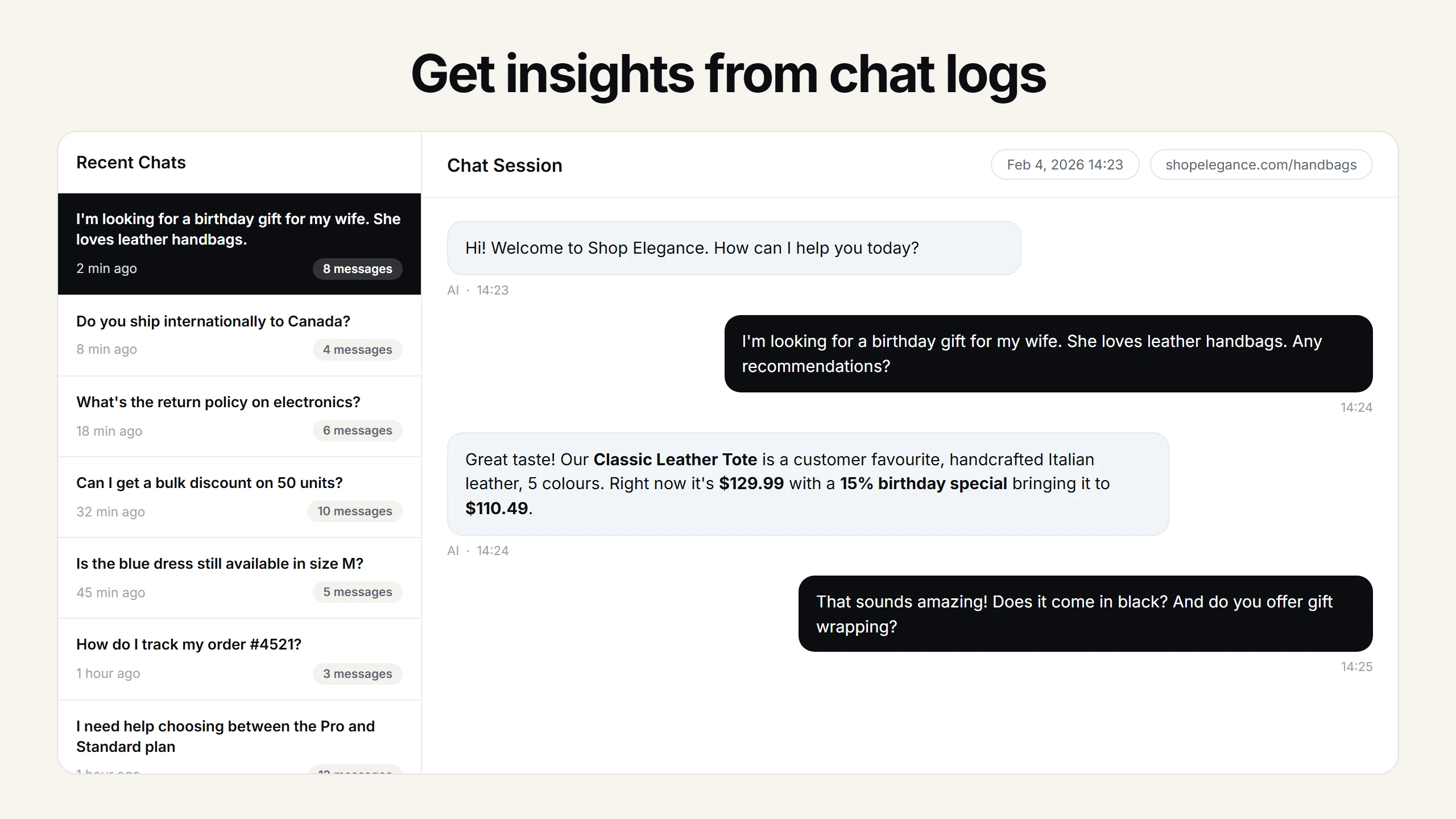
The analytics that accumulate over weeks of operation become a documentation improvement engine that no traditional knowledge base plugin can match. When visitors interact with a search bar, you see search terms and click-through rates — useful but shallow. When they interact with an AI, you see full conversations: the exact question phrased in the visitor's own words, the answer the AI constructed, whether the visitor found it satisfactory, and where the AI had to escalate because the documentation had a gap. After a month of data, patterns emerge. You discover that twenty percent of conversations cluster around a topic you thought was well-documented but apparently is not, because visitors phrase the question differently than your article addresses it. You find that a specific product page generates three times more chat interactions than any other, suggesting the page itself is confusing. These insights let you improve the documentation strategically rather than guessing which articles to write next.
White-label branding is available for agencies and SaaS companies that embed the knowledge base plugin on client sites or customer-facing portals. On Pro plans ($449/month), Asyntai branding is removed automatically — the chat widget appears as a native part of your WordPress site. On Standard plans ($139/month), white-label is available by contacting [email protected] for manual activation. For WordPress agencies managing documentation sites across multiple clients, this means each client's visitors see a seamlessly branded experience with no third-party logos or attribution visible.
Content freshness is a concern that WordPress site owners raise immediately, and rightly so. Documentation changes — articles are revised, new guides are published, old procedures are deprecated. The AI's knowledge needs to stay current with those changes. Asyntai handles this through on-demand re-crawling: when you update articles on your WordPress site, you trigger a re-crawl from the dashboard and the AI's content base updates within minutes. There is no overnight batch process, no weekly reindexing schedule, no stale-content window where the AI might reference outdated information. For sites with frequent documentation updates — software products shipping new features monthly, e-commerce sites updating seasonal policies — this keeps the conversational layer synchronized with the published content in near real-time.
The escalation workflow is designed for documentation teams that need the AI to handle what it can and route everything else to humans gracefully. When a visitor asks something that falls outside the crawled content and uploaded documents, the AI does not fabricate an answer or redirect to a generic contact page. It acknowledges the limitation, offers to connect the visitor with a team member, collects their email and a summary of their question, and delivers the complete conversation transcript to the Asyntai dashboard and optionally to your email inbox. The human agent who picks up the thread sees exactly what was discussed, what documentation the AI referenced, and where the gap occurred. There is no cold restart, no "please describe your issue again" moment. This handoff quality is what separates a useful knowledge base plugin from one that frustrates visitors at the exact moment they need help most.
WordPress multisite installations and networks benefit from the multi-site capability on paid plans. A university running separate documentation portals for admissions, IT help desk, and student services can configure each as an independent AI instance under a single Asyntai account. An agency managing client WordPress sites gets clean separation between each client's knowledge base. Site limits scale with the plan — one site on Free, two on Starter, three on Standard, and up to twenty on Pro — with each site maintaining its own crawled content, uploaded documents, custom instructions, and conversation archive.
The fundamental shift that a conversational knowledge base plugin brings to WordPress is this: documentation stops being a place visitors go and becomes a service that comes to them. Instead of navigating to a help center, scanning categories, typing search queries, and hoping the right article surfaces, visitors simply ask their question wherever they are on the site. The AI, having already read everything, meets them with the answer. For documentation teams, this means the articles they write actually reach the people who need them, instead of sitting in a well-organized library that nobody browses. For visitors, it means getting answers in seconds instead of minutes. For support teams, it means a dramatic reduction in tickets that were always answerable by existing documentation — the tickets that consume the most time precisely because they are repetitive and low-complexity.
Getting started takes less than an afternoon. Create a free account at asyntai.com/pricing, install the official WordPress plugin, point the crawler at your documentation pages, write a few behavioral instructions, and the AI is live on your site handling visitor questions using your own content. The free plan covers one site and 50 messages per month — enough to validate that the AI answers accurately before committing to a paid tier. From there, paid plans scale with your traffic: Starter at $39/month, Standard at $139/month with Custom Tools and 15,000 messages, and Pro at $449/month with white-label branding and capacity for high-traffic documentation sites.