Shopify chatbot that knows your products
Asyntai is an AI Shopify chatbot that reads your store in minutes and answers every shopper 24/7 — in their language, in the moment they hesitate, before they close the tab.
Try it on your Shopify store for free
Enter your store URL and see how the Shopify chatbot would actually answer your shoppers
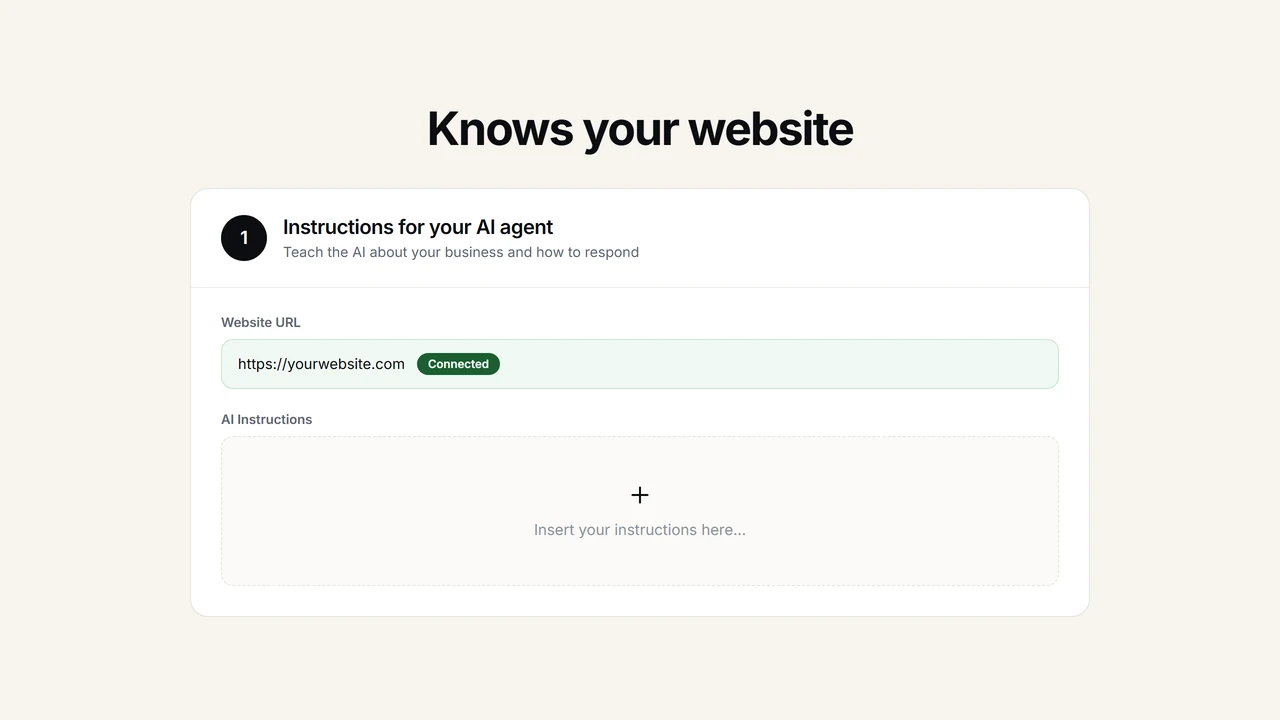
Paste your Shopify URL. That's the training.
Asyntai crawls your product pages, collections, and policies automatically. Need to add context the AI can't see from your store? Upload PDFs, paste text, or give custom instructions — the Shopify chatbot blends it all.
- Auto-crawls product catalogEvery title, description, price, and spec becomes part of the chatbot's knowledge within minutes.
- Upload docs for internal infoSize charts, fabric guides, return procedures, B2B pricing — anything not on your store can be added as files.
- Custom behavior rules"Always recommend bestsellers when undecided." "Never quote shipping before asking country." You set the voice.
Built to rescue the checkout, not just chat
The Shopify chatbot is designed for the moments that actually move revenue — hesitation on a product page, confusion about shipping, abandoned-cart questions. It doesn't just talk; it closes.
- Proactive engagement on product pagesOpens at the right moment, suggests relevant answers, reduces bounce.
- Smart lead capture in conversationsThe chatbot can ask shoppers for an email or phone number during a chat. Leads land in your Asyntai dashboard, and optionally in your inbox via email notifications.
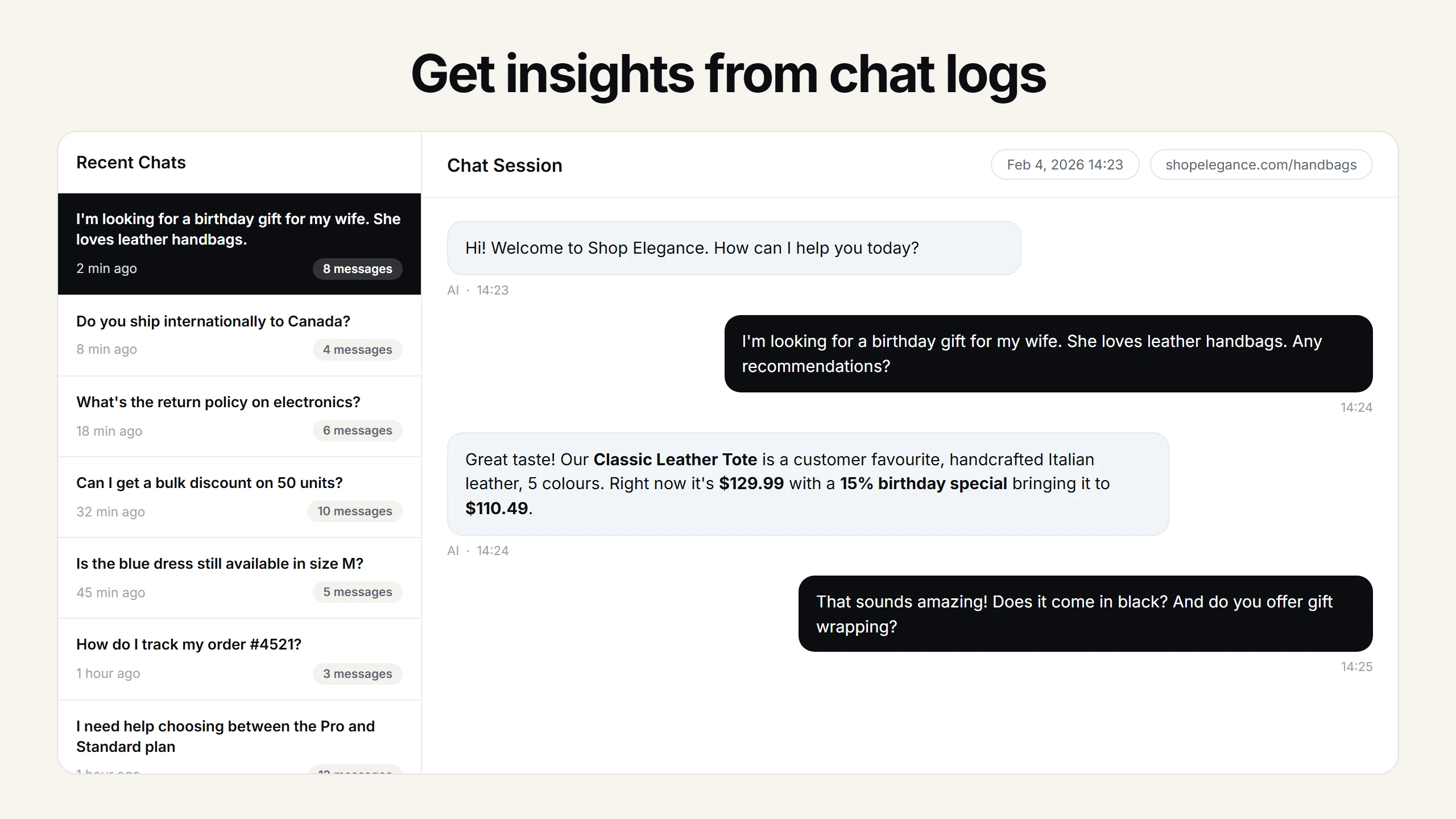
- Full conversation analyticsSee what shoppers actually ask, where your product descriptions have gaps, and which topics block checkout.
One script tag. No Shopify app install.
Skip the Shopify App Store install and the broad store-data permissions. Paste the Shopify chatbot snippet into theme.liquid and you're live.
- Sign up for a free Asyntai account and copy your personal snippet.
- In Shopify admin, go to Online Store → Themes → Edit Code.
- Open theme.liquid and paste the snippet before
</body>. - Save. The Shopify chatbot is now live on every page of your store.
<script src="https://asyntai.com/widget.js"
data-id="your-store-id" async>
</script>
</body>
# That's it. Really.
Shopify chatbot — FAQs
The practical stuff store owners usually want to know.
Is Asyntai a Shopify App Store app?
No, and that's deliberate. It's a JavaScript snippet you paste into theme.liquid — no App Store install and no broad store-data permissions. The Shopify chatbot only sees what shoppers type into the chat.
Which Shopify themes does it work with?
All of them. Dawn, Debut, Brooklyn, Sense, Refresh, Impulse, Prestige, and any paid or fully custom theme. The chatbot loads as an overlay, so it never touches your theme files or cart drawer.
How does the Shopify chatbot learn about my products?
Paste your store URL and Asyntai crawls your product pages, collections, and policies. For anything not on your store — size charts, supplier info, B2B pricing — you can upload PDFs or paste text directly.
Will it slow down my store?
The widget loads asynchronously after your Shopify theme renders, so it doesn't block page load. It's a single script tag, similar in weight to a Meta Pixel or Google Tag.
Does it handle international shoppers?
Yes. The widget UI is available in 36 languages and detects the shopper's language from their message — so a French shopper can get a French reply and a Japanese shopper a Japanese one, without any extra setup.
What happens when I hit my message limit?
The Shopify chatbot pauses new replies until the next billing cycle or until you upgrade. Email warnings land in your inbox before you actually hit the cap.
Can I use it on multiple Shopify stores?
Yes on paid plans. Free: 1 site, Starter: 2, Standard: 3, Pro: up to 10. Each store gets its own separately trained Shopify chatbot.
How is this different from Shopify Inbox?
Shopify Inbox is a live chat tool that needs a human to reply. Asyntai is an AI Shopify chatbot that reads your store and answers automatically — no agent required, even at 3 AM.
Everything you need to know about a Shopify chatbot
The best time to add a Shopify chatbot to your store was three years ago. The second-best time is this afternoon. Every shopper who lands on your product page has a question — about fit, delivery, materials, return policy, promotions, stock, or whether the item will arrive in time for a birthday — and most of them will not scroll to find the answer. They will open the chat if one is there, and they will close the tab if one is not. That closed tab is the most expensive event in any Shopify store: you already paid to acquire the visitor through ads or SEO, they showed clear purchase intent by clicking through to a product page, and then they left over a question that could have been answered in seconds. The whole argument for a Shopify chatbot comes down to that one closing tab.
What separates a useful Shopify chatbot from a frustrating one is intelligence. For years, the standard approach was rule-based flows — you drew a decision tree of every possible question a shopper might ask and every possible answer you might give. Sit with that for a moment: you are being asked to predict, in advance, every phrasing a human being might use to ask whether a shirt runs small, and then map each phrasing to a pre-written reply. This worked for five or six predictable paths and collapsed the moment a real shopper typed something you hadn't imagined. Asyntai skips the decision tree entirely. You point the AI at your Shopify store, it reads your product catalog and policies, and it answers freely. Ask about sizing in Spanish, follow up with a shipping question in English, reference something you said two messages ago — the Shopify chatbot handles all of it without a single flow to configure.
Training the Shopify chatbot to answer like it actually works at your store is where most tools get complicated. Asyntai keeps it simple: paste your store URL and the AI crawls your product pages, collections, and policy pages automatically. The model ingests every product title, description, price, and spec, plus your shipping terms and return policy, and holds all of that as context for future conversations. If there are things the AI cannot see from your public store — size charts kept as internal PDFs, supplier-specific shipping notes, a B2B pricing sheet, or care instructions that did not make the final product copy — you upload them as PDFs or paste them directly into the knowledge base. The same goes for custom instructions: "always recommend bestsellers when a shopper seems undecided", "never quote a shipping estimate without asking destination country". You write the rules in plain English, and the Shopify chatbot follows them.
If your Shopify store ships internationally, language is the difference between a converted sale and a bounced tab. The chatbot widget UI is available in 36 languages and the AI detects the shopper's language directly from their message — so a French shopper gets French answers, a Japanese shopper gets Japanese ones, a German shopper gets German replies, all without any plugin setup, translation app, or manual configuration on your side. For Shopify brands selling across the EU, the US, Latin America, and Asia, that alone saves hours of translation work and meaningfully reduces the drop-off rate from shoppers who would otherwise close the chat because it replied in a language they do not read. The Shopify chatbot treats multilingual support as the default, not a paid upgrade, not a localization project, not a nice-to-have.
The other split is how the Shopify chatbot gets installed. Most options live in the Shopify App Store, which means granting a third-party app broad permissions over your orders, customers, and store data, and going through a review process every time the vendor ships an update. Asyntai takes a lighter path: a single script tag in theme.liquid, the same way you would add a Meta Pixel or a Google Tag. No App Store install, no broad data access — the chatbot only ever sees what shoppers type into the chat. You keep control of your store, your customer records, and your order history. For agencies managing multiple Shopify clients or brand holdcos running a portfolio of stores, this install pattern is also dramatically easier to replicate: paste the snippet once per store, and move on. No app to migrate, no permission prompts to re-approve, no Shopify App Store policy changes to worry about.
A passive chat widget sits in the corner of a store and waits to be clicked. A Shopify chatbot that actually moves revenue does the opposite — it opens proactively at the moment a shopper is most likely to need help. Asyntai supports an auto-trigger, which opens the chat after a configurable delay on product pages, category pages, or anywhere else a shopper might be weighing a decision. On mobile, the trigger can be a smaller chat bubble rather than a full-screen takeover, so you do not scare away a thumb-scrolling buyer mid-scroll. The net effect is simple: shoppers who would have bounced silently because their question felt too small to send an email now get the answer in seconds, and the product page converts instead of leaking traffic.
Not every conversation ends in a purchase on the spot. Some shoppers ask a question, get a useful answer, and leave to think about it. The Shopify chatbot can turn those conversations into leads. During a chat, it can ask for an email or phone number, configurable depending on how you want to run lead capture — either, both, or neither. Every captured lead lands in your Asyntai dashboard, and if you turn on email notifications, you also get a real-time email with the full chat transcript every time a new lead comes in. That means when a wavering shopper leaves, you are not empty-handed. You have their email, the full context of what they were interested in, the objections they raised, the answer the AI gave them, and an opportunity to close the sale through your usual follow-up flow.
What shoppers actually ask your Shopify chatbot is a goldmine of product-page insight. Conversation analytics show you the questions that come up over and over — usually the exact gaps your product descriptions, shipping pages, and FAQ sections are not filling. If fifty shoppers in a week asked about machine-washability for the same linen shirt, that is an obvious update to the product page. If most European shoppers ask for delivery estimates before adding to cart, that is a shipping policy deserving more prominence on the PDP. If the same three size questions keep appearing for a specific hoodie, the size chart needs work. The Shopify chatbot does not just handle support; it tells you what your store is missing. Every chat log is accessible from your dashboard, so you can spot patterns with your morning coffee rather than guessing from scattered support emails.
Pricing is designed to make a Shopify chatbot viable at any stage of a store's growth. The free plan includes 50 messages a month, which is enough to test the chatbot on a newly launched store or a single product line. Paid plans start at $39 a month for 800 messages, with higher tiers for stores that do serious chat volume during peak seasons. Plans also scale in the number of Shopify sites you can connect: free supports one site, Starter two, Standard three, and Pro up to ten — which matters if you are running multiple brand stores or operating as an agency. If your store hits its monthly message cap, the widget pauses new replies until the next billing cycle or an upgrade. You get email warnings before you actually run out, so you are never caught off guard during a sudden traffic spike or a viral product moment.
Not every Shopify store needs a chatbot at the same intensity, but almost every store that sells more than a couple of SKUs benefits from having one. Fashion brands gain the most from sizing and fit questions answered in real time, which is where silent bounces concentrate. Skincare and supplement stores benefit from ingredient and allergy questions handled before the shopper leaves to search somewhere else. Home and furniture brands close more carts with instant answers about dimensions, delivery windows, and assembly requirements. Dropshipping stores — where products are less familiar to first-time buyers — rely on the Shopify chatbot to close trust gaps around shipping timelines and return policies. Across all of these categories, the common thread is the same: shoppers have questions, and silence is the enemy of the sale.
A reasonable question: when is an AI Shopify chatbot enough, and when do you still need a human in the loop? Asyntai handles the long tail of repetitive, content-based questions extremely well — sizing, shipping, product specs, return windows, language-specific queries, anything grounded in what is on your store or what you have uploaded. For the narrow slice of conversations where a shopper genuinely needs a human — a specific order dispute, a custom bulk inquiry, a refund edge case — the chatbot can capture the shopper's details as a lead and hand it off cleanly to your existing support workflow. The point is not to replace every touch with AI. The point is to stop letting eighty percent of answerable shopper questions go unanswered because you are a small team or your support inbox is asleep.
When you add all of this together — real AI that reads your store, an install that does not go through the App Store, 36 languages out of the box, proactive triggering, smart lead capture, and real conversation analytics — you get a Shopify chatbot that feels less like a bolted-on widget and more like an extension of your storefront. Shoppers get answers. You stop losing sales to silence. And the whole setup takes under ten minutes from signup to a fully trained assistant live on every page of your Shopify store. The best time to add a Shopify chatbot was three years ago. The second-best time is before your next paid campaign drives traffic to a store that cannot answer its own shoppers.