Odoo chatbot module that installs straight from your addons
Asyntai provides an Odoo chatbot module for Odoo 16, 17, 18, and 19 — a proper addon that installs from your Odoo Apps list, connects with one click, and puts AI chat on every page of your Odoo website.
Try the Odoo chatbot on your website
Paste your Odoo website URL and watch the chatbot answer real visitor questions using your site content
Installs like any other Odoo addon, not a bolt-on script tag
The Asyntai Odoo chatbot isn't a generic snippet — it's a proper Odoo module (asyntai_chatbot) built for the Odoo ecosystem. Download, extract to your addons folder, restart the server, install from the Apps list, and connect in a single click.
- Versions 16.0, 17.0, 18.0, and 19.0Tested across every supported Odoo release, with dedicated versions in the module archive for each.
- One-click connect flowAfter installation, click "Get started" in the Asyntai app inside Odoo — sign in to your Asyntai account, and the module stores the connection automatically.
- Admin control inside OdooSettings and site connection live inside the familiar Odoo admin interface — no separate app to switch between just to manage the integration.
Answers from your Odoo website, uploaded docs, and custom rules
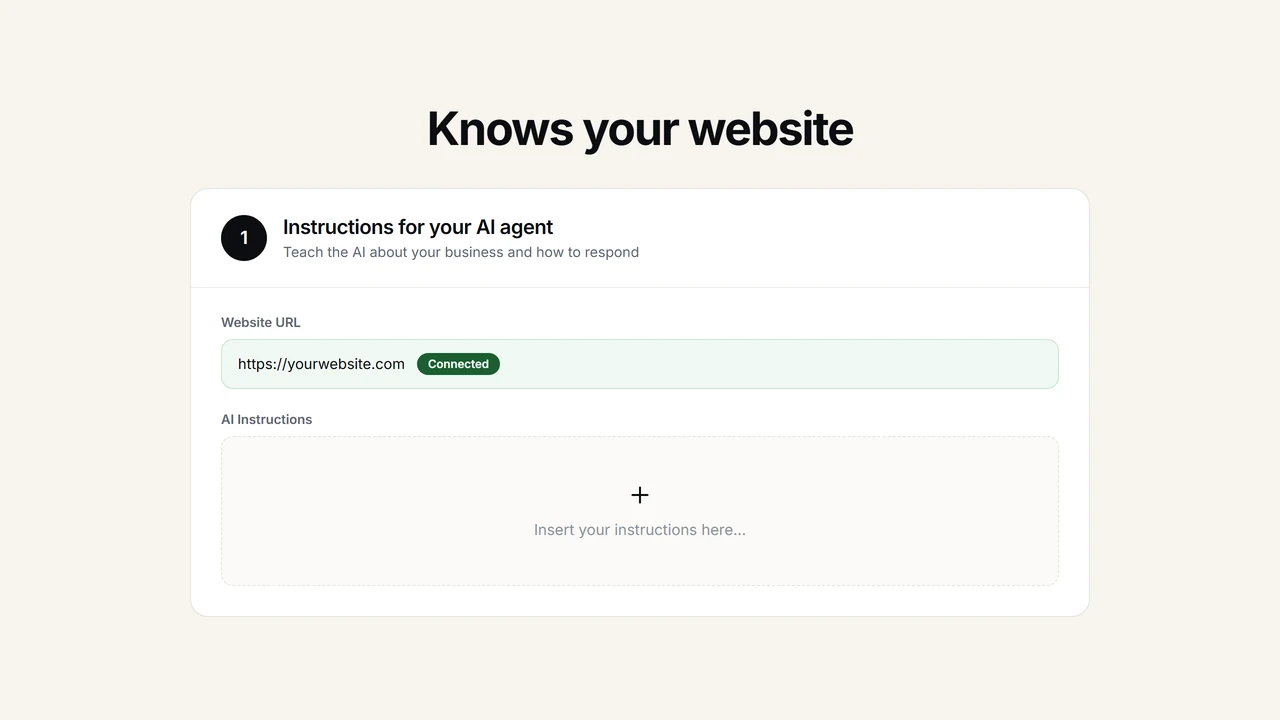
Once the Odoo chatbot is connected, Asyntai crawls your Odoo website pages automatically and builds a knowledge base from them. Private documents, internal SOPs, partner-specific pricing — add them as uploads. The chatbot blends all of it when answering visitors.
- Auto-reads your Odoo pagesHome, about, services, products, contact, policy pages, any published blog posts — absorbed into the chatbot's working memory within minutes.
- Upload what's not publicPartner pricing, manufacturing specifications, internal procedures, regional policies — add them as PDFs or pasted text to cover what's off the public Odoo site.
- Plain-English custom instructions"Always link to the quote request form when pricing is asked for enterprise deals." "Never promise delivery dates without knowing destination country." You set the rules; the Odoo chatbot follows them.
Install the Odoo chatbot in three steps
The Odoo chatbot follows the standard Odoo module install flow — no surprises, no custom tooling. If you've installed any Odoo addon before, this will feel familiar.
- Download the Asyntai Odoo module from your dashboard (choose the version matching your Odoo release: 16.0, 17.0, 18.0, or 19.0).
- Extract to your Odoo addons directory and restart the Odoo server. Go to Apps, click Update Apps List, search for "Asyntai", and click Install.
- Open the Asyntai AI Chatbot app in the switcher and click Get started. Sign in to your Asyntai account in the popup — the module stores the connection automatically.
- Your Odoo chatbot is now live on every page of your Odoo website. Manage chatbot settings and review chat logs at asyntai.com/dashboard.
→ asyntai_chatbot (extract to /addons/)
→ Restart Odoo server
→ Apps → Update Apps List → Install
→ Get started → Sign in (OAuth popup)
# Odoo chatbot live on every page of your site.
Odoo chatbot — FAQs
What Odoo admins, integrators, and website owners typically check before installing.
Which Odoo versions does the chatbot module support?
Odoo 16.0, 17.0, 18.0, and 19.0. The module archive includes a dedicated version for each release. If you're on an older or customized Odoo build that doesn't work with the module, you can still add the chatbot as a JavaScript snippet from your Asyntai dashboard without installing the module at all.
Does this work on Odoo.sh, on-premise Odoo, or Odoo Online?
It works on Odoo.sh and on-premise Odoo where you control the addons folder. Odoo Online (SaaS) is more restricted — you can't install custom modules on Odoo Online, but you can still add the Asyntai chatbot via the JavaScript snippet through the Website module's header injection. Either approach gives you the same chatbot capability.
Do I need the Website module installed?
Yes. The Asyntai Odoo chatbot extends the Odoo Website module. If you're running Odoo purely as ERP/CRM without the Website module enabled, you'd first need the Website module before the chatbot can appear on your site.
Will the module conflict with other Odoo Website customizations?
No. The Asyntai module injects the chatbot as a website template overlay, which loads on top of your existing Odoo pages without modifying your custom themes, page templates, or Website Builder blocks. Removing the module cleans up the injection without leaving artifacts.
Can the chatbot work with Odoo eCommerce products?
Yes. When Asyntai crawls your Odoo website, it reads your public product pages, category pages, and eCommerce content — so the chatbot can answer product questions, pricing questions, and availability questions grounded in your Odoo eCommerce catalog.
Does the Odoo chatbot support multiple languages?
Yes — 36 languages. The widget UI is localized, and the AI detects each visitor's language from their first message. For Odoo deployments serving international markets, this covers language markets your Odoo website translations may not.
Can the chatbot personalize answers for logged-in Odoo users?
Yes, via the User Context feature on Standard and Pro plans. Your Odoo website can pass logged-in user data — portal user name, company, account details — into a JavaScript object before the widget loads. The chatbot uses that context for personalized replies without needing additional API calls.
Can I manage multiple Odoo sites under one Asyntai account?
Yes on paid plans. Free: 1 site, Starter: 2, Standard: 3, Pro: up to 10. Each Odoo website gets its own separate chatbot with its own content, instructions, and branding — useful for multi-company Odoo setups, different domains on the same Odoo instance, or partners managing Odoo deployments for multiple clients.
Odoo chatbot — what it is and how it fits the Odoo stack
Running a website on Odoo puts you in a specific technical context. Odoo isn't a drag-and-drop site builder with a chat widget marketplace — it's an open-source ERP/CRM platform that happens to include a Website module, and the ecosystem around it expects real modules rather than third-party JavaScript afterthoughts. Odoo admins and integrators reach for modules first: something they can install from the Apps list, configure through the standard res.config.settings flow, and uninstall cleanly. A chatbot for Odoo has to fit into that pattern or it doesn't belong on an Odoo site. That's the first reason the Asyntai Odoo chatbot is shipped as a proper Odoo module — asyntai_chatbot — rather than asking Odoo users to paste raw snippets into theme headers.
The module ships for Odoo 16.0, 17.0, 18.0, and 19.0, with a separate build for each version because Odoo's internal APIs change enough between major releases that a single module archive can't cover all of them. Installation follows the exact pattern every Odoo administrator already knows. You download the module archive from your Asyntai dashboard, extract it to your Odoo addons directory (typically under /addons/ or the path your Odoo config specifies), restart the Odoo server, and the module becomes visible in the Apps interface. Click Update Apps List if it doesn't appear immediately. Search for "Asyntai," click Install, and the module is active. Nothing unusual, no custom tooling, no command-line steps beyond the normal Odoo restart.
The connect flow is where the Odoo chatbot improves on the traditional API-key-copy-paste approach most third-party modules use. After installation, an Asyntai AI Chatbot app appears in your Odoo app switcher. Click Get started, and a popup opens to asyntai.com. You sign in to your Asyntai account (or create one if this is your first install), the popup confirms the connection, and the module stores the site ID automatically. There is no API key to locate in a dashboard, copy, paste, validate, and debug when the connection fails. The connection is either live after the click or it isn't — and if it isn't, the error message is specific enough to fix without opening a support ticket.
Training the Odoo chatbot on your website is the next step and the one that determines answer quality. Once connected, Asyntai crawls your Odoo website directly — home page, About, product catalog, services pages, blog posts, Contact, privacy policy, terms, any published URL the Odoo Website module exposes. Everything the crawler finds gets indexed into the chatbot's reference layer. For content that lives off the public Odoo site — your internal sales playbook, partner-specific pricing tables, manufacturing specifications only shared under NDA, a regional terms document that isn't published publicly — you upload it as a PDF or paste the text directly through the Asyntai dashboard. The chatbot uses both layers when answering. Custom instructions, written in plain English, shape behavior: "always link to the quote request form when enterprise pricing is asked," "for product questions, confirm the customer's region before quoting availability," "escalate technical spec questions to the engineering team email."
Odoo eCommerce is where the Odoo chatbot earns its keep fastest for companies running product sales through Odoo's native eCommerce module. Product pages, category listings, pricing tiers, eCommerce policies — all get absorbed into the chatbot's knowledge when the site is crawled. Visitors asking "do you ship to Austria," "is this product available in quantity 500," "what's the difference between the standard and premium versions" get answers pulled from your actual Odoo eCommerce catalog. The chatbot won't write orders into Odoo directly — that still happens through the normal Odoo checkout flow — but it handles the pre-purchase questions that typically kill eCommerce conversions before the buyer ever gets to the cart.
The Odoo ecosystem is unusually international. A disproportionate share of Odoo users are European and Latin American businesses operating across multiple language markets, and Odoo's translation infrastructure reflects that. Your Odoo website might already be translated into three or four languages through Odoo's standard i18n tooling, but the chatbot needs to cover every language a visitor might use — not just the ones you've manually translated. Asyntai handles 36 languages at the widget UI level, and the AI detects each visitor's language from their first message, producing replies in the visitor's language even when your Odoo pages aren't translated to it. A French-speaking visitor to a Spanish-translated Odoo site gets French responses; a Japanese visitor to a German Odoo site gets Japanese responses. The translation budget for the public Odoo content stays limited to your priority markets; the chatbot covers the long tail without additional translation work.
Personalized answers for logged-in Odoo portal users — customers accessing their account section of your Odoo site — work through Asyntai's User Context feature on Standard and Pro plans. The Odoo website can pass the logged-in portal user's data — name, company, account tier, recent orders, open invoices, support contract status — into a JavaScript object before the widget loads. The chatbot uses that context to give account-aware answers: a returning customer asking about their open order gets a specific response because the Odoo portal has passed the order reference into the chat context. You control exactly what data the chatbot sees; nothing is pulled from Odoo through a permissioned API, so sensitive ERP data stays in Odoo unless you deliberately push it.
Multi-company and multi-domain Odoo setups are common, and the chatbot handles them naturally. Each Odoo site you run — whether it's a different company in a multi-company setup, a separate brand on a different subdomain, or a regional site for a specific market — can be connected to its own Asyntai chatbot, with its own knowledge base, its own custom instructions, and its own branded widget. Plans scale with the number of sites: free one, Starter two, Standard three, Pro up to ten. For Odoo integrators and agencies deploying Odoo across multiple clients, this means one Asyntai account can cover multiple client sites without reconfiguration or duplicate licensing.
The lead capture mechanics matter more for B2B Odoo sites than they do for consumer storefronts, because B2B conversion cycles are longer and every qualified inquiry has meaningful value. When the Odoo chatbot can't resolve a question itself — a complex project scope, an enterprise pricing request, a custom manufacturing inquiry — it asks for the visitor's email and company, captures the full conversation transcript, and routes the lead to your Asyntai dashboard. If email notifications are enabled, the transcript arrives in your sales team's inbox in real time, with enough context that a salesperson can follow up intelligently rather than starting cold. For Odoo companies running CRM in Odoo itself, the most practical pattern is forwarding the Asyntai notification to an Odoo email alias that creates a lead record in CRM automatically — the chatbot captures, Odoo handles the pipeline.
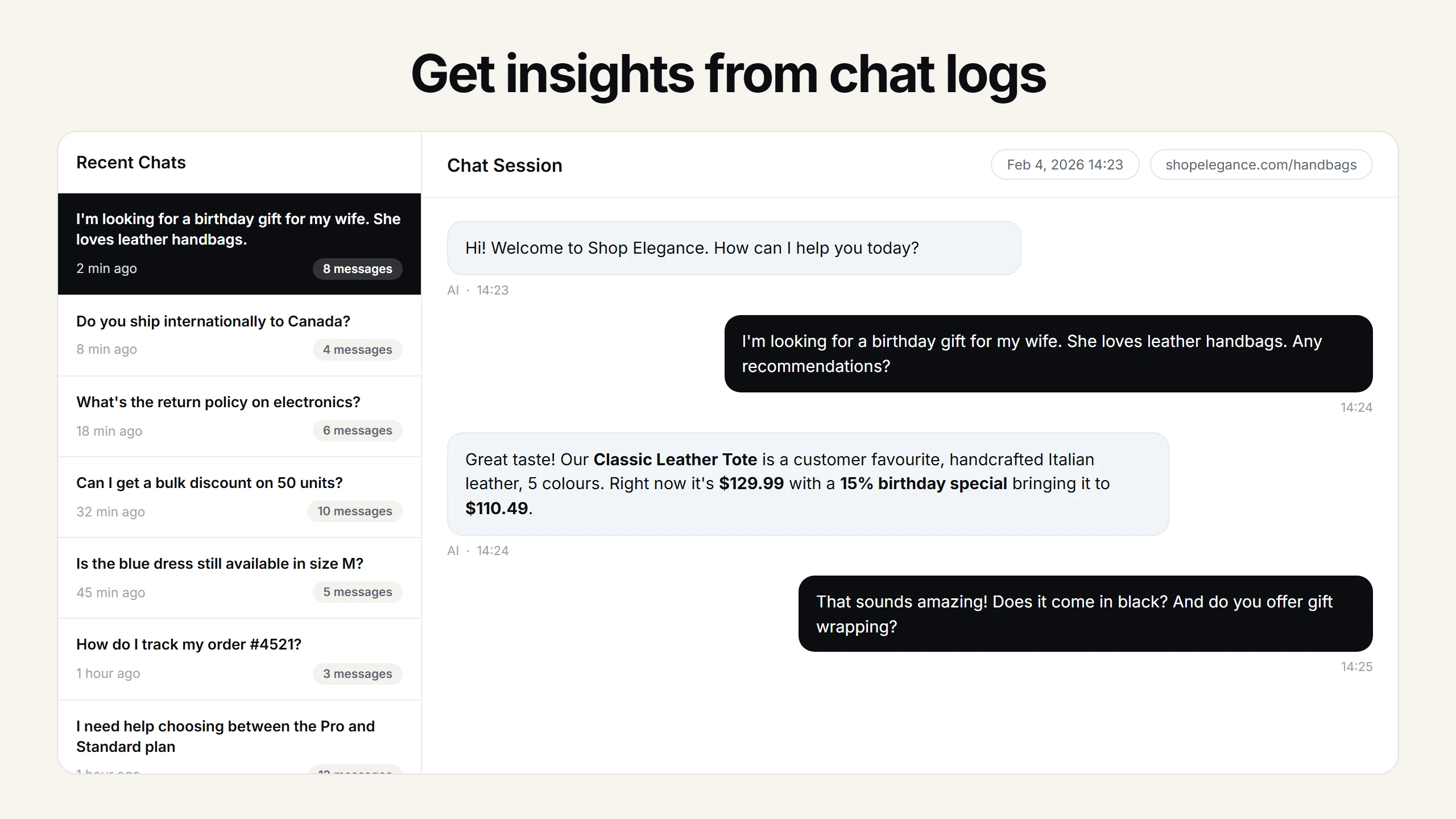
Analytics from the Odoo chatbot surface patterns you wouldn't notice from Odoo's native web analytics. Every conversation is logged in the Asyntai dashboard, grouped by topic, frequency, and language, so you can see which product pages generate the most chat traffic, which policy questions keep coming up, which regions your visitors are actually browsing from. For Odoo websites whose site analytics are limited to Odoo's built-in tracking, this conversation-level view is usually the first proper signal of what visitors actually want. Over time, the patterns become a list of Odoo Website edits — the product page that needs more technical detail, the pricing page that needs clearer regional pricing, the blog post that generates questions because it's missing a conclusion.
Odoo deployments where the chatbot produces the clearest return on investment share a specific profile. Odoo-based manufacturers selling to B2B buyers win on pre-sale product qualification. Odoo eCommerce stores win on shipping, returns, and availability questions. Odoo service companies — consulting, accounting, legal — win on lead qualification before a paid call. Multi-company Odoo groups win on per-brand chatbot deployment without extra licensing overhead. Odoo integrators and partners win by offering managed chatbot deployment as part of their Odoo implementation work. Across all of these, the common pattern is that Odoo sites often have significant international and B2B traffic, both of which benefit disproportionately from AI-first multilingual chat coverage.
Rolling the Odoo chatbot out doesn't require structural changes to how your Odoo site or ERP operates. Install the module from your addons directory, connect to Asyntai in one click, let the chatbot crawl your Odoo website, upload private documents you want it to reference, write a handful of custom instructions that capture your sales and support voice, test real visitor questions, and switch it live. Existing Odoo workflows — CRM, sales, eCommerce, invoicing — keep running as they always did. The chatbot quietly handles the visitor-facing layer on top of the Odoo site, catching the inquiries and leads that would otherwise leave your funnel before they ever reached an Odoo record.