Build an AI agent without writing a single line of code
Asyntai is a no-code AI agent builder. Auto-crawl your site, upload documents, write rules in plain English, connect APIs through form fields, and customize every visual detail from a dashboard. No developers needed. No technical skills required. Your AI agent goes live in minutes.
Watch your AI agent answer questions using your own content
Paste your website URL below and see a no-code AI agent built from your content in real time
Everything you need is a form field away
Asyntai's no-code AI agent builder replaces developer workflows with a visual dashboard. Your site gets auto-crawled the moment you paste a URL. Documents upload with drag-and-drop. Custom instructions are sentences you write in your own words. Widget branding is a color picker and a text field. Every step is something you can see, click, and change — no terminal, no config files, no deployment pipeline.
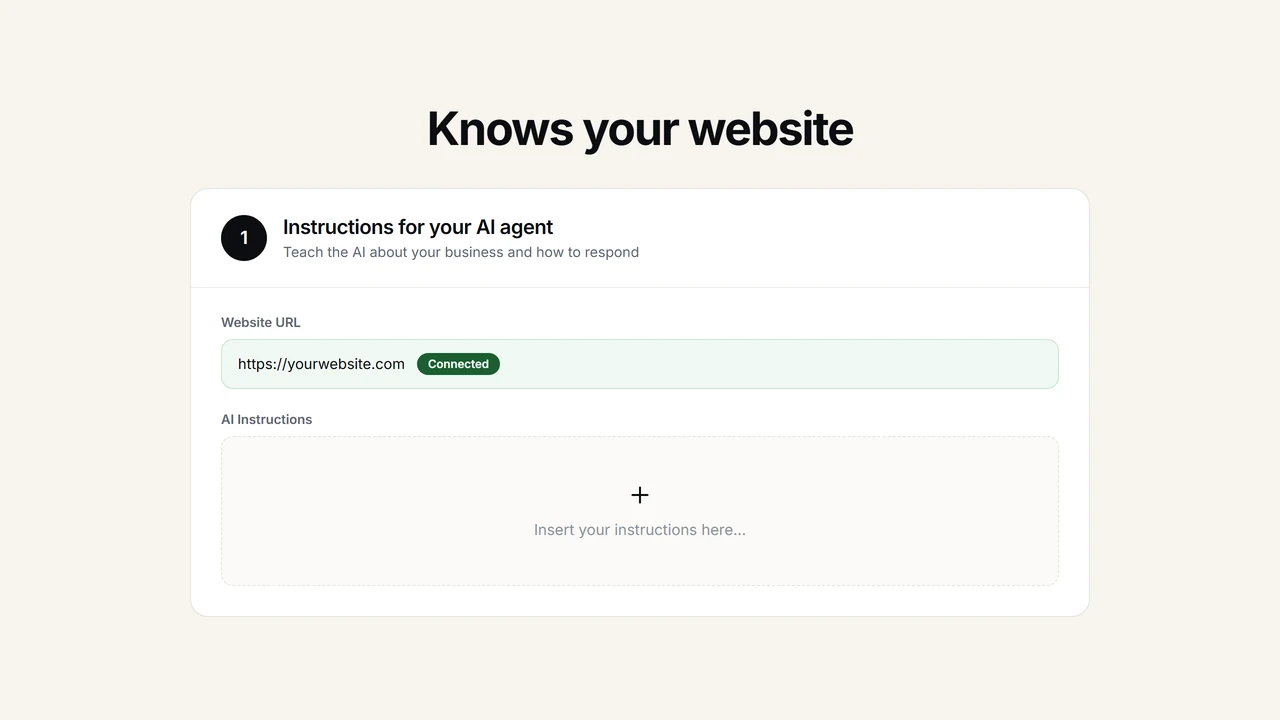
- Auto-crawl indexes your site in one clickPaste your URL and Asyntai crawls every page, pulling in product descriptions, help articles, policies, and FAQ content. Your AI agent learns your entire site without you copying a single paragraph.
- Plain-English instructions replace programming logicWrite "always recommend our premium plan when someone asks about pricing" or "never discuss competitor products" — the AI follows your rules exactly as you wrote them. No if-else trees, no scripting syntax, no technical translation layer.
- Visual branding makes the widget yoursPick your brand colors, upload your logo, set the agent name, choose the avatar, adjust the greeting message. The widget looks like part of your site, not a third-party add-on. Every change previews live before you save.
API connections, personalization, and 36 languages — all from the dashboard
No-code doesn't mean no power. Asyntai's Custom Tools let you connect any REST API through form fields — name the tool, describe when the AI should use it, paste the endpoint URL, define parameters. The AI calls your systems mid-conversation to pull live data. User Context pushes visitor info into the chat for personalization. And the agent speaks 36 languages automatically — you don't configure or translate anything.
- Connect APIs without writing integration codeCustom Tools are configured through dashboard form fields: tool name, description, endpoint URL, parameters, and optional auth header. No webhooks, no SDKs, no middleware. If your system has a REST endpoint, you fill out a form and the AI agent starts calling it.
- Personalize with User Context — no backend workPass visitor data like name, email, or account tier into the widget with a one-line JavaScript snippet your platform probably already supports. The AI uses it to greet returning customers by name and tailor responses to their account level.
- 36 languages with zero translation effortThe AI agent detects the visitor's language and responds in kind — German, Japanese, Arabic, Portuguese, all 36. Your knowledge base stays in English. The AI handles translation on the fly, including when calling your English-language API endpoints.
Your AI agent goes live in four steps
No developer handoffs. No staging environments. No deployment queues. You sign up, paste your URL, adjust the settings you care about, and embed one snippet. The AI agent is live on your site, answering visitors, in the time it takes to finish a coffee.
- Sign up and paste your website URL. Asyntai auto-crawls your pages and builds the knowledge base — no manual content entry.
- Write custom instructions in plain English: tone of voice, topics to avoid, escalation rules, product recommendations. The AI follows them exactly.
- Set your brand colors, agent name, avatar, and greeting message from the visual editor. Preview changes live before saving.
- Copy the embed snippet into your site's
<head>tag. Your AI agent is live and answering visitors immediately.
<script src="https://asyntai.com/widget.js"
data-id="your-site-id" async>
</script>
</head>
# One snippet. No code. Your agent is live.
No-code AI agent builder — FAQs
Common questions from non-technical founders, marketers, and operations teams who want AI agents without developer involvement.
Is this truly no-code, or will I eventually need a developer?
Truly no-code for the entire setup and daily operation. You create your account, paste your website URL to auto-crawl your content, write instructions in plain English, customize the widget visually, and embed one script tag. The script tag is the only thing that touches your site's HTML — and most website platforms (WordPress, Shopify, Squarespace, Wix) have a dedicated field where you paste it without editing code. Ongoing changes — updating instructions, adding knowledge, adjusting branding — happen entirely in the dashboard.
How do I connect my APIs if I can't code?
Asyntai's Custom Tools feature uses form fields, not code. You fill in the tool name, write a plain-English description of when the AI should use it, paste your API endpoint URL, and define the parameters the AI should extract from the conversation (like "order_number"). If your endpoint needs authentication, you add a header name and value. That's it. No SDKs, no webhook handlers, no middleware. If your platform already has API endpoints — and most modern platforms do — you're connecting them through a form, not writing integration code.
How does the AI learn about my business?
Three ways, all without code. First, auto-crawl: paste your website URL and Asyntai crawls every page, absorbing product descriptions, help articles, policies, and FAQs. Second, document upload: drag and drop PDFs, Word docs, or text files for internal knowledge that isn't on your website. Third, custom instructions: write rules and facts in plain English that the AI follows in every conversation. All three are managed from the dashboard and can be updated anytime.
How do I update the agent's knowledge when things change?
From the dashboard. You can re-crawl your site anytime with one click to pick up new pages and content changes. You can upload new documents or remove old ones. You can edit your custom instructions — add new rules, change the tone, update product details. Changes take effect immediately. There's no rebuild step, no retraining process, and no waiting period. You update it the same way you'd update a Google Doc.
Can I fully customize how the widget looks on my site?
Yes, everything is visual. You pick primary and secondary colors with a color picker, upload your own avatar or logo, set the agent's display name, write a custom greeting message, and choose the widget position. The chat window matches your brand so visitors see it as part of your site, not a generic third-party tool. Every change previews live in the dashboard before you save and push it to your site.
What if the AI gives a wrong answer — how do I correct it?
You review conversations in the dashboard and add a custom instruction to address the gap. For example, if the AI incorrectly states your free shipping threshold, you write an instruction: "Our free shipping threshold is $75, not $50." The AI follows that instruction from the next conversation onward. You can also update your crawled content or upload a document with the correct information. The feedback loop is entirely non-technical — you read conversations, spot issues, and fix them with plain-English rules.
Do I need to handle anything for non-English visitors?
No. The AI agent automatically detects the visitor's language and responds in that language — 36 languages are supported out of the box. Your knowledge base stays in whatever language you wrote it in (typically English). The AI translates on the fly during the conversation. You don't configure language settings, create translated versions of your content, or manage locale files. A visitor from Tokyo and a visitor from Berlin both get native-language responses from the same agent.
What happens when the AI can't answer a question?
You configure escalation rules in plain English — for example, "if the visitor asks about pricing for enterprise plans, collect their email and company name and tell them a team member will follow up." When the AI hits a boundary you've defined, or when it genuinely doesn't have the information to answer, it follows your escalation instructions: collect contact details, summarize the conversation, and hand it off to your team. You receive the full transcript and context in your dashboard so your human agent picks up without the customer repeating themselves.
The no-code AI agent: why most "no-code" tools still need a developer, and what actually doesn't
The phrase "no-code AI agent builder" has become one of the most searched terms in the AI tools space, and for good reason. The people who stand to benefit most from AI agents — small business owners, marketing managers, operations leads, solo founders — are overwhelmingly non-technical. They don't write Python. They don't manage API integrations. They don't deploy to cloud infrastructure. They run businesses, and they want an AI agent that handles customer questions, captures leads, and reduces their support workload. The promise of no-code is that they can have that without hiring a developer or learning to program.
The reality, unfortunately, is that most tools calling themselves "no-code AI agent builders" are no-code in the same way that IKEA furniture is no-tool assembly — technically possible, but you'll still need a hex wrench, three YouTube tutorials, and a tolerance for ambiguous diagrams. They give you a visual interface for the easy parts (choosing a color, writing a welcome message) and then drop you into YAML configuration, webhook URLs, or "just paste this JavaScript callback" for anything beyond basic FAQ answering. The moment you want your agent to actually do something — look up an order, check availability, personalize a response — you're writing code, or you're paying someone who does.
This is the gap Asyntai was built to close. Not by simplifying code into a visual wrapper, but by eliminating the need for code entirely at every layer of the agent: knowledge acquisition, instruction logic, API connections, visual customization, and deployment. Each of those layers is worth examining individually, because the devil is in the details — and the details are where most "no-code" claims fall apart.
Knowledge acquisition is where every AI agent starts: the agent needs to know about your business before it can answer questions about it. The traditional approach involves exporting your knowledge base, formatting it into a specific structure (usually JSON or CSV), uploading it, mapping fields, and hoping the chunking algorithm doesn't split your product descriptions in the middle of a sentence. Some platforms require you to tag documents, organize them into categories, or write metadata headers. All of this is work that feels technical even when it technically isn't — because it requires you to think about data structure, which is a developer's mental model, not a marketer's.
Asyntai replaces all of that with a URL field. You paste your website address. The crawler visits every page, follows internal links, and indexes the content — product descriptions, help articles, policy pages, FAQ sections, about pages, blog posts. The AI agent can now answer questions about anything on your site. If you have internal knowledge that isn't published on your website — training materials, internal policies, product specs — you drag and drop those documents (PDFs, Word files, text files) into the dashboard. There's no formatting requirement, no field mapping, no metadata tagging. The AI reads the documents the same way a new employee would: start to finish, extracting the relevant information and making it available for conversations.
The second layer is instructions — the rules that shape how your agent behaves. This is where many platforms introduce their first code-like requirement: decision trees, flow builders, or conditional logic that looks suspiciously like programming with a drag-and-drop skin. You draw arrows between nodes, define variables, set conditions. It's visual, technically, but it requires you to think in programmer logic: if this, then that, else the other thing, unless a third condition, in which case branch here. For someone who thinks in business outcomes — "I want the bot to recommend our premium plan when pricing comes up" — the translation into node-and-arrow logic is a barrier.
Asyntai's custom instructions are plain English sentences. You write "always recommend the Pro plan when someone asks about pricing" and the AI follows that rule. You write "never discuss competitor products — redirect to our own features instead" and the AI complies. You write "if someone seems frustrated, acknowledge their frustration before answering the question" and the AI adjusts its tone. These aren't simplified programming statements — they're instructions in the same format you'd give a human team member. The AI interprets intent, handles edge cases, and applies the spirit of your rule across varied conversational contexts. You don't build a decision tree for every possible customer utterance. You state the rule and the AI generalizes it.
The third layer — and the one where "no-code" claims most often collapse — is API connections. An AI agent that only answers from static knowledge is useful, but it's a chatbot, not an agent. The distinction matters: an agent takes action. It looks up an order status, checks inventory, retrieves account details, processes a return request. To do this, the agent needs to call your systems — your order management API, your CRM, your booking platform, your inventory database. In almost every other tool on the market, connecting an API means writing code. You write a webhook handler, you configure OAuth flows, you parse JSON responses, you handle error cases in a scripting language. Even platforms that call themselves "no-code" hand you a code editor at this step and say "just write a simple function."
Asyntai's Custom Tools feature keeps the entire API connection within the dashboard, using form fields. The process works like this: you click "Add Tool," give it a name (like "Order Status Lookup"), write a plain-English description of when the AI should call it ("Call this tool whenever a customer asks about their order status and provides an order number"), paste your endpoint URL, and define the parameters the AI should extract from the conversation (like "order_number" with a description "the customer's order number"). If your endpoint requires authentication, you add a header name and value. You click save. The next time a customer asks "where is my order #10294?", the AI extracts the order number, calls your endpoint, receives the response, and composes a natural-language answer with the real data. You connected a live API integration without writing a function, a webhook, or a single line of code.
This works because Asyntai handles the parts that normally require a developer. The AI parses the customer's message and extracts parameter values — that's natural language processing, not regex matching, so it works even when the customer phrases things differently than expected. The HTTP request is made server-side from Asyntai's infrastructure — you don't write fetch calls, handle CORS, or manage browser-side networking. The response parsing is handled by the AI — it reads the JSON (or plain text) your endpoint returns and incorporates the relevant data into its reply. Error handling is built in — if your endpoint is down or returns an error, the AI tells the customer it couldn't retrieve the information and offers to escalate. All of the plumbing that normally requires a developer is abstracted away behind a form.
The fourth layer is visual customization. This is the one area where most platforms actually deliver on the no-code promise — picking colors and fonts doesn't require coding in any tool. But Asyntai goes further than a color picker. You set the agent's display name, upload a custom avatar, write the greeting message, choose the widget position on the page, and configure behavior like whether to show the agent as "online" or display typing indicators. The widget renders on your site as a branded experience that matches your design language, not a generic chat bubble with someone else's logo. All changes preview live in the dashboard before you push them to your site.
The fifth layer is deployment — getting the agent onto your actual website where visitors can interact with it. This is often a surprisingly technical step in other platforms: install an npm package, add environment variables, configure a build step, deploy to your hosting provider. Asyntai's deployment is a single HTML snippet — a script tag you paste into your site's head section. On WordPress, that goes into your theme's header or a header scripts plugin. On Shopify, it goes into your theme's layout file. On Squarespace, Wix, Webflow, and virtually every other platform, there's a designated spot for custom scripts. You paste it once and the agent is live. There's no build step, no npm install, no environment configuration. The snippet loads Asyntai's widget, connects to your configured agent, and starts answering visitors immediately.
The total time from signup to a live, working AI agent on your site is measured in minutes, not days or weeks. That's not a marketing claim — it's a reflection of how few steps are involved when code isn't one of them. Sign up, paste your URL (the crawler runs automatically), write a few custom instructions (optional — the agent works without them, just less specifically), adjust the branding (also optional — the defaults are clean), and embed the snippet. Most users have a working agent answering real questions within fifteen to twenty minutes of creating their account. Compare that to the typical timeline for deploying a coded AI agent — two to six weeks of development, testing, integration, and debugging — and the value proposition of genuinely no-code becomes clear.
What surprises most non-technical users is how capable the agent is without any configuration beyond the initial crawl. The AI reads your entire site, understands your products and services, learns your policies and procedures, and answers questions accurately from day one. A visitor asks "do you offer free shipping?" and the agent finds your shipping policy page, extracts the threshold, and answers "Yes, we offer free shipping on orders over $75 within the continental US." A visitor asks "what's the difference between your Standard and Pro plans?" and the agent pulls the comparison from your pricing page and presents a clear breakdown. This isn't template matching or keyword lookup — the AI genuinely understands the content and composes original responses that address the specific question. The quality of these answers is often better than what a human agent would provide, because the AI has perfect recall of every page on your site and never misremembers a detail.
The custom instructions layer is where you shape the agent from "generically knowledgeable about your site" to "sounds and behaves like a member of your team." A fitness brand might write "use an energetic, motivational tone" and "always suggest the starter pack for first-time buyers." A law firm might write "maintain a professional, measured tone" and "never provide legal advice — direct them to schedule a consultation." A SaaS company might write "when someone asks about enterprise features, collect their company name and email before answering." Each instruction is a sentence or two. The AI applies them consistently across every conversation, in every language. You're not programming behavior — you're describing the team member you wish you could clone.
The economics work differently for non-technical teams because the cost comparison isn't Asyntai versus a cheaper tool — it's Asyntai versus hiring a developer. A freelance developer to build and integrate a custom AI chatbot runs $5,000 to $20,000 and takes weeks. An agency to build a full AI agent with API integrations runs $15,000 to $50,000 and takes months. Asyntai starts at $39 per month with 800 messages — and you set it up yourself in an afternoon. Even if you eventually want Custom Tools for API integrations (available on Standard and Pro plans), the setup is still a dashboard form, not a development project. The developer cost stays at zero.
The ongoing maintenance model is equally important for non-technical teams. When your business changes — new products, updated policies, different pricing, seasonal promotions — you update the agent the same way you update any other content. Re-crawl your site to pick up new pages. Edit your custom instructions to reflect new rules. Upload a new document with updated specifications. These are tasks any team member can do, regardless of technical skill. You don't file a ticket with your development team. You don't wait for a sprint cycle. You don't worry about breaking the integration. You open the dashboard, make the change, and it's live.
The question non-technical users ask most often is whether a no-code agent can be as powerful as a custom-built one. The answer depends on what "powerful" means. If you need the AI to call your existing API endpoints, answer questions from your crawled content, follow your custom rules, speak 36 languages, escalate intelligently, capture leads, and look like a natural part of your website — yes, a no-code agent does all of that, and it does it without the maintenance burden, fragility, and ongoing developer dependency of a custom build. If you need the AI to run custom machine learning models, integrate with proprietary internal systems that have no API, or perform complex multi-step workflows that require conditional branching across dozens of systems — you might need a custom build. But for the vast majority of businesses, the no-code capabilities cover 95% of what they'd hire a developer to build.
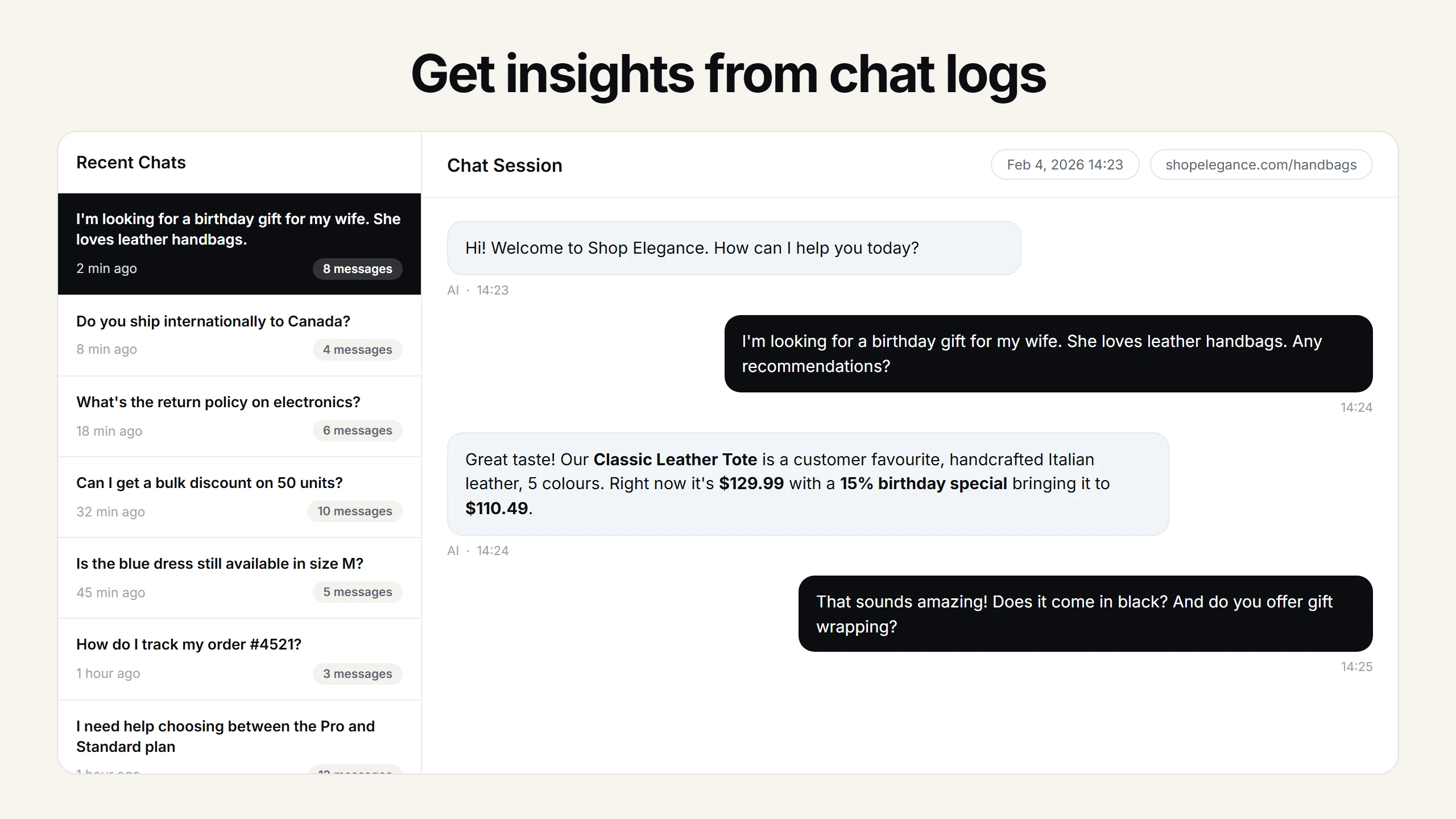
The non-technical users who get the most value from Asyntai share a pattern: they start simple and layer on capability over time. Week one, they paste their URL and let the auto-crawl build the knowledge base. The agent starts answering FAQ-level questions immediately. Week two, they write custom instructions to refine the tone, add specific rules, and handle edge cases they noticed in the conversation logs. Week three, they connect a Custom Tool to their order status API — still through the dashboard, still without code — and suddenly the agent handles their highest-volume support question autonomously. Each step takes minutes, not days. Each step is something they do themselves, without filing a support ticket or hiring a contractor. The agent grows with their business because they can grow it themselves.
The movement toward no-code AI agents reflects a broader shift in who gets to build with AI. For years, AI was the domain of engineering teams with machine learning expertise, cloud infrastructure budgets, and months of development time. The people who understood their customers best — the founders who answer support emails at midnight, the marketing managers who know exactly which question kills a sale, the operations leads who see the same ticket come in two hundred times a month — couldn't act on that knowledge because the tools required skills they didn't have. No-code AI agent builders change that equation. The person who knows the business best is now the person who builds the agent. They don't describe requirements to a developer and hope the implementation matches. They build it themselves, iterate based on real conversations, and refine it continuously — because the barrier between "I want the agent to do this" and "the agent does this" is a form field, not a code deployment.
That's the core promise of a no-code AI agent builder, and it's the promise Asyntai delivers on at every layer. Not "low-code." Not "code-optional." Not "visual interface that eventually requires a developer." No code. From knowledge base to API connections to custom instructions to deployment. Every step is a dashboard interaction. Every change is immediate. Every capability is accessible to someone who has never opened a code editor. The AI agent you'd pay a developer $20,000 to build is the same agent you build yourself in an afternoon — and the one you can update, expand, and refine without ever needing help.